With 6.4 million downloads on Spotify, this almost a cappella song- perfect for a flat road, isn’t just a favorite of mine! This 17 year old from New Zealand knows how to put out the singles. She’s already released 3 this year and she’s still finishing Year 12 at Grammar School.
My class has been enjoying the great harmonies and driving beat of this 3:21, 85 bpm by Lorde’s. Here’s “Royals”:
I used a new metaphor this morning that seemed to resonate with my class.
Watch this video and see if you can see the similarity between an eagle catching a fish and proper pedaling technique.
Through the magic of slow-motion photography it's obvious that the act of plucking a large salmon out of the water is a very fluid, near circular, motion by these powerful birds.
This morning was a cycling strength day. I really enjoy teaching these classes and I describe the format to the class as; BIG PEDALS turning slowly. But slow = STOMP for many in my class.
To help everyone move beyond stomp, I've been introducing the concept of ankling through each pedal stroke to my class. If you missed it here are two videos that demonstrate what local bike fit Guru Chris Balser categorized as USA vs. EU pedaling techniques. To help communicate the concept I've been talking about how there shouldn't be any specific action; stomp, scrape, pull up, ect.. Rather just one fluid motion of your feet rotating around the pedals, with flexible ankles. Tough to describe until I happened to see this video and then it clicked – the focus is on your toes! Or in the case of the eagle, its claws & talons.
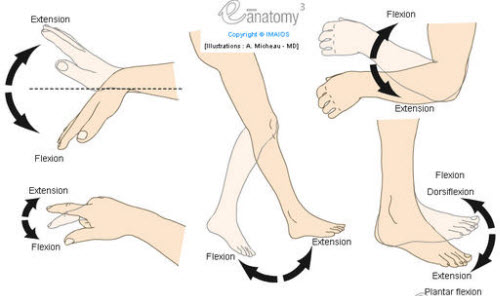
Watch the video again and see how the eagle's talons and *ankles are at full extension as it reaches forward and down in preparation to grab the fish. The eagle's claws then flex forward, essentially rotating around its catch, as it lifts it from the water. This is the same movement Chris was helping me learn to improve my pedaling mechanics and power output.
The difference between extension and flexion in joint movements.
How would you describe this movement to your class?
I had everyone try to visualize what it would feel like to be an eagle, swooping down on a fat, tasty salmon. Talons extended as your pedal crosses the top of the circle, then, flexing forward while you sink your talons into the flesh. Your claws rotate around the fish as you drag your catch from the water… only to drop it… so you try again.
*I'm not sure what that joint is called on a bird, but you get the point.
In the early days of indoor cycling, there was a problem. When bike resistance was low, the weighted flywheel connected to a fixed gear with a chain produced an unnatural degree of momentum. It permitted riders’ legs to spin at cadences far above their natural ability.
This resulted in the infamous “bouncing” in the saddle, as well as potentially catapulting them over the handlebars if they were to suddenly stop pedaling. Then there were the as-yet-unknown, uninvestigated forces working on knees and hips.
So a ceiling was put on cadence. Everyone believed 120 rpm was fast enough. Some education bodies restricted it to 110 rpm. The reasons were obvious at the time. One look around a cycling class filled with “jumping beans”, or the surprised look on Superman’s face as he went over the handlebars made it clear that we instructors needed to control cadence.
As IC evolved, cadence became less of a worry. Better control was taught from the start, and IC became safer. The 110-120 rpm ceiling has been challenged on occasion, but usually sticks. People don’t typically ride at higher cadences, the logic goes, so why use them in cycling classes?
Is high cadence still unsafe? Do higher cadences offer training benefits in an authentic class, or general exercise benefits in a non-authentic class?
My opinion on safety is that high cadence is unsafe in some situations, but not in others. Cycling coaches are documented as recommending max-effort cadence drills up to 140-160 rpm. Arnie Baker’s Smart Cycling is an example.
Arnie Baker’s not alone. Cycling coaches don't have the same concerns IC instructors do about cadences above 110-120 rpm. They train athletes who are on road bikes on a track stand or a Computrainer. There’s no weighted flywheel. There’s no help on a real bike. It's all you. To spin at 140-160 rpm, you have to develop the necessary muscular composition and/or neuromuscular recruitment, or you can’t do it.
Not so on a chain-driven indoor cycle. The weighted flywheel creates substantial inertia, which we’ve spent decades teaching our students to control with technique and proper resistance. Chain-driven bikes create excess momentum and allow you to cheat on cadence training.
But belt-driven bikes can allow high-cadence training to become part of indoor cycling. The reduced momentum on a belt-driven bike makes it more like a real bike in terms of how hard you have to work to spin fast. I wrote about this in a previous post (“From Chain Junkie to Belt Convert”).
Should we create high-cadence trainings for our students if they’re riding belt-driven bikes? The statement that we don't typically ride at those cadences and shouldn’t train at them makes little sense to me.
High-cadence training, called spinning, can be defined as any cadence that exceeds a rider’s preferred cadence, usually 120-160 rpm. These cadences are performed in lower gears, applying lighter pressure to the pedals with each stroke. Neuromuscular adaptation increases pedal stroke fluidity and reduces the force the leg muscles and joints must transmit for a given workload.
Higher cadences also allow the muscles to work aerobically. Less activation of type II muscle fibers delays the burning of carbohydrate stores. In a study by Ahlquist et al., a higher cadence resulted in less stimulation of fast-twitch muscle fibers. As fast fibers deplete their glycogen stores from slower, high-strength pedaling, they become less forceful. Additional muscle fibers must then be activated to maintain a given speed. The activation of a larger number of muscle cells leads to higher oxygen consumption rates and reduced economy.
With proper high-cadence training, pedaling rates of 80-100 rpm become easy for slow-twitch muscle fibers to handle. High-cadence training may also make type I muscle fibers faster and more fatigue-resistant. Then, even less glycogen is used within type II fibers because slow-twitch, type I fibers can handle the fast, low-force contractions.
To take advantage of these adaptations, cyclists use cadence drills. They train the neuromuscular system to increase coordination and efficiency at high pedaling rates and promote fatigue resistance in type I fibers at the same time. In the end, higher cadences preserve glycogen, leading to faster and more powerful finishes over a day of riding.
None of this makes a difference unless you believe in the effectiveness of high rpm. We do at ICG because the cycling world does. We train at much higher rpm than we promote in the industry because of the traditional 110-120 rpm ceiling and the stigma of going above it.
Also, some cyclists do pedal fast. Track cyclists do, as do riders on fixed-gear bikes going downhill — unless they’re braking to slow their legs.
So high cadences have been validated in real cycling. What about non-authentic indoor cycling?
SoulCycle uses cadences over 120 rpm. They now produce their own bike, a chain drive. Is this safe? Maybe not. That's one reason we suggested that ACE research SoulCycle's training program. Would exceeding 120 rpm be safe on a belt-driven bike? We think so.
Still, the benefits I list above relate to cyclists. How does high-cadence benefit general membership? For one thing, it burns a ton of calories.
My view, and that of ICG, is it’s time to allow faster spinning in certain situations. We’ve advocated a belt drive for years, and I frequently train at cadences far in excess of 120 rpm on our bikes. Although our education still limits cadence to 120 rpm as a general rule, we’re in discussion regarding high-intensity spinning.
When is high cadence okay? When the bike's momentum can be controlled and the instructor’s training is of sufficient caliber to instruct correct pedaling efficiency.
‘You can’t just give it away like it means nothing’, is the lead line in today’s Free Friday Favorite from an English electronic music producer that features beautiful female vocals.
The heavy bass and drum kick up a motivating flat at 87 rpm’s. The original version is 3:47, with an additional 4 remixes immediately available on Spotify & Deezer, varying in length from 4:10 to 6:28. I am currently using this tune right after warm up, as we launch into steady state aerobic work.
(Jim Karanas has been travelling on ICG business and hasn’t been available to supply posts for ICI-Pro for several weeks now. I’m sure his many followers are disappointed, but I hope this brief post will be of interest and practical use for instructors and students of indoor cycling.)
Over 15 years ago, Frank Day created independent crank arms for bicycles. With independent crank arms, one leg can’t assist the other in turning the pedals. The cyclist can’t relax on the upstroke, but must actively raise the pedal, using the hip flexor and hamstring. If the rider does it right, the pedal stroke will be smooth and feel like a “regular” bike. If the pedal stroke is wrong, the entire stoke will be off in timing and simply fall apart. Mastering independent crank arms forces the rider to pedal more efficiently. It’s said to increase power, as well. Another benefit is that the right and left leg muscles become more balanced, whereas fixed crank arms could perpetuate any strength imbalance between the sides. Finally, the rider gets to train ancillary muscles and coordination.
I never gave much thought to independent crank arms until I started Kranking in 2007. As most of you know, Johnny G created Spinning. (Where would any of us be today without that?) He also created Kranking and put independent crank arms on the Krankcycle.
Johnny knew Spinning would never “go” if he used independent crank arms because cyclists and riders of stationary fitness cycles in the gym were too accustomed to fixed crank arms. (One of my friends, a highly accomplished cyclist and a regular in Jim’s classes, did a 95-mile ride with independent crank arms, which impressed me no end. He’s an obvious exception.)
Kranking, however, had no such limitation because there were no expectations about the crank arms. The Krankcycle is a complete departure from the upper body ergometer. Few people like UBEs anyway, so departing in one more way was unlikely to meet with resistance. Enter independent crank arms on the Krankcycle, with all the benefits they provide.
All of that said and out of the way, here’s the point of this post. Kranking can help you and/or your students develop better pedaling technique on an indoor cycle.
In order to Krank without letting the crank arms “clunk” as they go around the axis, you need to smooth out the basic arm stroke. One of the best ways to do that is to imagine and feel that you’re making the biggest circle possible by pushing the crank arm around the largest circumference you can.
In Silicon Valley, where I’ve done a lot of teaching, the engineers think I’m crazy when I say that (“The crank arms are this long and won’t change!”), but use your imagination and make the biggest circle possible. Push outward against the edge.
Keeping the crank arms together on the double Krank stroke takes coordination. Keeping them 180 degrees apart for a split rotation, as the legs are positioned on a bike, takes even more work. It will improve your upper body coordination, muscle balance and core strength. Once you’ve smoothed out the basic stroke and mastered keeping your arms exactly 180 degrees apart for a good 15 minutes or longer, you’re probably ready to transfer what you’ve learned to indoor cycling.
I honestly don’t have any specific training plan for you to follow here and wish I could present one. What happened to me after doing a lot of Kranking is that I noticed my cycling felt different. My pedal stroke on the bike — indoors and out — felt smoother and more even. I found myself pushing to the “outside” of the circumference of the circle as an automatic and natural motion.
It would be great to report that I did pre- and post-Kranking power tests on the bike, but as researchers say, it was a serendipitous finding, and purely anecdotal. Other faithful Krankcycle users did confirm having the same experience on bikes.
Of course, you could — and can — improve your pedaling technique on a bike with PowerCranks. But your students might not have access to one, while many gyms have Krankcycles.
At any rate, if you’re looking for a way to help your students improve and balance their pedal stroke, this might be the unconventional solution. And it’s fun. Please let me know how it works.
It was the Podcast that launched dozens of new cycling studio startups. Our February 2010 interview with Indoor Cycling Studio consultant Bill Pryor (Podcast #88) presented the idea that a passionate Instructor could open a successful studio. We're aware of dozens who did and Bill has assisted over 200 entrepreneurs around the world plan and operate their new fitness business.
That was three years ago and there's been a lot of changes in our industry as it affects independent studios; all the new indoor cycles with power/watts, MyRide+ big screen virtual ride offerings from ICG and others, rider metrics displayed and captured by Performance IQ & MyZone and the ascension of SoulCycle, Flywheel and the new Peloton studios that have interjected an enormous amount of buzz in our market.
Online payment systems from MindBody Online and others have dramatically reduced both the time and effort required to manage a profitable studio.