Until I took the red pill (see initial post), I spent 95% of my working life in healthcare; specifically workflow methods and technology. As I got more and more involved on the clinical side of the equation, I began to learn about a distinct approach to the real life practice of delivering care to the patient called Evidence Based Medicine. In some ways, it looked to put to bed some of the same issues I feel burdened with as I continue to teach Indoor Cycling Instructors and coach competitive riders; that of competing opinions or treatment protocols for the same set of symptoms or circumstances.
In the case of practicing medicine, researchers and physicians in the day to day work of caring for patients were trying to answer the question “Is there a best practice here?” Instead of going with the status quo, or citing the research material that best support a given physician’s personal preferences, those who ascribed to tenants of Evidence Based medicine would often conduct their own research. This was often coupled with retrospectively looking at a lot of data from patients treated at their specific facility in order to uncover the patterns or practice protocols that yielded the best outcomes.
Perhaps this is why I started down this path early in my initial days after opening my own cycling studio in the suburbs of Pittsburgh. I started the studio from day 1 as a facility for mountain bikers, road cyclists & rails to trails recreational riders; to produce better fitness, better results, and more enjoyable riding.
Little did I know that there were entire groups of indoor riders who didn’t even ride outside. Little did I know that there were seasoned outdoor riders that would never ride inside if their life depended on it. Little did I know that there were techniques of riding inside that seemed to have nothing to do with how actual bikes are ridden. Little did I know that outdoor riders would actually trade good training and a comfortable environment for the status or challenge of enduring all manner of horrendous weather conditions, as a sort of “badge of honor” among the super dedicated.
Consequently, I was faced with groups that already had clear lines of demarcation and identification, and the harmonious “blending” of activities and venues I had a vision for was proving to be a bigger pipe dream than I had anticipated. The harmonizing I was looking for was much closer to dissonant jazz than a crooning quartet, and if I were to make any progress, it was clear that I was going to have to “prove my case”.
Now almost 5 years later, after pirating the practice methods, I’m borrowing the term and calling it Evidence Based Cycling.
Functional Threshold Power, better known as FTP, is the basis for establishing individual training zones using power/watts. Now that I'm teaching power based classes I've developed some questions about FTP and asked STAGES Indoor Cycling's Cameron Chinatti to answer them and give all of us a better understanding of Why is FTP Important? What exactly is FTP? and How can I help my students discover their individual FTP?
We are planning to have Doug Rusho (another Power expert) in the show soon to give all us Big Box Instructors an abbreviated version of an FTP assessment -OK not FTP exactly, but some benchmark that we can use during a typical class – giving our students some understanding of of where they should be working. Stay tuned 🙂
By Team ICG® Master Trainers Jim Karanas & Joan Kent
A key difference between training and exercise, as touched on briefly last week, is that training brings consciousness to the process. In so doing, it takes a more mindful approach toward work that induces physical pain.
Training is not about always working out at a comfortable level so we can enjoy exercise. That leads to stagnation. It’s not about always kicking it into high gear. That leads to overtraining or injury. We need a balance between soft and hard. We must have challenge, both mentally and physically, but know when to recover.
Performance is the crux of the hard going. It provides the opportunity to experience our self-imposed limitations and better understand how to go beyond what our muscles can do. Doing something arduous teaches resilience, maybe the greatest lesson we can take from physical training.
Performance creates conflict and anxiety that bring the ego forward, along with ideas about what is or isn’t possible. It can bring up self-doubt and self-defeating thoughts that lead to self-defeating emotions. It seems counterintuitive, but these are good things.
We begin to worry about how well we’ll be able to perform in comparison: in comparison to our goal (or the coach’s goal for us), in comparison to past performances, in comparison to other people. We can’t get past the anxiety until we know it’s there and look at it closely.
The objective of performance training is to put ourselves in situations in which we can learn to be nonreactive to discomfort, pain, and even defeat. This isn’t ignoring pain or defeat. It’s learning to feel them, but not react. (For the record, we’re not talking about pain that can permanently injure you. The only benefit of not reacting to that kind of pain is when your life, or someone else’s, hangs in the balance.)
A feeling of achievement or confidence is related to ego, and that becomes secondary. Even increased self-efficacy, our concept of what we’re capable of doing, becomes secondary. The point is to go beyond reacting to the difficulty. It’s not that it doesn’t hurt. It’s just that it doesn’t matter.
Not that we should discount achievement. There’s nothing wrong with success as such, or acknowledging it. When we bolster our egos by seeing ourselves differently through achievement, however, we’ve lost touch with the absolute side of who we are. Achievement is fun, but carving out an identity from it is ego.
With regard to athletic potential, the ego is a limitation. No matter how big it gets or how confident we feel about our achievements, there will always be someone better. Also, whatever ability we have will diminish with time because we’re impermanent. Ego obscures our true ability.
An amazing performance from someone who didn’t expect to perform well and isn’t really sure what happened is a spiritual experience. Wanting to repeat it and do well again is ego.
It’s an interesting paradox: Continued training will generate better and better results. But, as we get away from ego and experience our being through training, we find ourselves caring more about the training and less about the results.
Ideally, performance results become secondary to the awakening process. The events enhance our transformation — through heightened senses during preparation, through aliveness, and through focus. To prevent being overwhelmed by the physical side of the experience, we go through preparation. That’s training.
The danger with performance is that it can bring out the ego. If we do well, the ego expands. If we don’t do well, the ego may go into self-pity — or refuse to continue because of the bad performance. That’s also an ego response. We’re just creating an identity for ourselves in a different way.
What happens in a performance event happens. There’s no good or bad result, even if it’s a DNF — just an opportunity to experience life and examine ourselves more closely.
Everything is impermanent except the aliveness of our being. Every experience, good or bad, can help us become more enlightened. Even suffering serves a purpose. It makes us more conscious and helps to awaken us. Then it’s no longer suffering. Buddhists say, “Suffering is necessary until it is no longer necessary.”
Sure, performance can be simply a physical test of fitness, but it can also be a chance to go beyond self-imposed limitations. We may do better than we expected. If we don’t do as well as we’d hoped, we may have a different perspective on it and feel good about having done a great effort. We may even find that helping others get past their limitations is as gratifying as, or more gratifying than, getting past our own.
Ultimately, training is a spiritual practice. As the culmination of training, performance is, as well. Training on the bike means riding in such a way that it brings balance to life. Performance on the bike can be the culmination of that balance.
Some love it, some find it boring and some start digging for their ear plugs the minute they hear it. Say what you like about Drum & Bass electronic music, but I'm finding that many in my class really enjoy the consistent, driving beat. The effect is hypnotic, taking your class to their Happy Place during an endurance ride. Especially when when you deliver the sound in long, continuous tracks like the free tracks below. Even better if you take and mix them together or play them using your computer and iTunes set to cross fade.
Each of these tracks are ~87RPM making them perfect for any endurance class or a long flat between some challenging climbs.
They would also work very well for a FTP Assessment class where the unbroken beat will help everyone keep their cadence up, without needing to focus on the console.
I would use this track as my introduction song, really encouraging everyone to find this pedal RPM and use the music to control their legs.
I’ve decided to start a new Blog. It will be a cacophony of Rants, Research and Reality Checks. In 2007 I took the proverbial “red pill” see original Matrix movie if you are not familiar with that reference — it will be good for you :), for Indoor Cycling and the science of training, and ever since I’ve been wondering if I wouldn’t have been better off taking the blue pill. Ignorance is bliss after all.
Truthfully, I have no regrets. As in much of life, there is good news and bad news. The good news is that there is a very real difference between exercise and training, and that difference can be felt through and through; body, mind and spirit. Furthermore, the science behind creating this change in our fitness and performance on the bike is thoroughly captivating; compelling me to want to learn more and more.
However (you knew the other shoe would drop eventually, right?), the bad news is that seemingly opposite techniques can sometimes yield the same results. Educated, respected and credible sources can, and often do, disagree vehemently with each other with regards to methodology, technique and overall approach to training.
Each one will site well vetted and published research, making their respective cases as to why their methods are superior, or at least founded on science and therefore the proper way to achieve their desired results. So what’s the big deal you might ask. Everyone has their own way of doing things, right? The “big deal” is that I want to make sense out of this stuff, and it gets dog gone hard to separate fact from fiction, or formula from philosophy.
For example, there are studies showing VO2 increases from very intense H.I.T. type training, and there are studies showing VO2 increases from doing a ton of steady state riding in the low heart zones like zone 1 and 2. Likewise there are coaches that swear by weight training to augment your strength objectives, while there are others who won’t let their athletes near the gym; both siting research to support their position.
Yet we can see these extremely different methods produce equally successful athletes in many cases. It’s as if the body is somehow affected by the belief the athlete and coach have about what they are doing, and not the science behind it. Am I the only one that thinks this is completely illogical, weird and by the way, maddening?
So what’s a coach or educator supposed to do? Well, I’m not throwing up my hands… at least not on this account. Actually, not on most accounts. Instead, I have been doing the only thing we control freaks know how to do in the face of confusing facts and information. That is to take matters into our own hands, and do our own research. If one or more of these philosophies seems to ring true, we do our own homework, set up controlled studies, and we base our methods and techniques on the reality of our own findings – of what works — where we can see it, feel it, record it, and repeat it.
On my next post, I’ll try to explain how we wash this red pill down with enough spring water to yield this fruit.
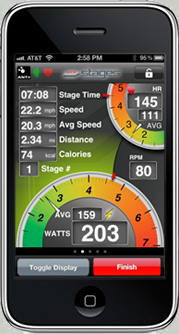
Master Instructor Cameron Chinatti joins me on this episode of the Podcast to discuss their new iPhone App. Looks very cool as it uses Ant+ to connect to the FreeMotion Power console, displaying your ride info on your iPhone. More on this once I have the chance to use it myself 🙂
You'll need this Ant+ dongle from Wahoo Fitness to connect to your iPhone.
The It's not easy staying green -Video PROfile from Cameron we discuss in this interview will post later today.


 Until I took the red pill (see initial post), I spent 95% of my working life in healthcare; specifically workflow methods and technology. As I got more and more involved on the clinical side of the equation, I began to learn about a distinct approach to the real life practice of delivering care to the patient called Evidence Based Medicine. In some ways, it looked to put to bed some of the same issues I feel burdened with as I continue to teach Indoor Cycling Instructors and coach competitive riders; that of competing opinions or treatment protocols for the same set of symptoms or circumstances.