Most interviews begin with an intro call where a potential guest and I discuss the process and I answer any questions they might have. Most of these calls are uneventful – but Gloria is not what you'd describe as leading an “uneventful” life. When I called her at the scheduled time she was breathless, having just rescued a stray dog from a busy highway. As she describe to me (in real time) how she was helping this poor, frighten dog into her car – I knew right away that I had found another Awesome Instructor!
Gloria was nominated by ICI/PRO member David Santiago. If that name sounds familiar it's because David was a past winner of our Ultimate Instructor Class Profile contest. You can hear his Racing With Pros Audio Profile here.
Please feel free to contact us to nominate an Awesome Instructor.
Here's David's nomination email:
Hi John,
I want to nominate Gloria Stover Lewis as an Awesome Indoor Cycling Instructor at the Y and for her endless volunteer work, especially with the “Girls on the Run” program held locally in NC.
Gloria started out as a regular student coming to IDC. All of the other teachers enjoyed having her in class. She is enthusiastic with boundless energy and has an outgoing winning personality. She is also a very strong cyclist and competed in several elite outdoor mountain bike races.
It did not take us teachers long to suggest she should become certified as an IDC instructor. We are always looking for talent. She eagerly agreed and become certified. She was a natural at it and now has huge followings at two YMCA locations. Her ability to combine challenging and fun profiles with fantastic music is among the best in the area.
Gloria is now certified to teach several classes:
– Indoor Cycling (of course)
– Jump pump and spin
– Boot Camp
– ABS
– INSANITY (I took this class once and it is now off my bucket list. Toughest workout I ever had.)
I am nominating her not only as an awesome indoor cycling teacher, but also for her volunteer and charity work with kids:
– Youth triathlon volunteer
– Ecvelo club at Cotton century ride and bike post trails race (volunteers with the youth part of mountain bike race)
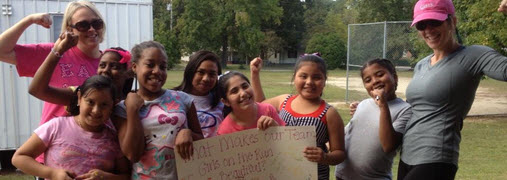
– “Girls on the Run” program as both a dedicated Coach and Fundraiser requesting donations for kids who could not afford them (athletic cloths and shoes).
David Santiago
Girls on the Run is an incredible program supporting young girls from 3rd to 8th grades. It provides a safe and interactive way to learn about healthy living which includes an introduction and education on important topics such as goal setting, cooperation, healthy decision making, and self respect, while training for a 5k event. The innovative curriculum teaches girls to listen and open up while also encouraging them to commit to a healthy lifestyle and harness the inner strength that they possess. Their important mission is accomplished by giving girls the tools to make positive choices for a healthy body and mind, while reducing the many risks they face today.
Attached is a fairly long and informative video explaining the Girls on the Run Program from the Chicago area. If you have any questions about starting a program in your area, please email them at StartingGOTR@girlsontherun.org.
Listen to my interview with Gloria below.
Long time friend Suzelle Snowden from Fit Bodies, Inc sponsors our Awesome Instructor Award. Suzelle is providing a $500.00 certificate that Gloria and a guest can use toward an All-Inclusive Teaching Vacation at any one of 60 beautiful resorts in the Caribbean You can learn more about participating in these trips here.
New Year’s Resolutions are upon us, but that doesn’t mean clear sailing. Things that can waylay resolutions are everywhere. Christmas candy will be on sale till early January, when the Valentine candy goes out and will be on display till February 14. February 15 it goes on sale. That brings us to March, when the Easter candy appears — even in years that Easter is late in April. And so on through the year.
Everyone offers tips for sticking to your resolutions. Ideas for quitting sugar, for example, may include (Don’t take notes here!) having fresh fruit instead of juice or dried fruit; flavoring plain yogurt with fruit or honey; using artificial sweeteners; switching to dark chocolate from milk chocolate; limiting sugar to desserts only; weaning yourself off desserts by reducing the weekly number; substituting wine or spirits for high-sugar mixed drinks.
Those tactics don’t — and can’t — work for those of us who have a sugar addiction. Here are a few suggestions — and some of them are just common sense.
1. Keep sugar and other junk food out of the house. Totally. Don’t buy it and tell yourself you won’t eat it. Don’t buy it and tell yourself you’ll have just a small portion. Don’t make your kitchen a binge blowout waiting to happen. Just don’t.
2. Stop putting your willpower to the test. I keep reading that we have only limited conscious self-control, limited willpower — and it certainly appears to be true. Instead, look for ways to change the situation. Ask the waiter to remove the breadbasket from the table. Don’t even ask for the dessert menu. Reread Suggestion 1. The fewer willpower tests you have each day, the fewer lapses you’ll experience later that day.
3. Train yourself to end a meal without dessert, no matter what time of day it is, no matter what everyone else is doing, no matter what others think, no matter what other say, no matter what habits you learned as a child. It takes practice, but it’s worth it.
4. Lie. (That’s fun to say because it grabs attention.) Don’t worry — I’m definitely not telling you to become untrustworthy and lie for no reason or about important matters.
But, seriously, sugar is a need-to-know issue. Does everyone at the dinner table need to know that you’re turning down dessert because you’re addicted to sugar? Or trying to lose weight? Both reasons will bring out every form of sabotage your “friends” can serve up:
“You’ll eat less tomorrow.”
“You’ll work out harder tomorrow.”
“Just a little can’t hurt.”
“But I made it myself.”
Harsh as it may seem, anyone who sabotages you is not a friend. If you have to pretend to want the food, claim to be full from the terrific dinner and ask for a doggie bag. On the way home, stop at the nearest trashcan and dump it. Don’t take it home and tell yourself you’ll make it last several days. Reread Suggestion 1.
5. That brings up another important point, covered in a previous post: Learn to throw away food, especially stuff that’s not really food, but junk. No compunctions here. The U.S. overproduces food significantly, and on a daily basis. Tossing the junk is survival, NOT a sin, as you may have been taught.
6. Little things add up. Focus on short-term actions — what you can do right now to avoid sugar. A recent study showed this approach — versus thinking about the long-term goal — was better for weight loss. It works for quitting sugar, too. Plan your next meal: how can you make it healthy? Buy nutritious foods when you shop. Develop an end-of-day ritual for the first 20 minutes after you arrive home to keep you out of the kitchen.
There won’t be any sugar in there, anyway, right?
As I’ve written in previous posts, motivation is not necessarily enthusiasm. It also tends to fade when daily life presents its daily challenges. But using these suggestions consistently can be transformational.
Enthusiasm is entirely optional. In fact, it’s often the result of consistent action.
Please feel free to share this article with riders and friends!
Dr. Carl Foster joins me to discuss his upcoming sessions at this year's ICI/PRO conference in Boston 9/30 – 10/2. As our conversation progressed we steered into; some of the history of zone based heart rate training, where “220-your age” came from (it's actually valid, in some respects) and we talked about my favorite subject – creating a standard method of describing heart rate training zones. I apologize for the length of this episode, I find it all very fascinating 🙂
These free Podcasts are provided through a sponsorship from Cycling Fusion
Michael working hard during the Tour L'Etape on Mt. Baldy
Studio owner Michael Stadvec joins me to discuss his upcoming event – The Tour de Pier on the Manhattan Beach pier. You can hear more by listening to the Podcast below.
John and Jennifer,
Thanks for the opportunity to promote the Tour de Pier!
Several months ago a student and friend (they all become friends!), Jon Hirshberg, approached Fit On Studios with a goal of getting “hundred's of bikes” for a one-of-a-kind charity event here in Manhattan Beach on May 19th called the Tour de Pier ( www.tourdepier.com). Jon lost his father to pancreatic cancer over 15 years ago and he started the annual 5k/10k LA Cancer Challenge, which has helped the Hirshberg Foundation become the largest Pancreatic Cancer non-profit in the country. We immediately said “yes” and then quickly began wondering how the heck we were going to get “hundreds” of bikes (we have 40). Our first call was to our buddy, over at Studio Cycles, Jeff Wimmer. Jeff has supplied us all of our bikes and not only is he a master bike mechanic, he has a knack for filling his warehouse with new and used bikes that he ships all over the world. He quickly committed 100 and then we pressed and he upped it to 200 bikes! That gave us 240 and we pooled some resources and Spectrum Clubs committed to another 150 or more bikes from local clubs and the total has kept growing to over 400 bikes!
Personally, I love anything to do with cycling – indoors, outdoors, going around a track in circles, so that was an easy selling point, but what hits home is that during all of this, my mom was diagnosed with a stage 4 Glioblastoma brain tumor. We had not been strangers to the devastation of this disease as my wife's father has been battling liver cancer for over 6 years. My mom fought hard, but passed away earlier this year. The Tour de Pier has become even more personal for me and bringing awareness and money for research that is critical to beat this unforgiving disease.
All of the fundraising dollars will go directly to four worthy charities: Hirshberg Foundation for Pancreatic Cancer, Cancer Support Community of Redondo Beach, Livestrong and the Friendship Circle.We will also have a Kids Zone and a Health Expo with sponsors focused on promoting healthy living in kids and adults.
We have a quote on the wall in our studio that one of our favorite (ok, they are all favorites) students masterfully phrased that sums up not only what we strive for in our studio, but for this event and all others like it… “The Power of Shared Energy.” That is such a powerful statement, but even more powerful when put into practice. It is hard to describe to someone if they haven't experienced it first hand, but it is so true…it keeps us going when we want to quit, it fuels us when we are down, and it inspires us to give that energy back.
If you're teaching with power, there's a good chance you'll have a participant ask you this simple question; how many watts should I be making when I'm working at my threshold? Same goes for any new studio or one that is upgrading to indoor Cycles with power/watts. You will be asked for a number from many of your riders. The reason is pretty simple, many people naturally want to know how they compare.
There are two schools of thought on if, or how, you should answer this question:
There's the “Don't give them a number – ever” school that believes whatever you tell them could be wrong and potentially upsetting. You don't want to demoralize riders, or hurt their feelings, especially with a new rider with no/limited fitness, by suggesting anything. The recommendation is to respond with a question; how many watts did you see today? Then respond positively to any response.
Then the “give them something to work with” approach. My preference is to start with the suggestion of one watt per pound or a little bit over 2 watts per Kg.
They're adults = tell them the truth… they can handle it.
Have you ever had someone lie to or mislead you, under the pretense that they didn't want to hurt your feelings? Did it make you feel valued and respected? If you have experienced a situation where you weren't told the truth, did you feel you would have acted differently, if you had been given accurate information?
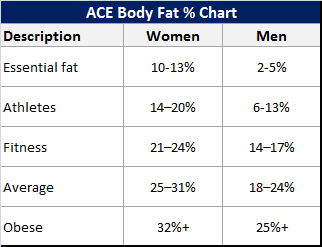
Imagine for a moment you're a personal trainer and your client asks you this question; what percentage of body fat should I have? A common question I'm sure. Is the correct response; “what is your body fat percentage now?” And then to positively affirm what ever answer they give? I don't think so… do you? There are established ranges for body fat %, published by credible fitness authorities like ACE. Here's their chart.
Let's see where you fall on this chart…
If your female client told you their body fat is 34% – would you smile and say; “that's great!” ? Of course not. You would probably suggest a diet and exercise program directed toward reducing their fat percentage down, with a goal to get into the average range. The person standing in front of you may not like hearing that they're obese, but don't they need to learn the truth so they can decide to do the work needed to change their body composition?
What about running a 5k? Or bowling for that matter? They both have metrics that define a reasonably achievable level of proficiency for an able-bodied person. Would it be wrong to suggest a goal time of 36 minutes (12 minute mile) for a 5K or 120 pin score in a bowling game?
Teaching with power for two years has me in the “give them something to work” with camp. And that something is a goal of one watt per pound of body weight*. I've asked multiple dozens of riders; “are you close to your body weight in watts?” Are they all there? No, but it's been very few. I'll bet if you were to privately poll your regulars, at the end of a 3-4 minute sustainable threshold effort, you would hear wattage #s around body weight.
At the end of the PST (Personal Spinning Threshold) assessment I did at WSSC, MI Janet Toussaint allowed me to ask the class this exact question. The majority agreed that their PST was at or above their body weight. Now a room full of fit Instructors may not be a representative sample, but it reaffirmed my experiences.
If you'd like to learn more about this concept – listen to this podcast where I first learned about it.
*I've heard other Instructors suggest using lean / goal body weight, which would reduce the number slightly. This calculator provided by ACE might be helpful.
Indoor cycling classes have become inextricably linked with dim lighting, and I’ve never understood why. Personally, I’m not crazy about training in the dark and will tell you why in a moment.
Studio lighting is one of the factors involved in creating the best class environment, along with music, video, voice, tone, cueing and more. Here are two scenarios from my teaching experience, in which the lighting differences span the spectrum.
In Studio A, the lights are always on and always bright. There’s no on/off switch in the studio because the lights go on when the club is opened. The master switch controls all.
In Studio B, the lights can be brought all the way up to a bright level, but the previous instructor, who had a huge following (okay, it was Jim Karanas), liked to keep the lights dim by flipping only the middle switch on the 3-switch panel. Needless to say, whenever I subbed for him, I made sure the lighting matched what everyone was accustomed to in his class.
The dimmer lighting was okay, but periodically one bank of lights, often on the far side of the room, would burn out, leaving everything on that side of the room just plain dark. It wouldn’t affect the participants close to the door because light outside the studio shines in on the near side of the studio.
We’d notify the front desk staff about the burned-out bulbs, and a short time later, we’d have lights — until they burned out once more.
By my last observation, though, that infamous bank of lights was out again and had/has been for a long time. It made me think about this topic. Apparently, no instructors have reported it to the desk. Apparently, no one has complained.
That last fact amazes me. Because of Jim’s teachings, everyone in the class uses a heart rate monitor (see How to Get Your Students to Wear Heart Rate Monitors). I always train with a HR monitor, mainly because of what I learned from both Johnny G and Jim.
So here’s the thing. In this studio, the bikes don’t have computers that light up and display HR. It’s virtually impossible to see a HR monitor on the far side of the partially lit studio. I’ve seen riders hold up their HR monitors, twist them around to catch available light, and keep track of their heart rates that way. What’s wrong with this picture?
Now I happen to find it difficult to train extremely hard in the dark. For a club anniversary one year, the theme involved decorating the studio like a spooky forest and turning out almost all the lights. Several people did complain that they felt nauseated. Guess I tend to feel that whenever I’m training really hard in the dark.
I had hoped the current instructors might take notice (read ‘take the hint’) when I started bringing a small flashlight to class with me to light my HR monitor on days that I ride on the far side. No such luck.
I have a feeling I’m in the vast minority on this — indoor cycling is almost always taught in dark rooms. Of course, in studios with bike computers that light up, much of this is solved. Still, if I had to choose between the glaring lights of Studio A and the darkness of Studio B, I’d go for the glare. I can monitor my HR easily and definitely feel better physically.
How do the rest of you feel about lighting? Which is most important to you — the atmosphere that goes with dimmer lighting, tracking heart rates, other factors? Please let us know, and thanks.


 You can learn more about participating in these trips here.