What’s the use of a state-of-the-art bicycle and a robust training plan if the rider hasn’t developed spirit or mental control?
Many coaches will tell you that no equipment or training method has value unless it helps to develop your spirit. Those coaches search for ways to infuse a calm and balanced mental attitude in their students and assure heightened clarity of perception. They may turn to enlightenment/spirituality to help students understand life better and cope with its complexity.
In the pursuit of effortless power on the bike, you must know that you are more than your intellect tells you. Training that emphasizes discipline of mind and recognition of spirit is paramount in that. To my understanding, two concepts are the basis of all training: center and intrinsic energy. In previous posts, I’ve referred to these as balance and aliveness or vitality.
I first witnessed effortless power in the mid-1970s at a martial arts demonstration. An aikido master displayed the power of ki (or chi), our intrinsic energy. With the slightest shove, he sent the five students attacking him into the air and onto the floor. The attackers appeared to be on wires doing a Hollywood stunt.
The next time I witnessed it was in the late 1990s at an indoor rowing regatta. The women’s world record holder for 2000 meters was on a rowing ergometer, warming up for the upcoming heat. The power output on her computer and the ease with which she rowed simply did not match. It was the first time I witnessed the combination of advanced fitness and the effortless generation of power.
I saw it again in 2002, during an annual time-trial up Mt. Diablo in Northern California. I was pursuing the coveted “under an hour” t-shirt for the 10.8-mile, 3200’ ascent. Most of the way, I followed a giant of a man, 6’4” tall, who outweighed me by 50 lbs. He wasn’t built for climbing but floated up the mountain effortlessly. He broke the hour and I did not. What I saw didn’t match what I believed he should have looked like on that climb.
My first personal experience with effortless power was in 2006, during the Furnace Creek 508, which I rode in 33 hours and 49 minutes, qualifying for RAAM. It was my pinnacle in cycling, training and racing. During my race preparation, my coach instructed me to “forget everything you think you know about cycling.” I learned that you can’t train your way to effortless power.
Although effortless power is not a result of fitness, fitness does result from the necessary training that culminates in effortless power. The simplicity is what I still struggle with, even to this day. It’s not a constant state, being centered and channeling intrinsic energy. The last time I experienced it was in 2008.
Center, maintaining balance, is always a struggle because of our chaotic reality. I spoke with one of my mentors recently about the difficulty of maintaining balance if you’re involved with business, friends and family, or are at an age where health matters manifest. Balance is more achievable when things are simple. In our society, living simply takes great discipline and sacrifice. Our balance is in constant flux, and so is our ability to achieve effortless power.
Sensing intrinsic energy is easier for some than for others. It’s not a simple declaration that you’re happy to be alive. It’s not a thought at all. Thinking obscures the sensation of feeling alive, even though it’s inherent in everyone. It takes discipline and practice to stay constantly aware of it, even more so to direct it. I spend time in all my classes searching for new ways to communicate the sensation. Without it, effortless power can’t be experienced.
In part 1, “What About The Watt?” I alluded to an indoor cycling practice that uses watts for something more meaningful than measuring power and improved fitness (along with its inevitable decline).
The watt measures force. How much force you can apply is a perception. So watts represent a limitation — in your mind — of your ability. Typically, to improve your ability to generate watts, you train your fitness. This improvement is short-lived. My experience is that generating watts beyond your current belief system is largely unrelated to fitness. It’s related to balance and your ability to coordinate and direct your intrinsic energy.
If the training you provide in your classes deals solely with fitness improvement, your students will never sense effortless power. Their watts may go up for the short term, but will eventually decline and disappoint. If, instead, the training you provide deals with achieving balance and coordinating the sensation of life, the students’ watt display will, at times, feel effortless, regardless of age. The pursuit of that engages the student for life and will lead to greater clarity and understanding.
Accepting that effortless power happens can be difficult, but becomes more possible once you witness it or experience it yourself. To experience it, however, you must have the discipline to deviate from the way you currently train and train others.
You can experience this through indoor cycling and using watts. My next post will provide pragmatic, specific, how-to exercises for leading yourself and your students to effortless power.
If you watched any of this year's Tour de France, you almost couldn't miss seeing Clean Bottle's mascot Bottle Boy running along with the Peloton. As I watched and listened as Phil Ligget and the other Tour commentators talking about Dave Mayer and Clean Bottle, all I could think was “who ever is behind (or inside) that Bottle Boy is a marketing genius!”
Fast forward to early September, less than 30 days till the ICI/PRO conference and it dawns on me that I had completely forgotten to source water bottles for our participants. Last year's provider was tapped out and I started looking at just purchasing bottles when I though I should check with Clean Bottle.
This rest is history – I contacted Dave and he quickly had boxes of Clean Bottles on their way to Boston.
The more I learned about Dave and his story the more I felt he would make an interesting guest for the Podcast 🙂 Listen as Dave describes the three year process he went through to take his initial idea all the way to the to Tour de France!
Click to download this App – I'm sure a search on your Droid phone will find something similar.
ICI/PRO member Kristin Krantzman makes an excellent point here in her comment, to my earlier post about sound levels.
I have one student that really complains about the loudness of the music. She has tried wearing special noise protectors. She tells me that I am damaging my own hearing as well as that of my students if I do not reduce the volume.
BUT, when she is in my class and I reduce the volume to the level she wants, the rest of the class can barely hear the music. Students start cross-talking in class and they lose interest. What can I do? I agree that increasing the volume so high that the walls are shaking is not healthy. But, when the members cannot hear the music and they start talking to each other in class, that is not good either. Anyone have ideas about how to handle this sensitive problem???
Kristin you're making a great point about “subjective” vs. “objective” measurements. We all have different levels of hearing. I want to call it a “sensitivity” to sound that may have reader's nodding in agreement, if they've ever had an argument with their spouse about the sound level coming from the TV.
You and your student are having the time honored, back-and-forth of; “it's too loud”… “no it's not”… “yes it is”… “I like it this loud”… “it will damage your hearing”… “no it won't”… which goes on without resolution because there's no “objective” sound level you can point to as an authority. I know from 24 years of marriage that a subjective argument like this will never end in “Win – Win”. Amy get's mad and leaves the room or I begrudgingly turn down the volume. Either way only one of us “wins” and, more often than not, neither of us feels good about the outcome.
The same is true for you and your noise sensitive student. If you had a sound meter in your studio (or living room) you could point to it and say something like; “our sound levels don't exceed 85 dB, which is the maximum level recommended by The National Institute for Occupational Safety and Health (NIOSH).
Can you see how having this “objective” measurement could change everything [wlm_firstname]? Instead of your student arguing with you, her complaint is totally with some third party authority. She may still believe that the music is too loud, but her issue isn't with you or your club. You're following the recommendations of a highly authoritative government body.
She maybe frustrated by all of this, but none of it will be directed at you. Smile and say; “I'd really like it if you stayed for my class, but I will completely understand if you don't.” And then it's critical that you make a very direct disengagement from him or her. Physically turn your body, break eye contact or say hello to another student. If you give her the chance, she'll re-load and come at you with another complaint or a different spin on her original complaint.
Handled correctly, my guess is that she'll stay for your class because…
People frequently use non-specific complaints to advance their own self interests!
It's said, but true. Every day people are trying to manipulate you into doing… what they want you to do!
Kristin's comment included this:
She tells me that I am damaging my own hearing as well as that of my students if I do not reduce the volume.
Please tell me if I'm wrong here – This student's expressions of concern, for Kristin and the other students, maybe completely well-intentioned. But I've been around far too long not to think that at some level she's simply taking advantage of Kristin's concerns for the wellness of everyone in her class, with the intent to manipulate Kristin into doing what she wants.
If you've had sales or customer service training, you'll recognize customer comments such as “your music is too loud” as a classic objection or complaint without specificity. Sales people learn that when presented with a non-specific objection; “your price is too high” the only effective response is to make the objection specific; “compared to what?”
The same is true in a customer service situation; “your music is too loud” needs to be qualified and made specific “our classes don't exceed the recommended safe maximum of 85 dB” effectively neutralizing the complaint. “Next?” you say, as you smile and greet the next person in line.
Like it or not, as the Instructor you are also a front line Customer Service person for your club or studio. Be aware that complaints from students aren't always what they appear. Bringing clarity to a complaint, by identifying specifics, can go a long way toward peace and harmony in your class and a lot less frustration for you, the Instructor.
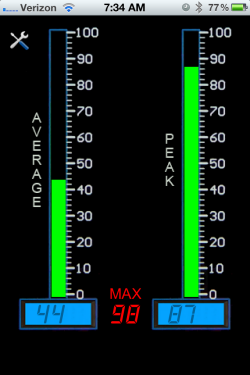
P.S – I've downloaded the free sound meter App for my iPhone shown in the screen shot above. I played around with it last night and plan to use it to establish an agreed sound level for the TV in our home. So the next time I hear; “it's too loud!” I can check and see who's right 🙂
P.S.S. You may want to forward this to your owner or Dept Head, so you're both on the same page if/when this student tries to escalate her complaint to management.
Cameron Chinatti from Stages Indoor Cycling alerted me to this Indiegogo project: BreathAcoustics All-in-One Headset. She was excited by it and I can see why.
I've spoken with the inventor Nirinjan Yee who's the CEO and Founder of BreathResearch and we will be recording an interview this coming Thursday morning – I'll try to have it posted by Friday so there's still time for you to help fund this project.
Nirinjan has some big hitters on her team including Sally Edwards and Dr. Carl Foster. Dr. Foster is conducting clinical research at UW Lacrosse to validate if this headset can accurately identify VT1 (first ventilatory/aerobic threshold) and VT2 (second ventilatory/anaerobic threshold) by measuring the distinct changes in breathing that occur with changes in intensity.
Here's why I feel this project is worthy of your support.
Perhaps the hardest part of teaching/Coaching Indoor Cycling / Group Fitness classes is effectively communicating your intended intensity.
Effective communication requires a common language between you and your participants.
How hard is HARD? What exactly does MODERATE feel like? Is my perception of an “8”… the same as yours? All of those descriptions are subjective = they only mean what I (me/you) think or feel they mean.
Walk into a Home Depot and ask for a gallon of Red paint – or – visit Amy at the makeup counter and ask for Red lipstick. Both Amy and the paint salesperson will ask; “we have quite a few different Red's… which shade are you looking for?” Then they'll show you a chart with all the different shades of Red for you to choose from.
With out realizing it, you're probably doing the same thing in your classes. In our attempts at getting our classes to work where we want them, we introduce more object descriptors = we'll probably be cuing to breath & breathing patterns; you've first noticed your breathing, need to open your mouth, jaw dropped, lost interest in speaking, sound like a freight train, gasping for air! etc… to help our riders understand the intensity we're looking for in class.
Next, we try to correlate those breathing patterns to a Heart Rate number or HR Zone; when you feel that early change in your breathing you're crossing your Aerobic Threshold T1… That strong, rhythmic breathing (without feelings of distress) has you in the middle of Zone 3; etc…
So why do we try to tie breathing (direct indication of intensity) to a Heart Rate number? Because it's really (beyond watts) the only objective measurement we can easily (and repeatably) make and we do so by using a heart rate monitor. We then assign a range of HR BPMs to a “Zone”. These HR Zones* become the common language between you and your students. If everyone knows their HR at VT2 (AT/LT) I can simply cue; “I need everyone at threshold” and the class understands.
Is there something magical about a specific Heart Rate BPM? Not at all… your heart is just responding to requests for more or less O2 and energy from the muscles it serves. Those requests are based on intensity and IMO anything that could improve the connection between intensity and Heart Rate BPM will help us to more effectively communicate with all those smiling faces riding in front of us.
Improving that connection (without needing to wear one of those awful New Leaf masks) sounds like something we should be supporting. That's exactly what BreathAcoustics is trying to accomplish with their Indiegogo project.
*I'm continuing my crusade advocacy toward the fitness industry adopting a common HR Zone system and have a number of expert interviews planned for later the Fall.
At the Indoor Cycling Group, we believe that teaching with video will be the next wave to influence Indoor Cycling, differentiate in the eyes of customers, and keep instructors from being seen as a commodity by the big-box clubs.
Media consoles like Myride®+ will enable instructors to work with cycling videos more easily than ever before.
It takes only seconds to create a video playlist of any length and any profile from the most extensive cycling-video library in the world.
One touch moves the video forward or back seamlessly from one point in the video to another.
Organizing the video library by terrain type (flat, mixed, climb, descent) gives instant access to any type of terrain with just a touch.
Cutting-edge technology enables any video to fit any piece of music, and vice versa.
The strategy here is simple. Movies are slick, impact our physical sensations and drive emotion. ICG® is speculating that, once club operators see the quality of our video and its ease of use, they’ll want to offer it and get an edge on their competition. We wouldn’t be doing this if people weren’t already asking for it.
Now it comes down to us, the instructors. To differentiate ourselves and go beyond being a commodity — one that club operators see in blanket terms regardless of how much we invest in our education or how high the quality of our classes is — we have to be ready and able to teach with video.
We’re guessing that this transition will be hard for many instructors. Anytime change feels intimidating, we tend to dodge it. At ICG®, we don’t see that as good for the industry, or for us.
When the change feels too big, we’ve got to shrink it to make it more manageable.
[!private ‘PRO-Platinum|PRO-Monthly|PRO-Gratis|PRO-Seasonal|Platinum-trial|Monthly-trial|PRO-Military|30-Days-of-PRO|90 Day PRO|Stages-Instructor|Schwinn-Instructor|Instructor-Bonus|28 Day Challenge']
“Shrink the Change” has gotten a lot of press lately. Chip and Dan Heath, authors of the bestsellers Made to Stick and Switch, have discovered that the rational mind and the emotional mind are two different systems. The rational mind wants to change something; the emotional mind loves the comfort of the existing routine. This tension can doom a change effort. If it’s overcome, though, change can come quickly.
We believe that the Myride®+ technology, along with our latest online tutorial will shrink this change and make it easy and fun for everyone to use video in their classes. For instance, with just a touch of the screen, you can display a forward-moving flat road — indefinitely. You can do the same with a climb. Or just use beautiful scenery without forward motion. You can pause and start, prepare fully, partially, or not at all. BTW, the online tutorial is free for everyone.
Three videos follow that demonstrate how incredible it is. These videos have been selected from over 30 that make up our online tutorial. Each one is a gem and shows you another cool way to use Myride®+ and/or teach with video.
NOTE: These are massive HD Video files – click play and then stop… and wait for the video to buffer before clicking play again if you have a slow Internet connection.
Teaching with Video Introduction
//
Teaching with Video Road Ride
//
Teaching with Video Trail Ride
//
We’re launching Myride®+ at the IHRSA 2012 trade show on March 15-16 in Los Angeles at Booth 1201A. I hope you can come by and join Team ICG® for one of the 20 Myride®+ demo rides we’ll lead over the two days.
Allen Jones from EpicPlanet.tv always sends me an advance copies of new Indoor Cycling DVDs he produces. Allen does this because – A) he knows I frequently use video in my class, B) there is no better place on the internet to promote videos for your next Spinning class and C) because yours truly did the ride profile for his latest video – Epic Wine Country.
Actually I had received an advanced, advance copy that he burned by hand, so I could use it in my class before writing the profile.
I have a brand new copy of Epic Wine Country indoor cycling dvd that I want to give it to an ICI/PRO member along with an official ICI/PRO long sleeve t-shirt.
So I devised a little contest 🙂
What is my favorite David Bowie Song?
Now I realize that there are a lot of Bowie songs, so I will give you a few hints:
It was produced before 1980
I would sing a song to my two girls when they were very young, but not if Amy was around – you don't want to hear me sing 🙁
It had a little Doo-Wop in it.
On the the album it transitioned to a song with a title (actually a statement) that I would prefer my two girls say NO to.
It wouldn't work in any Indoor Cycling class – way to slow.
Now I realize that the majority of ICI/PRO members were born after 1980, but just the same I'm guessing there are a few Bowie fans in our community.


 By Team ICG® Master Trainer Jim Karanas –