
by John | Oct 3, 2019 | Instructor Tips and Tricks, Instructor Training, Training With Power

How steep is a 4% grade? 8%? Over 10%?
How do I effectively explain % of grade to my class?
What are the feelings I would experience climbing different % grades on a bicycle?
And finally, how do I effectively communicate that feeling to my class?
Every July we hear commentators Phil Liggett, Paul Sherwin and Bob Roll discuss how the Tour de France is won or lost in the mountains. Just winning one of the popular climbs; Alpe d'Huez, Mont Ventoux, Col du Tourmalet or others can be the highlight of any cyclists career. But when Liggett explains that Alpe d'Huez has an average grade of 8% what exactly does that mean? Based on context, we can assume that this is a very difficult climb… but how difficult? What does it feel like to ride with the professional Peloton as everyone powers up a long climb at 8% grade?
So with the Tour only a month away and many Instructors and students riding outdoors, I felt you might benefit from some cliff notes on Grade and Slope. If you are reading this outside of North America, the concepts that I'm going to present are the same, but how they are noted on street signs varies from country to country.
Simply put, % Grade is gain in elevation (what's called the Rise), over a horizontal distance (the Run) – “typically” 100 feet or meters. The actual distance traveled is the Slope length which is slightly longer than the Run – it's that A²+B²=C² Pythagorean theorem thing you grew to love in highschool 🙂
So…
A 5% grade = a 5′ increase in elevation in 100′ of horizontal travel.

Image from Wikipedia
So you don't confuse the engineer's in your class, be careful not to mix up % of grade and the degrees of angle. They're completely different and roads aren't measured in °. If you feel it would be helpful to your students, you may want to comment that a road at 45° (as if that would be possible) would have a 100% grade, i.e. 100′ forward @ 100′ up.
Wikipedia has an informative page on Grade / Slope if you'd like to learn more.
Alpe d'Huez has an average grade of 8.1% over a run of about 13 km. Click to see the profile. That sounds impressive but it really tells you nothing if you don't understand what it feels like to ride a bicycle up an 8.1% grade. Actually 8.1% is the average. The first kilometer and a half are at over 10%.
If you want to clearly communicate the pain of climbing a 8.1% my suggestion is to find a steep hill, ride up it and experience what it feels like.
So now you may be thinking; “great idea John… but I don't recall seeing the grades marked any of the roads in my neighborhood.” My response would be; go out, find one and measure it.
I made the video below for a different project where I recommend that cycling studios measure and mark the road as a helpful guide to outdoor cyclists. In the video I describe the simple process of measuring the grade of one of the local climbs in your town.
If that went by to quickly, you divide the number of vertical inches by 120 (10′) which gives you the % grade.
How I communicate % grade in my classes.
Discussions of % grade typically come up when I'm teaching a virtual ride using an Epic Planet DVD or Global Ride's Dirty Dozen DVD, the grade of each climb is listed in the information bar at the bottom of the screen and I'll use it to help explain the intensity of each effort. I start by explaining that, although it doesn't sound like much, 4% is a serious climb that will have most of us at Threshold HR or Power FTP if it's of any length. I go on to explain that (at least where I live) most roads or highways rarely exceed 4%.
I'll reference local roads, that I understand the % grade, to my class – my apologies to those of you in flat lands of Iowa or Florida, you're on your own. Some of these roads, on established cycling routes, have steeper grades that I have measured. I'll talk about them by name; “Fox Road Turn” 8%, “Carver Wall” 12% and “Eden Prairie Road” 13.5% as a way to appeal to my cyclists who have experienced these climbs for real.
Other examples:
- 5% has you in your small chain ring (the sprocket in the front) and you need to manage (limit) your effort so as not to blow up!
- 8% and you're wishing you had a smaller gear and it's everything you can do to ride in a straight line. It's also everything you can do keep your pedal stroke smooth. Time here is short with your HR way over VT2 – Threshold.
- 10% is the limit of most recreational cyclists, if the climb is longer than a block or two. Smallest gear, out of the saddle and HR is as close to maximum as you can tolerate.
- 15% or more and you get off and walk 🙁
Once you've measured and ridden a climb with known grade, my guess is you're going to have a new appreciation for how truly difficult those famous climbs in the Tour de France really are and a new respect for the professional cyclists who climb them.
You can find the profiles of every climb, in every major Tour, along with 33,773 others at http://www.climbbybike.com/
Do you have any tough climbs near you?
Originally posted 2012-06-06 11:45:22.
by John | Sep 19, 2019 | Master Instructor Blog, Training With Power

Every year it's the same. We all have high aspirations that the weather will be nice enough to ride what's called the Minnesota Ironman Bicycle Ride. Not a true Ironman (no swimming or running thank God), this Ironman is the first large, organised/supported ride of the season. It gets its name from the notoriously crappy weather we normally have here in Minnesota the last Sunday in April and the foolish people who enjoy riding in it.
Twenty years ago freezing temps and a little rain wouldn't have stopped me from attending. Not having anything more to prove, I'm one of the first to politely decline any invitations – unless the forecast calls for a reasonably decent day. Rain is a non-starter, which was exactly what we experienced this morning. Add to that 37° F + 22 mph cross winds and a bunch of us found ourselves inside the warm and dry studio at Life Time Fitness 🙂
I like to ride with my class during long endurance rides. As this wasn't a regularly scheduled class, I have the freedom to sit in and enjoy the class with my friends and get the same workout as everyone else.
But I'm still “The Instructor” and everyone still expects a proper class. I start with an intro about how, as endurance athletes, we're all pretty self directed – so I'm going to be giving everyone a minimum amount of cuing and they will do the work they need to do.
My classes always include power and the first 15 minutes typically follow the same general format.
Warm Up — 10 minutes. 5 minutes of gradual increases in wattage. During the second 5 mins. we’re finding the wattage where everyone is first noticing a change in breathing; VT1 / Aerobic Threshold = the top of the Recover Zone. This establishes a rough understanding of a Base Level Wattage that we use throughout the rest of class.
3 x 30 sec. Hard / 30 sec. Easy – Openers to AT/LT. I cue these by first having everyone find the amount of load @ 70 RPM that has them feeling they should (not just could) come out of the saddle. The 30 sec. Hard is then simply accelerating to 90+ RPM which results in some pretty impressive power numbers. The 30 sec. Easy is back to 70 RPM — many will stand during the Easy portion.
1-3 minutes rest – I encourage riders to focus on their recovery. Once they feel calm in their breathing, bring back the Base Level Wattage.
3-5 min. Hard Effort — Here’s a “Best Effort” to establish a benchmark PTP Personal Threshold Power (top of the Perform Zone) or ride at 110% of FTP if known. It’s very helpful to riders to have that understanding of their personal upper wattage number. The “Best Effort” Threshold # + the Base Threshold # we found earlier form the three Power working zones I use in class. This “Best Effort also helps everyone understand where they are today… on this bike. Despite the efforts of our maintenance people, there are differences in the displayed wattage between bikes. My power meter was indicating that superman must have been riding it because I was seeing 320 watts, when I normally push ~240 watts at threshold.
With an Epic Planet DVD providing the entertainment, and me perched front & center between two regulars, we were off to virtually ride this year's Ironman indoors.
My cuing was very simple; depending on the song, we would ride at Base Level Wattage, Best Effort or something in between. Two hours is a long time to keep anyone's attention – so don't feel you need to. They're self-directed after all. Stand when you feel you need to and then give them a hard push at the end. You needn't make it any more difficult than that.
Here's my playlist.
Originally posted 2014-04-27 17:00:56.
by Joey Stabile | Sep 11, 2019 | Audio PROfiles, Best Practices, Class Work-Sets, Creativity Indoor Classes, Instructor Training, KEEPING IT FUN, Master Instructor Blog, PRO/Playlists, Training With Power
Welcome to the The Weekly Ride by Cycling Fusion
Welcome to our new era of The Weekly Ride, you get:
- Full Ride PDF
- Apple Music Playlist
- Spotify Playlist
- File to Download the Ride directly into My Fitness DJ (Yes, no Programming)
- The Ride will be available for purchase in the iClass Builder Store (No Programming)
- A Podcast of the ride being delivered by a master instructor.
(more…)
Originally posted 2018-12-18 21:31:33.
by John | Sep 2, 2019 | Class Work-Sets, Instructor Training, Training With Power
Week #2 of my Performance Cycle class and I introduced the concept of using your stage average watts as a “riding buddy” today + had a nice email when I got home.
Hi John-
Thank you so much for the great class this morning. I took a picture of my results when I was finished. My avg watts was 148, not 212. I have no clue where I got that number. 😉
I also took your advice and upgraded my membership, so if it's ok with you, I would like to take advantage of the class next Sunday as well. Do I need to come early to be tested or will this take place during your class?
My goal is to get strong and gain endurance. I have an Ironman in 2014 that I would love to CRUSH! 😉
Thanks again for the great morning!!
Tina (Smiley, Orange Shoes girl)
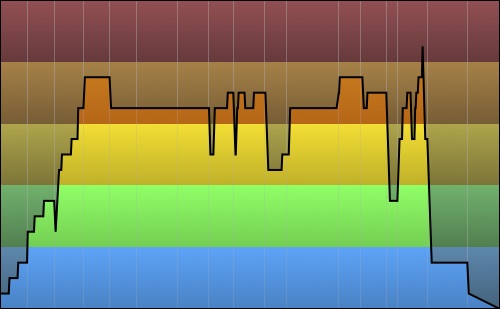
This gal is an animal – the 212 watts she refers to was her average for both of the 10 climbs we did, with only a minute of recovery in between them. Here's the picture she took.

Those are awesome #s for anyone.
Now to the Riding Buddy
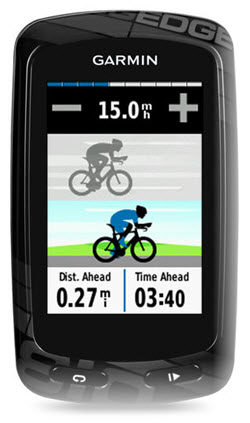
Pictured on the right is a Garmin 810 cycling computer. Beyond measuring and displaying all the typical stuff; RPM, MPH, Distance, Time elapse, etc… these computers allow you to race against a Virtual Partner, which is yourself previously riding over a known course. Racing against yourself is a fascinating concept which allows you to compare today vs last week or last year. Are you getting stronger/faster/fitter? Yes? No?
http://youtu.be/o8YhrAAvh7w
After all, it's just you, who you're really racing against.
I use the stage average timer in class as a sort of Riding Buddy, comparing a specific intervals against earlier efforts. Asking; are you keeping up? Yes? No?
Today's class followed Spinervals Competition 41.0 — Ascending Mountains in Leadville, CO
Class length 75 minutes + Cool Down
Spotify Playlist 12-29 Performance Cycle class
Warm Up — 10 minutes. 5 minutes of gradual increases in wattage. During the second 5 mins. we’re finding the wattage where everyone is first noticing a change in breathing; VT1 / Aerobic Threshold = the top of the Recover Zone shown above. This establishes a rough understanding of a base wattage that we use throughout the rest of class.
3 x 30 sec. Hard / 30 sec. Easy – Openers to AT/LT. I cue these by first having everyone find the amount of load @ 70 RPM that has them feeling they should (not just could) come out of the saddle. The 30 sec. Hard is then simply accelerating to 90+ RPM which results in some pretty impressive power numbers. The 30 sec. Easy is back to 70 RPM — many will stand during the Easy portion.
3 minutes rest – I encourage riders to focus on their recovery. Once they feel calm in their breathing, bring back the Base level work wattage.
5 min. Short Hill — Here's were we do our 5 min. “Best Effort” to establish a benchmark PTP Personal Threshold Power (top of the Perform Zone) or ride at 110% of FTP if known. It’s very helpful to riders to have that understanding of their personal upper wattage number. The “Best Effort” Threshold # + the Base Threshold # we found earlier form the three Power working zones I use in class.
– 1 min. build at preferred cadence (suggested as 85-95 rpm) — press the Stage Button to reset the averages.
– 5 min. “Best Effort” This should hurt, but be do-able. I ask everyone to observe their average at the end and then…
2 minutes rest
3 x 5 min. Medium Hill @ 1 min Rest – Now that everyone knows how hard they can go for 5 minutes, we worked at ~90% of PTP on each of the three, five minute climbs. The recoveries and transitions back to climbing are simplified by leaving resistance where it is and do what I call Walking. Have everyone stand and pedal slowly “walk” for a minute. Load should be too high for seated soft-pedaling. Then accelerating up to preferred cadence brings everyone back to ~90% of PTP.
3 minutes rest
2 x 10 min. Long Hill @ 2.5 min. Rest – the songs I used were a little short so I had everyone up to RPM/Watts before starting the songs and hitting the Stage button to establish averages. I prefaced the first climb with; “As Endurance Athletes, you recognize that you get stronger as the class goes on.” Here's where I got a few smiles and hoots… “so my expectation is that you can all climb this at your PTP (5 min. Best Effort wattage)” and we did 🙂 The Spinervals profile calls for near constant changes in gears and cadence, which is easy to do on a bicycle… not so easy on an Indoor Cycle. So instead we made 3-4 changes in load/RPM + alternated in & out of the saddle.
Here's where I was cuing everyone to focus on their Riding Buddy. No matter the change, it is imperative that you keep your instantaneous watts at or above the average, so you keep up with your Riding Buddy.
5 minutes at Base wattage @ 90RPM – which becomes a recovery > step down in intensity while we stay aerobic.
Cool Down
I'm very excited to be able to teach these Performance Cycle classes – they fit me and my personality perfectly and we have an excellent group of athletes to ride with.
Next Sunday 1/5 is the official kickoff of the winter training program > FTP assessment day. Feel free to contact me if you'd like to ride with us.
Originally posted 2013-12-29 16:27:31.
by Gino | Aug 30, 2019 | Master Instructor Blog, Training With Power

It’s finally time to take a look inside.
First I have to apologize for taking almost 2 months to report on results that were secured after just 4 weeks of data collection. That’s part of the problem with Evidence Based Cycling; once you do herd all those cats on bikes (see last post) and send them on their way to collect data, you have to eventually herd them over again to retrieve the data. I only got the final piece of performance data last week.
I won’t hold you in suspense any longer, the results appear below in summary form — with the bottom line of: “What effect if any did this protocol or riding drill have?“ or perhaps more simply stated “Did we get an better?” or better yet, would it be more appropriately states as “can this protocol be used as a specific prescription for improving Muscular Endurance in cyclists?” Frankly, I want to know that for myself and my own riding, as much as I want to or need to know it for the riders I coach personally.
Summary Results
The summary results shown here simply compared the Baseline Test (our method for determining their power generation and sustainability levels at the start of the test) to their Performance Test that sought to measure the same thing, on the same bike, in the same manner. The results seem to suggest that this riding drill for improving Muscular Endurance works.
|
SUMMARY RESULTS
|
Muscular Improvement
|
Endurance Improvement
|
Efficiency Improvement
|
|
Average Change:
|
5.03%
|
3.35%
|
17.29%
|
|
Throwing out High & Low:
|
5.04%
|
5.04%
|
13.90%
|
The one fact that can, and often does bring seemingly good findings into question is the sample size. While we started with 11, we ended up with only 8 riders who completed the study. There are a variety of reasons for this, none of which had anything to do with the test itself. In any event, to be considered valid by almost any rigorous standard, this type of study would have to be repeated with a bigger sample size. May this preliminary “investigative type research” would inspire some budding graduate student in the physiological sciences to pursue a wider study.
Are The Results Statistically Significant?
In terms of whether we can consider these results meaningful or not, we must first introduce the term or phrase associated with this question; “statistical significance”. In regards to research findings, it has a fairly specific definition. Wikipedia explains it this way: “Statistical significance” is a statistical assessment of whether observations reflect a pattern rather than just chance…” It further defines the level or degree of significance this way: “The choice of significance level is somewhat arbitrary, but for many applications, a level of 5% is chosen by convention.[3][4]”
As you can see from the summary results, by all accounts calculated, only the Average Change in Endurance would come into question. This is quite understandable given the fact that these results were assessed only 4 weeks after the study began. In training other athletes, and in training myself as a semi-retired racer, I can tell you that most real and lasting training effects take 6 weeks to be “established”; established as in the gains are likely to not be reversed any time soon, and that there was a real cause and effect relationship between the work and the result.
The Gory Detail
Below is the table with all the numbers that make up the summary findings above. Data geeks control yourself — these numbers only represent 4 weeks of following the M.E. protocol, and we need much more data to begin to think of implications beyond the obvious conclusions drawn from what we see here. That will be the focus on our next blog post — what all can we see and say about this data and its implications for both training and further research.

Click image to enlarge
Stigler S (2008). “Fisher and the 5% level”. Chance 21 (4): 12. doi:10.1007/s00144-008-0033-3.
Fisher RA (1925). Statistical Methods for Research Workers (first ed.). Edinburgh: Oliver & Boyd.
Originally posted 2012-10-24 11:49:24.

by Joey Stabile | Jul 29, 2019 | Audio PROfiles, Best Practices, Class Work-Sets, Creativity Indoor Classes, Instructor Training, KEEPING IT FUN, Master Instructor Blog, PRO/Playlists, Training With Power
Welcome to the The Weekly Ride by Cycling Fusion
- Full Ride PDF
- Apple Music Playlist
- Spotify Playlist
- File to Download the Ride directly into My Fitness DJ (Yes, no Programming)
- The Ride will be available for purchase in the iClass Builder Store (No Programming)
- A Podcast of the ride being delivered by a master instructor.
(more…)

