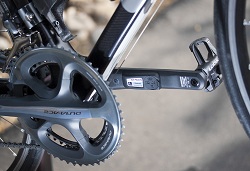
I'm going to need a pair of these so I can see when Amy is slacking off on the Tandem.
Stages Cycling has taken the technology they developed for the FreeMotion S11 series Indoor Cycles and is now offering the StageONE Power Meter to outdoor cyclists.
I don't have any direct experience other than a heads-up email announcing the launch of this , but there are two very informative posts from bloggers who are at Eurobike earlier this summer.
Stages Cycling readily admits that it's not necessarily trying to go head-to-head with established players such as SRM, Powertap, and Quarq in terms of outright technology, instead preferring to go after so-called ‘blue collar' riders who merely want a consistent means of tracking progress for training purposes.
Using a Bluetooth enabled device (the StageONE doesn't come with any display) you can add power and cadence for $699.00 which is less than half that of other systems = outdoor power gets a bit closer to being real for many of us 🙂
Will Grossman from Stages Cycling has promised me more information soon. Right now they are swamped with their launch and Interbike which starts tomorrow. Their website is supposed to go live today. http://www.stagescycling.com/
“the needs of the many outweigh the needs of the few… or the one”.
Trekkies (fans of the old Star Trek franchise) will instantly recognize this quote from Spock, which to many of us makes perfect sense; the needs of the majority of our students should outway the needs of a single individual.
And yet applying Spock's logic in our classes can become quite difficult, if not impossible for many of us.
Many of us have experienced a situation where one person is disruptive in class or acts in a way that requires us to focus on them, at the expense of everyone else.
In his Monday post, Chuck Cali relates a problem he had with his new power program:
In the second class, a 73-year-old woman in Birkenstocks walked in after class had started. She’d heard cycling might good for her and demanded to be shown how. With the CEO looking on, and everyone else looking impatient, I set her up. She disliked cycling and left, wasting almost 15 minutes. Such a disruption to this sort of class is catastrophic.
It's like watching a slow moving train wreck and we've all been there. Powerless (forgive the pun) to prevent what all of us with any experience knows will happen next – this one person will, in some way, negativity affect the entire class.
The answer is NO. As in; “I'm sorry, but for your safety and out of respect for everyone who was here on time, we don't allow people into class after it has begun.” “If you'd like to come back in an hour, or come in ten minutes before the next class, I will be happy to get you set up.” And then you physically turn your body (and attention) back to the class.
Saying NO is hard for all of us. Nobody likes to hear NO. For some of us it's almost impossible to turn someone away or ask that they stop whatever they are doing that causes you to feel you need to focus on them, instead of everyone else.
Ignoring the needs of the manycan does limit the effectiveness of your class and diminishes your rapport and/or authority with your students. I'm using “authority” here to mean your perceived role as a leader and a fitness expert.
What got me motivated to post this was a question I received ICI/PRO member Pat Williams.
Hello John,
Hope you are doing well. Thanks for all your hard work with Indoor Cycling. Our gym is in the process of moving and maybe purchasing some new bikes. We currently have 18 Star Trac NXT bikes and they have served our group well. Trying to stay with current trends, I am interested in bikes that could provide more objective information i.e. power, heart rate, speed, and distance ridden. I know that you are currently riding Free Motion bikes that provide this information. If you were in charge of the world, what bikes would you recommend and what are the pros and cons of your choice? I know there are many choices that are out there. Thanks for your help.
Whenever I'm asked for my opinion about what road bike someone new to outdoor cycling should buy, my answer is always; “you want to purchase the bike that you'll ride… not the one that will collect dust hanging in your garage”.
My objective is to identify whether or not they are willing to commit to the changes in their lives, necessary to becoming a cyclist… or are they simply just in love with the idea of being a cyclist?
The same is true with clubs excited to purchase new Indoor Cycles that include Power indication.
No manufacture makes a bad Indoor Cycle with Power. They're all different and all have their strong and weak points. If you spend any time over at Pedal-On you've maybe read some of the never-ending debates over the fine points of which cycle is better.
Do I have a preference? Sure I do. I have experience riding and teaching on most of them. If Pat and I talked and I learned more about his club's specific needs, I could probable help him narrow his choice down to one or two. But any of the currently available Indoor Cycles; CycleOps 300, FreeMotion s11.9, Keiser M3 or Schwinn AC would be a good choice for Pat's club.
But none of them will guarantee a successful power based program.
I'm hearing, seeing and experiencing studios (like Chuck's) who were in love with offering Power to their students. But unfortunately not all of them are willing to make the commitment to Instructor training and class formatting / programming needed to develop truly effective power based program.
One major barrier to success is an inability to say “NO” to some of their students.
This isn't a new problem.
IMO – the failure of a majority of of clubs to implement effective Zone based Heart Rate training classes in large part goes to a reluctance to say NO to students who aren't interested in wearing a monitor. Instructors feel compelled to teach to the lowest common denominator (the few without a monitor) which effectively waters down the HR Zone class content until many of us have given up on HR training completely. Power based classes aren't any different.
Because Power is so new, I see all of us in a unique position to make the changes needed to establish effective Power based classes. I'm not deluded into thinking I have all the answers, but here are a few ideas that I'd like to see discussed in the future:
Clearly separate Power Training classes from Generic Indoor Cycling classes on the schedule.
Teach these Power Training classes to the many, saying NO to the random drop-in student – after first explaining that our club offers…
Regularly scheduled Introduction to Power classes where students can learn all about Power and can learn their FTP based training zones.
Establish a policy that no one can enter class after it has begun and install signs communicating this on the studio doors.
Math, for some of us, isn't our strong suit… especially when you are trying to compute specific training zones on the fly using Lactic/Anaerobic Thresholds (LT/AT) or Functional Threshold Power (FTP)
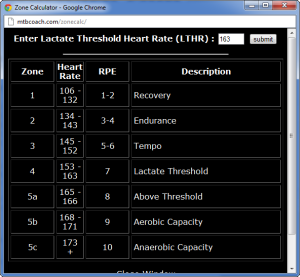
MTB coach Curt Wilhelm has created two easy to use, online tools you can find here.
And for you data junkies, Cycling Power Models has a very comprehensive tool that is sure to satisfy you for years.
A word of caution
The computer world has a saying; “garbage in = garbage out” which describes how using inaccurate (garbage) data to compute with can only lead to inaccurate (more garbage) results. The calculators above are designed for endurance athletes who have achieved a level of fitness and learned to tolerate the pain/discomfort of working at or above LT/AT or LT2 (upper Threshold) for extended periods of time.
In this three part series from last year; Is a 20 Minute Threshold Field Test realistic for your class? I discussed multiple reasons why I question using 20 minute field tests to determine Threshold Heart Rates for the “typical” student in your class. If you haven't read them I'd encourage you to do so now. My biggest issue with 20 minute field tests is that many of the Club Athletes in our classes haven't learned or developed the pain tolerance needed to sustain the Threshold level of intensity necessary to find an accurate average HR… but instead find some number below Threshold = “garbage in” 🙁
[wlm_firstname] if you feel you have a good understanding of your AT/LT/LT2 I'd like you to try one of the calculator above. Then consider what will happen if instead of entering a true Threshold HR, you use a HR 5%-8% below it.
Can you see how “garbage in” could have some students under training?
In case you are wondering, I see using HR training zones based on LT1 (Aerobic Threshold) as much more accurate for Club Athletes, especially when combined with the simplified Two Threshold – Three Zone system advocated by ACE – The American Council on Exercise.
The “Heads Up Display” of student's performance data (watts, calories, cadence, HR, etc…) from Performance IQ looks like a fascinating addition to any club or studio. While not for everyone, the competitive element it introduces can make for a very exciting and motivating class experience.
But I had felt Performance IQ it was missing a few things:
The pre-class setup (entering all your students into the system) was a lot of work for the Instructor during the frenetic moments before class time.
There wasn't any option to collect or retain the each student's data.
The system only worked with the Keiser M3 Indoor Cycle.
All of that has changed now that Performance IQ is partnering with ZingFit who has a full-featured management system system for cycling studios. The beauty of this partnership is how well they compliment each other's service
Now…
Participants can reserve their bike online when they register for class using Zingfit's registration system. This in turn tells Performance IQ who's on which bike. No more need for the Instructor to do anything beyond starting their class and pressing the GO button.
Zingfit collects all the ride data from Performance IQ and displays it on a secure section of the Studio's website. Zingfit can even send an email to each of your students at the end of each class.
Performance IQ is now compatible with all Power bikes that use Ant+ (FreeMotion S11, Schwinn AC and CycleOps)
Listen to the Podcast below it hear all the details.
Getting Started
Recruitment is never easy, and it seems we never get quite as many subjects as we like. This is the big advantage of a University setting, it’s a veritable gaggle of guinea pigs. No offense to the college student, but they’ll participate in just about anything — believe me, I know — having participated in just about everything myself (back in the day).
While I understand this fact, there is still a point where too few participants makes it hardly worth doing, and right now that is sort of where I am with the project. I do not have enough volunteers to really get started. Our Indoor Cycling classes are down to a few digital offerings through the weekdays only, and a few outdoor rides. It’s how we like to do it in the summer; taking advantage of as much outdoor riding as we can.
Consequently, I think this study is going to be more easily conducted with volunteers from around the country, than by the usual lot I find in Pittsburgh. So, this is my official plea to all you fine would-be researchers and guinea pig hopefuls. Please send a message right on this blog post if you want to participate in the study.
What Will We Be Doing?
I can already hear the questions, starting with this one being top of mind. I will ask each participant to conduct a baseline test (specifics laid out in Blog Post #10 with a few tweaks — which will be communicated via email). After our baseline, I would like to conduct a 4 week study whereby each participant fits in Muscular Endurance work (specifics below) at least 3 times per week, and for the durations specified.
This work can be done inside or out, and can be fairly easily incorporated within any indoor “spin” session and any outdoor ride.
Here are the requirements:
After a suitable warm-up, attempt to pedal consistently at 75RPM while in mid zone 3 for riders who consider themselves beginners or intermediates, or mid zone 4 for those who race or who consider themselves advanced to expert level. As far as possible, make this drill last contiguously for a duration of 15 minutes to 30 minutes. Beginners & Intermediates do 15 min segments while the competitive or advanced rider will do 30.
Once the 15 or 30 minutes is completed, make sure to write down:
Total time (should be 15 or 30 min)
Was it conducted on an indoor cycle or a outdoor bike
Average cadence
Average heart rate
Average power
How you felt — on an RPE scale
If you did 15 minutes, try to do some recovery, or at least ride with less resistance if possible for 5 minutes, then repeat. If you did the 30 minutes, you are done with the M.E. requirements for the day.
Repeat this a total of 3 times each week, ideally with a day separating each one. However if your schedule doesn’t allow a day to separate each episode, it’s still fine to do them on back to back days.
At the end of each week, the information noted above for each 15 or 30 minute segment should be put into a spreadsheet and sent to yours truly; gene at cycling fusion dot com.
Do I need Power?
You will only need access to a power bike (hopefully the SAME bike) before and after the initial baseline testing and the subsequent performance test. Once you do your baseline, it will be strictly cadence and heart rate that will be used. So yes, you will need each of those two training tools, on either your indoor bike or your outdoor ride.
Thus, a minimum requirement for participation is a heart monitor and a cadence meter on all the equipment where you do your Muscular Endurance work.
The Benefits of Being A Guinea Pig
In the event you are reading this and thinking of joining our band of merry men and researchers, I applaud and encourage you for that. In fact, there are certain benefits for you in forging new ground like this:
1. The satisfaction that you are doing something few others may have done — trust me, it’s a good feeling.
2. You gain the “inside track” at Cycling Fusion® as a study participant. Future studies (even if you don’t participate) benefits all of our study participants & Cycling Fusion® members.
3. Analysis of your training as it relates to the subject matter being studied — it’s like getting free coaching.
4. Advanced copies of all literature related to our research and Evidence Based Cycling efforts.
So there you have it — no reason to hold back now. Let me know what you think, and/or use my email address listed cryptically above.
For many (me included), the biggest appeal of spectator sports like motorcycle racing or watching the Tour de France is projecting yourself into the event as one of the participants. Having road raced motorcycles for years, I know intimately the continuous sound of an engine at redline… what it's like to hang off the side of the motorcycle at over 100 miles an hour… the rush of adrenaline as my knee scrapes the asphalt. So it's easy for me to let my mind drift and fantasize that I could make starting grid for a MotoGP race, from the comfort and safety of my couch at home.
Same is true for me when it comes to bicycle racing, especially while watching the tour each July. I can hear commentator Paul Sherwen describe my break from the front as I power up the road, intent on bridging to the breakaway; “Macgowan as made his move, as we knew he would… He's definitely saved just a little bit in his tank for this final climb… this will be an exciting finish Phil!”
Could I really ride with the Tour? Not hardly. I've ridden and raced with people who could simply ride away from me with little or no perceived additional effort. And these people were certainly not able to make the starting roster for a professional cycling team. I'm guessing that few of the cyclists is I've ridden with, the ones who really impressed me with their strength/speed/endurance, could even hang with the professional team on their recovery days.
In the past my comparisons were based on direct experience (typically getting dropped) or simple perception. Now, with the availability of power indication in our classes, I can compare my power output (watts) with that of a professional cyclist and know with certainty how quickly I'll be dropped 🙁
They say that the beauty of using metrics in training is that; if you can measure it – you can improve it. But metric's also provide a tangible point of comparison we can use to compare ourselves to others.
I talk a lot about the 1 watt per pound concept that Gene Nacey uses to decide whether or not you're ready to go out and start climbing hills. Gene says ” One watt per pound is the gateway to outdoor riding.” Where Gene lives in Pittsburgh it's very hilly. Long climbs don't exist here in the flat-lands of Minnesota. So I like to discuss a second metric in my classes; what's your sustainable flat road speed? Or based on your sustainable wattage, what speed would you be riding outdoors?
This website has a fantastic tool for computing sustainable flat road speed, based on your individual (male or female) power output. It also has a fun chart where you can compare yourself to cyclists who race in the various categories; Cat 5 – Cat1 – all the way up to professionals.
You enter your body weight in Lbs and your Threshold Power in Watts. I know I can sustain 250 watts on a FreeMotion Indoor Cycle and I weigh 160 lbs. Here is my result.
I believe ~23.82 mph is quite close. I dug back into my records and saw my average speed for the bike leg of the Apple Duathlon was right at 23 mph. This 33k race course is dead flat. I raced it three times, partnering with my neighbor Mark who did the runs. The comparison chart shows me as a Cat 4, which was the highest I ever raced.
So how would I compare to a time trial ridden by a professional? Because the length and course of the individual time trials in the Tour De France change every year, there's some debate as to who had the fastest average speed. Local boy Greg LeMond (he's from Minnesota) in 1989 and David Zabriskie (2005) both won individual time trial stages averaging ~34 miles an hour.
Here's how much power they needed to not only produce, but sustain for nearly 60 minutes:
Assuming they both weighed 160 Lbs, Greg and David needed to double my wattage to ride 50% faster than me… astounding!
Go over to the calculator and see where your power falls and which category you would race. And if you're brave, add your results below.