
by John | Dec 26, 2011 | Heart Zones USA, Zone based Heart Rate Training

Sally Edwards with Paul "Pinkhouse" Camerer
Here's a walking testament to the utter fallacy of (220 – your age) as a predictor of Maximum Heart Rate. Paul Pinkhouse Camerer is having his 93rd birthday today. To celebrate the occasion, Pinkhouse and a few of his friends will all train together at his home/cycling studio. During the training Pinkhouse will spend a large portion of the ride around 150 bpm – which is way above his age predicted maximum HR of 127bpm. Actually Paul has been cycling and participating in running races above his “Maximum HR” for years 🙂
Sally Edwards introduced me to Paul (Pinkhouse comes from the color of his home… which as you can guess is Pink) three years ago at a Heart Zones conference in Colorado. I recorded Podcast episode #18 with Paul while I was there, but many our our newer subscribers may not have heard it as it has dropped off the iTunes feed. Thinking it would be fun to republish it in celebration of Paul's 93rd birthday here it is again.
HAPPY BIRTYDAY PINKHOUSE!
[audio:https://indoorcycleinstructor.com.s3.amazonaws.com/018_Paul_Camerer.mp3]
Podcast: Play in new window | Download
by John | Dec 9, 2011 | PRO Deal of the Week, Zone based Heart Rate Training

After his list, Santa checks his Blink
Santa Says; “It’s time you had a Blink Heart Rate Monitor of your own.”
Today’s PRO/Deal of the Week is the perfect Christmas gift for yourself, your family members or friends planning to start a work out program in 2012.
Sally Edwards says, “The joy of working out to blue, yellow or red cannot be understated,” “it takes the ‘work’ out of heart rate training, is simple to use and gives the user tremendous instant feedback.” A perfect compliment to any weight loss program.
This Blink records all time in zone, calories and works perfectly with the latest two threshold, three zone training system popularized by ZONING’s program in a Can. ZONING is a division of Heart Zones USA.
Click here today only, ZONING® is offering the Blink for $42.50
50% off the Retail price of $84.99. There are only 50 available at this price.
With your Blink heart rate monitor you also get instructions on how to perform the The ‘Can You Speak Comfortably’ Foster Threshold Field Test.
Known as the ‘Gold Standard of Field tests, this assessment will help you discover your (or your students) T1 & T2 thresholds to accurately set when the LED changes colors.
And, of course, ongoing support from ZONINGâ„¢
by John | Jul 12, 2011 | Latest News, Zone based Heart Rate Training

In a typical fitness conference “sponsorship”, Company A pays Event Promoter B a bunch of money to to be part of the event. That sounds good, but if you have been following us for any length of time you know that we don't always do what's “typical” here at ICI/PRO.
So when Chuck Cali from Zoning Fitness offered to become a sponsor of this year's conference I said; “only if your sponsorship will add value to the Instructors who attend!”
Chuck's response was “how about if we give the next 75 Instructors* who register a free $80.00 Blink Heart Rate Monitor?”
I love my Blink and see it as an excellent choice for the Club Athletes we teach each week. It's the perfect companion to the 2 Threshold / 3 Zone Heart Rate system we have been talking about.
So I said; “Chuck, we've got a deal!”
Click here to register today and be one of the 75 who will be sporting a new Blink in October.
You can find more info about the conference here.
* Of course all of you who have already registered will receive a blink as well 🙂
by John | Jun 21, 2011 | Zone based Heart Rate Training

Who's really in your class?
Do you look up at a room full of smiling, fit, self-directed, endurance athletes?
Or does your class more closely resemble the population where you live?
In Part 1 I shared survey results that showed that a 20 Minute Threshold Field Test isn't realistic (maybe practical would be a better word) for where most of us we teach – which is primarily large health clubs.
I also stated that;
It’s well documented that a 20 minute Threshold Field Test is effective in determining an Athlete’s T2 (Anaerobic/Lactate Threshold) or FTP (Functional Threshold Power).
Are we training real Athletes in our classes?
I now see that asking an additional question on the HR training survey regarding class makeup would have been helpful in getting a true understanding of class makeup. So please permit me to make this assumption based on personal experience of 15 years teaching (and attending classes) at small studios, large “Big Box” clubs and conversations with hundreds of Instructors; the majority of our students are what could be described as “Club Athletes” who attend class or workout 2-4 times a week. My observation is that a very small percentage <15% are true endurance athletes. Of course every class or club is different. Class format and the time of year has a large bearing on class composition. For example my 90 minute endurance classes in the winter are > 70% endurance athletes… but then that class is designed specifically for them.
The purpose of a 20 minute field test is to determine an accurate Threshold HR for the purpose of setting HR training zones. These HR zones will be used to structure training intensities for weeks or months in the future.
In an early post I talked about using your Heart Rate Monitor as a GPS instead of a Speedometer. I was trying to reinforce something that you already know; maintaining an effort at, or very close to, Threshold for any length of time is painful and difficult for anyone. Like you, Amy and I fall somewhere in that upper 15%. If we choose to, we could ride at a consistent RPE that we feel is our threshold for 20 minutes, for the purpose of determining our Threshold HR and be pretty close.
But what about the other 85% of the students in our classes? How many could maintain a true Threshold RPE over a 20 minute Threshold Field Test?
What happens to the accuracy of the test if your students are finding, over the course of the 20 minute test, a HR average that's somewhere in the middle of T1 & T2?
Fast forward a week, post field test.
All right class, You tell them, I want everyone to build their intensity to Threshold and we will keep it there for 4 minutes. Those students who made it to your Field Test last week are watching the numbers climb on their monitors to their newly determined Threshold HR. Except they find after a few minutes, they aren't really feeling the Threshold signals you are describing. Do they:
A. Ignore the physical clues (RPE) and go with the HR number you told them was their tested Threshold HR?
or
B. Ignore the Field Tested HR and instead push harder till they are feeling the physical Threshold clues you described?
As I see it:
Option A. Has them under training = missing out on potential fitness improvements.
and
Option B. Causes confusion and has some questioning why they took the test to begin with.
What's your experience?
Here's Part 3
by John | Jun 19, 2011 | Zone based Heart Rate Training
I am continually fascinated at the results of the Heart Rate Training Survey over 600 of you completed.
It's well documented that a 20 minute Threshold Field Test is effective in determining an Athlete's T2 (Anaerobic/Lactate Threshold) or FTP (Functional Threshold Power). In the past I've played the cheerleader for using 20 minute Threshold Field Tests in class…
Except for one problem… I can't offer them to my class where I teach… and based on what I'm seeing in the survey results, neither can (or do) most of you 🙁

Which makes sense. The majority of us teach at a large club and the option to schedule and conduct a special Threshold Field Test class really doesn't exist. I know from experience that trying to do something “special” is very difficult to get approval for, from management. Digging a little deeper into the survey shows me that of the 5.6% who report conducting a regularly scheduled Threshold Field Test, the majority teach at a small independent studios. Instructors at small facilities also report a much higher ability to effect changes in class formats and schedules.
Now contrast that with what looks to me as a very high percentage of us who teach with an emphasis on Heart Rate.

What this shows me is that there is a big discrepancy between our intent to help students train effectively with Heart Rate vs the realities of using a 20 Minute Threshold Field Test to help these students determine some Metabolic Marker they can use to accurately set their HR training zones.
Could you ever hear yourself saying this? Don't worry if you missed the Field Test last week Linda… we'll be having another one in six months 🙂
Some anonymous responses to the HR survey:
I personally hold Threshold test 2X year.
We do a threshold test twice a year. I include the zones when I teach and they follow The other instructors do not use it.
FTHR testing is done every 6-8 weeks and we throw in LT rides to give them a sense of what this feels like. They are told specifically, “if you haven't done the FTHR ride, please go off of the RPE scale of 1-10.” I qualify LT as a 5-6.
Wouldn't this be of more value to your students?
Every class I try to establish where LT/AT is, how it feels to be at, below, or above it, and how to move around them. Executed through a combination of speaking, cuing, and guiding them through it as the class goes on.
Here's part 2
by John | Jun 14, 2011 | Instructor Training, Zone based Heart Rate Training
Reaching the end of the MS150 yesterday Amy commented to me that she was still relatively fresh and willing to go longer… which was the exact opposite from last year when we arrived completely trashed at the end of both days. I was in complete agreement and began to wonder why I too felt great at the end of 150 miles in the saddle and didn't feel like I wanted to eat everything I saw for the next 24 hours.
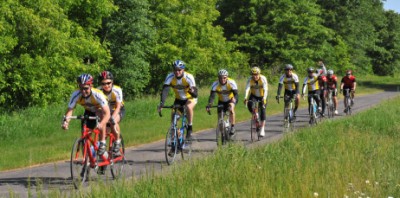
Pulling up front, for 150 miles, riding the bus
The question we both had was WHY? This was the exact same route, distance and trusty Trek Tandem. (We call it the Bus) Our training was about the same both years… so that wasn't it. This year was a little bit cooler and there was a minimum amount of wind… helpful, but we have ridden in the wind before without needing a nap the minute we got home. So what was it?
Then we figured it out. This year we managed our intensity while pulling our team for nearly the entire distance; 150 miles over two days. And while averaging ~20MPH for the total distance we found ourselves ready for more. That's right, we pulled the whole thing 🙂
Now if you are confused as to how we were able to ride for hours without a break and still felt fresh at the end, it's really simple. I used my HR monitor as a GPS, instead of a Speedometer. Let me explain…
In years past we had two very strong members on our team: Dana and Jim. They could ride very comfortably at ~ 24 MPH, seemingly forever. Now if you don't ride outside trust me when I tell you that riding a steady 24 MPH pace takes a very fit and strong cyclist. Our strategy for the ride was to use Dana and Jim's strength to pull most of the time and the rest of us would keep up, riding in a nicely disciplined pace-line behind them. Sounds like a good plan except for one thing: with a combined total weight of ~320lbs (Me, Amy and the Bus) riding in a pace-line becomes a bit of a challenge. After years of racing both bicycles and motorcycles, riding very close to others is easy for me. Yes, Amy trusts me. Our problem was in responding to all the small changes in speed that occur in a group. In any pace-line these changes in speed can create a sort of Slinky or accordion effect that has riders in the back constantly slowing and then accelerating to catch back up. What can be easy for a single rider becomes a series of intense intervals on a 320lb tandem. Because the Slinky gets more stretched out, the farther back you are, we found that we needed to sit in the number two or three position.
As the third strongest bike in the group, Amy and I took occasional turns up front. The expectation (maybe peer pressure is a better way to describe it) was to maintain a constant 24 MPH. With one eye on my computer and one on where we were going, our pulls lasted until we could no longer keep our target MPH. I didn't pay any attention to my HR monitor other than a quick look to confirm what I was already feeling; I was way over my T2 – anaerobic threshold. Despite what you may think, both riders tend to work equally hard on a Tandem. Equally hard in relation to their level of fitness that is. If I'm above Threshold, then Amy will be as well. With both pedals solidly connected there is no way for the Stoker in the back to coast.
The end result was a fast, but very exhausting MS 150 that left us completely spent at the end of both days. And did we EAT! We would skip every other rest stop and when we did stop I would be shoving PB&J's down as fast as the volunteers would hand them to me.
This year was very different.
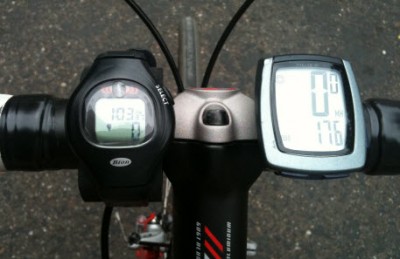
Guided by my Blink - Not my Speedometer
With no Dana or Jim this year we were a bit concerned about setting a respectfully fast pace that would have us showing off our sponsor's jersey, while passing hundreds of other cyclists. Amy and I decided to sit up front for a while and experiment with our speed on the flat sections. While monitoring my HR with my Blink HR monitor this is what we found:
- 17 MPH = ~140 BPM
- 19 MPH = ~ 146 BPM which is my T1 (Aerobic Threshold) or what I refer to as JRA (Just Riding Along)
- 21 MPH = ~ 154 BPM
- 23 MPH= ~ 162 BMP my T2 (Anaerobic Threshold)
So we settled into a very steady 21 MPH which we were able to maintain for hours at a time. If we encountered a change in grade or headwind I kept my HR right there in between both Thresholds, without concern for our actual speed.
