Endurance Coach and Author Grant Molyneux joins us to discuss his book Effortless Exercise
and its importance in actually enjoying exercise, while building aerobic fitness & endurance, vs. dreading the thought that it is time to thrash yourself on the bike yet again.
Wouldn't it be fantastic if you felt great every time you exercised — every step of the way? What if you could consistently experience the bliss of the runner’s high or the flow of a perfect swim stoke and benefit from all the positive health benefits of exercise without any of the downside of pain and injury. Imagine what your life would look like if it became effortless to maintain your ideal weight, play with your kids, climb a mountain or participate in a triathlon on any given day, at any given age.
If you answered a resounding “Yes!” then effortless exercise is for you. Whether you’re a beginner or wanting to win an Ironman triathlon, the principles in this book apply to anyone seeking a deeper experience of exercise. Come on a journey into the Zen state of exercise that will transform your training and help you to achieve more with less. The ideas in this book will help you to go within for a deeper, richer experience that creates sustainable fitness and peak athletic performances through meditative flow states. Fundamentally you’ll discover the pleasure of exercise and be drawn to move every day because it feels so good to exercise this way.
I'm curious to hear your responses to this. Grant makes a great point how the pendulum of “conventional thinking” tends to swing back and forth… Long and Slow works best – no, wait. HIT is what will make you fitter, faster & thinner.
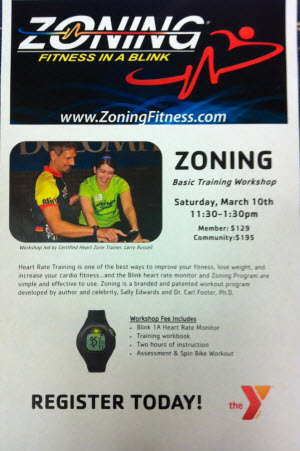
Here's the poster promoting Larry “Link” Russell's Zoning Fitness Workshops at his YMCA.
Would like like to make $500.00 for teaching a 2 hour workshop? While at the same time making a huge impact on the fitness of your students?
Larry “Link” Russell is doing just that by conducting Zoning Fitness Workshops at his YMCA.
Zoning Fitness provides everything you need to start profiting from conducting Zoning Fitness Workshops at your club or studio.
Here are some past interviews and articles where you can learn more about the Blink Heart Rate monitor and the 2T/3Z (Two Threshold / Three Zone Heart Rate training zones)
Math, for some of us, isn't our strong suit… especially when you are trying to compute specific training zones on the fly using Lactic/Anaerobic Thresholds (LT/AT) or Functional Threshold Power (FTP)
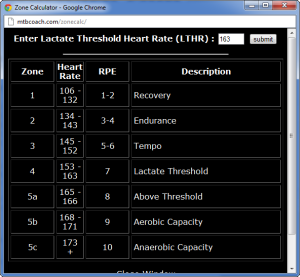
MTB coach Curt Wilhelm has created two easy to use, online tools you can find here.
And for you data junkies, Cycling Power Models has a very comprehensive tool that is sure to satisfy you for years.
A word of caution
The computer world has a saying; “garbage in = garbage out” which describes how using inaccurate (garbage) data to compute with can only lead to inaccurate (more garbage) results. The calculators above are designed for endurance athletes who have achieved a level of fitness and learned to tolerate the pain/discomfort of working at or above LT/AT or LT2 (upper Threshold) for extended periods of time.
In this three part series from last year; Is a 20 Minute Threshold Field Test realistic for your class? I discussed multiple reasons why I question using 20 minute field tests to determine Threshold Heart Rates for the “typical” student in your class. If you haven't read them I'd encourage you to do so now. My biggest issue with 20 minute field tests is that many of the Club Athletes in our classes haven't learned or developed the pain tolerance needed to sustain the Threshold level of intensity necessary to find an accurate average HR… but instead find some number below Threshold = “garbage in” 🙁
[wlm_firstname] if you feel you have a good understanding of your AT/LT/LT2 I'd like you to try one of the calculator above. Then consider what will happen if instead of entering a true Threshold HR, you use a HR 5%-8% below it.
Can you see how “garbage in” could have some students under training?
In case you are wondering, I see using HR training zones based on LT1 (Aerobic Threshold) as much more accurate for Club Athletes, especially when combined with the simplified Two Threshold – Three Zone system advocated by ACE – The American Council on Exercise.
Which heart rate monitor is best for you — digital or analog?
One Button Analog Blink Heart Rate Monitor
As a heart rate monitor, i.e. ZONING fitness enthusiast, you can now choose between two different types of heart rate monitors — digital or analog. But, what is the difference between a digital and an analog heart rate monitor? And which of the two is best for you? The answer lies in the transmission of the heart rate number, the bpm or beats-per-minute. And that transmission — that wave or that binary code — can make all of the differences to you.
First, both digital and analog heart rate monitor transmitter belts detect the same electrical activity of the heart’s contraction using sensors. The sensor in your transmitter belt can be viewed by looking at the back side of the belt which goes next to your skin. On each side of the elastic strap there is a soft and black rubber-like material that is usually oval in shape. There are always two the sensors — one on each side of the transmitter — that detect the electrical changes in the heart beat by using the amplitude of the EKG wave of the heart muscle.
Both digital and analog transmitter belts and watches are equally accurate. What is different is how they transmit the beats-per-minute of the heartbeat to the wrist top watch. And, that watch must either have a digital or an analog receiver that can accept that signal and convert it to a number that displays on our wrist or on your forearm or on your mobile device like an iPhone.
Analog transmission uses signals to the watch that are exact replicas of a sound wave. Analog signals can interfere with other nearby signals and this challenge is called the “cross talk” of two signals. The main advantages of analog heart rate monitors are the following:
Compatible with most, now about 99%, of the cardio machines at the gym,
Analog transmitters and receivers in the watch are less expensive
The signal is carried through water so swimmers and those doing water activities can use a heart rate monitor.
The disadvantage of analog heart rate monitors is that if you are within 3 feet of another analog wave transmitter which can be another person wearing a transmitter belt or another source of an analog signal you will experience “cross talk”. In this case, the receiver in the heart watch will accept both signal sources and add them together and you will get an incorrect number until there is only one signal for the receiver to sense.
Two Button Blink Digital Heart Rate Monitor
Digital transmission converts the heart’s EKG activity into a digital signal using binary code which is made up of 0s and 1s. Digital transmission is a clearer signal because it is impossible with packets of data rather than analog wave signals for interference. Digital heart rate monitors are more expensive yet have the following advantages:
The technology is newer
Digital signals do not interfere or “cross talk with other users or other signals.
Digital signals can be used with Bluetooth and ANT+ receivers in mobile devices like iPhones and others tools.
Digital heart rate monitors will not work for most swimmers because digital signals do not transmit from the transmitter to the watch under water. Here’s an example for you. If you are working out with another person who is using a heart rate monitor, the digital monitor is better because it will not receive both watches data and hence cross talk or allow interference.
What’s the best heart rate monitor for you — digital or analog? The answer is simple: it depends. It depends on price with analog less expensive, it depends if you are working out with others, digital is better because there is no cross talk, and if you are a triathlete or a swimmer — well — it depends because you cannot use it for swimming. My answer — just get a digital and get a less expensive analog and you have the best of both worlds.
I've added a new media player option that we'll use when embedding the full video player isn't necessary or whenever we feel that the normal player will take up too much space.
It's pretty cool and you can try out the new player by clicking this link to a zone based heart rate training video produced the people at Experience Life magazine. Life Time Instructors will recognize the monthly magazine Life Time provides to their members.
We may also use the player for music – playlists – made – up – of – multiple songs whenever the mood strikes us 🙂
Everyone agrees that indoor cycling classes using heart rate are more effective and even more fun to teach. This post is not about which HR training principles to use or the best way to determine training zones. You or the facility at which you teach can decide those things.
This is about how to get your students to wear HRMs in the first place.
I’ve used HR-based training in all my classes since 1998. 100% of my students wear HRMs in every class. Instructors ask me how I achieved that.
Use HR-based training yourself.
You can’t convey the benefits of HR training unless you fully appreciate them. Once you adopt a specific training regimen, note your results so you recognize how the body is changing internally. My first awareness was on the rowing ergometer. (There weren’t many indoor cycling computers in 1998.) I was amazed at how my HR/power correlation improved with the use of periodized training.
If you don't prove to yourself the efficacy of HR training, you won’t present it to others with conviction.
Don’t Worry About Understanding Everything at First.
HR training science can get technical. You can use it and appreciate its benefits without understanding the science fully.
For instance, Polar offers Ownzone, a way of determining HR training zones based on Heart Rate Variability (HRV). HRV is not the easiest thing to explain. It's fascinating but takes a fair amount of study to understand fully unless you have lots of technical training. Still, Ownzone is an effective way to determine a student's HR training zones without a max-effort test.
One of the most interesting things about HR-based training is that it keeps evolving. Yes, there are way too many interpretations of the same information, but it's interesting to read and learn.
Perfect Your Pitch.
Sometimes I hear instructors ask if anyone wants to borrow or use a loaner HRM to try in class. Not surprisingly, the response is minimal. Your pitch is important. This is mine.
I never announce it. I walk over to a new student, hold up a HR strap and say, “Have you seen one of these before? No? This is a heart rate monitor. I want you to wear it today. It’s going to change your life.”
No one has ever refused. There’s no question in my mind that using a HRM will change his/her life. If you have that level of conviction, people will try it. They’re not paying for the loaner and have nothing to lose.
Carry Loaners.
I can't tell you how many of my HRMs have disappeared over the years. What's odd is that just as many HRMs come into my life as I lose. I no longer consider them an expense. If you want to teach with HR, you have to carry loaners. Get them on students at the start of every class.
You won't have enough for everyone and don’t need to. That's part of the fun. Carry three or four, plenty to get the class going. The others will want them next time. Then they’ll buy their own.
Cue Both Ways.
This is the clincher. It comes down to your cueing ability. You must make everyone feel part of the class but still demonstrate the efficacy of using HRMs.
Selective cues will make everyone see that the students using HRMs are actually getting a better workout than those who aren’t. It's extra work, but powerful. Example:
“Great job on that climb. Now spin your legs to recover, but not all the way. If you're wearing a HRM, I want you to drop your HR no more than 20 beats. Those of you without a HRM will not be able to do this as effectively, but you can still do it. Regain control of your breathing, but don’t feel as if you're cooling down. No shift in body temperature. This is only one of the reasons I want you to wear HRMs. They enable you to control the amount of recovery you allow yourself.”
Keep It Simple.
I was just talking about this with Team ICG® Master Trainer Chuck Cali. At ICG® Academy in SF, where we showcase Myride®+, we have many first-time cycling students. As we switch all of our classes to HR-based training, we have to be careful not to give too much information too quickly.
I call this Qualitative HR training. I don't talk about zones, threshold or HRV to start. I ask the students to watch their HR with respect to how they feel and what they’re doing. At what HR do you first start to breathe more consciously? Where’s your HR when you start to sweat? When you can't talk? When your muscles burn? When you’re cross-eyed and drooling?
Don't get rid of RPE. Simply get everyone to have FUN training with HR. There will be plenty of time later for numbers and metrics. And another post….