
by John | Jun 17, 2014 | Instructor Tech Help, Latest News, Zone based Heart Rate Training
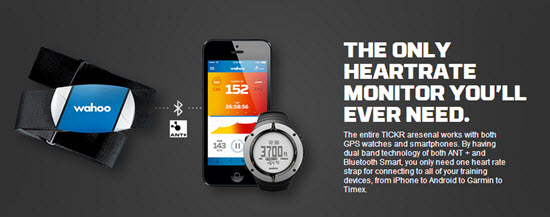
Finally a Heart Rate strap with both Bluetooth and Ant+ connectivity 🙂
I've been using a new TICKER Heart Rate Monitor straps – I'm excited to tell you about them + they'll be awesome used with the new Apple Smartwatch.
The guys at Wahoo Fitness emailed me today about their new line of HR straps that send out both BLE (Bluetooth Low Energy) and Ant+ frequencies. About time someone thought to offer both in the same monitor strap!
Up until now, your decision about what monitor strap to purchase was based on what device you wanted to connect with:
- I want to connect to my iPhone / smart phone = you buy a bluetooth strap. Bluetooth is the only signal your phone can pair with.
- I want to connect to a Garmin bike computer or use the strap with Performance IQ's display system = you purchase an ANT+ strap.
This new TICKR strap has both Bluetooth and ANT+ and it doesn't cost anymore than most single frequency straps – that's awesome in my book!
They've solved a second problem
How many times have you felt like saying; “IS THIS DAMN THING ON?
No Heart Rate strap, that I've ever seen, gives you any understanding that it's working. Is the battery good or dead? Do I need more spit to get it connected? I'm seeing that these new TICKR straps have two colored LED lights to show the TICKR’s device connection and heart rate detection – more awesomeness – and no more wasted trips to Walgreen's to buy one of those ridiculously expensive little flat batteries, when that isn't the problem.

I can't wait to try one and will update you once I have.
You can learn more here.
by Sally Edwards | Jul 17, 2012 | Heart Zones USA, Zone based Heart Rate Training
Which heart rate monitor is best for you — digital or analog?

One Button Analog Blink Heart Rate Monitor
As a heart rate monitor, i.e. ZONING fitness enthusiast, you can now choose between two different types of heart rate monitors — digital or analog. But, what is the difference between a digital and an analog heart rate monitor? And which of the two is best for you? The answer lies in the transmission of the heart rate number, the bpm or beats-per-minute. And that transmission — that wave or that binary code — can make all of the differences to you.
8/14 UPDATE: I have posted a new review about what I feel is the best indoor cycling heart rate monitor strap.
First, both digital and analog heart rate monitor transmitter belts detect the same electrical activity of the heart’s contraction using sensors. The sensor in your transmitter belt can be viewed by looking at the back side of the belt which goes next to your skin. On each side of the elastic strap there is a soft and black rubber-like material that is usually oval in shape. There are always two the sensors — one on each side of the transmitter — that detect the electrical changes in the heart beat by using the amplitude of the EKG wave of the heart muscle.
Both digital and analog transmitter belts and watches are equally accurate. What is different is how they transmit the beats-per-minute of the heartbeat to the wrist top watch. And, that watch must either have a digital or an analog receiver that can accept that signal and convert it to a number that displays on our wrist or on your forearm or on your mobile device like an iPhone.
Analog transmission uses signals to the watch that are exact replicas of a sound wave. Analog signals can interfere with other nearby signals and this challenge is called the “cross talk” of two signals. The main advantages of analog heart rate monitors are the following:
- Compatible with most, now about 99%, of the cardio machines at the gym,
- Analog transmitters and receivers in the watch are less expensive
- The signal is carried through water so swimmers and those doing water activities can use a heart rate monitor.
The disadvantage of analog heart rate monitors is that if you are within 3 feet of another analog wave transmitter which can be another person wearing a transmitter belt or another source of an analog signal you will experience “cross talk”. In this case, the receiver in the heart watch will accept both signal sources and add them together and you will get an incorrect number until there is only one signal for the receiver to sense.

Two Button Blink Digital Heart Rate Monitor
Digital transmission converts the heart’s EKG activity into a digital signal using binary code which is made up of 0s and 1s. Digital transmission is a clearer signal because it is impossible with packets of data rather than analog wave signals for interference. Digital heart rate monitors are more expensive yet have the following advantages:
- The technology is newer
- Digital signals do not interfere or “cross talk with other users or other signals.
- Digital signals can be used with Bluetooth and ANT+ receivers in mobile devices like iPhones and others tools.
Digital heart rate monitors will not work for most swimmers because digital signals do not transmit from the transmitter to the watch under water. Here’s an example for you. If you are working out with another person who is using a heart rate monitor, the digital monitor is better because it will not receive both watches data and hence cross talk or allow interference.
What’s the best heart rate monitor for you — digital or analog? The answer is simple: it depends. It depends on price with analog less expensive, it depends if you are working out with others, digital is better because there is no cross talk, and if you are a triathlete or a swimmer — well — it depends because you cannot use it for swimming. My answer — just get a digital and get a less expensive analog and you have the best of both worlds.
Sally Edwards, author
ZONING, Fitness in a Blink
The Heart Rate Monitor GUIDEBOOK
This was originally posted by Sally at http://zoningfitness.com/blog/heart-rate-training-for-weight-loss/which-heart-rate-monitor-is-best-for-you-digital-or-analog/
