by John | Aug 28, 2026 | Instructor Training
 –
It worked for Subway so now Taco Bell has launched their “Drive-Thru Diet” complete with a spokesperson who supposedly lost 54 pounds eating at Taco Bell. What began with Subway Jared will be continued by Drive-Thru Christine.
As you know, the Drive-Thru Diet® menu is not a weight-loss program. It’s about making different choices. For me, I didn’t want to cut out my fast food so I started choosing Fresco items from the Drive-Thru Diet® menu and making other sensible choices. I reduced my daily calorie and fat intake by 500 calories to 1250 calories a day, and, after two years, I ended up losing 54 pounds! These results aren’t typical, but for me they were fantastic!
I’m guessing that 100% of the participants in your class are there for some form of weight management. You may want to recommend to your class that if they really want to reduce their weight they should consider; packing their own lunch with healthful food, eating it as multiple small meals and then take a walk (or better an Indoor Cycling class) over lunch. Here’s the link for the free taco.
Originally posted 2010-01-11 09:20:20.
by John | Mar 30, 2011 | Indoor Cycling Bikes, Training With Power
More evidence of Indoor Cycling 2.0
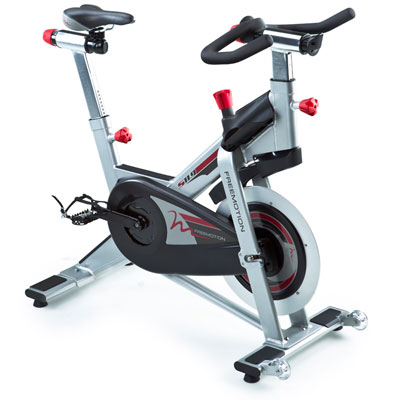
Gene Nacey tipped me off about this new Freemotion S11.0 Indoor Cycle
with power from a company called Foundation Fitness. What’s interesting about this Indoor Cycle is that it uses magnetic resistance (the best system in my opinion) and it’s wattage readings are based on measured power, through a strain gauge in the left crank. This may prove to be an improvement if it reduces or eliminates the need for frequent calibration. Why is this important? Because some question the accuracy and repeatability (consistency between one bike to the next) from a system based on calculated power; i.e. the Keiser M3 and the Schwinn AC performance.
Update: July 2011 – I am now teaching on the FreeMotion s11.9 and have a page dedicated to my review of this indoor cycle.
I did some research on them and they’re promoting this Freemotion S11.0 Indoor Cycle that includes a Power Sensor Console
I see that they are connected to a new Indoor Cycling Certification program called Stages Indoor Cycling. No info there yet, but they do have a place where you can signup for email notifications.
I’ll be digging in further and will report more soon. I find all of these new bikes with power to be simply fascinating. We all have a front row seat to watch Indoor Cycling 2.0 unfold and blossom right before our eyes 🙂
You can find more information about the FreeMotion s11.9 Indoor Cycle with power here.

by Dr. Haley | Jun 15, 2010 | Mental Toughness

You need to ask, Is it worth the risk?
With the increase popularity of indoor cycle classes comes new participants. These club members have been eyeing your class and have been asking other members about their experiences. As much as they would like to try out your cycle class, there are a few distracting, “what if” thoughts they can’t seem to eliminate: What if I can’t keep up with the rest of the class? What if I get injured? What if I don’t like indoor cycle? What if I’m uncomfortable on the bike? What if I can’t grasp the technique?
No matter what the “what if” thought, you can ask the individual this follow-up question: Is it worth the risk?
To achieve optimal health and fitness, it takes 100% focus and commitment to your performance. Your ‘soon-to-be’ participant’s desire to get results must outweigh his/her desire not to fail. In other words, during your indoor cycle class, his/her focus must be on exerting effort and not on predicting unfortunate outcomes.
To have an unwavering focus on effort and achievement, your participant has to be prepared to make the necessary sacrifices in order to progress. In an indoor cycle class, those sacrifices include: (1) spending 45-60 minutes learning that you do not enjoy this type of class, (2) spending 45-60 minutes out of your comfort zone to improve your health and fitness, and (3) feeling sore the next day. These ‘sacrifices’ have to be worth the risk in order to achieve his/her fitness goals.
Call to Action
As soon as a participant has a “what if” thought, ask him/her if it’s worth the risk? You may think this approach is a bit harsh. It’s also very effective. First, you are prompting the individual to think differently about his/her fears. Second, as the conversation continues, you will help that individual to understand that his/her “what if” thoughts are not justified. As a result, you will help him/her counter the thought with a more effective focus: putting forth effort and experiencing something new and exciting!
Believe and Achieve,
Haley Perlus, Ph.D.
Visit http://DrHaleyPerlus.com and register to receive Dr. Haley’s FREE Mental Toughness Articles for sport and fitness.
Visit http://TheUltimateAchievementJournal to learn how Dr. Haley makes it easier to achieve your fitness goals.

by Ben Greenfield | May 7, 2010 | Ben Greenfield
 It doesn’t matter how much you exercise, how well you eat, or how strictly you control your caloric intake — your body is constantly stressed or your sleep is inadequate, you will constantly fail in pursuing your health, wellness, or performance goals. But if these barriers are removed, you will vastly improve your ability to gain maximum benefits from a good nutrition plan.
As you explain the importance of stress and sleep to your class, here is what to tell them:
The body has several neurotransmitters that are actively involved in control of appetite and mental motivation. Dopamine, one neurotransmitter, is your body’s pleasure molecule, acting to significantly affect desire for activity, eating satisfaction and food cravings. Inadequate dopamine increases the chances that you will have a decreased drive to exercise and be less effective at regulating your nutritional intake.
(more…)

by Ben Greenfield | Apr 8, 2010 | Ben Greenfield
 So if your indoor cycling students eat your fruits and vegetables, expose yourself to adequate sunlight, get plenty of sleep, and stay well hydrated, their body shouldn’t really need a supplemental source of vitamins and minerals, right? Wrong.
Here are 5 powerful reasons that you explain to your students about why they need to take a multi-vitamin, no matter how healthy their lifestyle may be.
- Nutrient depletion in the soil. Modern farming techniques utilize fertilizers that actually deplete the soil of essential nutrients. Agriculture relies on the elements in the soil for absorption of proper amounts of minerals, and when this process is interrupted, the plant does not contain essential minerals and cannot form essential vitamins. And if the plant doesn’t have it then you’re not going to get it from eating the plant!
- Your ability to absorb nutrients from food actually decreases as you age. So while growing children should absolutely be taking a multivitamin to support healthy tissue and bone formation, supplementation becomes equally important for the older population. Sure, you could just eat more food, but this introduces a problem with caloric balance. Beware that many medications also interfere with proper nutrient absorption.
(more…)