I had the privilege of visiting the Stages Cycling HQ and factory in Boulder Colorado with my buddy Randy Erwin. Director of Indoor Cycling education Cameron Chinatti, along with Stages vice president Pat Warner, were our tour guides. We spent a fascinating couple of hours learning exactly what goes into building the Stages single side crank arm power meter used on the new Stages SC3 Indoor Cycle and available for most road/mountain bicycles.
You know these people are cyclists the moment you walk into the place. Everywhere you look there are bicycles; tucked into every corner, hanging from the ceiling, along every wall – heck, their conference room has probably the coolest table I've ever seen. Instead of legs, the table top is supported by a pair of 70's vintage Schwinn Sting-Ray bicycles.
Cameron explained the hiring process, “you pretty much have to be a passionate cyclist to even be considered… many of these guys have been riding buddies for years.” And I'll add that these “cyclists” are also some of the most brilliant people I've ever met 🙂
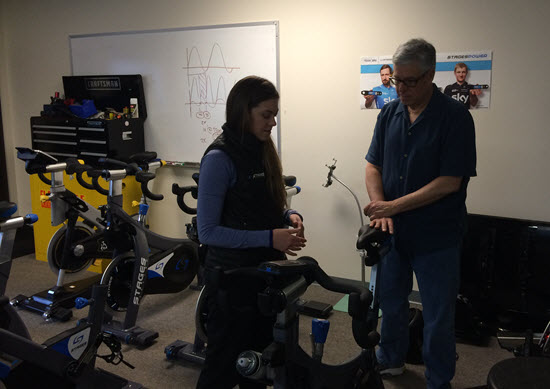
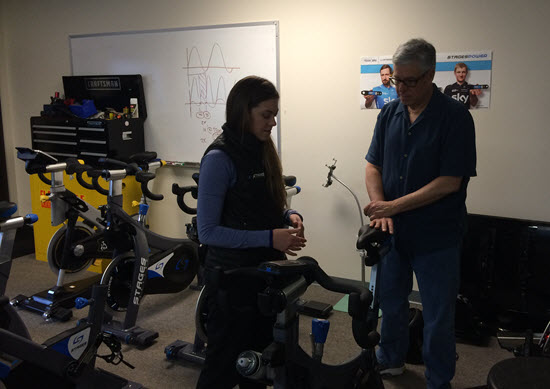
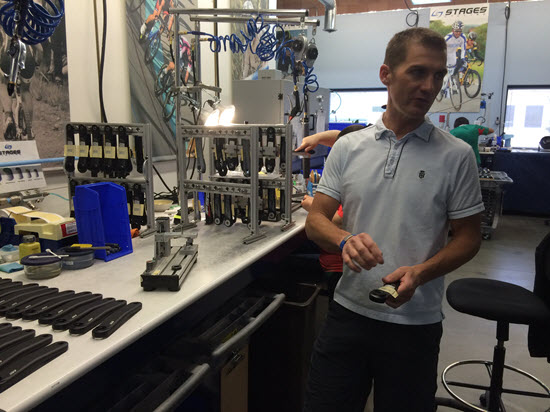
Cameron explaining all the cool features of the Stages SC3 to cyclist Randy Erwin
Cameron met Randy and me and our tour started in their official “training room” except it won't be for long. Stages is growing so fast that half of this room has been taken over by manufacturing stations. My friend Randy was very interested in the new SC3 because the Westminster, CO Life Time Fitness (where he's a member) will be the very first location to get these new cycles. Now if we could get Dennis Mellon in there as an instructor…
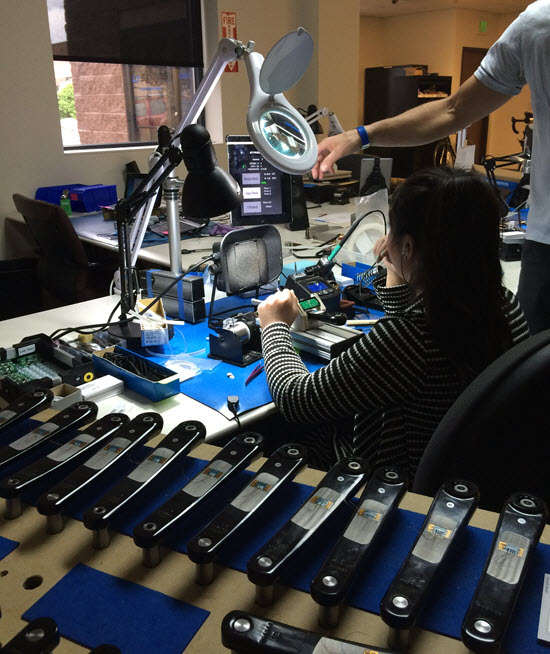
New power meters being installed and tested – this is super technical stuff.
Early in the our factory tour, I asked Pat; “why aren't your power meters built in Asia, like most other technology companies?” His responses made perfect sense to me; “there are multiple reasons actually.” “Stages has become the leading provider of bicycle power meters, after only a few years. We can't afford any preventable issues when it comes to quality or availability. It's critically important that we control the quality of these power meters… we can't if we're dependent on a third party supplier's factory, regardless of where it's located.”
Pat explained how keeping everything in-house provided a solution to a unique challenge they faced. “We manufacture power meters for 16 different model bicycle crank arms, from major suppliers (Shimano, SRAM, Cannondale and FSA) plus the power meter for the SC3 Indoor Cycle. Bicycle cranks aren't made just one size. Multiply each model bicycle crank by the four or more available crank arm lengths and we have to stock over 60 part numbers. Sure, 172.5 is the most common size for a road bike, but how many of each should we be building? The lead time for overseas manufacturers is measured in months – customer's won't accept waiting that long. We have thousands of stock crank arms on hand and we're setup to quickly change production. So if we receive an order for an out of stock power meter, we can normally build one and ship it within a few days!”
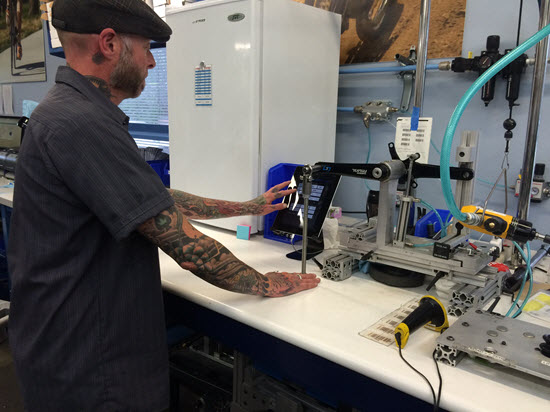
Pat Warner explaining the complicated process that attaches the power meter to the crank arm.
Every power meter is checked for proper calibration and the results captured using a iPad with custom software that's developed in-house too!
The Stages SC3 is build by Giant Bicycles in Taiwan – Pat told me,”those Giant guys are experts at mass producing high quality bicycles and fitness equipment, so we leave that part to the experts. We still produce the SC3's power meter here in Boulder and then ship them out for installation on the cycle.”
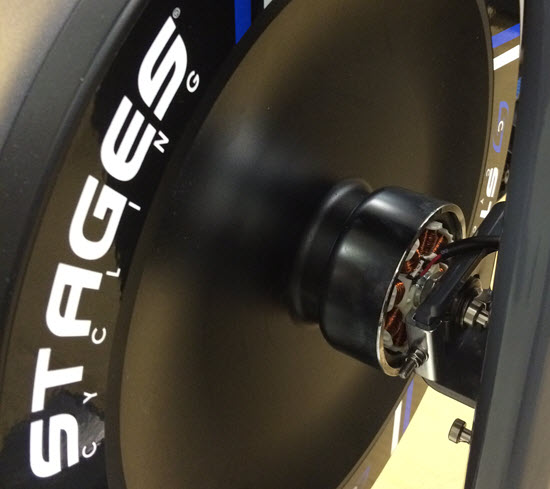
Stages has a separate facility, near their main offices, that's use for product endurance and destructive testing. We just missed the completion of a test rig that repeatably pressed down on a handle bar, tens of thousands of times without any failure.
Want to know how long the drive train will last pedaling at a continuous 360 watts? This video shows the test rig that pedals 24/7 for weeks at a time. Not only are they watching to see if something will break, or wear out, but they also record the actual power readings vs what they know their electric motor is pushing.
Quality control – Early production Stages SC3 cycles are unboxed and checked for any defects.
Feel free to leave the lights on! There's the battery charger for the Stages SC3 power meter.
When I'm asked to review a product or service that includes new technology, I'm always a bit hesitant. You see I like simple and I tend to see many new products trying to solve a problem that really doesn't need to be solved or will add another (needless) layer of complexity/frustration/distraction to the lives of Instructors and/or their students.
Power indication in our classes is a perfect example. Seeing our watts is a huge step for many of us and equally so for our students. We see the value of all this information (metrics) about the amount of work we're doing in class. Many of us are excited to use that data as the basis for improving our fitness.
But what do we do with all this new information?
Collecting your data is a good place to begin. Both the FreeMotion and Schwinn Power Meter consoles offer the option to plug in a USB flash drive. After your training session you can download the ride to your computer to see what you've done. Which is interesting, about two times. Then you realize that looking at a snapshot of a single day isn't really telling you anything of value. If you're an Excel expert you can build a fancy spreadsheet to show graphs where you can see trends. Or you can subscribe to an online service like Training Peaks ($20 a month if you want the graphing features), upload your results and track your fitness. I see online services as an excellent choice for a committed athlete, but a bit over-the-top for the Club Athletes that make up the majority of our classes.
When Cameron Chinatti from Stages Indoor Cycling explained their new iPhone App, which is designed for use with the FreeMotion console, I saw it as a potentially useful tool that could benefit both you and your students.
So I agreed to give it a try to see if it was in fact useful and not needlessly complex or distracting.
I have a “Is it intuitive and easy to use?” test, which is simply; “do you turn it on and it works… Yes or No?
The App passed – and as long as I followed the proper procedure, every time I turned it on it worked.
The console is designed to “Pair” fancy word for connecting to both a Heart Rate strap and/or your iPhone during “Warm Up” mode. Once you advance to Stage 1 Pairing is no longer available. With the Stages App turned on, pedaling the bike and the console in Warm Up you will see:
Pressing the Stage button brings you to the main screen.
My second test is; “what value does this product provide, beyond some fancy graphics?”
Something we all need to know.
The Stages App will calculate your FTP (Functional Threshold Power) and your Heart Rate at FTP over a series of rides. Understanding your FTP is as important as knowing your Threshold Heart Rate. With both these metabolic markers you can create specific training zones. Once your student's know their Power Zones your class will be a whole lot easier to teach for you and more understandable (and beneficial) for them 🙂
Here's the setup screen where you can select to App to calculate your FTP or you can manually add it if known.
Auto-Calculate FTP is HUGE
I talked to Cameron about the auto-calculate feature because after three rides it was showing my FTP as 186 Watts vs. ~240 watts which I'm normally seeing during a long hard effort. Her response was; “how hard did you ride during those classes?” I admitted that I hadn't worked as hard as I could have. Cameron explained that App is looking for your best 20 minute average wattage and if I don't provide a hard/long effort the App doesn't have the necessary data to work from. It didn't have any trouble calculating my FTHR 🙂
There's much more to this App and I am planning a Podcast with Cameron to explore all it's functionality in more detail. For more now please check out this Quick Start video and if you are teaching or training on a FreeMotion S11 series Indoor Cycle I highly recommend that you start using this App – ASAP. Order your Freemotion S11.0 Indoor Cycle – with Power Sensor Console
Group indoor cycling began 25 years ago. With great class delivery by instructors, indoor cycling can provide low impact, high energy, thrilling and inspiring workouts. It’s globally one of the most popular indoor classes and in the last few years dedicated indoor cycling studios have raised the bar in terms of class quality and experience. All good there then … no need for change eh? Not so! One fundamental omission from group cycling has finally been properly addressed: the intelligent measurement and use of data. Consumers have shown that data is here to stay with the exponential increase in use of fitness apps, trackers and wearable technology. Data has finally reached the world of indoor cycling! Boutique studios followed closely by some of the large operators are leading the way utilizing big screen displays and cloud-based performance tracking tools to provide an accurate fitness picture to members. It’s not guessing, estimation, and assumptions any longer. Studio owners are able to provide real value to their members through showing them real, measureable results.
Reliable data can be extremely motivational, demonstrate historic improvement, and provide clear and achievable goals. This also equips the studio and the instructor with incredibly important information as to which members are achieving their goals and which members may benefit from some additional instruction, guidance, or motivation. Applications such as VismoX, Performance IQ and MyZone are smart tools that help the instructor and participants with structured predefined classes, simple and clear analytics and goal setting. This is a brave new world for indoor cycling but one that can be rolled out to supplement existing programs with minimal challenges.
With indoor cycling moving into the data world this is also an opportunity to appeal to an entirely new audience … the outdoor cyclist. Outdoor cyclists at the elite level have been training using power meter measurement for nearly 15 years. The benefits are clear, measurable and attainable as a cyclist trains within power ‘zones’ that are set based on his or her personal ability and goals. When this system of measurement is translated to an indoor class, the results are remarkable. Now a class of 30 participants can all train at the correct intensity which is personalized to each rider’s body. For too long indoor cycling classes have been high RPM and lots of sweat, with no tangible gains or goals to strive for. On the simplest level it’s now possible to accurately calculate calorie burn and improve endurance, sprinting or whatever you or your coach/instructor set as your target. The data can be used as an integral motivator real time in a class or it can be tracked in the background depending on the type of class being offered.
The world of data is going to take the world of indoor cycling firmly into the 21st century, attracting a whole new audience, providing more variety in programming, new instructor aids, and personalized goal setting and tracking. For more information on how adding power measurement could help your business, visit www.stagesindoorcycling.com
Whether you’re riding indoors or outdoors, cumulative cycling efforts are often measured in kJs (kilojoules). For example, at the end of a Stages Indoor Cycling workout you’ll see total kJs on the Stages Power Console on the RESULTS screen. After a ride outdoors on your bike, you may also see total kJ’s on your cycling head unit. So, what is a kJ and why should you care? We’re glad you asked!
Let’s start at the beginning. We’ll explain this KJ thing in terms of a workout on the SC3 Stages Indoor Bike and Stages Power Console. Basic mathematics comin’ atcha, consider yourselves warned.
What is a Watt?
A watt is a standard international unit of power. More often than not it is represented in horsepower. In fact, 1 horsepower = 746 watts. Try to generate 700+ watts. It’s a fun experiment and rather quickly you will realize that yes it’s true, a horse is more powerful than you.
The Stages Power Meter and Console will measure and display the user’s power output in watts. To get this wattage we need movement (RPMs) and force. On the Stages bike, force is measured when the rider steps down on the pedal. As you turn the resistance dial to the right you have to work harder to step down on the pedals, thus more force is generated.
This product of movement and force = WATTS. With us so far?
Now what if you could take all those little watts and add them up over the total time of your ride to see how much energy was expended? You can do just that, if you convert to kilojoules.
1 watt = 1 joule applied for 1 second
1000 of those joules = 1 kilojoule (KJ)
In other words…
kilojoules = watts X seconds / 1000
Now let’s look at kjs to kcals:
The last conversion in our chain of interrelated metrics is converting kilojoules (work over time) to kilocalories (food energy required to do the aforementioned work).
At Stages Cycling we choose NOT to think of calories as the enemy and in fact we’re growing a bit weary of superfluous calorie conversations. Instead we have chosen to give you the straight facts and the straight science.
So first, let’s answer a question that we get asked all the time:
“Why do you call it “kcal”? Can’t it just say “Calories?”” Funny you should ask, there’s a Trivial Pursuit-worthy answer for that!
A calorie- sometimes called a “gram calorie” or “small calorie” (note the lower-case “c”)- is a unit of energy. In fact, it is the amount of energy it takes to raise the temperature of 1 gram of water by 1 degree Celsius. But it turns out that, metabolically speaking, the calorie unit isn’t very practical due to its small value. In nutritional contexts kilocalories- also known as “large calories” or Calories (the upper-case “C” is important)- are preferred. As you might guess, 1 kilocalorie is equal to 1000 calories, or 1 Calorie. Interestingly, the large Calorie is not officially recognized as an international standard unit of measurement. However, in spite of its non-official status, the large Calorie is still widely used as a unit of food energy in the US, UK and some other Western countries. If you travel abroad or purchase any packaged imported food you may notice that within the European Union, both the kilocalorie (kcal) and kilojoule (kJ), another unit used to describe energy, appear side-by-side on nutrition labels.
“Wait, what? How am I supposed to wrap my head around that? Besides I thought kilojoules were watts added up over time?!”
Keep in mind that energy is energy, regardless of its units. We’re simply going to take the work that you put into the bike and convert it into its equivalent energy in Calories (kcal) rather than kJ. A benefit to using the Stages Power Meter with the Stages console is that all these energy and power measurements become readily available! And now, the last step in the chain, the secret sauce, and the moment you’ve all been waiting for: converting kJ to kcal!
Here are some fun figures:
4.186 kJ = 1 kcal = 1 Calorie
Standard assumption of human mechanical efficiency = 22%
I know what you’re thinking, “Where does that 22% come from?”
As it turns out, the human body is amazing, but it’s not very mechanically efficient. The efficiency of human muscle has been measured (in the context of rowing and cycling) at a whopping 18-26%. This means that only 18%-26% of the energy available to the muscles is actually translated into doing work- the rest is lost as waste. For our calculations we simply chose the median point, which is regarded in the fitness equipment industry as the standard assumption of mechanical efficiency, also known as the best approximate value.
The Stages console uses the following formula to convert the kJ value to the kcal value:
kJ / 4.186 / .22
First, the kilojoules value is converted to the kilocalories equivalent (4.186 kilojoules = 1 kilocalorie). Then, this value is divided by the standard assumption of human mechanical efficiency (22 percent). The result is the approximate amount of food energy used.
Your homework assignment- should you choose to accept it- is to do a ride on the fabulous Stages bike with Power Console and take two pictures at the conclusion of your ride. One picture with the kJ info showing at the top and another with the kcal info at the top. When you have a spare moment try out the equation above and you’ll be amazed, it’s Math-magical!
You can learn more about Power, the Stages Power Meter and the Stages Indoor Cycling bike at the Stages Cycling website.