Over the past week, I've observed or participated in 11 Indoor Cycling classes, lead by Master Trainers and everyday Instructors. In the very first class I attended, by a popular MI, I found myself critiquing the quality of her amplified voice. It was terrible. I could hardly understand what she was saying and it really diminished what she was presenting. I'm sure that if she was aware of how poorly she sounded, she would have taken steps to correct the problem.
I'm super anal about the sound quality of my guests on the Podcast. I request demand that we use Skype when recording remotely. It's typically crystal clear and has the guest sounding like they're in the same room with me. I'll only accept using a phone line on very rare occasions.
So with all that in mind I made a point of critiquing every class I attended, listening for the following:
Can I clearly understand what's being said?
Was there a clear difference in volume between their speaking voice and the music?
I'm not going to call out anyone in specific, but in a number of the workshops and classes I had a difficult time understanding the cues given. None of the classes lead by men had the issue – only the women… and only those with naturally high voices. Now I realize that many of these classes were at a conference, with temporary sound systems, but that didn't appear to contribute to the difficulty understanding the presenters. I sat in on two team taught rides, where multiple presenters spoke (male and female) and it was only the female presenters who I had trouble understanding. I wanted to be sure it wasn't just me, so each time I had trouble hearing I asked other's in the class. In each instance they confirmed the issue.
The importance of hearing it for yourself.
I've encouraged you to record your class, so you can hear firsthand what your class hears. We devoted an entire podcast to the subject that featured communication expert Alexa Fischer.
You maybe surprised by what you hear.
I recorded this short sample a few months ago for another Instructor. She cringed when she heard it and instantly understood that she needed to make some major changes, if she wanted her class to understand what she was cuing. As it was, you barely understand anything she said 🙁
So, what are potential solutions?
#1 Get off your bike. When was the last time you walked to the middle of the room while you're teaching? If you've been reluctant to do this, here's another reason to hop off and work the room; you'll hear your amplified voice as your class hears it. If you don't like what you hear, then make some changes and run back out to see if it's improved.
NOTE: I don't feel you can depend on your class to give you accurate feedback. If you ask “how do I sound?” they don't have anything to compare to and will typically say “great” so they don't hurt your feelings. Better to hear for yourself.
#2Deliver from your lower register. Women (and men) with high-pitched voices need to learn to deliver their voice from their diaphragm. The feeling should be that you're breathing out while speaking, not like holding your breath.
#3 S l o w d o w n y o u r s p e e c h… Slow down and breath = your words will come across much better. If you ever feel short of breath while teaching, your vocal quality is probably suffering. The easiest fix for this is just stop talking until or limit your cues to short sentences.
#4 Consider purchasing a different microphone. I don't have specific knowledge about what mics work best with what voice type, but I do know that every mic is different and you may improve your delivery with a different mic. Would this make for an interesting Podcast?
Principles to being a successful Group Fitness Professional
You have your Mic on, your equipment is all set, you have new killer choreography, and your class is packed! You head over to hit play and start class… What’s going through your head? For me personally when I head over to my IPOD to hit play, I take a deep breath, clear my mind and focus in on what, Don Miguel Ruiz calls, THE FOUR AGREEMENTS: Be Impeccable With Your Word/Don’t Take Anything Personally/Don’t Make Assumptions/Always Do Your Best. When I do this, I know that the class that I am about to teach can change lives and inspire people to be better than when they walked in to class.
Be Impeccable With Your Word, say what you mean and mean what you say. This is so important when you are in front of your class because your participants are hanging on your every word and every word needs to mean something. Try to avoid filler words and repetitive motivational cues, like some of my favorites, GOOD, LOOKS GOOD, and KEEP GOING. Although some of those may seem like okay phrases to use, they really don’t provide and significant feedback that will help participants during class. Instead try being stronger with your phrases; Keep Going For 20 More Seconds, Your Form Looks Good, and Excellent Job With That Drill. These cues are letting your participants know exactly what to do and how they are doing at it. When your cueing is STRONGER and more EFFICIENT your classes are easier to follow and this will help grow your numbers!
Don’t Take Anything Personally. When your participants come in and want to criticize or don’t show excitement during your class, 99% of the time is has nothing to do with you. This is a hard thing for many instructors, including me, to understand but once you do, it will be that much easier for you to relax and enjoy your classes.
Don’t Make Assumptions, because not everyone in your class is going to tell you everything or always ask for help. When someone walks into your class, you are responsible to make sure that they get everything they need and are clear on the format and goals of the class they are about to take. Even if you have regulars in your classes it’s still very important that you not assume they know everything and make sure they understand and are clear on the set-up and goals for the class ahead. Great each person as if it’s their first time and if you know them or remember them, make the greeting more personal by using names or asking them if they are seeing progress on their goals. This small touch will keep people coming back time and time again!
Always Do Your Best, because people are counting on you to help them achieve great things! No matter what may have gone on in your day, you need to leave it at the door and do your best to help those who have come to achieve great things in your class. Make sure you come into class prepared and ready to motivate and inspire people to be better and the only way to achieve this is if we are doing our best! Best ways to be prepared is to plan out your classes well in advance, learn choreography fully before teaching it, rehearse your script of what you’re going to say and when, dress the part, show up early to check equipment and be available for participants, and the most important part, have fun!
Following these Four-Agreements as a Group Fitness Professional will ensure that you are always on top of your game and helping change lives every time you press the play button.
My guest in this PRO Podcast episode wants to help you develop a 1,000 Watt Presence & express yourself brilliantly. It starts with“taking a personal inventory” of yourself interacting with and teaching your class.
Listen as communication expert Alexa Fischer explains why recording yourself interacting and teaching your class is the first step to making small improvements to how effectively you present to and communicate with your participants.
About Alexa Fischer
There’s nothing like a 1,000 Watt Presence to ignite and inspire everyone you meet. In case you have lost touch with your own star qualities, Alexa Fischer knows how to bring out your inner light. She has transformed normal civilians into confident, dynamic speakers. The results? Less Fear. More FUN. And maybe some fame if you’re a really dedicated student! Alexa is a graduate of Northwestern University, B.S. in Speech, and The Yale School of Drama, M.F.A. in Acting. She has appeared on countless episodes of hit television shows and national commercials. Beyond the television, her audiences include entrepreneurs, non-profits, corporations and teens.
Listen to my interview with Alexa below or you'll find it in the ICI/PRO members only iTunes feed.
Here is a past Podcast that explains an easy way you can record your own class, using your iPhone or Android phone.
Click the image for more information on Alexa's course
What message do you send from the bike, while conducting your class?
If that's that's of interest to you, here are two short videos to help you.
First is communication expert Alexa Fischer. She sets up her video on body language this way…
I was at a networking event recently (actually enjoying it, as I am wont to do), shaking hands, making small talk, when I saw her — arms crossed, head down, avoiding eye contact while she alternated between sipping her drink and scrolling through her phone.
And this made me think two things:
1. My friend, we’ve all been there. Who among us hasn’t felt nervous at an event filled with new people?
2. I want so much to come over and say hello! And ask you where you got that great haircut! But your body language is telling me you’d rather … not.
In today’s video, we talk about how body language affects how others view us, how our own body language affects how we feel, and how we can read someone’s body language and use that information to choose our words.
If you missed hearing our past interview with Alexa you can find it here.
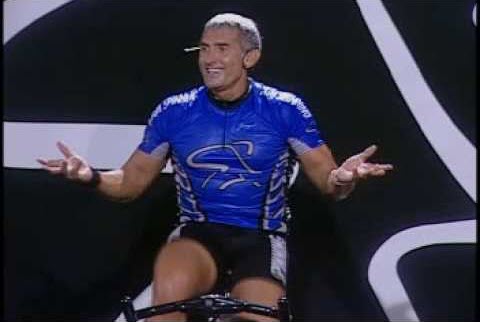
To build on the concept of projecting confidence, take a few minutes to watch Johnny G and see how he presents that “outward energy” on the bike.
Watching Johnny has me considering how often I sit up and project openness – rarely now that I think about it.
Do you spend the majority of your class down? Or are you sitting up frequently to reinforce an important point or simply to extend that outward energy to your class?
Remember from Part 1 that teaching indoor cycling is a form of public speaking, which itself is an art. Employing some public speaking skills will impact your class dramatically. Great public speakers know that much of their impact comes from body language, including stance, gestures and facial expressions.
Stance
When you teach, a strong, disciplined position on the bike is essential for building credibility, expressing your emotions, and connecting with your students. Nothing discredits an instructor more than moving poorly — rounded back; hunched or protracted shoulders; no fluidity when changing positions; sitting up constantly, often unconsciously, to recover. You’ve lost the class before you’ve started.
Being strong on the bike is not just about your monster CV system. Your ride position, like a public speaker’s stance, must be solid to project confidence in front of a class. Students respond to instructors whose bodies are alive and disciplined. If someone filmed you while teaching, you might be amazed at how your posture sometimes portrays the opposite of what you tell your class to do.
Gestures
Use your hands to gesture every so often. On a bike, your hands belong on the handlebars, but you can keep one hand connected and use the other to emphasize a point or express emotion.
Sit up occasionally and use both hands as a public speaker would. When sitting up, I tell my students to keep their hands on the handlebars unless they need a back break.
Get off your bike at times, not only to work with individual students, but also to stand closer to the class and gesture with your entire body.
Facial Expression
Eye focus is the most important element of facial expressions, particularly to communicate sincerity. Don’t just look around the room as you speak to maintain general eye contact. Nothing connects you to your students better than focusing on one student long enough to deliver an entire phrase without looking at anyone else.
Pause when you finish and let it sink in for a moment.
This connection between you and one student can rivet the entire class. What did he say? Why didn’t she say that to me? The technique contributes significantly to comprehension and retention by giving the listener, and anyone else who tuned in, time to process the message.
Most instructors lose their facial expressions while teaching and “solidify” into a single look. Relax your face right from the start, and always greet your class with a smile. You won't smile throughout the class, but smile at least at the appropriate moments, like when you crack a joke that was actually funny. Somber and serious can be effective too, depending on training intensity.
It isn't natural to sit on a bike in front of a group. It's unusual and odd, so don’t try to be natural. Be larger and more powerful. It takes effort, skill and practice. Work on your body language to make the most of every class you teach.
Media Support
Steve Jobs was the maestro of using media with his public presentations. In 2005, he called Madonna on iChat after she signed an exclusive deal with iTunes and displayed the call on a big screen — a great use of media to enhance a presentation. Check the link: http://everystevejobsvideo.com/tag/madonna/
As instructors we can use voice, music and video to deepen our class presentation experience.
Voice
Our tone of voice shows our students whether or not we care. It tells them whether we’re in fun mode or feeling excitement, passion and enthusiasm about teaching. If the members think our class is boring, it may have nothing to do with the workout or music selection, but with a monotone that sounds dull.
Here are some suggestions for making classes more impactful through tone of voice:
Pause before emphasizing an important word or concept.
Speed up your speaking to show excitement.
Tell a story. This will translate to your vocal quality.
Define a moment in your class that might be considered a pinnacle: “Everything we’ve done to this point has prepared us for the next 2 minutes!”
Music
In public speaking, music is often used as background when participants enter a room to set the mood for a meeting or event. How much attention do you give to the music you play as your class enters? The proper music gets people in the right mood to work and adds a touch of drama to your class.
What do you play as the class is leaving? Music can reaffirm a pleasant atmosphere as your students exit.
Avoid turning music on or off suddenly. It should always fade in or out slowly.
This post is not about how to use music when you teach, but to expand on your use of music to set the right mood for the class before it begins and when it’s over. That’s what great public speakers do.
Video
Effective use of video to enhance our classes is a prime directive at ICG®. Forward-motion video can make your class more absorbing and exciting. Beautifully filmed, high-energy video that showcases destinations from around the world entertains and engages.
Remember, however, that video should never dominate your class. That important job is always left to you, the instructor. Video is just another asset that supports your class profile.
At its best, public speaking is flawless talk in a compelling sequence that persuades through command of the language. It’s well structured, well delivered, informative, educational and entertaining. Striving to be better public speakers can make us better indoor cycling instructors.
John's note: We're highlighting some of Jim Karana's past articles this week.