JANUARY 10, 2017 I received the following text message from a customer… Your new employee Boomer Rose. He has a history of drug use. On supervised probation. Everyone deserves a second chance. We all make mistakes but just want you to be aware.
MEET BOOMER
Boomer works at TheBarn.
************************************
I used to be 300 pounds. I used to be an alcoholic. I used to be addicted to heroin. I used to be homeless. I have spent time in jails and rehabs. I have spent half my life unable to look in the mirror hating the person I was. Those days have passed, however, they remain fresh in my mind. Now I am a grateful recovering addict. A proud member of a 12-Step Fellowship. A proud member of TheBarn.
I’ve spent a good portion of my morning reading articles debating what Indoor Cycling should and shouldn’t be. In one of the articles, Karen Casler of CB CycleBarn® discusses her childhood, constantly searching for a place to fit in and trying to find acceptance. As an adult, she yearned for a place where others like her could find a safe environment and where they could be themselves. A place that no matter what or who they were … they BELONGED. It is under that principle, that CB CycleBarn® … aka … TheBarn was born. I too have spent most of my life trying to find somewhere that I felt accepted. The moment that I walked into TheBarn I found that place. A place that is more than just an Indoor Cycling and Fitness studio. A place that I take pride in being a member of. I walk in everyday proud to be apart of the primary purpose: Bettering ourselves “one pedal stroke at a time”.
NOW … LET’S BACKTRACK
I had never met Karen Casler before February of 2016.
I had known that we have a sister for most of my life and that she had been given up for adoption at birth. I almost came to tears on the Jail phone in a pod full of 50 strangers when I heard the news that our sister had used DNA to piece together her past and to find us. 3 Days later, on February 5th, I was released from Jail. It was my first stint in Jail and it was Her birthday. When the offer was made for me to move from Virginia to California in November of 2017 I didn’t even have to think it over. I instantly agreed.
Looking back, the decision was somewhat crazy considering Karen and I had just recently met each other and collectively spent less than 24 hours around each other our ENTIRE LIVES. The opportunity to get to know my sister and her family was one that I simply could not pass up. I packed my whole life in a suitcase (36 pounds in total) and left my 4-year-old son and everything I have ever known behind. I awoke on January 8th and looked out on the Pacific Ocean for the first time in the daylight I felt as though I was dreaming. “I don’t deserve to be here” I thought to myself.
That morning Karen and I loaded into the car and headed off for my first trip to TheBarn. In the car on the way there we talked and she mentioned “I bet you would be a great cycling instructor.” I agreed with her. Coming from a theater and athletic background, it might be a possibility but I didn’t take it seriously. At TheBarn, I took my first cycling class. I clipped in and within the first 5 minutes I realized this was It. This was the CHEESE I had been looking for. A dark room, filled with loud music, full of people silently moving together. Working together. For the same common purpose. To better ourselves. That first class I was able to check out of my life and all my wrong doings for 45 minutes and everything that was weighing on me disappeared. It was just me and the bike. Nothing else mattered.
FAST FORWARD … 7 WEEKS
Today is February 26th.
I have been in California almost 2 months.
Four weeks ago, I celebrated my 1st year in recovery. Today, I am 399 days clean. I work at TheBarn. It is a place that is more than a job to me. I spend my time working, going to meetings, being active in my new church and getting to know Karen and my new family. The experience has been the greatest blessing I have ever received. Being apart of TheBarn Family brings me a feeling of pride I have never felt. After much thinking the past few weeks I have decided to embark on the journey of becoming a cycling instructor. The thought I brushed aside has now become a reality. I’m driven to help others who are like me, to find a healthy outlet for their addictive personalities in their recovery. My goal: to offer fun, safe and donation based rides to those suffering from the same disease as me. To give others a healthy way to release the same emotions and endorphins that we found with drugs and alcohol. The ability to safely work on our Mind, Bodies and Spirits. I have found in recovery it is important to focus on all three. The first thing you should do when you get clean, is change everything. I am excited for this adventure, humbled at the opportunity and grateful to be apart of TheBarn family. So here I am, outing myself to the masses as an addict. Hoping that those that are struggling know that they have someone safe to reach out too, and somewhere safe to work on themselves. It’s about progress not perfection.
I sit here watching the waves of the Pacific Ocean crash against the shores of Calafia and reminisce on the events in my life that have brought me here, to THIS place, paradise. My story isn’t over yet. This is just the beginning.
Interval: n., the amount of time between two specified instants or events.
You teach indoor cycling, so you know intervals. If you asked another instructor for the workout he/she used in class that morning, odds are you’d get a response something like, “The main climbing set was 4 X 5/1:30 min at 85%,” indicating four five-minute climbs at 85% max effort, with 90 seconds of recovery between efforts.
Intervals are standard practice in indoor cycling and all types of CV training because of how effective they are. Interval training dates back to the 1930s, when German coach Dr. Woldemar Gerschler pioneered training methods based on sound physiological principles. He teamed up with cardiologist Dr. Herbert Reindel to develop a training protocol that would maximize the heart’s fitness.
The study involved some 3000 subjects completing three weeks of precise, heart rate-controlled training. The participants were track athletes who ran a relatively short distance at a very fast pace. Average stroke volume increased 20%, with significant improvements in performance. Gerschler and Reindel dubbed the repetitions “interval training” and considered the recovery period between the runs the most important part of the training.
When I first read this, I was amazed. To the founders of interval training, “interval” meant the recovery interval. When managed correctly, that period of time had the greatest physiological impact. The descriptive “formula” I used above would have made no sense to them because the rest interval should be the primary concern and dictate the repetition of the work effort.
For Gerschler and Reindel, if my heart rate did not recover properly in 90 seconds, I wouldn’t be allowed to do the next interval. Improved fitness would have occurred when my heart rate actually achieved the desired recovery in 90 seconds.
If that heart rate reduction didn’t occur, the workout was too difficult. Unless it was adjusted, the heart would be overworked, leading to fatigue and exhaustion, rather than to the desired training effect. So, the reduction of the recovery interval is the most important aspect of the training, not the degree of effort or duration of the work interval.
Consider the state of training within indoor cycling today in light of that information. Rigid interval formats form the core of most classes, with limited (or no) attention paid to what the founders of interval training actually meant by interval training. And not just in indoor cycling. Consider the prevalence of high intensity interval training (HIIT), such as the Tabata Protocol, in the fitness industry in general. Tabata intervals are often max efforts with extremely short recovery — less than half the duration of the work interval. Consider Gerschler and Reindel rolling over in their graves.
Is respect for recovery even possible with current class schedules, equipment or perceptions? My guess is no, except in selected, controlled situations. Is it even desired by the average class member? Most of them would not feel they were getting a good enough workout because we gave them too much recovery.
As indoor cycling instructors, we’ve all heard, “It’s not how hard you work but how fast you recover.” Yet it’s difficult to implement, given what we have to work with, and that includes the mindset of our members.
Maybe the question becomes whether or not we should really be doing intervals at all. When an interval is considered as described in the first sentence — the amount of time between two specified instants — then it’s a valuable tool for us as instructors. It allows us to develop patterns and give participants an understanding of the training we have planned for them. It also enables us to implement music more effectively by selecting songs by length to fit the patterns that we create.
As soon as “interval” becomes “interval training”, however, I think it’s wise to take a step back and consider where this kind of training came from and what the founders of interval training discovered about the work/recovery relationship.
Boomer Rose is a BeatBoss & Schwinn® trained indoor cycling instructor with an AMAZING story. From the moment he first clipped in, Boomer knew his life changed. The ambience, atmosphere, and camaraderie of indoor cycling introduced the fact that a healthy high does exist. If you were to ask Boomer, he'll tell you it's hard to believe or even imagine the life from which he came. Here's WHY…
Boomer used to weigh over 300 pounds. He had a history of drug/alcohol abuse, homelessness, had been to jail twice, and had never held a real job. But … that was then and this is now … today, Boomer is a full time Crunch Fitness employee and teaches 3-8 cycle classes a week. He is adulting on the daily, has formed healthy relationships, and is an inspiration to anyone who struggles with anything. Most importantly, Boomer is happy, healthy, and strong!!! Indoor Cycling literally changed his life. Watch and listen as Boomer tells a little bit of his story here …….
Tonight, Boomer teaches a special and sold out indoor cycling class celebrating his 2 year milestone and it's going to be LIT!!! RockOn, Boomer Rose … ROCK ON!!!
“Today was the hardest recovery ride ever! I complained the entire way and had three different plans to abort and shortcut the ride throughout the route.”
That’s an actual comment sent to me by a former student of mine. The rider is dedicated, committed and strong. And the statement raised so much conflict in me, I felt obliged to write another post about the all-too-real dangers of overtraining. (Please see my earlier post, “Endurance Exercise and Heart Damage”.)
Being able to ride long distances makes you feel like a cyclist, regardless of how fast you are. Riding long gives a feeling of accomplishment. It’s the kind of training that can easily become overtraining because the conditioning increases your ability to endure whatever happens on the bike. Aches, pains, bad weather, lousy traffic are all part of it. You get tough. The tougher you get, the more you ignore the signs that it’s time to let the miles go.
Many of my students have graduated from my classes to the road. Some have gone on to become accomplished cyclists. Several have gone in the direction of riding long distances.
If you’ve never racked up a lot of miles, it’s important to understand that there’s a “buzz” to it. Each week, you end up riding many more miles than are good for you, but it’s gratifying to have finally reached the point where you can ride that many miles. All the training has culminated in considerable ability; you don’t want to let go of the conditioning. Couple that with the resilience you had to develop and, before you know it, you’re no longer getting stronger. You’re doing whatever you can to keep yourself from breaking down.
This kind of overtraining syndrome can be hard to discern. The intensity isn’t high, a day or two of rest helps you feel better, and there’s a mindset that this is what it takes to get strong on the bike. It’s difficult to know when you’ve crossed the line.
Dr. Philip Maffetone talks about three stages of overtraining. He calls Stage 1 Functional Overtraining. It may include a seemingly minor plateau or a slight regression in trainingperformance. While that may be noticeable in a professional athlete receiving close observation, it’s likely to be overlooked in the situation I’m describing.
Maffetone refers to Stage 2 as Sympathetic Overtraining. The sympathetic part of the nervous system becomes overactive, which results in a classic overtraining sign — increased resting heart rate. This is discussed by cyclists and indoor-cycling instructors all the time. I can say from experience is that it’s easy to keep training through this.
Stage 3 is Parasympathetic Overtraining. Chronic overtraining has led to more serious hormonal, neurological and mechanical imbalances that parallel adrenal dysfunction. Eventually the sympathetic nervous system becomes exhausted, and most, if not all, hormone levels are significantly reduced, including cortisol. Believe it or not, this is not an uncommon state for many of our students who like to ride long distances. At this point, negative feelings increase, such as depression, anger, fatigue and irritability. Ratings of perceived exertion increase, as well. (Consider the statement at the beginning of this post.) Serious injury is possible, as is an increased likelihood of crashing. Yet getting on the bike for another ride is still within reach, still feels accessible.
My question for discussion is: What can be done with students in this state? I know from experience they don’t want to hear anyone tell them to stop riding so many miles. They know from experience that their conditioning will lose its edge and they’ll detune. That’s hard to accept. The ego is engaged here because they’ve reached a level of conditioning that makes them proud of their training.
I’ve often tried to intervene — to little avail — with students going through this. A coach of mine once told me that life is the only real coach when it comes to ego, and that everyone needs to go through significant downturns and trauma to learn life lessons.
I’m interested in what the rest of you have experienced.
When should you go hard… and when should you take it easy?
It's a great question. Often our response depends on very subjective feelings = we may think we know, but we really aren't completely sure.
As Jim Karanas pointed out in his Intervals post this week, we are often too focused on the Work component of exercise and not enough on the Recovery.
So how can you know when your body is rested and ready for more work? Athletes have for years used resting heart rate as a measure to understand. If it's elevated above normal maybe it's time to take it easy, or if normal, time to hammer.
My guest today is Simon Wegerif, an expert on HRV and the founder of myithlete.com. Simon feels he has a more scientific method of deciding if & when your body is recovered and ready for more.
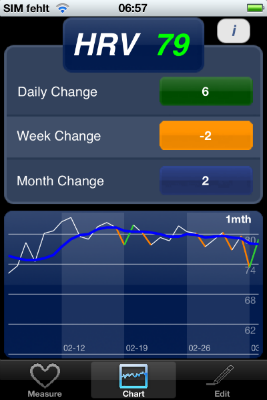
ithlete is an application for either iPhones or Androids that measures and tracks Heart Rate Variability (HRT).
We're using a new player now and iPhone & iPad users will now (finally) be able to play the Podcast directly from your device. Yes I realize it's a little ugly, I'm working on getting a better looking version.