
by Joan Kent | Oct 1, 2020 | Master Instructor Blog, Zone based Heart Rate Training
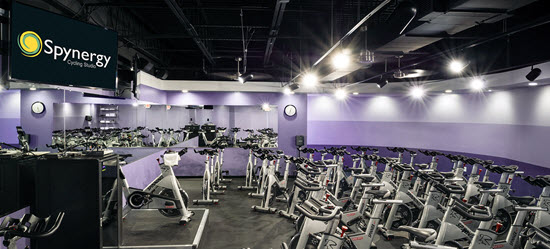
Bill Pryor's Spynergy Studio
By Joan Kent
Indoor cycling classes have become inextricably linked with dim lighting, and I’ve never understood why. Personally, I’m not crazy about training in the dark and will tell you why in a moment.
Studio lighting is one of the factors involved in creating the best class environment, along with music, video, voice, tone, cueing and more. Here are two scenarios from my teaching experience, in which the lighting differences span the spectrum.
In Studio A, the lights are always on and always bright. There’s no on/off switch in the studio because the lights go on when the club is opened. The master switch controls all.
In Studio B, the lights can be brought all the way up to a bright level, but the previous instructor, who had a huge following (okay, it was Jim Karanas), liked to keep the lights dim by flipping only the middle switch on the 3-switch panel. Needless to say, whenever I subbed for him, I made sure the lighting matched what everyone was accustomed to in his class.
The dimmer lighting was okay, but periodically one bank of lights, often on the far side of the room, would burn out, leaving everything on that side of the room just plain dark. It wouldn’t affect the participants close to the door because light outside the studio shines in on the near side of the studio.
We’d notify the front desk staff about the burned-out bulbs, and a short time later, we’d have lights — until they burned out once more.
By my last observation, though, that infamous bank of lights was out again and had/has been for a long time. It made me think about this topic. Apparently, no instructors have reported it to the desk. Apparently, no one has complained.
That last fact amazes me. Because of Jim’s teachings, everyone in the class uses a heart rate monitor (see How to Get Your Students to Wear Heart Rate Monitors). I always train with a HR monitor, mainly because of what I learned from both Johnny G and Jim.
So here’s the thing. In this studio, the bikes don’t have computers that light up and display HR. It’s virtually impossible to see a HR monitor on the far side of the partially lit studio. I’ve seen riders hold up their HR monitors, twist them around to catch available light, and keep track of their heart rates that way. What’s wrong with this picture?
Now I happen to find it difficult to train extremely hard in the dark. For a club anniversary one year, the theme involved decorating the studio like a spooky forest and turning out almost all the lights. Several people did complain that they felt nauseated. Guess I tend to feel that whenever I’m training really hard in the dark.
I had hoped the current instructors might take notice (read ‘take the hint’) when I started bringing a small flashlight to class with me to light my HR monitor on days that I ride on the far side. No such luck.
I have a feeling I’m in the vast minority on this — indoor cycling is almost always taught in dark rooms. Of course, in studios with bike computers that light up, much of this is solved. Still, if I had to choose between the glaring lights of Studio A and the darkness of Studio B, I’d go for the glare. I can monitor my HR easily and definitely feel better physically.
How do the rest of you feel about lighting? Which is most important to you — the atmosphere that goes with dimmer lighting, tracking heart rates, other factors? Please let us know, and thanks.
Originally posted 2014-02-13 10:09:37.

by Joey Stabile | Feb 19, 2019 | Health and Wellness, Instructor Tech Help, Instructor Training, Off Season - Winter Training, Strength Training
Exercises to Boost Hip Strength
When discussing muscles involved in the pedaling motion of cycling, most people think of quadriceps and hamstrings. While these muscles certainly play an important role, the many muscles of the hip also deserve attention, and the weight room is the perfect place to keep them functioning properly.
Before discussing different strength and mobility exercises, we should first look at activation exercises for your Gluteus Maximus (referred to as the glutes) muscles. The reason for needing to activate your glutes is simple–as a population, we spend way too much time sitting, and as a result, what happens is what noted spinal researcher Stuart McGill terms gluteal amnesia–your glute muscles can “go to sleep” and not function properly.
When your glutes aren't functioning properly, other muscles (hamstrings and lumbar extensors) are called in to do the job of the glutes, mainly hip extension. Think of hip extension as the downward action of pedaling.
The problem is that these muscles aren't designed to be prime movers–they're designed to support the action of the glutes. Inability of activating the glutes can result in low back pain (low back muscles compensating), hamstring strains (overacting hamstrings), hip pain (resulting from hamstring-dominant hip extension) and knee pain (poor glute medius strength).
So, to activate your glutes, try the Single-Leg Hip Lift. Here's how it's done: Lie down on the floor with your legs bent and lift one foot off the floor. Lift your hips up in the air, concentrating on contracting your glute muscles. Make sure you keep your toes of the working leg up as shown. Pause for a second or two and lower. Perform 2 to 3 sets of 8 to 12 reps on each side.
Hip Mobility: Keeping your hips mobile is important for overall hip function and athletic performance. Mobility refers to the ability of your joints to move through a pain-free, unrestricted range of motion. For cyclists, hip mobility is critical since pedaling occurs in one plane of motion, and after miles and miles in the saddle, hip tightness and restriction may develop. The following movements will help with hip mobility.
Split Squat: The traditional split squat is a great exercise to get started on hip mobility. To make this exercise even better, concentrate on contracting your glute on the trailing leg to help stretch your hip flexor.
Lateral Squat: Stand with your feet approximately double shoulder-width apart. Shift your weight to one side and drop your hips down and back, keeping your knee over your toes and your weight over your bent leg. Pause for a 2-count, return to the starting position and repeat to the other side.
Hip Strength: If you are currently doing a regular strength-training program, chances are you're already doing some foundation exercises for your hips. Squats, lunges, leg presses, and step-ups all work the prime movers of your hips. Along with these exercises, it's also important to do some supplementary exercises to work your hip's supporting muscles. you've probably heard of your shoulder's rotator cuff. Well, your hip also has a cuff, or a group of muscles that help stabilize and support movement. For these exercises, you'll need a mini-band, a longer thera-band or tubing (both are sold at many sporting goods stores, or can be purchased online), and a cable-column unit.
4-Way Mini-Band: Place a mini band around your ankles and spread your feet about shoulder-width apart. Keeping your legs relatively straight (you want the motion to come from your hips) and toes pointing forward, walk forward 10 steps, then backward 10 steps. Take a short break and then walk to the right 10 steps, then to the left 10 steps. Again, focus on keeping your legs straight and toes pointing forward. It is very important to start with a light-resistance band. You'll be working the smaller hip stabilizers, so you don't need a lot or resistance.
X-Band Walk: For this one, you'll need a large band or piece of tubing. Step on the band and spread your feet shoulder-width apart. Form an “X” in front of you with the band and stand up tall with your shoulders down and back. Keeping your toes pointing forward, take 10 steps to the right, pause and then return.
4-Way Cable Hip: You'll need a resistance band for this one. With this exercise you're focusing on four movements: flexion, extension, abduction and adduction. Stand up straight while doing the exercise. If you have to lean excessively, step closer to the anchor point of your band to decrease resistance. You'll find that not only are you working the muscles of the leg that's moving, the muscles of your stance leg will work quite hard stabilizing and balancing.
Modifications to Traditional Exercises: Our hip joints are very mobile and allow for movement in three planes of motion: the sagittal plane (flexion and extension), frontal plane (lateral movements), and the transverse plane (rotation). Knowing that, here are several modifications you can make to your traditional exercises to work your hips through a more complete range of motion.
Lunge Variations: You can do traditional lunges, or even clock lunges where you keep one leg stationary for 12 to 6 and then the other leg stationary for 6 to 12. To make the movement a touch more difficult, hold weights in your hands while you perform the exercises. There are Lateral Lunges, Rotational Lunges, Lateral Step-Up, and Rotational Step-Up as well.
Please see the full article for complete descriptions and videos of the exercises: https://www.active.com/cycling/articles/11-exercises-to-boost-hip-strength?cmp=18N-PB2000-S20-T9-cycling-AR2&eps=title_1004667
by Joan Kent | Sep 10, 2018 | Health and Wellness, Master Instructor Blog

I’d like to ask for your help with an extremely important campaign. The campaign is to raise money for pregnant women with metabolic disorders: diabetes, high blood pressure, high cholesterol, low “good” cholesterol, obesity, insulin resistance, and more. These metabolic conditions make it more likely that the moms-to-be will give birth to babies that develop autism.
I specialize in reversing these metabolic disorders through nutrition. I want to help get these pregnant women healthy, so they can give birth to healthy babies that stay healthy. This is significant and worthwhile — and I definitely need your help.
The research linking metabolic disorders in pregnant women and babies that develop autism is new. Researchers are worried that autism will increase due to rising obesity rates nationally, which, of course, impacts pregnant women. No one to my knowledge, however, is targeting the cause of these metabolic conditions at the root level — specifically, the nutrition of the pregnant women.
These metabolic conditions can be completely reversed; I've been helping people reverse metabolic syndrome for 20 years. I would now like to target pregnant women and try to reduce the incidence of autism.
Please help by donating if you can and/or by spreading the word and letting your friends, family and coworkers know about this campaign. Any support they can offer would be greatly appreciated.
I truly believe we can make a difference by reversing a problem that looks as if it will only get worse — unless people like you help to stop it! Thank you for your support and your willingness to help.
Here’s a link that will take you to the Indiegogo site, where you can get more information on this important campaign: ‪http://goo.gl/ouS9NR ‬
by Joan Kent | May 8, 2018 | Health and Wellness, Instructor Training

Type 2 diabetes is epidemic in this country, and typically begins with insulin resistance.
What we usually read or hear about insulin resistance is that it’s a result of overweight/obesity. This is not always the case, since the reverse can be true. Insulin resistance (IR) may actually cause overweight. What’s important to remember is that no matter which comes first — IR or overweight — the metabolic consequences are exactly the same.
This post is on the role that dietary sugar and fructose can play in causing insulin resistance, and the ways in which that can happen. IR appears to result from changes in both receptor number and receptor activity or sensitivity.
A high-carbohydrate diet can lead to IR, particularly if the carbs are high on the glycemic index. Sugar would be a prime example of a high-glycemic carb. High-glycemic carbs are quickly absorbed and trigger a high insulin response. The high levels of insulin secretion can in turn lead to a diminished response by the body to insulin, due to something known as “down-regulation”. Down-regulation is a term originally borrowed from brain chemistry research. It refers to a reduction in both the number of insulin receptors and the sensitivity of the receptors. The changes mean that whatever insulin is available no longer works as well as it did before.
Down-regulation is even more likely to occur for someone who is carbohydrate sensitive. Carb sensitivity is an exaggerated insulin response to sucrose or other carbs. The possibility of down-regulation of insulin receptors is even greater with that extra-high insulin release. And down-regulation of insulin receptors occurs fairly rapidly.
So eating sugar — especially lots of sugar, as might occur with sugar addiction — can cause insulin resistance.
What about fructose?
There’s a rather odd adaptation here. Fructose has been shown to change muscle fibers from type 1 to type 2b. Type 1 is a high-endurance fiber that responds well to insulin, while Type 2b is better for explosive power but less responsive to insulin. It has been suggested that this is the mechanism behind the well-known fact that fructose triggers IR. Yes, the original research was done on animals, but studies on human subjects have shown similar results — although training can modify the results somewhat.
The bottom line is that fructose — which, as you may recall, is half of the sucrose molecule — may cause insulin resistance in this interesting way. It might even be hypothesized that sucrose (granulated table sugar that everyone knows is junk) is capable of causing insulin resistance through both mechanisms: down-regulation of insulin receptors and modified muscle fiber type due to the fructose in it. Especially if it’s eaten in large quantities — for example, by someone who's addicted to sugar.
Please recall that all research seems to confirm that the fructose in sucrose is what makes sucrose the junk that it is.
Healthful recommendations? Skip the sugar, definitely skip processed fructose or concentrated fruit juice used as a sweetener, and get your wholesome nutrients primarily from vegetables and only incidentally from fruit. It’s not what you’ll hear most places, but it may work better than what you will hear elsewhere.
by Joan Kent | Apr 17, 2018 | Health and Wellness, Master Instructor Blog

Let’s use this post on labeling loopholes to cover three of them. The first is glycerin.
Glycerin (or glycerol) is an alcohol. It’s not like ethanol, so it won’t give you a buzz, but it is an alcohol.
So what? Maybe you haven’t heard of it or haven’t paid much attention to it, but it’s used as a sweetener. It’s in many foods — including about 99.999% of the food bars that are so convenient and far too numerous to name individually. It’s always in the ingredient lists because the FDA insists, but that’s where the disclosure seems to end.
Things may get fuzzy once you check the nutrient counts. If you were ever geeky enough (yes, that would describe me) to do the arithmetic and calculate the calories of fat, carbs and protein in a glycerin-containing food bar, you might notice a discrepancy between the carb numbers you calculated and the label count of carbs per serving. According to Mendosa.com’s Diabetes Update, about half the glycerin-containing bars that were tested were off in their nutrient counts.
Why is that? Glycerin/glycerol doesn’t fall into the reported categories. Strictly speaking, it’s not a carb, not a protein, not a fat, so it doesn’t have to be counted in with any one of them.
What that technicality allows the product developers and packagers to do is make claims on the label, such as “low carb” or “no carbs”. They can say “low sugar” or “sugar-free.” The claims are considered true because glycerin isn’t any of those.
But it’s definitely a sweetener — and often high on the list of predominant ingredients. The product developers know that, of course, but some are willing to keep consumers in the dark because it might limit sales if everyone understood how much sweetener they were getting in the bars. Don’t be fooled.
A second labeling trick is how sugars are placed on ingredient lists. Several bars use a variety of sweeteners and list each of them separately. (I’ll blow the whistle on Cliff Bars because I’ve counted between 9 and 13 different sugars on their labels. At last count, there were no exceptions.)
This practice may encourage the “casual” label reader to skip over many of the sugars (such as “cane juice”) or simply remain unaware of how much sugar is in the bar as a whole. If all the sugar in the bar came from the same source, it would have to be first on the list as the predominant ingredient. Separating the sugars prevents that.
Here’s another labeling trick, although it’s not really about nutrition.
Does anyone besides me remember the “large economy size”? You may already have noticed that unit prices on large sizes are sometime higher than on smaller sizes. Shoppers who are hurried or shopping with young children may not bother to check the unit pricing. They buy the large size because they need that quantity and also — out of cultural habit — expect the larger size to be a better value.
Product developers are paid to know all of these things and help food companies take advantage of it (and us). The only way to prevent it is to remain aware.
More rants to follow.
