by John | Jan 21, 2015 | Latest News, Master Instructor Blog, Training With Power, Zone based Heart Rate Training
Hey [wlm_firstname] how hard should I be working to; get faster, lose weight, build endurance, ect…
Answering that is the age old dilemma many of us face when questioned by our riders. We try to be helpful by offering subjective descriptions of what both thresholds should feel like. We give breathing cues, run special FTP classes and/or include Best Effort intervals into our class. They're all designed to help our participants discover (for themselves) their threshold hearts rates and/or threshold wattages. We can get close… but at the end of the day they're still subjective measurements = not always as accurate as we would like.
Breathing gas exchange monitors can scientifically measure the two thresholds. Systems like those from New Leaf and Korr can objectively measure the changes in our breathing levels of O2 and CO2. They work well, but are very expensive to own (you can no longer purchase a New Leaf cart, now that they were purchased by Life Time Fitness) and individual metabolic testing can run to $200.00 or more. The actual tests are rather unpleasant, requiring you to wear a very uncomfortable mask – trust me on this > I've had over a dozen tests and would dread doing another.
The only other option was blood lactate testing during a graded exercise test at a university or sports performance center. Here they prick your finger every two or three minutes, while you work to failure during the assessment. I haven't done one of these personally, but it sounds equally unpleasant.
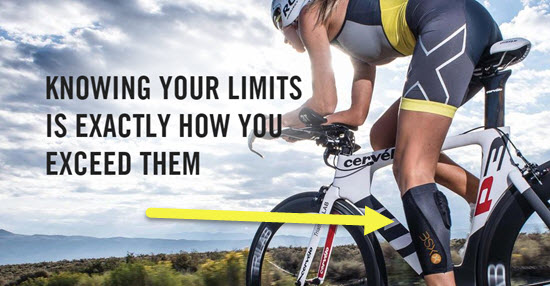
Enter the new BSXinsight – a wearable device that optically measures your O2 levels = this could be exactly what all of us training athletes were looking for. Pictured above, the BSXinsight is positioned on your calf using a compression sleeve. It wirelessly communicates with a smart phone and the data is displayed by (you guessed it) their special app.
Don't just listen to your body, look inside it.
Data and gear are only as good as their ability to improve your riding. Now you can access the most powerful training metric in endurance sports, making every mile more effective and putting every piece of technology you already use into valuable perspective.
BSXinsight uses revolutionary technology that allows you to see inside your muscle, measuring your lactate threshold and generating personalized training zones. Stop trying to “feel” whether you’re pushing too hard or leaving too much in the tank and let the science of your body speak to you.
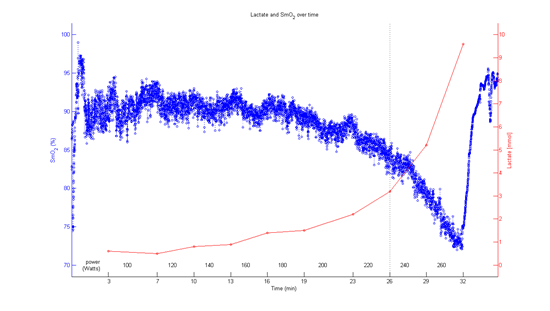
Clearly identifying LT2 threshold
I just finished a fascinating conversation with one of the principals of the company. They have offered to send me a demo BSXinsight to experiment with. When I'm done I'll be sending it to Dennis Mellon for his feedback. Once we are done accurately learning our own LT and overlaying it with our Heart Rates and wattages, we will record an episode with the company spokesperson so we can share what we've learned with all of you.
Stay tuned 🙂
by Sally Edwards | Jul 17, 2012 | Heart Zones USA, Zone based Heart Rate Training
Which heart rate monitor is best for you — digital or analog?

One Button Analog Blink Heart Rate Monitor
As a heart rate monitor, i.e. ZONING fitness enthusiast, you can now choose between two different types of heart rate monitors — digital or analog. But, what is the difference between a digital and an analog heart rate monitor? And which of the two is best for you? The answer lies in the transmission of the heart rate number, the bpm or beats-per-minute. And that transmission — that wave or that binary code — can make all of the differences to you.
8/14 UPDATE: I have posted a new review about what I feel is the best indoor cycling heart rate monitor strap.
First, both digital and analog heart rate monitor transmitter belts detect the same electrical activity of the heart’s contraction using sensors. The sensor in your transmitter belt can be viewed by looking at the back side of the belt which goes next to your skin. On each side of the elastic strap there is a soft and black rubber-like material that is usually oval in shape. There are always two the sensors — one on each side of the transmitter — that detect the electrical changes in the heart beat by using the amplitude of the EKG wave of the heart muscle.
Both digital and analog transmitter belts and watches are equally accurate. What is different is how they transmit the beats-per-minute of the heartbeat to the wrist top watch. And, that watch must either have a digital or an analog receiver that can accept that signal and convert it to a number that displays on our wrist or on your forearm or on your mobile device like an iPhone.
Analog transmission uses signals to the watch that are exact replicas of a sound wave. Analog signals can interfere with other nearby signals and this challenge is called the “cross talk” of two signals. The main advantages of analog heart rate monitors are the following:
- Compatible with most, now about 99%, of the cardio machines at the gym,
- Analog transmitters and receivers in the watch are less expensive
- The signal is carried through water so swimmers and those doing water activities can use a heart rate monitor.
The disadvantage of analog heart rate monitors is that if you are within 3 feet of another analog wave transmitter which can be another person wearing a transmitter belt or another source of an analog signal you will experience “cross talk”. In this case, the receiver in the heart watch will accept both signal sources and add them together and you will get an incorrect number until there is only one signal for the receiver to sense.

Two Button Blink Digital Heart Rate Monitor
Digital transmission converts the heart’s EKG activity into a digital signal using binary code which is made up of 0s and 1s. Digital transmission is a clearer signal because it is impossible with packets of data rather than analog wave signals for interference. Digital heart rate monitors are more expensive yet have the following advantages:
- The technology is newer
- Digital signals do not interfere or “cross talk with other users or other signals.
- Digital signals can be used with Bluetooth and ANT+ receivers in mobile devices like iPhones and others tools.
Digital heart rate monitors will not work for most swimmers because digital signals do not transmit from the transmitter to the watch under water. Here’s an example for you. If you are working out with another person who is using a heart rate monitor, the digital monitor is better because it will not receive both watches data and hence cross talk or allow interference.
What’s the best heart rate monitor for you — digital or analog? The answer is simple: it depends. It depends on price with analog less expensive, it depends if you are working out with others, digital is better because there is no cross talk, and if you are a triathlete or a swimmer — well — it depends because you cannot use it for swimming. My answer — just get a digital and get a less expensive analog and you have the best of both worlds.
Sally Edwards, author
ZONING, Fitness in a Blink
The Heart Rate Monitor GUIDEBOOK
This was originally posted by Sally at http://zoningfitness.com/blog/heart-rate-training-for-weight-loss/which-heart-rate-monitor-is-best-for-you-digital-or-analog/
by John | Jun 14, 2011 | Instructor Training, Zone based Heart Rate Training
Reaching the end of the MS150 yesterday Amy commented to me that she was still relatively fresh and willing to go longer… which was the exact opposite from last year when we arrived completely trashed at the end of both days. I was in complete agreement and began to wonder why I too felt great at the end of 150 miles in the saddle and didn't feel like I wanted to eat everything I saw for the next 24 hours.

Pulling up front, for 150 miles, riding the bus
The question we both had was WHY? This was the exact same route, distance and trusty Trek Tandem. (We call it the Bus) Our training was about the same both years… so that wasn't it. This year was a little bit cooler and there was a minimum amount of wind… helpful, but we have ridden in the wind before without needing a nap the minute we got home. So what was it?
Then we figured it out. This year we managed our intensity while pulling our team for nearly the entire distance; 150 miles over two days. And while averaging ~20MPH for the total distance we found ourselves ready for more. That's right, we pulled the whole thing 🙂
Now if you are confused as to how we were able to ride for hours without a break and still felt fresh at the end, it's really simple. I used my HR monitor as a GPS, instead of a Speedometer. Let me explain…
In years past we had two very strong members on our team: Dana and Jim. They could ride very comfortably at ~ 24 MPH, seemingly forever. Now if you don't ride outside trust me when I tell you that riding a steady 24 MPH pace takes a very fit and strong cyclist. Our strategy for the ride was to use Dana and Jim's strength to pull most of the time and the rest of us would keep up, riding in a nicely disciplined pace-line behind them. Sounds like a good plan except for one thing: with a combined total weight of ~320lbs (Me, Amy and the Bus) riding in a pace-line becomes a bit of a challenge. After years of racing both bicycles and motorcycles, riding very close to others is easy for me. Yes, Amy trusts me. Our problem was in responding to all the small changes in speed that occur in a group. In any pace-line these changes in speed can create a sort of Slinky or accordion effect that has riders in the back constantly slowing and then accelerating to catch back up. What can be easy for a single rider becomes a series of intense intervals on a 320lb tandem. Because the Slinky gets more stretched out, the farther back you are, we found that we needed to sit in the number two or three position.
As the third strongest bike in the group, Amy and I took occasional turns up front. The expectation (maybe peer pressure is a better way to describe it) was to maintain a constant 24 MPH. With one eye on my computer and one on where we were going, our pulls lasted until we could no longer keep our target MPH. I didn't pay any attention to my HR monitor other than a quick look to confirm what I was already feeling; I was way over my T2 – anaerobic threshold. Despite what you may think, both riders tend to work equally hard on a Tandem. Equally hard in relation to their level of fitness that is. If I'm above Threshold, then Amy will be as well. With both pedals solidly connected there is no way for the Stoker in the back to coast.
The end result was a fast, but very exhausting MS 150 that left us completely spent at the end of both days. And did we EAT! We would skip every other rest stop and when we did stop I would be shoving PB&J's down as fast as the volunteers would hand them to me.
This year was very different.
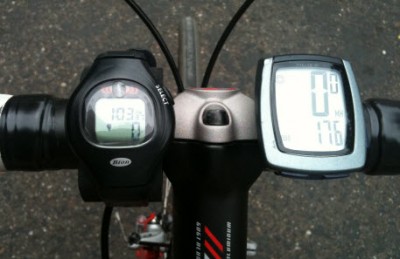
Guided by my Blink - Not my Speedometer
With no Dana or Jim this year we were a bit concerned about setting a respectfully fast pace that would have us showing off our sponsor's jersey, while passing hundreds of other cyclists. Amy and I decided to sit up front for a while and experiment with our speed on the flat sections. While monitoring my HR with my Blink HR monitor this is what we found:
- 17 MPH = ~140 BPM
- 19 MPH = ~ 146 BPM which is my T1 (Aerobic Threshold) or what I refer to as JRA (Just Riding Along)
- 21 MPH = ~ 154 BPM
- 23 MPH= ~ 162 BMP my T2 (Anaerobic Threshold)
So we settled into a very steady 21 MPH which we were able to maintain for hours at a time. If we encountered a change in grade or headwind I kept my HR right there in between both Thresholds, without concern for our actual speed.