
by Jim Karanas | Jan 8, 2021 | Engage Your Students, Instructor Training, Master Instructor Blog

By Team ICG® Master Trainer Jim Karanas –
The experience of flow remains one of the least-understood phenomena in training. Yet it’s one of the richest, most memorable experiences we can help deliver to our students. Creating the circumstances though which students can experience flow in a training session is the topic of this article.
When I mention flow, people sometimes confuse it with being “in the zone”. That often relates to a brain release of beta-endorphin as a result of the activity. It’s a different phenomenon and not what I mean here. When you’re able to collapse what you’re doing down to a single moment and experience total immersion in it, you will feel flow. You’re completely involved in the ride for its own sake. There’s no ego, no awareness of time or distance. Every action follows seamlessly from the previous one.
You might be tired or in pain, but those things don’t distract you. You might not even notice them at times.
Recently, I led a five-hour ride at ICG® Academy in San Francisco. We rode an indoor 100 miles as a fall, base-building ride. The ten 30-minute segments were each built around a different 30-minute “Challenge” video on Myride®+. The plan was not to take any scheduled breaks or rest stops, and to roll from one world destination to the next. To be quick and efficient if anyone needed to get off the bike, but we were going to ride 100 miles. I calculated that, if the riders could average 85 rpm for the 5 hours, they would total 100 miles on their odometers.
I wanted to make this more challenging than an outdoor century.
There were 30-minute segments of pure hill climbing, where we would average 65-70 rpm. We had to compensate on the flat segments by turning fairly high rpm. That doesn’t sound hard until you understand that we were on belt-drive bikes with little or no momentum from the flywheel. 90+ rpm on a belt-drive bike takes a much bigger hit on your legs. We also had a heart-rate challenge. Early on, I had the participants commit to an average training heart rate that they would not go below.
I wasn’t making it hard for training purposes. I wanted to take everyone to a place where they could experience flow. This isn’t always possible in a 45- to 60-minute class.
After four hours, I looked around the room. Not one person was not experiencing flow. How did I know? I asked them if, at that time and for the first time that day, they felt as if they could ride for 10 hours. Everyone smiled and nodded. The discipline and fatigue created a state where they had to go beyond what they normally felt they could do. That’s when you experience flow: a state of non-reaction to fatigue and discomfort; a feeling of serenity; a loss of self-consciousness; a heightened awareness; a feeling of control over the situation and the outcome.
Once you’ve experienced true flow, you can feel it any time.
And that’s when you realize that flow is more than a beta-endorphin rush. You can sense it while walking on a busy street, winding your bike through traffic and stalled cars, in a conversation, in a business negotiation, in the supermarket shopping for food. Flow is working with what’s happening, as opposed to against it (see my previous post on Timing). On my road bike, I often notice that the farther away from home I go, the greater the feeling of flow. I simply stop thinking about things I have to do.
Psychologist Mihaly Csikszentmihalyi describes the mental state of flow as “being completely involved in an activity for its own sake. The ego falls away. Time flies. Every action, movement, and thought follows inevitably from the previous one, like playing jazz. Your whole being is involved, and you're using your skills to the utmost.”
Csikszentmihalyi spent time in an Italian prison camp in World War II. At age 16, he traveled to Switzerland, where he had the opportunity to listen to Carl Jung speak. The experience influenced him. He later explained, “As a child in the war, I'd seen something drastically wrong with how adults — the grown-ups I trusted — organized their thinking. I was trying to find a better system to order my life. Jung seemed to be trying to cope with some of the more positive aspects of human experience.”
Csikszentmihalyi's theory of flow has influenced people in a wide range of fields. Former U.S. President Bill Clinton and former British Prime Minister Tony Blair were reportedly influenced by his book Flow: The Psychology of Optimal Experience. Jimmy Johnson, former coach of the Dallas Cowboys, utilized Csikszentmihalyi’s ideas to prepare for the 1993 Super Bowl. His ideas have also influenced people in business, government, education and the arts.
Flow can occur in such diverse situations because it simply requires full immersion and involvement, energized focus, and enjoyment of the process. Clearly, that can apply to many activities.
Csikszentmihalyi calls flow “focused motivation”, deep focus on nothing but the activity. It works particularly well for cycling, brings consciousness to it, and can be created through the right combination of factors.
Originally posted 2014-12-24 06:24:37.
by Jim Karanas | Dec 30, 2020 | Instructor Training, Master Instructor Blog, Zone based Heart Rate Training

By Team ICG® Master Trainer Jim Karanas
Now that more of your students wear heart-rate monitors (HRM) (see previous post “How To Get Your Students To Wear a HRM”), you must teach them how to use one.
An important first step is sometimes lost when introducing HRMs. Instructors immediately start estimating maximum heart rate and discussing zones. But the first measurement of intensity, how hard the students are exercising, must always be perception.
Relating perceived exertion to heart rate is a fascinating personal discovery for the indoor-cycling student. If it’s done correctly, the student will immediately ask at what heart rate he/she should be training. Then a discussion of training zone estimates makes perfect sense.
The following protocol, developed by Team ICG®, provides a template for a “first HRM experience” that the student won’t forget. Initially, you want the HRM to help the student link a given heart rate with a perception, which enhances awareness. The student feels his/her body go through changes in perceived exertion, along with a visible numerical progression.
Resting HR — 2 minutes
Once the students are wearing their HRMs, have them sit quietly on the bike. No pedaling, no talking, just sitting still. Tell them to breathe deeply, relax and see how low they can drop their HRs. This is not a true resting value, but shows them how relaxation and breathing affect their HR. It also gives them a numeric indication of how prepared the body is to receive training. It may well dictate an alteration of their plan for the day.
Warm-Up — 15 minutes
Roll the legs with no resistance on the bike. Feel the ease of motion, the momentum. Get into a rhythm with it: no effort, just smooth, continuous, even circles. Before taking the HR up, we want to accomplish two things. First, we must shunt blood to the leg muscles. Fifteen minutes of easy spinning will do that. Second, we want the students to sense what’s happening in the body as they get warm.
For the first 5 minutes, set the cadence at 90-100 rpm. Have the students increase the resistance just enough to feel as if their legs are working, without changing cadence. This isn’t much effort. Just bring the HR up slightly.
The first change in perceived exertion is an increase in body temperature. Assuming the room is appropriately cooled, the air temperature initially felt cool or cold. Ask them to notice the change — the air no longer feels cold — and note at what heart rate that occurred. Was it 5 beats up from resting? 10 beats?
For the second 5 minutes, have them make another small increase in the resistance. The second sensation in perceived exertion is awareness of breath. Their breathing pattern has not really changed. Their breathing is not hard or labored. They’ve just become aware that they’re breathing, something we’re unconscious of most of the time. At what HR did they become aware of their breathing?
For the third 5 minutes, bring on a little more resistance without changing cadence and raise the HR again slightly. Two things must happen here. They must notice that all momentum is gone from their pedaling. There’s a distinct point, especially on chain-driven bikes, where the sensation of momentum is replaced by effort. This is very visible to the instructor — the “looseness” is gone from the pedaling — however, it’s still not hard.
The other thing they need to notice is a sudden spike in body temperature. They now feel hot. We experience discomfort just before we begin to sweat because the cooling of evaporation hasn’t begun. What’s the heart rate when this happens?
Settle the cadence down to 90 rpm as they continue to work and begin to sweat. This is the next level of perceived exertion. At what HR did they begin to sweat? They’ll notice the hot feeling leave, then a cool sensation against their skin. They might feel perspiration on the brow, under the arms, or elsewhere.
Their warm-up is done.
As you can see, this isn’t an elaborate or complicated warm-up, just a gradual awareness process for the students. The next step is a heart rate ladder, again to connect the students with their perception of the effort.
Heart-Rate Ladder — 20 minutes
Now that the students are warmed-up, it’s time to take them through levels of greater exertion, while connecting their perception of the effort with the HR at which it occurs. Most of this work takes place seated, so give them periodic breaks from the saddle.
Level 1
Level 1 continues the intensity that they reached by the end of the warm-up. All feeling of momentum has been replaced by a feeling of effort. They’re aware of their breathing and have cracked a sweat.
Their HRs should be consistent. Tell them the first lesson of heart-rate training is stabilization. They should be at a HR that they could maintain for hours. Forget about mechanical difficulties, how the saddle feels, whether they need water, fuel, etc. Ask them to settle into a HR that — in terms of the effort level — they could hold for hours.
Maintain that intensity for 5 minutes.
It’s not uncommon for them to be unsure about whether they’re at the right level of effort. Tell them to check their HR, sense their effort level and ask themselves, “Could I maintain this for 1 hour? 2 hours? 3 hours?” If the effort is too high, they’ll have an internal reaction to the question and should adjust as necessary.
Keep the cadence at 90 rpm; this is important. Let them know that the HR they’re training at is called a target HR. Their job is to maintain that target at 90 rpm.
At this point, it’s helpful to explain what’s going on metabolically. Discuss aerobic vs. anaerobic metabolism and changes in the use of fat and carbohydrate as fuel.
As mentioned above, Level 1 is of the same intensity as the final part of the warm-up. From here, the progression builds to greater levels of effort, which will be covered in the next post.
Originally posted 2012-09-24 05:39:49.
by Jim Karanas | Dec 9, 2020 | Class DVDS & Videos, Master Instructor Blog
By Team ICG® Master Trainer Jim Karanas
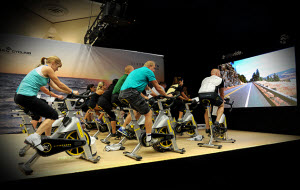
Video is taking over the world. Over 4 billion hours of video are viewed each month, and YouTube is the most-used search engine, after Google. Video is also changing indoor cycling classes everywhere. Like music, video engages our emotions. To reach a cycling audience with imagery and music creates a synergy that lifts indoor cycling to new levels.
Club owners seek something innovative. Cycling with video is enjoyable, entertaining, and a dramatic differentiation from the current indoor-cycling market. The number of emerging businesses that produce video attests to the impact it will have on indoor cycling.
As entertaining as video can be, however, the key reason people join clubs is to achieve their fitness goals and be educated in how to do that, not for entertainment.
Before writing the check, anyone investing in video programming must investigate the quality of education or coaching that accompanies the video product. This applies equally to live-instructor group classes and virtual group classes.
At ICG®, we believe it’s important to remember that video is JUST video. It’s an asset that can add to the indoor-cycling experience but will never dominate it. Even with the world’s best video, without proper coaching for the live instructor or excellent voiceover coaching in the virtual product, you’ll have:
- Instructors continuing to teach to music only, or turning on the projector but never integrating video into their classes.
- Virtually instructed classes projected to empty classrooms, and/or DVDs sitting unused in a box or drawer in the studio.
Quality instruction has always been the key to any successful indoor-cycling program. That won’t change with the addition of video. As long as facilities offer live-instructor classes, the instructors must first appreciate, and be energized by, what video brings to their classes. Once they support video’s benefits, they will sincerely recommend virtual programming — so long as that virtual class stands up to the quality of live coaching.
Bringing video to your cycling program is not a stand-alone purchase. Whether it’s to enhance live instruction, provide virtual classes, or both, it must be supported by online learning, as well as live education and training offered by your video provider.
Empowering instructors to use video in their classes demands technology that allows them to control the video as easily as they control their music. (DVDs just don’t make the grade in that regard.) It also requires an education platform that teaches them to integrate video readily into what they’re already doing — while producing a significantly enhanced experience for the members.
If a club offers both live classes with video and virtual classes, then the instructors must stand behind the virtual-class program and see it as complimentary to, not competitive with, their positions. Participants will typically follow the instructor’s lead. However, that alone will not motivate the members to participate in virtual classes.
For a workout video to compel people to train in a cycling studio with no instructor, the content can’t be good. It must be great. There’s no motivating instructor who knows your name, maybe no social interaction with other members. What works for a solo participant on a bike in front of a small screen may fail miserably in the group-cycling studio. This is even truer if the facility doesn’t employ instructors.
So the question is: What makes a virtual class compelling?
There are four dimensions to a successful virtual cycling class — Sensation, Flow, Challenge and Convenience.
Does the visual sensation grab attention? A compelling member experience must elicit strong, positive emotions. Is forward-motion video of beautiful destinations around the world more visually engaging than the world’s top master presenters sitting on bikes?
Does the workout flow? To be effective, a virtual class must be better designed than a live class. Members will come in and take an average class from a live instructor, but they won’t come in to take an average virtual class. Sound levels, content, matching voice and tone to the content, pacing — the sense of flow delivered through the interaction of voiceover cues and video must be better than with live instruction to be as effective.
Was the workout successful? The members will want to be physically challenged by the workout and mentally engaged by the information delivered. With no instructor and possibly no other members, what encourages the member to work hard? It comes down to quality recorded instruction, selection and use of music, music/video synergy, and editing.
Were the virtual classes offered at convenient times? Does the technology offer “auto” scheduling, where the virtual class and projector turn on and off at scheduled times? Dynamic club schedules that allow virtual classes to be easily added to, or taken off, the schedule based on participation will have a big impact on virtual programming success.
At ICG, we consider ourselves the leading authority in cycling with video. We believe indoor cycling is driven by instructor communication and motivation, plus social interaction. We believe instructors need education and training to integrate video skillfully and professionally into their classes.
We believe that virtual classes can rock and that instructors must support the classes.
Virtual classes must be visually stimulating. They must flow, provide a challenge, be offered at convenient times, and be better produced than a live class. We’re committed to developing better techniques and technologies to make future indoor cycling experiences more “real” as classes with video and virtual classes go mainstream.
Originally posted 2013-01-28 10:29:20.
by Jim Karanas | Sep 22, 2020 | Instructor Training, Master Instructor Blog

By Team ICG® Master Trainer Jim Karanas
Indoor Cycling has always been about engaging students face to face, in a setting where member safety is enhanced and the specifics of riding an indoor cycle can be communicated effectively. This requires educated faculty to deliver the classes. It also creates additional expense for either the club operator or the instructor to pay for the education and additional time for the instructor to travel to and attend it.
Although online education can impact any instructor’s teaching knowledge, it hasn’t been widely accepted in Indoor Cycling. Currently, only two education companies offer online training: the Indoorcycling Group (ICG®), partnered with LIVESTRONG® Fitness, and Mad Dogg Athletics®, which provides Spinning®.
In 2010, the U.S. Department of Education published “Evaluation of Evidence-Based Practices in Online Learning.” The study found that students who took all or part of their instruction online performed better, on average, than those taking the same course through face-to-face instruction. Further, those who took “blended” courses, combining elements of online learning and face-to-face instruction, appeared to do best of all.
At ICG®, we saw that the greatest advantages of online learning, as suggested by this study, were time spent and expanded curriculum. Students spent additional learning time because an online module is self-paced. Expanding knowledge is simplified for the student through an extensive online curriculum because it’s easy to offer. Online learning is far more conducive both to increasing learning time and to learning a diverse program of study than is face-to-face instruction because it removes the two greatest barriers to instructor development — inconvenience and finance.
We’re not suggesting that it’s simply better to switch to online learning only. Others studies have shown greatest effectiveness through the use of online learning for advanced study, while keeping the basic practices face-to-face. This makes a good deal of sense with Indoor Cycling. Initial certifications should be in the form of live practicums to give new instructors the most saddle time.
Based on a growing number of studies, however, review, re-certification and the learning of advanced theory might best be done online. Self-paced online education provides as much time for study as the student needs, which can be particularly helpful when covering new material.
So, considering how important and expensive certifications for indoor cycling professionals can be, what might it be worth to you to be able to earn CECs online at your convenience and at your own pace, free of charge?
ICG® offers the most complete, internationally accredited program of continuing education — and we offer it for free. This support is available for ALL instructors through our online education platform. You can take the tutorials all at once or individually, as your time permits. What could be easier?
Just go to http://www.ic-pro.org/en/account/signin and create your own personal account. Your account will be immediately activated with all of our FREE CEC courses that are approved by ACE/AFAA and other certification organizations.
Our free curriculum includes:
Cyclewell: Circuit Format
Dri-Tri®: An express triathlon workout and teaching plan for the busy schedule
Continuing Education: 9 topics
- Aging and Adaptation
- Stretching
- Nutrition
- Competitive Cycling
- Training the Cancer Survivor
- Music and Motion
- Overtraining
- Periodized Training
- Heart Rate Training and Zones
I.C.G. Archive: 2 topics
1. Nutrition Periodization
2. Sportif Seasonal Training
The indoor cycling instructor is a prime candidate for advancement through online learning. The number of ICI-PRO website members and visitors demonstrates that a good percentage of indoor cycling instructors are online frequently. ICI-PRO website information is, as we know, genuinely useful for the indoor cycling professional. However, we still need to maintain certifications, which are costly and somewhat inconvenient, depending on instructor schedules. It’s for this reason that we invite you to take advantage of the ICG® online courses — some of which are of equally high quality as postings on this website — when you next need CECs.
We welcome the opportunity to serve you in this way.
Originally posted 2012-02-20 16:37:44.
by Jim Karanas | Aug 17, 2020 | Engage Your Students, Indoor Cycling Group - Team ICG, Master Instructor Blog

Susan? or Bob?
It’s a given that different people come into our classes with different expectations, needs and goals. How can we as instructors/trainers accommodate their individual needs without alienating any single group?
Let’s take two hypothetical participants — Susan and Bob. They’re the same age, but Susan is interested primarily in weight management, arguably the most common fitness goal, while Bob is interested in getting stronger, fitter and faster on the bike because he rides outdoors frequently and races regularly. Can these two find happiness in the same indoor cycling class?
I’ve resolved this with a reasoning that works for me. First, I needed to define my professional role as I see it, which may differ from how the fitness industry sees it. As an instructor/trainer, my job is to create a situation and an environment in which members can experience the benefits of physical exercise, and nothing more. Which benefits these are will vary with the individual, and it’s important that I never assume what they could or should be.
Even though Susan tells me she wants to lose weight and Bob says he wants to race bicycles, I know from experience that what the members want is often far removed from what they need, regarding the benefits that training has to offer. Here’s an easy trap, though: I have to be careful not to presume to know what they need.
The goal-oriented approach to training has a built-in limitation. I have known many members who, after 10 years of trying to “get something” out of exercise (e.g., weight loss), were frustrated and disheartened. Maybe they had some limited success from time to time (that I even helped them achieve), but it didn’t last.
If a workout session has to produce a result, you have a paradigm for unhappiness. Instead, my current approach is to create a training session that allows a person to get whatever he/she needs from the workout without interference on my part. I keep in mind that the average member will not understand this approach right away, so the training has to be about something they can understand and offer them some fundamentals of training.
So I teach indoor cycling. This is because the bike has brought balance to my life. It has been a source of both hardship and delight, but the practice of cycling has made me happier. I look forward to riding my bike, whether indoors or out, every day.
I explain early on that I will ask them to ride as if they were riding a real bike outdoors because there are excellent reasons for everyone to train that way, no matter who they are: greater enjoyment of the class, for example, and good technique that will prevent them from wasting energy, so they can apply the energy to creating power. (The last point will clearly help Bob, but it helps Susan as well. The stronger the trainings make her, the more power she can generate, and the more calories she’ll burn.)
Now my job in class is simple: Teach the bike. Completely. Offer my students structured trainings that have helped me and never assume what they need. If it’s in my heart to lead a training on riding big gears in the hills, that’s what I do. What the students get, they get, and I don’t over- or underestimate my influence on it.
Sure, a student with a specific goal may need individual attention. If Susan really wants to lose weight, I can make recommendations and/or referrals. The same goes for Bob. My job as an educator is to show them how to modify what I teach — which is a valuable skill they can use in any class they may take in the future. I offer suggestions but recognize that this is their path. I can’t overshadow it with what I think they should do with, or gain from, their training. That’s not my job and would be a misuse of the trainer role.
Originally posted 2018-11-14 06:00:01.
