In Jennifer Lintz's last post; Use YOUR Workout as Inspiration for your Next Class , Jennifer talked about using your personal workouts and build a class around them. Makes sense to me… because I've experienced something, I can more accurately describe the feelings, intensity, frustration, etc…
I follow communication expert Alexa Fischer (she was featured on Podcast #296) and she's frequently sending out short videos that seem to always get me thinking. This week's email was on using thought bubbles vs. a script, when presenting:
When you are giving a speech or filming a video, I can appreciate the desire to communicate exactly what you want to say through a carefully crafted script. But let me ask you… Do you prefer watching a person reading a script or sharing their thoughts from their heart?
I used this technique in my class yesterday. Here are the thought bubbles I used to bring last Saturday's century ride inside:
Tour de Tonka – that's what the ride is named. I asked if anyone else participated (there were 6,000+ riders) or, if they were driving, were they forced to sit and wait while the mass of riders rode past. I told this personal story during the warm up:
Two years ago I offered to sub a Saturday 8:00 AM class on the day of this event. I wasn't running late, but let's just say I hadn't left myself much extra time. The last stoplight I hit is the corner where the club is located. It's also an intersection where the Tour de Tonka riders cross. So at about 7:50 I'm first in line at the stoplight, waiting while the cop is waiving hundreds of riders through. Light turns green, cop's still waving. I can see the club from where I'm sitting – cop's still waving. At around 7:55 I'm panicking – there appears to be no end of riders and the cop seems content to keep us waiting at the light, as he waves the cyclists through. So out of desperation I go through a very awkward series of multi-point turns to get pointed the opposite direction. I found a place to park two blocks away and with just minutes until the class was supposed to start, I'm running down the street barefoot (I'm one to eschew shoes in the summer) with my gym bag, the cop yelling at me as I dart through the line of bikes, on my way to the club's parking lot.
Distance's – you can ride as short as 15 miles… all the way up to 100 miles, a full (not metric) century.
As a (somewhat proud) cyclist, there's only one response you want to give when asked; “did you ride the Tour de Tonka?” “Yep (standing a little taller) – the century. Reporting any other distance tends to feel like a disappointment, and your body language will normally reflect this. I added this as a bit of foreshadowing, which you'll understand in a few minutes.
Matt and the rollers – That's Matt as in Matt Finnesgard, one of the riders in our group. He's in his mid 30's and a very strong. Oh, and he rides with no technology… not even a speedometer.
Our normal position in the pace-line is front and center. Tandems are best up front. Besides making a nice hole in the air, for the riders behind, all of our mass makes it difficult to react to changes in speed easily. 100 miles can make for a long pull. After the 30 mile rest stop, Matt offered to pull us. A nice gesture on the face of it, as long as the roads are relatively flat. They're not. The next section we rode was pretty much continuous rollers. I know he wasn't doing it on purpose, but Matt didn't slow from his steady 23 mph when the grade became positive. He just keeps a steady cadence and it was killing us to keep up. Here's where I had everyone doing 30 second intervals; just below PTP and then above. Some were load based with steady cadence… and some where accelerations from 80 rpm to 100 rpm and back again.
Old Market – a long, two section climb at the 98.5 mile point in the century.
The Tour de Tonka begins at the Minnetonka High School, which is only one mile from our home. The route goes right past our neighborhood – Old Market is only a few blocks from our house. It turned out to be a pretty hot day, 93° and Amy and I were pretty much toast as we approached the turn, that if we took it, would have us home and quickly in the shower and a nap. It would also have us about a mile and a half short of the full distance. It's hard to describe how tempted we were and we quickly discussed ending our ride then and there. “Who would know if we bailed early?” I asked. We were alone at this point. “We would.” was Amy's response. “You're right.” “We can't honestly tell someone; we did the century – if we really didn't 🙁
So up Old Market we went. Amy and I can did the whole thing + they had some fantastic pizza at the finish. My class got to replicate the two sections as 45 secs climbing above threshold, and the final 45 secs of the class with an all out effort, out of the saddle struggling to make it to the top.
There was of course more to the story that filled the hour.
Do you have a similar story you could present to your class?
If you're looking to add to your Instructor education resume, Schwinn Indoor Cycling and RealRyder Indoor Cycling are offering Instructor certifications at the IDEA World Fitness Conference in Anaheim, California. Both are running pre-convention, 8 hour live certifications on Wednesday, August 13.
Schwinn® Cycling: Instructor Certification LECTURE/WORKSHOP
9:00am—7:00pm (1-hour lunch is on your own)
Master Trainers are Julz Arney and Jeffrey Scott
Here's the link to register for the Schwinn certification and for more information.
RealRyder® Indoor Cycling: Certified Instructor Training WORKSHOP
8:00am—5:00pm (1-hour lunch is on your own)
Douglas Brooks, MS, and Adam Reid
Here's the link to register for the RealRyder certification and for more information.
I'm going to be there Thursday – Sunday > if you're planning to as well please shoot me a note. I would love to meet you while I'm there.
Have you ever considered giving up control of your class music to a DJ? I'm thinking it would be scary for some of us, those who enjoy the predictability of knowing exactly what track is next on their playlist.
Instructor Timothy Brumm says that fear can also be exciting and it will really challenge your improvisational skills as an Indoor Cycling Instructor!
Tim teaches at the Life Time Fitness in Boca Raton, Florida, where he's taught multiple special event classes with the assistance of a DJ. Seeing this as a trend, I looked for someone with experience and posted a request on Facebook. Tim responded and was nice enough to share his insights and experiences on successfully leading Indoor Cycling classes, where a DJ is providing the music.
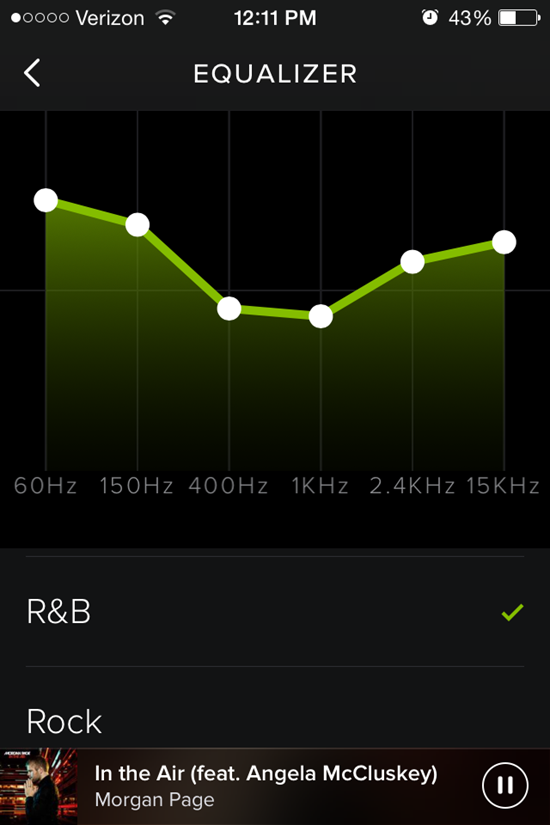
Spotify has added an Equalizer to their iPhone App in the latest update. NOTE: Spotify triggers software upgrades progressively, to groups of users over time. If you're not seeing the notification (pictured above) – you will soon.
This morning I saw the new notice, while I was checking that I had my playlist set to off-line mode and that it would play. This is cool, I thought and I had the chance to acquaint myself with how it worked, before my 6:00 am class. Wearing my ear buds, I found that the Electronic preset sounded the best… turns out I was wrong.
You'll find the new Equalizer in; Settings > Playback > (Scroll down) Equalizer toggle to turn it on/off. Spotify gives you 22 pre-set EQ settings or you can drag any of the six frequency ranges up/down to create you own personal settings.
I'm not sure why, but it seemed like I had to adjust both the sound system's and my iPhone's to a much higher volume level than normal. Please let me know if you experience something similar.
Class sounded OK – well actually I couldn't hear any difference where I sit. After class I connected my bluetooth receiver, so I could stand in the middle of the room to hear what my class hears – while changing the EQ settings.
Now I realise that this is completely subjective; what sounds good to me, may or may not be your preference and every studio's acoustics is different. The R&B setting sounded best, using Morgan Page — In the Air (feat. Angela McCluskey) as my demo track.
That track was part of today's playlist – 45 minutes. I built it from a larger playlist I followed from Instructor Gregg Pitts who teaches at Zengo Cycle in Washington DC – Gregg Pitts Cycle July Tunes. Gregg was featured in this Active Life DC fitness instructor profile. Here's my playlist.
I find it fascinating to watch all the posturing going on in the digital music delivery business. It all started with iTunes – who ruled the legal, digital download space for years. Multiple services (ZUNE, Rhapsody, Napster, etc…) have tried, and failed to take more than a tiny amount of market share from Apple.
But that's all changing because of Spotify, Deezer and a little company called Google. The article below opened my eyes to why.
In an interesting turn of events, Apple is reportedly considering opening up and launching their own streaming music service to compete with the likes of similar services like Spotify and the newly released Beats music. In addition to this they are apparently considering launching an Android app for the streaming service to go along with the launch of the service itself, all in an effort to attack the declining sales of US iTunes music downloads according to sources that are close to the matter. People still use iTunes? All jokes aside, it has been difficult for apple to compete with services that offer streaming music at a low price, as the music libraries are competitively similar in size, and listening is unlimited, all for a small monthly fee. Downloading the same number of songs through iTunes that you would have at your disposal with a service like Spotify would take massive amounts of money, even with most songs on iTunes being available as singles with most as low as $0.99 a hit.
It’s interesting to hear these possibilities as Apple and iTunes have always been known to be a partnered exclusive company and service. While Google’s popular Google Play Music is available on multiple platforms including Mac, Windows, Android and iOS, Apple’s iTunes is only accessible to those who use iOS devices or Mac computers. They have effectively closed themselves off from other possibilities for quite some time, and it used to work for them when they were the dominating force in digital music. With the iPod reaching its end of life though, and a myriad of subscription based music services available on virtually any platform you can think of, Apple will have to find a way to take the once reigning king of music services and transform it if they want to compete.
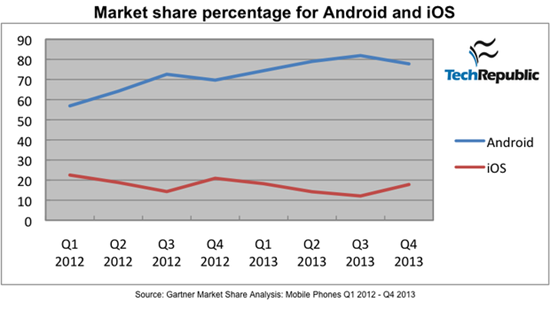
So I did some quick research to see how Apple's iOS competes with Google's Android market share for portable device sales.
… If you look at the raw numbers for sales market share between Android and iOS devices, Google seems to be dominating the space. In Q4 2013, Gartner reported that Android had 77.8% worldwide market share while iOS had only 17.8% share. One quarter prior, Android had 81.9% and iOS took second place with 12.1%. It is worth noting that, according to ComScore, iOS market share in the lucrative US market is about 40%, while Android accounts for around 50% of US sales. The problem with these numbers is that the do not take into account the fragmentation that Google has allowed with the Android platform.
What goes around…comes around
One of the legacies of Steve Jobs was his/Apple's decision to keep iTunes exclusive to iDevices (there is no iTunes App for an Android phone). While this worked to Apple's advantage for years, they now find themselves becoming uncompetitive now that Spotify and Deezer have Apps for both iOS and Android phones.
So what does this mean for you?
Choices, lots of choices for digital music coming with fewer restrictions on how you'll be able to build, share and then deliver great music to your classes. Many of us found Spotify to be revolutionary – it completely changed my views about renting vs. buying music. But now Spotify is SOP (standard operating procedure). I'm guessing that a few years from now we'll be using a music service that doesn't even exist today and we will access it using a device none of us has even seen.
And we can't wait to help you understand how you'll use it in your class 🙂