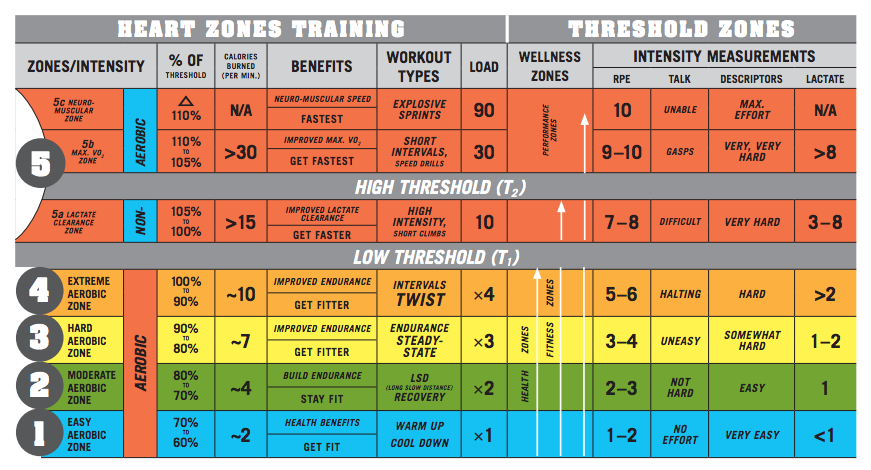
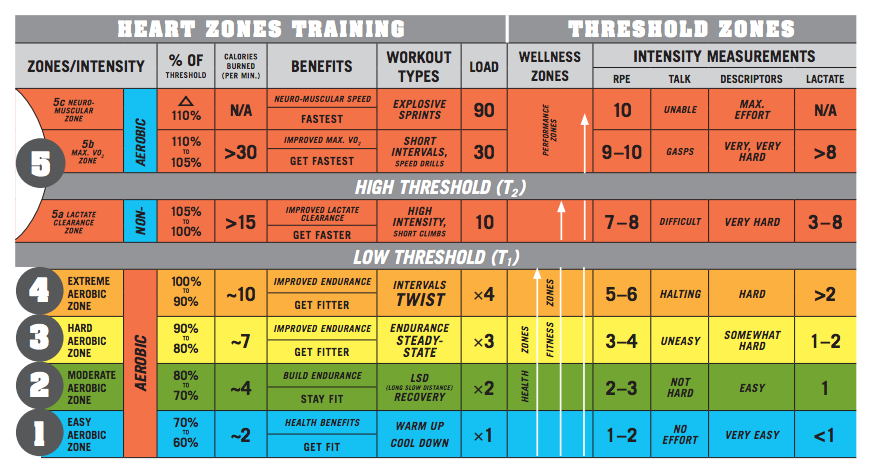
My friend Sally Edwards makes an excellent point here that applies equally to any endurance athlete and affirms our discussion from Podcast 368 — Does Intensity Trump Duration?.
It turns out that very fast runs are good for you–and that moderately fast runs (those just above threshold, in the Black Hole) are not. That’s because Black Hole runs are too slow to cause enough stress to make your body want to strengthen itself, and too fast to allow you to go long enough to improve your endurance. Studies of top runners find that they (by design or not) minimize their time in the Black Hole.
How fast is the Black Hole? In terms of pace, heart rate, and the Heart Zones chart, the Black Hole is actually a very narrow band. It starts at threshold, right as you enter Zone 5, and goes about 5 percent higher. So, if your threshold heart rate is 150 bpm, your Black Hole would extend from 150 to 157 bpm. That means if you really want to improve, your fast runs should roughly start at a second threshold: 158 bpm.
**This post is one of several in an excerpt series from the book, Be a Better Runner by Sally Edwards & Carl Foster**
But don't discount fun exercise = running/cycling that you enjoy just for how it makes you feel. Many people have no interest in structured “training”, they exercise because they find it fun.
Whether you’re in training or not, every ride has a purpose–and just about every one is legit
Fun, however, is a legitimate purpose. Stress relief is a legitimate purpose. The fact that you can finally ride outside after being trapped inside by a wall of snow and ice for six weeks, structure be damned, is a legitimate purpose. The only non-legitimate purpose I can think of is if you’re out there joylessly slogging through some self imposed workout because you feel like you need more miles when those miles are not a) making you happy b) making you faster or c) building your reserves, but rather a) making you miserable, b) making you slower and c) breaking you down.
As an A type male, it was difficult to understand the whole “fun exercise” concept. What's the point of taking this class, if you're going to talk through it?
Once I understood that for some folks, Keeping It Funis the objective, it became a lot easier to accept the appeal of SoulCycle type classes… and their wild success 🙂
After watching the presidential debate last night, I remembered this post that addresses the importance of being prepared. Originally posted on Oct 9th 2014.
Many of us have been guilty of showing up for class and then just “winging it”. But are we putting forth the best YOU when you're making stuff up as you go along?
I've featured Alexa Fischer's short videos in the past and feel you just might re-think your class preparation after watching this video… and then the video that follows below.
If you appreciate Alexa's wisdom like I do, I highly recomend subscribing to her email list. Go here and fill in form in the righthand sidebar.
Winging It
Here's the video Alexa refers to where Billy Joel agrees to let an unknown student play piano for him. If you need a “day brightener” this will be it 🙂
Tom Scotto from Cycling Fusion presents the second in his series of Audio PROfiles designed as the companion to Global Ride virtual cycling DVDs.
Paceline Cycling in France – DVD #2
PROFILE DESCRIPTION
A five minute warm-up and cool-down provide bookends to the perfect ride at the base of the French Alps. Two steady 20-minute efforts separated by a 5-minute recovery will provide many training scenarios and objectives with this DVD. OBJECTIVE AND INTENSITY
Since the structure of this DVD is based around two 20-minute steady-state efforts, one could easily approach this as a tempo ride (Zone 3) with intermediate recovery or a 2×20 threshold field test pushing the limits of Zone 4.
As you and your class transition into February 2017, it's often beneficial to begin adding some additional time in the saddle. Longer classes should (and often need to) be at a lower intensity.
So while a longer, endurance focused class has value, getting members to accept longer, steady state classes can be a challenge.
This week we'll be focused on the concept of “selling endurance” to your class participants.
Master Instructor Tom Scotto offered his thoughts in a previous podcast from 2012. If you haven't heard it, it will be time well spent.
Image from http://wattbike.com/uk/guide/bike_fit/general_wattbike_cycling_position_and_setup
Myth #9 – Handlebar height isn't really very critical on an Indoor Cycle.
An alternative of this myth is; handlebar height should always be set to where it's most comfortable.
When the enemy is the wind… the drops are your friend 🙂
Every cyclist in your class knows how important it is to be as aerodynamic as possible. They realize that something like 80% of the energy needed for them to ride their bicycle on flat ground, at 20mph, goes to over coming wind resistance. Add a stiff headwind that has you wanting to crawl inside the paint on your bike and it's probably more like 100%… or more if that's even possible
Reducing your frontal area has the greatest impact on aerodynamics, smaller = better. So many cyclists have a goal to get as low as comfortably possible on the bicycle. In fact road bicycles have a special bend in the handlebars specifically designed to help a cyclist ride low & comfortably… the drops.
Trouble is that very few people use them because they don't have the lower back or hamstring flexibility needed to get low and stay there comfortably.
So why not help our cyclists to develop some additional flexibility… or maintain the flexibility they developed over the summer?
As a fitness professional you realize that gains in; strength, endurance and flexibility all come over time. Please forgive the pun here but any desired change will only come when we stretch beyond what is comfortable/easy/normal.
Indoor classes are the perfect place to work on flexibility for a number of reasons. The limited time (45-60 minutes) is long enough to help, while not as intimidating as the thought of committing to a 4 hour group ride with low bars.
Here's how you can help everyone get down low.
If your club has the Livestrong / Tomahawk Indoor Cycles you can encourage your riders to spend time in the drops.
Lead by example by keeping your bars low, demonstrating good form and then make mention that you are doing this on purpose to help increase your flexibility.
Encourage everyone to observe where they have their bars set and then ask the question; “would your outdoor riding improve if you could spend more time comfortably in the drops?
Use Periodization – suggest a series of small changes over time.
Consider partnering with a personal trainer to lead post class stretching that focuses specifically on the hamstrings and lower back.
Incorporate a short stretching segment into your class. Now that I'm teaching longer endurance classes I'll have everyone stop and stretch at the 15 minute mark when we are all warm – and yet not fatigued.