Recently, I found myself at the local big box home improvement store looking for some primer paint. A helpful person asked if I had any questions. I explained that I had some pealing paint that I intended to scrape, prime and repaint. He suggested “brand X” as the best primer that they sold. Before I could ask if it would be possible to have the primer tinted, he moved off to help someone else. Content that I had the right paint, I carried a can of it over to the counter where they mixed custom colors. “What are you using this for?” asked the helpful person behind the counter. I told her the same thing I had told the earlier helpful person and asked if I could have it tinted. “This isn't what you want.” was her reply. She then began giving me a chemistry lesson that went way over my head. I listened politely before explaining I needed a few other things and would be right back.
I left the store with nothing but confusion.
In the survey I asked the question; What would you change, add or implement at your club or studio that you feel will increase Heart Rate monitor usage by members? 61% said they would implement Instructor training so everyone talks the same language.
Have we created a “Tower of Babel”?With 413 responses to the Heart Rate Training Survey it is clear that we have a language barrier that needs to be addressed. I feel the confusion it creates for our students is partially to blame for the low level of Heart Rate monitor usage in our classes.
I respect the fact that people will have their own point of view, i.e… which is the best paint for your house, but do our answers always reflect what's best for the customer?
I needed help making a decision and helpful person #1 gave me exactly what I needed; a simple, confident recommendation. Even though it was based on minimum information, his confidence left me feeling ready to take action… in this case making the purchase.
Helpful person #2, while thinking she was being helpful, did the exact opposite. The confusion she created had me second guessing what should have been a pretty simple decision. So I did nothing… which I'm thinking is what many of our students do every day.
In these three posts I am advocating for a standard method of describing HR training Zones and I would love your feedback.
Wahoo BLE & ANT+ cadence sensor easily attaches to either crank arm and doesn't require any magnet or second sensor.
We talk a lot about the new Indoor Cycles with consoles that display a rider's performance data; Power /watts, RPM, distance, calories. Training with Power is fabulous if your club or studio as invested bikes recently. It's even more fabulous when all of that data is connected to a display training system like what's offered from Performance IQ or Spivi. Either system really adds to the fun factor, while delivering true performance data directly into each participant's email box – an awesome convergence of Keeping It Fun & Indoor Cycling 2.0 🙂
But is there an option to bringing big screen display training to your club or studio using conventional Indoor Cycles?
Absolutely and around 90% of the investment you'll make today will carry over to when you do finally upgrade to Power bikes – assuming you do of course.
My assumption is based on the fact that if you are riding a conventional Indoor Cycle, with no computer/console, there's a good chance you're on Star Trac Spinner® NXT's and Spinner® Pro's. Star Trac owned the market for indoor cycles back in the 2000's and sold thousands of both models. To my knowledge, back then nearly all of the Big Box clubs were riding Star Trac's – the one exception being LA Fitness.
So if your NXT's or Pro's are in relatively good nick and you would like to add technology so everyone knows how fast they're pedalling, you have a couple of options.
NOTE: I haven't seen a studio adapt a bicycle computer successfully and don't recommend wasting your time trying.
The most common solution is to install a Spinning® computer. These consoles will display cadence, distance (wildly inaccurate) time and HR if you're wearing an analog HR strap. A few words of caution:
The Spinning computer has no option for connection (BLE or ANT+) to a display training system = they won't connect with Performance IQ or Spivi.
These computers are designed to fit multiple models of Spinners®. There is a setting (you use a magnet to get into the option screen) you need to make to adjust the computer to your model of bike – to have RPM displayed correctly.
They're pricey at $167.00 each and I'm not aware of any bulk discounts.
The alternative for studios not ready to replace their bikes, but do want to begin offering performance metrics (even RPM & HR can make a huge impression on clients) and possibly a bike reservation system, I recommend the new Wahoo RPM cadence sensor.
The $39.99 Wahoo sensor is about the size of a quarter and attaches easily to one of the crank arms. That's it. There's no second magnet or parts needed. The package comes with a number of attachment methods – I'm showing it simply stuck on using some incredibly sticky double sided tape.
Battery life (replaceable coin cell) is supposed to be a year or more with it's auto-on feature. The sensor transmits in both BLE and ANT+ with great range so you could have a large studio with 40 or more NXT's wirelessly connected to Performance IQ or Spivi. Let the fun begin 🙂
The other option would be for participants to bring in their personal portable device; iPhone, iPad or Android phone. There are multiple Apps that will receive the sensor's BLE signal (all phones have BLE) and the free Wahoo Fitness App would be my choice. It's super easy to use and paring is very intuitive.
Yes this sensor will work with the Spinning App – only after you purchase additional sensor options.
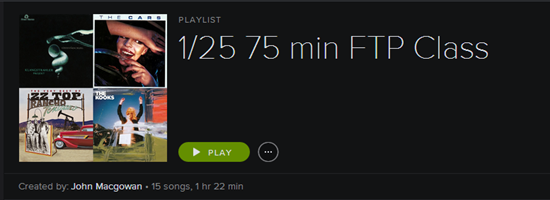
Here's the profile I used a while ago in our Performance Cycle FTP assessment.
[wlm_private ‘PRO-Platinum|PRO-Monthly|PRO-Gratis|PRO-Seasonal|Platinum-trial|Monthly-trial|PRO-Military|30-Days-of-PRO|90 Day PRO|Stages-Instructor|Schwinn-Instructor|Instructor-Bonus|28 Day Challenge']
At 10:47 Extremely Well is a perfect warm up song. Plenty of quiet early to give you time to announce the class format – followed by a number unique changes that you can use as a personal cues to initiate a change in intensity.
The Cars — Just What I Needed
Time for some openers – everyone knows this song, so load up the resistance @ 62 RPM and have them surge along to different segments. The objective is to have everyone up to threshold once of twice before the last 30 secs that is use as a short recovery.
ZZ Top — La Grange
Let's find your Best Effort! Have everyone find the 80RPM cadence and then add gears during the 30 sec intro. I start the timed three minute Best Effort at the intensity change in the song at 0:34. Stage button and then encourage everyone by asking; “is this really you… at your best? [This is also a great time to be off the bike, working the room.]
The Kooks — Junk of the Heart (Happy)
This happy go lucky track is a fun reset/recovery. No purpose here, just fun 🙂
Moby — Extreme Ways (Bourne's Ultimatum)
We're getting serious now! I use this 100RPMish track to have riders dial in and observe JRAP/Base Watts. Find the cadence and then gradually add load until you feel your HR begin to creep above VT1 (just above chatty) and then recover slightly. I have them repeat this a number of times, always observing the connection between RPE/HR & the watts they're maintaining.
20 Minute Assessment
I remind everyone how they've found two numbers already, now well find the third that will really validate the others. This 20 minute assessment should flow smoothly from the earlier base watts we were in during Extreme Ways.
Black Sabbath – Planet Caravan Remix download this remix to have for this playlist. Right Click > Save As
Planet Caravan is slightly slower @ 94RPM. Establish this cadence and find the watts that you feel will be your Best Effort over twenty minutes. This # will of course be somewhere between the Base watts and the three minute Best Effort.
Ted Nugent — Stranglehold
Slower at 75RPM – request the necessary changes, while staying locked into your average. We've moved more of the work to our legs = breathing will become slightly easier.
Golden Earring — Radar Love
Back to 100RPM to give our legs a break.
The Kooks — Ooh La – another fun reset & recovery
Klangstrahler Projekt — Take A Breath and Safri Duo — Snakefood – 13 minutes of steady JRAP/Base watts (they should all know exactly where to go by now) and I just let them ride – cuing occasional out of the saddle time.
America — Sandman – 5 Minute Best Effort – or – additional JRAP/Base work if they already appear cooked 🙁
This 80 RPM live track has an awesome lead in you can use for a one minute recovery. Have everyone dial in the wattage of their choice and cue your start at the 1:10 [you'll hear it] for this last 5 minutes of hell!
[/wlm_private]
Recover and Cool Down
Selah Sue — This World
Passenger — Let Her Go
Lana Del Rey — West Coast – Rob Orton Mix
We all experience this. You run into an old friend unexpectedly and greet them.
Their response includes something that you react to. It may have lasted only a fraction of a second. A raised eyebrow, indifferent smile, strange look, a shift in body language, the choice of a specific word… or the way it was said.
What ever it was, that tiny moment in time effected you in a way that has you thinking; is something wrong? Are you OK? Do you know a secret about me? You've forgotten my name!
The author describes the main subject of his book as “thin-slicing”: our ability to gauge what is really important from a very narrow period of experience. In other words, this is an idea that spontaneous decisions are often as good as–or even better than–carefully planned and considered ones. Gladwell draws on examples from science, advertising, sales, medicine, and popular music to reinforce his ideas. Gladwell also uses many examples of regular people's experiences with “thin-slicing.”
Gladwell explains how an expert's ability to “thin slice” can be corrupted by their likes and dislikes, prejudices and stereotypes (even unconscious ones), and how they can be overloaded by too much information. Two particular forms of unconscious bias Gladwell discusses are Implicit Association Tests and psychological priming. Gladwell also tells us about our instinctive ability to mind read, which is how we can get to know what emotions a person is feeling just by looking at his or her face. We do that by “thin-slicing,” using limited information to come to our conclusion. In what Gladwell contends is an age of information overload, he finds that experts often make better decisions with snap judgments than they do with volumes of analysis.
While reading Blink, I was struck by how people (yes they're experts on what they personally like/dislike) could be “Thin Slicing” our classes – and how they feel is based on just one little thing you do:
“I loved/hated the music” I love that she plays that new Pitbull song!
“She teaches a great class” Her smile makes me feel welcome/attractive/like I belong…
“It was boring” he looks like he's rather be somewhere else.
“He's awesome” he's the one Instructor here that remembers my name.
Slicing up your class into little pieces
There are 3600 seconds – in a 60 minute class. With 20 participants (who experience each of those seconds differently) your class could be Thin Sliced ~ 72,000 times or more. Yikes!
Now It would be ridiculous of me to suggest that you need to focus on that level. So how about just a few?
Let's start with this; how do you describe the people in your classes?
Students?
Members?
Riders?
Participants?
How about Pushers?
I was trading emails yesterday with Patty Kuhles who owns PUSH Cycle Studio in Prescott, AZ. Patty told me that they call their participants Pushers – which to me is a fantastic title to use as it connects everyone to her studio. I can hear one of their customers talking to a friend; “I'm a Pusher at PUSH Cycle Studio.” Kind of endearing, don't you think?
Let's go TEAM!
Brent Goodermont is an Instructor with Life Time Fitness. I took his class last month and was very impressed with how he referred to us as a TEAM.
It's time to really work now TEAM!
You need to keep up with the rest of the TEAM!
OK TEAM, you've earned this recovery 🙂
Now imagine that you ran into either Patty or Brent at the mall and they introduce you to a friend they're shopping with as…
This is [wlm_firstname], one of my Students…
This is [wlm_firstname], one of our Members…
This is [wlm_firstname], a Rider at our club..
This is [wlm_firstname], one of my Participants…
This is [wlm_firstname], one of our awesome Pushers…
If you've followed indoorcycleinstructor.com for any length of time you know that I'm a huge fan of the 2T/3Z method of Heart Rate training which is the basis for Zoning. That simple Blue/Yellow/Red response from my Blink Heart Rate monitor is (to me) the perfect way to introduce zone based heart rate training into your class.
Here's some proof of it's success – OK it's a bit rough, but Diana presents a powerful truth that Zoning has worked for her in this video. Your students are in your class to lose body fat and Diana losing 100 pounds and finishing the Danskin Triathlon is a testament to the effectiveness of 2T/3Z Heart Rate training.



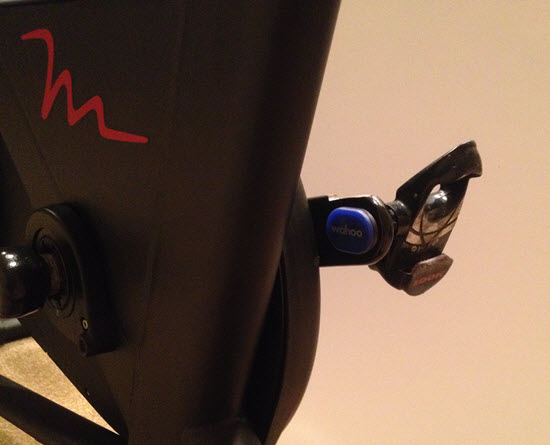
 magnet or parts needed. The package comes with a number of attachment methods – I'm showing it simply stuck on using some incredibly sticky double sided tape.