How much planning did you do (or should you do), before launching your new cycling studio?
What research did you complete to understand the difference between successful studios and those that are struggling?
Fitness entrepreneur Callie Bowling has completed an exhaustive planning process in anticipation of opening a new Indoor Cycling Studio in Boise Idaho next fall. Callie interviewed over a dozen studio owners and she shares what's working… what's not and what she sees as the future of boutique Indoor Cycling studios.
This interview is an hour long, and needed to be to record much of what Callie has learned.
If you own a studio, or are considering opening one, I suggest grabbing a pen and paper, find a quiet spot (maybe with a hot tea) and listen to the podcast below in it's entirety, while taking notes – I consider this one of my top five episodes ever, it's that good 🙂
[wlm_private ‘PRO-Platinum|PRO-Monthly|PRO-Gratis|PRO-Seasonal|Platinum-trial|Monthly-trial|PRO-Military|30-Days-of-PRO|90 Day PRO|Stages-Instructor|Schwinn-Instructor|Instructor-Bonus|28 Day Challenge']
Update: This episode wasn't showing up in the podcast feed = I republished it and it appears fixed 🙂
[/wlm_private]
I was originally alerted to Callie Bowling by Amy – she had talked with her and was very impressed by how thorough she was in her business planning and the amount of research she had done via interviews with other studio owners.
So I reached out to Callie about possibly appearing on the show. This was her response 🙂
Let me give you a little background, so you can be thinking of questions on your end:
I have learned quite a bit actually, so much that just when my business plan and financials were all buttoned-up and ready to go – I was literally sitting across the table from my lender – I decided to go back to the drawing board to lay some more ground work (A MUST) and further examine my goals for my business and a smarter implementation strategy solely based on the experiences I obtained from interviewing eight indoor cycling studios across the nation. I learned a lot, the owners of these businesses were extremely generous with their time and the truly sensitive information they were divulging (the scary icky stuff like money)… lol, perhaps it's my degree in Psychology, but I've usually never had a problem getting people to open up around me… it's a double-edged sword 😉
I've learned this “dream” for us who wish to open these studios is always opened with the best intentions and out of a passion for the “sport”; we're all fitness enthusiasts who wanted to bring our passion to our communities and also make a fortune at it! I mean why not, the preliminary financials reflect success, which is a super simple function of attendance… it seems like a no-brainer right!? Get people in the door and become profitable… minimal overhead, no accounts receivables, cash based service industry, no inventory, etc. … the business model is set up for instant success! I'm sure you see I'm being simplistic and sarcastic, because nothing in life is ever that easy, and if it looks easy… take a deeper look, because you're probably missing something 🙂
With that said, there have definitely been some strong and shared commonalities amongst the failures and the successes amongst studio owners that can't be ignored… but, they're probably taboo to talk about so no one ever does, because no one likes to admit they've failed or fallen flat on their face… but, the truth is the truth, and in the same token no wants to invest their life's savings or nest egg into a business that might be doomed from the get-go, so we need to talk about it.
I will say, I don't know what came over me, but I emailed studios in XX, YY, ZZ, BB, NN, RR, and FF (on the podcast I won't disclose which states though to respect and maintain the anonymity of these studios, because in some states there is literally just one studio, so that would probably give it away, and the information they shared is certainly sensitive – we can just accurately say I reached out to studio owners across the nation) and I didn't know what to expect. I was equipped with my generic list of questions, but those soon fell to the wayside and the conversation became personal and very much a theoretical conversation about what it takes to survive as an entrepreneur in our industry and what those basic principles are.
Alas, we can go over all of this & more on the podcast, I'm loaded with info, lol, and honestly I think the things I am ready to touch on will be useful information not just for others in the “pre-startup” phase, but also for any studio owner in general that is perhaps struggling or “hemorrhaging” (as one studio owner stated) and can draw even the smallest parallels in their own business with what I have understood has also been choke holding others.
What do you think!??! 🙂
P.S. Here's the juiciest part… I think I see the future of our industry!!! lol… that may be a bit pompous for me to predict, but I've done a lot of research and there are signs and clues I'd love to cover!
Callie Kelley Bowling
Founder & CEO
CKB Fitness, Inc.
Fitness author Pamela Light joins me to discuss her article in the latest IDEA Fitness Journal — Crystal-Clear Cuing for Indoor Cycling. In it, Pamela encourages Instructors to: Be smart about the exertion scale you use to help participants get the best ride.
Excellent Instructors use a system to describe what they expect for performance, and it's usually a combination of what they've learned in certification courses and what they've gleaned through real-world experience. Indoor Cycling teachers often rely on numbers to convey effort. While this is a good idea at face value, there are many variations on a theme.
Listen below to Pamela expand on each of the seven component parts she feels are important to Crystal Clear Cuing!
This maybe an option to adding cadence/RPM to any conventional Indoor Cycling Bike
Teaching to a room full of new Indoor Cycles with power & cadence monitors is awesome, if your club has made, or is ready and willing to make the investment. So what are the options for adding metrics to conventional cycles like the Star Trac Spinner® Pro, NXT or those made by Schwinn and others?
Let's get this part out of the way. At this time there is no, known option to add a power meter (that displays watts) to any Indoor Cycle that wasn't designed with power as an option. I get that question a lot.
How about a speed/distance meter? Nope. You can't accurately measure speed and/or distance by measuring the rotations of the flywheel.Could you install a bicycle computer and would it display something like speed/distance? Yes, but what you're seeing is nonsense. Years ago I watched my club add cheap bike computers to our NXTs in preparation for an indoor triathlon. It was comical to watch everyone spinning away like hamsters on crack, trying to reach their required distance. Please don't waste your time or money on this.
What can be added is a cadence (RPM) meter to display a riders pedaling speed. Not the same as power/watts, but it would make a big improvement to your class and simplify your cuing. I've talked to dozens of instructors who really aren't interested in teaching to power… but they almost all appreciate cuing to RPM and having everyone seeing their cadence.
Your options for installing a cadence meter to an indoor cycle are:
Wired Cadence Computer (NOT Recommended) – you'll need to run the wire down to the sensor added to one crank arm and the computer either needs to be attached to the cycle's frame (because the handlebars move) or you'll need to leave a bunch of cable slack so you can raise the bars. Looks tacky and I guarantee someone will rip off the wires no mater how carefully you route them.
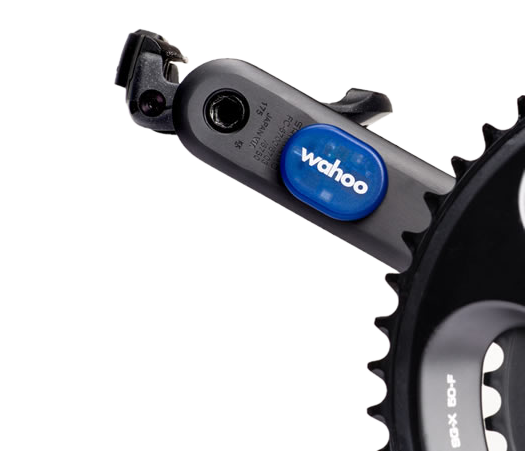
A wireless cadence sensor used with an iPhone or Android device. The picture at the top of this post shows the Wahoo Cadence Sensor which works with any of the dozens of free cycling Apps. Installation couldn't be easier > you just stick it on one crank arm and pair it to your phone. There aren't any magnets. This might not be the best option for a studio, but would be perfect for anyone training at home.
Speaking of Wahoo – I hear they are coming out with their new TICKR HR Strap – a Heart Rate strap that transmits both ANT+ and Bluetooth. Why this is important is your iPhone/Droid doesn't pickup ANT+, only Bluetooth. In the past you'd need to purchase a Wahoo ANT+ Key, a “Dongle” to plug into your device to read ANT+ signals. It's supposed to be out in a month or so and I'll let you know if you're on our newsletter list. You can join for free if you aren't.
No more hunting for new music or counting out cues to develop your ride profile. Here is your ready to ride profile for a fully choreographed ride, that can be displayed from your phone, or printed out onto cue cards for your class. This ride is timed out, down to the second, to make your life as easy as possible!
In part two we identified how the talkers act the way they do because of; cluelessness, a lack of respect for you and your class or they're challenging your position as the leader.
Much of this could also apply to the texters/bring their own music/do their own thing people.
I defined the three possible reasons WHY people act disrespectfully as:
They don't know they are acting disrespectfully…
They don't care they are acting disrespectfully…
They're disrespecting you on purpose…
Because you've made it here to part three, I'm guessing you'd like to know my ideas on how to solve these problems. But first, a few words of caution.
My recommendations below will be difficult for many Instructors, especially for those of you with a short amount of teaching experience. They require you to be the Leader your class expects you to be – not just one of their friends who happens to be on the bike in the front.*
I realise that this will be difficult for many Instructors who would prefer everyone just get along… but they won't > that's why they need you!
These suggestions may conflict with your natural instincts to protect the feelings of others. Attempting to implement these solutions may make you feel uncomfortable. I've heard it expressed dozens of time; I really wish I could get these people to stop disrupting my class… but I don't want to offend anyone 🙁
That's why I broke this up into a series and spent so much time on explaining WHY people are acting the way they do. My hope is that through this process you would already be coming up with these solutions yourself, or at least understand that at times being the leader is hard and not always pleasant.
Your class participants and manager/owner are expecting you to be the leader of your class.
So ICI/PRO Members let's end these Talker problems today!
First – Set your microphone volume level correctly
I can't tell you how many classes I've been in, where I wanted to run up and turn the Instructors mic level up… way up. Your voice must be the most dominant sound in the room!” IDEA recommends a mic level 10 decibels over the music. Your amplified voice should be clearly heard and easily understood, over the music.
Many new Instructors (and some not so new) are not comfortable hearing themselves through an amplified sound system, so they keep their mic level low. Do whatever you need to correct this – today! If you're a manager/owner please offer to audit sound levels for your Instructors > many rooms end up with a cone of silence, shielding the Instructor from accurately hearing their voice/music ballance – ultimately what the class is hearing.
Get help to properly set your voice/music levels.
Your class needs & wants to hear your big strong, confident voice > weak, quiet voices are very easy to talk over and this alone may solve many of your problems.
Second – don't talk over the lyrics
If two people are talking at the same time, which one is the leader?
Neither
You are diminishing who you are as a fitness professional and what you're trying to communicate, by competing with the voices of Bono, Pit Bull, Nicki Manaj, Ellie Goulding or whoever else you're playing. Talking over them forces your riders to have to choose between listening to you or their favorite singer. You'll lose with some and they'll potentially tune you out. Others, who can't understand what you are saying, just might decide to start a conversation that they can hear – with the person next to them.
Third – keep your cues short and actionable
Ever been at a party where you were stuck talking with “that person” who never seems to run out of words? What do you do? When I'm in that situation, I'll listen respectfully for a few moments and then I'm looking around for someone to rescue me.
I'm convinced that Instructors lose control of their classes for the same reason. I've seen it happen. She/he drones on and on to the point where riders just shut them out. Too much talking = you lose people. Once they've lost interest in what you have to say, it's natural to turn and engage with the person next to them. That is until there's a “SQUIRREL” moment that catches their attention.
Are you with me so far?
Excelent. Suggest trying these in order and you'll soon be teaching to the quiet, focused class you dream of having. …
#4 Solving – They don't know they are acting disrespectfully…
This one should cut out 60% or more of the talking > if you do it consistently in every class. You must firmly and clearly explaining that conversations are not allowed after the initial warmup.
Say it with me with a bib smile: We run our studio like a movie theater. Now that our class has started, talking and other distractions should stop. Please, no further conversations until after class has ended.
PERIOD… END OF SENTENCE!
I know this sounds really simple and it is. Your class isn't (and can't be) a democracy where everyone gets a voice. It should be a dictatorship with only one voice – YOURS!
If you don't set clear expectations, how can you expect people to behave properly? You can't. If you have a talker problem (and I listened to a recording your class) I'll bet you don't say anything, or at best you mumble something unintelligible that no one listens to.
If after your warm up you still have talkers, I want you to clearly tell them how it makes you feel. Remember, this group of talkers just doesn't realize the negative affect their talking has on you and the class. I've personally found this to very effective. A man, talking about his feelings? I better listen.
Turn the music way down (almost off) and say along with me: Can I get your help here? Pause long enough to get the attention of the talkers. Look directly at the talkers and say; It's really hard for me to teach this class when when I'm competing with the two of you talking. Can you understand how this can be difficult for me?
The temptation is to address the whole class (there's that fear of offending someone) rather than communicate directly toward the talkers. Is that fair to the rest of the class? No. Demonstrate your leadership here by confidently addressing the actual people who are causing the problem.
For the next two (#5 and #6) you'll need the full support of your owner or manager because both of these could get ugly**. Which means you should have already discussed this problem with them and they agreed that the issue needs to be corrected.
#5 Solving – They don't care they are acting disrespectfully…
Members who feel entitled and don't care might not respect you, but they will care if you shame them (just a little) in front of other members. I used this method a few weeks ago at a class I subbed. The aftermath was overheard by another member who's email to me is part of this post; It’s a good thing I don’t teach in New Jersey .
After making specific requests for people to stay quiet and focus on the ride, I turned down the music – which makes my voice seem even louder – and I pointed directly at the people located around the two talkers. I asked them; are you all OK with those two talking? This resulted in a bunch of frowning faces vigorously shaking side-to-side. NO! Then sitting up, with both hands extended, palms forward, I made a meek, squinty face and said; I'm sorry, but they don't want you talking during class. And then got right back to my cuing as if nothing ever happened.
Both women looked at each other with stunned looks on their faces and we enjoyed complete silence for the rest of class. I do hope the regular Instructor will carry this policy forward > so I don't have to repeat this exercise again.
Why does this work, when making general statements to the whole class doesn't? The first is probably obvious; no one likes being shamed in front of their peers. These rich members might not respect you, but they do care about the opinions of those riding around them.
The second reason this works is that you are supporting all the non-talkers who are too polite to say something. Don't be surprised if you are thanked multiple times after you give them the chance to show their disgust for the Chatty Cathys who are disrupting your class.
#6 Solving – They're disrespecting you on purpose…
When nothing else works, then you're left with two choices and neither is easy:
Confront them directly and they stay
Confront them directly, they leave and never come back
You and your manager need to be OK with either result.
You've probably figure out that I have a very low tolerance for nonsense or disruptions in my classes. As a result my participants are all very well behaved 🙂 I've learned that people who are challenging your authority need to be confronted quickly and directly. The longer you tolerate their negative behavior, the harder it will ultimately be to address this successfully.
In my entire career, I've only had to ask two people to leave the room – they were together and it wasn't even my class. If you can believe it, this couple had removed their seatposts in the middle of a class I was attending. There were two loud BANGs as the aluminum posts hit the floor, scaring everyone. I saw that the Instructor had frozen in place, unable to comprehend what had happened. I hopped off and in a very loud voice I said: YOU BOTH NEED TO LEAVE NOW! And I stood there in front of them until they did. As you can imagine, there were a few angry phone calls to our GM. Because my GFDH was very understanding after talking with the Instructor, she backed me up and nothing became of it.
If I remember right, another two I asked on separate occasions not to come back. None of these confrontations were pleasant and part of me is sad that it got to the point where I would need to exclude someone from my classes.
In both instances I had decided during the class I would confront the person privately as soon as possible after the class.
Start with a question
Do you realise how disruptive it is when you; talk/criticise me/do your own thing/etc…?You've established the specific behavior you don't want in your class. My experience is they will get defensive at this point > be ready for “I've been a member here for 20 years!” but don't let it deflect where you're going.
You are welcome in this class, but not if you continue to; talk/criticise me/do your own thing/etc… If you come again and continue to; talk/criticise me/do your own thing/etc… I will ask you to leave immediately.
Is that clear? To confirm what you are expecting. And then quickly turn and walk away. You don't want to get into a debate here. Just set your clear boundary and leave.
Then I would document the exchange in an email to your GFDH/owner ASAP – so they aren't blindsided by an angry phone call. I would ask the GFDH/owner to contact the member and reinforce the requirements for her/his attending your class in the future.
My experience is that you'll never see the person in your class again. If they do (and behave) it's all good.
What if they return and continue to disrupt your class? You've done everything you can. Now it's time for your owner/manager to step in – so no I wouldn't publicly confront them… unless you feel it would be appropriate.
I truly hope this will help and I'd love to hear what happens in your quest for a quiet & focused class!
*I'm not suggesting you aren't supposed to be friendly with your class. Just as parents need to be Parents to their children and not their children's friend – Instructors need to be Leaders in the studio.
**There are some who dismiss what I'm writing here as overly dramatic and hyperbolic. They obviously have never had a regularly scheduled class, at a Big Box club, in an affluent part of town.