
by John | Jan 6, 2015 | Best Practices, Big Box Instructor, Instructor Training, KEEPING IT FUN, Music, Spotify
Spotify is continuously updating both their computer software and iPhone/Android Apps. To keep you up-to-speed with changes and improvements, here are a few new tricks you might not be aware of – a few of these are courtesy of PC Magazine:
Recover Deleted Playlists
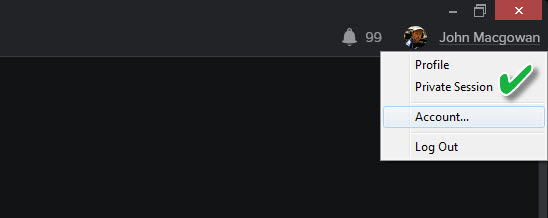
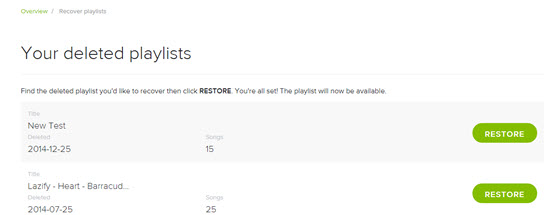
Oh Crap! Ever have that sinking feeling when you've inadvertently deleted a spotify playlist? Have no fear. Spotify has a place where you can recover deleted playlists. To find your deleted playlists go to your Spotify Profile (opens in your browser) and scroll down to Recover Playlists.
While you're on your Spotify profile
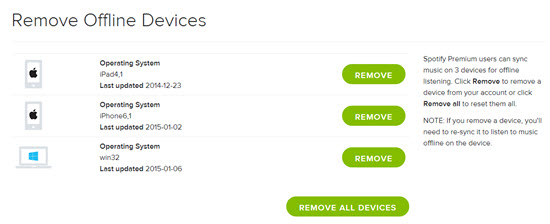
Spotify only allows you to sync three devices. So if you've upgraded, replaced or added any devices (new iPad for Christmas?) you can Remove Offline Devices there.
Clean House
If your sidebar has your scrolling through a few hundred playlists, it maybe time to get organized! While it's not a new feature, how to create new Playlist Folders isn't readily apparent > but it is easy. From the File navigation you can select New Playlist Folder or the Ctrl+Shift+N shortcut has the same result. Create a folder name and then drag playlists into the folder.

Garbage in… Garbage out
To be fair, the Normal setting for sound quality is fine for most listening situations and streaming. Your studio isn't one of them. Can I assume you what the very best sounding music possible? Amplification of music will magnify the quality (or lack of quality) and the difference will be noticeable to your participants. Follow the Settings > Music Quality and set the Sync Quality to Extreme. Sure it takes a bit more memory, but the clarity and PUNCH of your Extreme 320 kbps tracks will make a subtle (yet impactful) impression on your class! NOTE: this setting only effects music you've set to make available offline > which is the only way you should be playing class music.

Find the best EQ for your studio
Do you have a few participants who always show up early? I do and last Thursday (New Years Day) I put them to work before the start time for class. I used Aly & Fila — Perfect Love – Radio Edit, a fun track from this Jan 1st Playlist and went through each option on the Equalizer: Settings > Playback > scroll down > Equalizer. The Dance EQ setting was the popular favorite so Dance was what I used – and will continue to use in that studio.
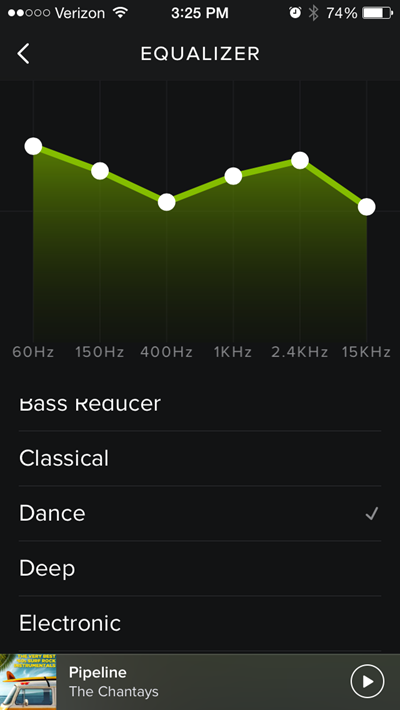
NOTE: If you want to get really fancy you can tap and drag the white dots to make your own custom EQ setting. It appears that Spotify remembers your setting after it's been closed, even though the little check mark doesn't show the next time you open Spotify, so it's all good 🙂
What's this remote control thing?
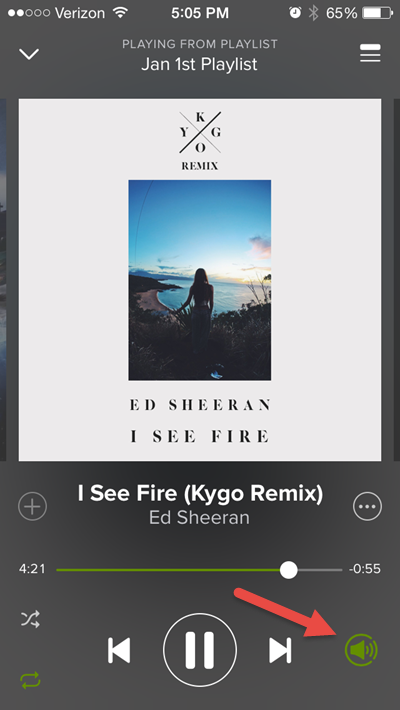
Spotify assumes that if you're playing music from your computer, you automaticly what to control said music from your handheld device. But what if you don't want to control your music from your iPhone? It drove me crazy for a while until I figured out that I could turn off the remote control by taping the green speaker icon shown below.
Did I miss anything?
by Joan Kent | Dec 15, 2014 | Best Practices, Engage Your Students, Master Instructor Blog

The word “technique” intrigues some and makes others yawn. But there’s much to be said for technique. It’s the foundation for all athletic performance features.
Technique involves improved skills. In the broadest, most general terms, that means eliminating unnecessary movement; making movements in the correct directions; applying the necessary power, but no more than that; using the right muscles for the activity; and using optimal speed if time isn’t a factor.
Okay, that’s a dry list. Still, the benefits of good technique — and the consequences of bad — affect training and performance. The last thing I’m going to do is describe cycling technique; vastly superior riders have done that in too many venues. (Check out the excellent videos here on ICI-PRO.) Instead, I’d like to list some benefits of good technique.
Efficiency
The main benefit of good technique is efficiency. Efficiency is the ratio of work output to expended energy. If work output increases OR energy expenditure decreases, efficiency has improved. Efficiency and technique are closely related because principles of efficiency are so similar to principles of technique.
Many activities have an optimal rate. Rates above and below that cost more energy. The mechanism behind that is stored muscle elasticity, which requires the shortest time between muscle relaxation and contraction to prevent the loss of energy as heat.
Good technique reduces the energy required for the pedal stroke, reduces energy lost as body heat, and retains more mechanical energy for the next pedal stroke. Strength goes up — functional-type strength.
Practice reinforces cycling technique, so it improves efficiency.
Consistent velocity
Consistent velocity also affects technique. Unintentionally accelerating or decelerating due to poor technique wastes energy. Obviously, holding a single cadence throughout a cycling class isn’t usually part of the workout plan.
But staying consistent during a song or segment — an important technical skill — can increase efficiency. Beatmatch is an excellent teaching tool for helping students develop consistency.
What else affects efficiency?
Efficiency may involve factors other than technique. For example, it may depend on the contractile properties of the muscle: slow-twitch is more efficient than fast-twitch. It may depend on training, which can increase strength and endurance by increasing muscle efficiency. Big-gear training, for example, can improve efficiency in fast-twitch fibers.
Other benefits of good technique
Doing something with correct technique feels good, probably because the body is being used the right way.
Correct technique makes the student look good. In my master’s thesis, I compared the principles of technique and efficiency to principles of movement aesthetics. It turns out that what makes a movement correct and efficient is also what makes it beautiful.
So technique leads to efficiency, and that wastes less energy. The less we waste, the more energy is left for the demanding parts of the class when it really counts. And the better we look and feel cycling.
You’d like your students to look and feel good while taking your class, complete it successfully, and want to come back for more, right?
Jim Karanas always said, “Endurance athletes don’t mind expending energy, but they never want to waste it.”
Good cycling technique is the key.
by John | Dec 4, 2014 | Best Practices, Health and Wellness, Instructor Training, KEEPING IT FUN

If there was every a reason for Keeping It FUN in our classes – this could be it.
I just read a short article from the latest edition of the IDEA Fitness Journal – Think “Fun” When Exercising To Eat Less Later.
If clients could meaningfully impact ingrained eating behavior by subtly fine- tuning their thinking patterns about exercise, would you try to help them do that? Consider these new findings from the Cornell Food and Brand Lab as an opportunity to move people in the right direction.
Research published recently in Marketing Letters showed that if participants thought of exercise as “fun” or a “well-deserved break,” versus a “workout,” it significantly changed the way they approached postactivity food consumption. Those with fun top of mind ate less than those who viewed exercise as a workout.
Abstract:
Do consumers eat more when they exercise more? If so, the implications could ripple through the multi-billion dollar fitness and food industries and have implications for both consumers and health-care providers. Three studies–two field experiments and one observational field study–triangulate on this potential compensatory mechanism between physical activity and food intake.
The findings showed that when physical activity was perceived as fun (e.g., when it is labeled as a scenic walk rather than an exercise walk), people subsequently consume less dessert at mealtime and consume fewer hedonic snacks. A final observational field study during a competitive race showed that the more fun people rated the race as being, the less likely they were to compensate with a hedonic snack afterwards. Engaging in a physical activity seems to trigger the search for reward when individuals perceive it as exercise but not when they perceive it as fun. Key implications for the fitness industry and for health-care professionals are detailed along with the simple advice to consumers to make certain they make their physical activity routine fun in order to avoid compensation.
I had to look up the word hedonic to be sure I understood what they meant by; consume fewer hedonic snacks. According to this online dictionary:
Adjective
hedonic (comparative more hedonic, superlative most hedonic)
- Of or relating to pleasure
- Pursuing pleasure in a devoted manner
What I think they are referring to here is eating as a pleasurable reward, as in; I worked out today… so now I can treat myself to carmel roll/large vanilla latte, candy bar, etc…
All of us in the USA heard (or said) this last week during Thanksgiving – we're doing a “pre-burn” ride or “I'm doing the Turkey Trot Thursday morning”. The purpose of both is to give permission to indulge in hedonic eating, post workout. Problem is that even riding a hard, hour-long class will only consume maybe 300 – 800 calories. One small slice of pumpkin pie has around 300+ calories and that's without whipped cream.
So are we undermining our participants weight loss goals, with all of the metrics we offer?
by John | Nov 20, 2014 | Best Practices, Instructor Training, KEEPING IT FUN, Master Instructor Blog

This isn't good… I had two Oh Shit “senior moments” in the same week 🙁
The first was when I arrived at the Laguardia airport on Friday, only to discover I had left my wallet and ID back in the safe at the hotel where I had stayed in NYC. So I missed my flight back to Minneapolis and made another loop back into the city to retrieve my forgotten items. Thankfully USAirways has some compassion for people like me and they placed me on a later flight back home
But this morning was actually worse. It was 5:45 am. I was parked at the club, collecting my stuff to teach. I said outloud (to myself) “Where's my iPhone?” And then remembered (or is it realised?) that I had left it back home on the kitchen counter. “Now what do I do?”
And then I remembered, you have the rescue CD that you created for just such an occasion. I relaxed a bit, as I thought about where I would retrieve my CD.
It's in my employee folder…
In the steel cabinet…
Which is in the Group Fitness Dept Head's office…
AT A CLUB WHERE I NO LONGER TEACH!!!!!!!!!!!!!
OH CRAP – now what am I going to do?
During the short run accross the parking lot and into the club, I came up with a plan. “we will be riding to the sounds of riding outdoors!” So as soon as I was dressed and in the studio, I announced just that and we all rode along to the Epic Planet DVD Epic Race Day. This DVD is complete with all of the sounds of riding a road bike during a criterium – including the cheers of all of your adoring fans!
Actually this was an inexcusable, rookie mistake that should have never happened. I know better than to not have a second option for music. I had gotten lazy and too confident that my trusty iPhone would always be there for me. Until I forgot to bring it.
So while I'm typing this post, I'm burning a few CDs that I will stash in my car, as well as in the cycling studio. Here's to having a backup plan!
Do you have one?
by Jim Karanas | Nov 20, 2014 | Best Practices, Master Instructor Blog
With 1800 articles in our archives, there's a good chance you may have missed some of our best posts. So we will be reposting a few that we feel are not only very special, but timeless in their value to ICI/PRO members.
By Team ICG® Master Trainer Jim Karanas
Organized systems of physical movement have the potential to progress toward artistry, yet most indoor cycling instructors wouldn’t call themselves artists. Still, any instructor who wants to create a compelling class experience could benefit from thinking that way.
Certain activities fall under the term “art”. A dancer of any level could reasonably be called an artist, even though many dancers are not particularly artistic. But indoor-cycling instructors are seen as fitness instructors, people who teach indoor cycling.
Are we artists? We’ll get to that in a moment. Is there any benefit in considering yourself an artist? I would definitely say yes. Being an artist implies that you transcend the ordinary and do something creative in your trade.
There are those who cook, garden, design home interiors, or cut hair and have elevated what they do to an art. Isn’t “transcending the ordinary” what many of us strive for as instructors? I don’t teach simply to be a competent exercise instructor. My class is my craft, but it’s more because I create each ride with an approach that feels, at this point, like artistry.
The assets I use to create the experience include music, lighting, voice, words and, most recently, video. I also incorporate concepts and philosophy and combine all of these elements in the cycling studio environment to create art. (I covered some of this in a previous post on The Art of Cueing.)
So can you consider your class art?
It’s an important distinction to make because art enriches our lives, sometimes more than work. When we approach something as art, it stimulates different parts of our brains, makes us laugh or cry, with the gamut of emotions in between. Art gives us a way to create and express ourselves. There are days that creating my next ride is the main reason I get out of bed in the morning.
We’re hard-wired for creativity and hone it to our specific abilities. Giving life to something original from within to share with the world purely for its intrinsic value is perhaps one of the most rewarding feelings we can have.
Originality may be a key concept in art. We’ve all heard that imitation is the sincerest form of flattery, but is the imitation art? I’d say often not, even if it’s imitating something that is.
That’s where the distinction occurs for many instructors. Approaching your class as art may be joyous and provide great return, but it takes authenticity — a willingness to share what’s really you. A copycat workout, even skillfully run, isn’t authentic.
I believe the ability to make art is inherently human, but it TAKES WORK. When I began teaching, my class wasn’t art. I was no more skilled in teaching indoor cycling than anyone else at the beginning, but I’ve poured arduous hours, days, weeks, months and years of my life into it.
My point is “art” is more than a label; “my class is art” isn’t something just anyone can claim, even a good instructor. The difference between art and craft lies in the intent behind it. If your intent is merely to design a great workout, to emulate that amazing instructor at the last conference, or to impress the class with your skill, I’m not sure you can claim to be an artist.
I make my class art because I love creating. There’s nothing more gratifying to me than working on a playlist for days, selecting just the right videos, and planning what I’ll talk about — leaving enough room to improvise that I never know how a class will turn out until it’s over. The process itself is enjoyable: I express my interests and empower my students to enjoy training and go beyond what they thought they could do.
Sometimes class participants dismiss artistic attempts, saying, “I just want to work out”. Such a statement speaks to the loss of creativity in our world and only magnifies the need for us to consider our classes as art. Fitness can be so much more than a workout.
Is your class art? Why should you consider turning your class into art? Are you willing to do the work to make it art?
Art is natural and instinctive, like language and laughter. Pablo Picasso said, “Every child is an artist,” and every culture has art. Expressing something artistically makes us feel more complete.
Art is also a medium for expressing ideas. While a class could be just a workout, treating our class as art gives us greater range of expression and helps us share thoughts, ideas and visions that may not be easily articulated in words.
It’s also healing. Creating your class from an artistic perspective will enliven and stimulate you. The process of creating engages both body and mind and provides us with time to look inward and reflect.
Finally, it’s a shared experience. When you look at your class as art, you recognize it as collaboration with the participants. It uses your skills as exercise specialist, cyclist and public speaker, which combine with the musician’s artistry in the songs you play and the cinematographer’s artistry in the videos you select. Art offers us a reason to share talents in a collective manner.
Approaching my cycling class as art has been good for my soul. It’s been good for my brain and my body. I’m a better cyclist now than I would have been if I hadn’t brought artistry to the practice of teaching indoors. I’ve been a mediocre dancer and a horrible musician, but teaching indoor cycling as art has allowed me to bring my bike to life.
by John | Nov 16, 2014 | Best Practices, Master Instructor Blog, Training With Power
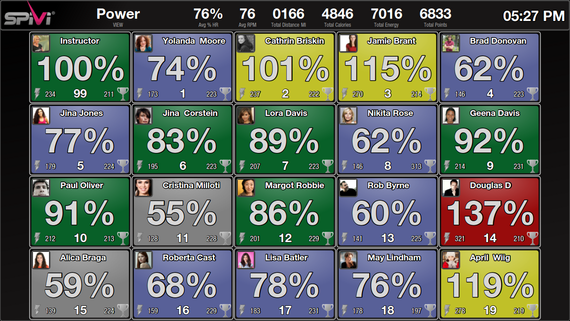
Hey – I just got an email explaining that Spivi has added a FTP (Functional Threshold Power) Test to their display training system. I can't begin to tell you how beneficial these short threshold/best efforts are for engaging participants in your power based classes. That's why I describe these as a Best Practice for anyone teaching with power.
Like PIQ, Spivi offers the option for riders to manually add their FTP / PTP wattage into a user profile. Another option is to enable the Fitness Test option where you can select an 8 or 20 minute FTP test that will record each riders average watts for the period and then add either 90% (8 minute) or 95% (20 minute) of it to their user profile.

 To start the FTP tests wizard, press the left analog stick once, just like if it was a button. Now select the requested test from the menu and press the “Start” button to start.
Don't forget to Instruct the group how to ride and what to do during the test. The FTP test lasts as long as the progress bar on the bottom right side of the screens appears.
