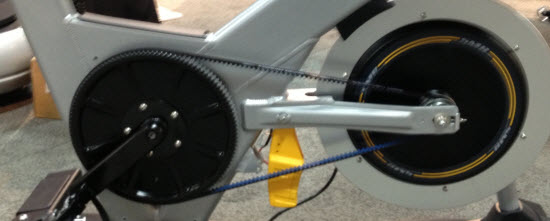
FreeMotion introduced a new belt drive option for their S11 series indoor cycles at IHRSA this year. Bill Pryor and I discussed it on Podcast # 204.
Not being there to ride it, I figured that a belt is just a belt, right?
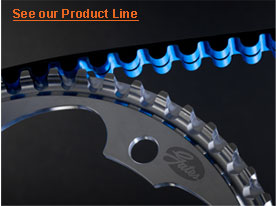
Well no, in this case it isn't. Instead of using a high tension automotive style v-belt, FreeMotion is offering the Gates Carbon Drive as an option. Looking more like a rubber chain, Carbon Drive is becoming very popular on single speeds and tandem bicycles. You can learn more at the Gates Carbon Drive System website.
I've ridden and taught on belt driven Indoor Cycles from; Keiser, Livestrong and LeMond. All of them offer a club owner reduced maintenance costs and Instructors a very quiet class.
But I've always felt something was always a bit off about the feel of these belt driven bikes. Do the people in your class notice or care? Probably not… but what if there was a solution that had all of the advantages of belt drive, without any of the negatives?
In the videos below Doug Crawford (VP of Product Development at Foundation Fitness and designer of the the FreeMotion S11.9) does a very good job explaining the differences between the two systems and shows how they tested and evaluated the Carbon Drive System to ensure would survive in a commercial setting.
In part three Doug shows how they tested it for thousands of hours.
Of course, those of us at Stages Indoor Cycling believe the opposite to be true, (made you look, didn't I!) but we hear this all the time from people that haven't experienced a power-filled class the way it was meant to be. There exists an assumption that indoor cycling is moving away from fun and silently drifting towards a sterile, personality vacuum filled with muzak and boredom. Fortunately, it doesn't take long to convince people otherwise… just a content-rich, fun-filled ride.
In this two-part exploratory look at training with reliable metrics, we'll first discuss HOW to infuse data monitoring in your classes while keeping things fun and interesting. Then in Part 2 we will dive deeper into the physiological benefits and even the community benefits that these new tools can provide. For those of you that don't yet have immediate access to indoor cycles with data providing consoles, I think you'll find that the tips below apply to you as well.
I'm all about Super-7 lists, so… Here are my Super-7 ways to keep Power-Based classes interesting.
1.) Establish a goal and tell them why: Talking about data for the sake of talking WILL get boring really fast. Choose one particular metric to discuss because it will aid your participants in reaching– as I like to call them– “micro-goals.” Micro-goals can be anything, for example:
“For the next 5 minutes your goal is to give me a thumbs-up at the top of each minute. No thumbs-up means you're suffering and this 5 minute segment is about remaining in a place of comfortable, sustainable effort.”
Based on that particular micro-goal, the only thing they should be concerned with on the console is the TIME. They were not asked to base their efforts on ANYTHING other than a perceived effort. And that's okay!! Which leads us to the next point…
2.) Leave the kitchen sink at home: It's very tempting to talk about all the metrics on the console…ALL AT ONCE! Remember, no one is pressuring you to constantly speak about the numbers- this is unnecessary! In fact, it is rare that I ever focus on more than 2 pieces of data in a typical indoor cycling class, because people get easily overwhelmed. We have to warm them up to these concepts over time. Pick something that supports your micro-goal and stick to it.
3.) Luv ya, Don't ever change!: Did that just remind you of your middle school yearbook signatures? Well, it has merit when it comes to teaching- especially if you're already successful! Don't forget to be YOU! Not only is throwing in the kitchen sink overwhelming for your riders, but it has another dreaded side-effect: instructors forget to be themselves and do what they do best. Don't neglect your charismatic side! Tell them that funny story, sing along with your music (if you dare!), ask trivia questions… Basically continue doing the things that make you the unique leader that you were obviously born to be. The data at your disposal can never replace you: it simply increases your odds for more effective communication.
4.) Reduce the filler: 60 minutes is a lot of time to talk about… nothing. With quality information we can now reduce some of the fillers that creep into indoor cycling classes. I promise you, people won't mind if you reduce the number of times you…
Count backwards from 8. (It ain't Sesame Street folks!)
“Woohoo!” (That gets old quickly)
“How we doing?!” (This come across as a cheap way to get them to respond. It only works once or twice before they tune you out.)
“Give me more!” (More what?)
Don't get me wrong, there's nothing inherently bad about these group exercise idioms, but are they really motivating people the tenth time you've said them? Probably not. Once you reduce the fluff, you give yourself valuable time to discuss the task at hand, ask them work-inducing questions and give them a reason to want to achieve those micro-goals.
5.) Lather, Rinse, Repeat: There's no easier way to feel successful on an indoor cycling bike that measures power than to have multiple chances to reach your goal. Near the conclusion of a stage or interval, ask your riders to look at one piece of information and remember it. Give them ample recovery time and let them know that they get another shot at improving upon last time's performance. For instance,
“Get ready to rumble folks because we have a 5 minute stage coming your way, but don't fret; it's nothing that you can't handle, and I'll guide you the whole way. Towards the end of your 5 minutes, before we press the Stage button, I want you to focus on your total distance for this stage.” 5 minutes later… “How did you do? Do you remember the distance you covered? Great, because we get to do that exact same 5-minute stage again. No surprises from me! However, this time I want you to find a way to go just a little further. Could you increase your distance by 1/10 of a mile? Even more? Let's find out!”
Seriously, nothing is more motivating then knowing beyond a shadow of a doubt that you are capable of besting yourself!
6) Games, games and more games!: We've all done games in our classes: front row busts a gut for 30 seconds while everyone else is recovering, then the 2nd row goes, then the 3rd row…etc, but in order to truly be playing a game there must be an objective and there has to be a way to win or at least achieve said objective. The objectivity piece was always missing prior to bikes with consoles. Let the games begin! We'll do an entire post on games in the near future, but for a few examples of games you can check out the BIG RIDE that Pam Benchley and I taught on Saturday night of the ICI/Pro conference. Just remember, competition can get overly fierce very quickly amongst your participants. For this reason, consider integrating games as team efforts first.
7) Deliver Measurable Progessâ„¢: For those of you familiar with the Stages Indoor Cycling method, it will come as no surprise that I really, I mean REALLY stand behind this mantra. At Stages Indoor Cycling we Deliver Measurable Progress via Benchmarks. By assessing where you are today, you now have a means by which to achieve where you want to be 6-weeks or 12-weeks down the road. Functional Threshold Heart Rate testing is wonderful, but what if you could compare that alongside your ability to generate Power at Threshold?! Surprisingly it's very doable even in a large group setting. Of course, FTP/FTHR testing isn't for the Day-1 newbie off the street, but there are many other initial assessments that we can provide our participants that will show them where they are today and what to shoot for tomorrow.
Once benchmark assessments become a regular part of your programming, magic takes place! Participants start planning their workouts around these benchmarks as if they were training for an event, even if participating in a race or organized outdoor event has no appeal to them personally.
This all boils down to the “Susan and Bob” conversation from a few weeks back. It's true people come to your classes for a plethora of reasons, but I think it's safe to say that NO ONE would be disappointed if by coming to your classes they were able to do more work with less effort, endure more physically and emotionally, travel farther and go faster. If this helps them achieve their weight-related goals, what a wonderful side effect! If this breathes new life into indoor cycling as we know it – PRICELESS! And that, my friends, is far from BORING.
I'm so excited for Part 2! Your feedback regarding the Super-7 reasons above will dictate the direction of ‘Power Is Boring: Part 2.” Think of it as a “Choose Your Own Adventure” novel! Speak now or forever ride in silence. 😉
I need to publicly thank both Cameron Chinatti, the Education Director for Stages Indoor Cycling along with Marketing Director at Foundation Fitness & Stages Indoor Cycling, Laurel Mylin for believing in ICI/PRO and co-sponsoring our conference this year.
Cameron will be conducting the Stages Essentials Instructor Certification as a Pre-Con on Friday 9/30 and will also be presenting four sessions during the conference.
Of course this turns our conference planning on it's head. I plan to have the final registration details completed by Monday 5/9 night for ICI/PRO members to make their selections.
I have opened early registration for those of you wanting to get a jump on everyone else. This year we are offering you the chance to make multiple payments, rather than one lump sum. Here is the link to register.
Last year the hotel sold out. Even if you are thinking about sharing a room I would suggest that you reserve a room here’s the phone number to the hotel 978-750-7987 and tell them you are in the Indoor Cycling group. We will be helping connect those looking for room-mates. NOTE: Our block of reserved rooms extends from September 28th to October 4th for those of you wanting to come early or stay a day or two longer.
Listen to the Podcast below for more information about Stages Indoor Cycling and their participation in the conference.
Minimal required maintenance – the belt doesn't stretch and you never need to lube it.
Should last forever
Did I mention that it's very quiet?
Weaknesses
More expensive than a chain drive
It may require the pedal crankarms be spaced further apart = wider “Q-factor”
That's all I can think of.
Disclaimer and perspective: I have taught on the FreeMotion S11.9 for the past year at two Life Time Fitness clubs. I train at home on a S11.0 (the home trainer) that was given to me for evaluation purposes.
My only real complaint with the original chain drive FreeMotion S11 series Indoor Cycles has been the amount of chain noise coming from the drive system. That noise, multiplied by 50 or more cycles in a class (or just one in a basement) can be very distracting/unsettling/frenetic and it requires much more volume of both you and your music.
If you've every experienced how calm/relaxed a class with belt driven cycles is, you'll understand exactly what I'm talking about.
Where does this additional noise comes from? It's from the chain wrapping around very small front sprocket used to rotate the flywheel at a much higher RPM than on a friction IC.
Big drive gear x small driven gear = very fast flywheel RPM
All Indoor Cycles use some form of weighted flywheel to mimic the momentum of riding a bicycle. Cycles with magnetic (Eddy Current) resistance (FreeMotion S11.x, Keiser M3 & Schwinn AC) all use an aluminum (or combination aluminum/steel) flywheel. All steel alone won't work when you're using Eddy Currents to create resistance.
Aluminum is lighter than steel = less mass = less rotating momentum. Also the design of the combination flywheels has the “steel” portion closer to the hub, resulting in less mass around the perimeter of the flywheel. The flywheel needs to rotate quite fast to create enough of these “Eddy Current's” to make the requested resistance, which is good because this additional speed makes up for the aluminum's lack of mass. The gear ratio (big crankshaft gear x small flywheel gear) needed to achieve this flywheel speed = additional chain noise.
By using a belt, instead of a chain, FreeMotion has eliminated the noise problem… but all belts are not the same…
There are a number of popular Indoor Cycles using a belt drive system; Keiser M3, Livestrong/Tomahawk and the LeMond RevMaster. All of these cycles all use a Kevlar belt – perfect for most people, except for the cyclists in your class. For them, these Kevlar belts feel very foreign. They don't “feel” like a bicycle because chains create a vibration as it rolls across the sprockets and that vibration is missing from a super smooth Kevlar belt.
I'm sure that Gates did a bunch of research and testing when they developed the Carbon Drive system as a replacement for bicycle chains. Their success (I'm presuming here) would be dependent on creating a replacement for a chain that eliminated all the negatives; maintenance, wear, weight, grease and noise – while retaining the familiar feel of riding a bicycle. The “teeth” of the carbon belt, as it rolls across the pulleys, create a similar vibration to a chain = the “feel” of a bicycle, W/O any of the negatives of a chain.
I want to share this email exchange I had with ICI/PRO member Julie Zweck-Bronner.
Hi John,
You have said you teach at a facility that has the Freemotion bikes. I was wondering if that facility uses the pedals that came with the bikes or different pedals. We will get 40 Freemotion bikes in May and are wondering how to accommodate our riders that have LOOK cleats. Should we spend the money to switch out to all Schwinn Triple Link pedals like on our Star Trac bikes we currently have? There was some talk about using the Triple Link Pedals off the old bikes to save money, but I worry they are too worn to put on brand new bikes. Do you also find that many riders wearing bike shoes do not like the basket/cage staying on the underside of the pedal as they ride?? Thanks for your insight.
You're going to have so much fun Julie.
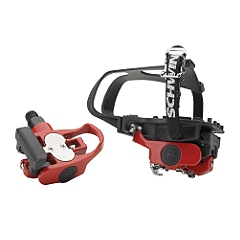
If you are getting the S11.9 I think they come with a good two sided pedal with SPD/shoe basket. Where I'm teaching they switch out everything for triple links as that's just what they do.
If it was my studio I would work toward getting everyone to switch to SPD. Look doesn't make the traditional “LOOK pedal” anymore. Now they have the KEO which looks like it should work – but it doesn't.
I would swap the best 10 triplelinks onto the new bikes and leave the rest.
Unless of course you normally have 30 cyclists with LOOK cleats every class, then you already know what to do 🙂
Can I have your permission to create a post about your question?
Thanks John, yes you can post and thanks for your insight. Do you think avid bikers who wear bike shoes prefer the triple link because the can remove the cage/basket on the flip side of the pedal unlike the pedal that comes with the FreeMotion bike? That has the spd on one side and the fixed/permanent cage on the flip side. Sounds kind of anal but want to address all concerns. Thanks again, Julie ZB
Julie LOOK pedals were the most popular for years (but are no longer) and cyclists wanted to use their shoes – I don't think they care if the basket is there or not.
SPD is rarely used by road cyclists (they were first used by mountain bikers) but are best for indoor because they work on a recessed shoe = easy to walk in and safer – road shoes were never meant to walk in and are very slippery on any polished surface.
Rather than speculate, I suggest you ask your students and act accordingly.
Thanks John we will take a poll!
I haven't heard the results of Julie's poll, but I have conducted one myself at the two clubs where I teach that use the Triple Link pedal with some interesting (yet very unscientific) results:
About half of the riders using LOOKs had purchased their shoes/cleats specifically for indoor use.
Another 25% originally had LOOK cleats on their road bike = their shoes just happened to fit the pedals we used indoors.
Almost no one was using the original LOOKs on their road bikes anymore.
Almost everyone had multiple pairs of shoes.
I feel it's very important to be as accommodating to cyclists, but times are changing. If you're looking at an equipment upgrade a simple email poll using Survey Monkey will tell you a lot + identify those few participants you will need to accommodate if/when you make a change.
I'm going to need a pair of these so I can see when Amy is slacking off on the Tandem.
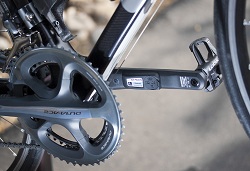
Stages Cycling has taken the technology they developed for the FreeMotion S11 series Indoor Cycles and is now offering the StageONE Power Meter to outdoor cyclists.
I don't have any direct experience other than a heads-up email announcing the launch of this , but there are two very informative posts from bloggers who are at Eurobike earlier this summer.
Stages Cycling readily admits that it's not necessarily trying to go head-to-head with established players such as SRM, Powertap, and Quarq in terms of outright technology, instead preferring to go after so-called ‘blue collar' riders who merely want a consistent means of tracking progress for training purposes.
Using a Bluetooth enabled device (the StageONE doesn't come with any display) you can add power and cadence for $699.00 which is less than half that of other systems = outdoor power gets a bit closer to being real for many of us 🙂
Will Grossman from Stages Cycling has promised me more information soon. Right now they are swamped with their launch and Interbike which starts tomorrow. Their website is supposed to go live today. http://www.stagescycling.com/