This Podcast is was originally published on February 22, 2009, I have updated it with our new Podcast host information and I am representing it now. I hope you enjoy it, Joey
Keiser Master Trainer Suzette O'Byrne and I discuss the initial response to their new correspondence Indoor Cycling certification course. Keiser has recently introduced their new M5 elliptical trainer and have created a certification program so you can bring the cross training benefits of an elliptical trainer into your class. Update: here is a video of the M5 in action - http://www.keiser.com/m5/
149 Keiser® Striding and Cycling: An Indoor Collision
Workshop PREMIERE (Description from IDEA's site) Suzette O’Byrne and Krista Popowych Group elliptical classes are HOT in Europe! Now you can be among the first in North America to experience “striding” in combination with indoor cycling in this fun and innovative workout format. First, we will cover striding foundations and teach you how to use the on-board computers so you may monitor your progress. Next, discover how you can implement a variety of training methods (i.e., interval drills, speed drills, hiking drills, recovery drills, etc.) for ultimate fitness. Finally, get information on how to develop a class that blends these two formats into one amazing workout. Repeated as sessions 209, 249 and 309. Listen to the Podcast below or subscribe for free using iTunes or Zune.
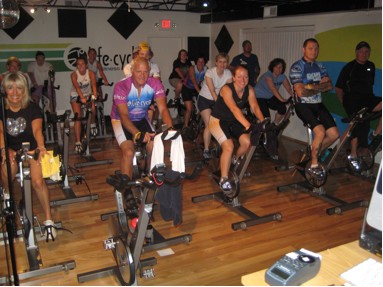
Fun pic from Julie's facebook.com/TheWallCyclingStudio
Hi John,
My name is Julie and I am the owner of a cycling studio in Philadlphia, PA called “The wall cycling studio.”
This past weekend I had a couple instructors over and after a little time we somehow got on the discussion of how one of my biggest dreams to live is to show up to a spin class while on vacation, the instructor not show up and for me to be able to jump up and say “I'm certified and ready with a playlist!”
My friend then sent me the most recent email from you about traveling instructors. I think it is amazing and a great way for places to be able to offer quality classes!
Could you let me know some more info? This would be a dream trip for my husband and I!
Thanks again and I look forward to listening to your pod cast!
Julie we've helped hundreds of Indoor Cycling Instructors make this fantasy a reality – except for the part about the absent Instructor – unless it's you who's supposed to teach, but you're asleep in a hammock, on the beach 🙁
My wife Amy and I have been teaching group fitness classes, at All-Inclusive resorts in the Caribbean, pretty much every year since the mid 90's. Every trip has been a dream and we could not have afforded to travel as often as we have, without the assistance of our (now friends) at Fit Bodies, Inc.
We have a separate site devoted to these teaching fitness vacations – and the process is super simple. Here are the basics:
About Fit Bodies, Inc.
Fit Bodies, Inc. has been offering international leisure travel for the fitness instructor since 1992. FitnessProTravel.com is home of the Fit Bodies teaching vacation program.
Instructors offer a couple hours of teaching to resort guests daily and in exchange you and companion(s) stay at luxury all-inclusive resort with accommodations and amenities provided just like a full paying guests. You wine and dine, enjoying an all-inclusive vacation usually costing thousands of dollars for a fraction of the price.
How does it work?
With the Fit Bodies, Inc. program you do not pay the hotel for your stay. You pay a fee for each week you travel, it’s roughly $500 for you and a companion (family resorts include two kids 12 or younger as well) to stay at the resort with all-inclusive everything for seven nights. The resorts are 4-5 star all-inclusive luxury destinations. Teach one or two indoor cycle classes on your non-travel days. It is a WIN WIN! You get a low cost vacation and guests have a great fitness experience! There are even more opportunities to the cycle instructors who also offer group exercise formats.
The details are instructors’ pay for flights and sometimes airport transfer costs (to and from hotel). All resorts participate in the GIFT FUND where we keep the hotel’s activities and sports department up to date with items or money contribution. The gift fund has a value of $150 at most hotels so that is part of your expenses.
There is no cost or obligation when you apply but I encourage you to apply by completing an online account with us at FitnessProTravel.com. The account gives you real time booking availability at all the resorts you qualify to teach at. So then you can choose when and where to travel, book it online with us, and be quickly confirmed with permission to buy flights.
Once you are online at FitnessProTravel.com and going through the app process you will come across membership levels. I know it’s explained on the site but want to elaborate here- With the BASIC (free) membership you can view complete availability but with your free membership you only have access to book 15 resorts. By upgrading to any premium account (including TRAVEL) you will then have booking access to every resort you qualify to teach at. You can view resort details without even having an account by clicking on “TRAVEL SPOTS” on the FitnessProTravel.com home site.
Bill Pryor from Spynergy Consulting visited the annual IHRSA Show last week to learn what’s new for cycling studio owners and entrepreneurs. Here are some highlights and photos from his report.
“……once I got over the sensory overload, I made a point of visiting all the bike manufacturers to ride the bikes and hear about new trends. I also tried to see what kinds of metrics, programming and video content are out there. I even spent some time with the flooring, lighting, sound system and insurance folks to see if there's anything new studio owners might want to hear about……”
StarTrac. The market leader in bike sales, they were of course showing the NXT and the Blade which have been recently re-designed (very cool styling.) One of their engineers also walked me through a demo of a new console (measuring power) that will be built into the Blade within the next year. You'll be able to get the Blade with or without a power console.
Schwinn. I also rode the magnetic resistance Schwinn AC and got a close look at their console. Power is measured as well as heartrate, cadence and more. Data from the console can be downloaded to a USB pen drive, or wirelessly transmitted via ANT transmission to a garmin or other device.
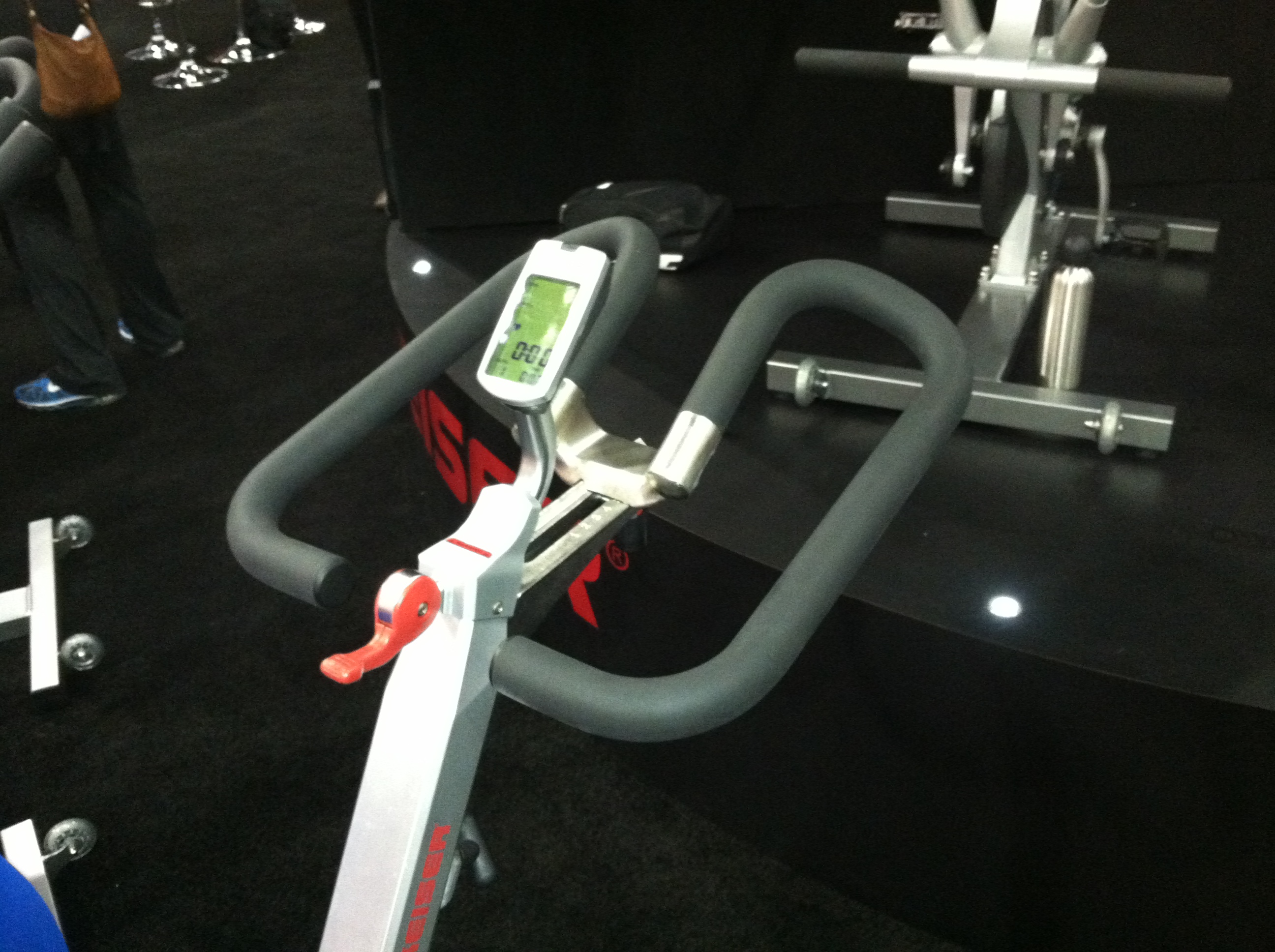
New Keiser handlebar
Keiser. A new handlebar design for the Keiser M3 should silence complaints from some smaller riders who had troubles with bike fit. They have an established power console and also numbered resistance which lots of people really like. Performance IQ was co-exhibiting with Keiser…they have a system for projecting on-bike data to a screen so instructors and students can view their data.
RealRyder. This uniquely designed bike with the swaying motion is becoming a favorite with some studio-starter who want to have something to clearly delineate them from the large gyms and health clubs. Optimizing the experience does require some special training for instructors and students, but they make a compelling case about the differences and benefits once folks learn.
Freemotion. These guys are the newest player but have created good buzz as they have made the power console and related programming an integral part of what they provide. The design of their console is well organized and highly readable. At this show, they also introduced a quieter “carbon drive” to make for a more smoother, quieter ride, with good durability
Livestrong. I had not ridden their bike before and found it really comfortable. Outside riders will love the fact that there are a wide range of hand position options including actual “drops”. The bike was cool, but to be honest it was hard to focus on the bike because they were showing it in conjunction with the MyRide virtual ride video system with was absolutely astounding….more on that below.
MyRide video management
Non-Bike Highlight: No matter what bike you have or choose….the good news is that if you want to use a video system, there's an amazing one out there. I have seen a lot of video for indoor cycling classes, but the MyRide systems from Matrix/Livestrong was absolutely stunning. The video itself (multiple terrains and imagery), but also the control system interface. There are systems deployed in Europe, but this is brand, brand new in the U.S. A pilot studio is up in San Francisco.
Bill Pryor owns a 48 bike studio in the Boston area and is also founder of Spynergy Consulting, helping entrepreneurs launch and develop their businesses.
Minimal required maintenance – the belt doesn't stretch and you never need to lube it.
Should last forever
Did I mention that it's very quiet?
Weaknesses
More expensive than a chain drive
It may require the pedal crankarms be spaced further apart = wider “Q-factor”
That's all I can think of.
Disclaimer and perspective: I have taught on the FreeMotion S11.9 for the past year at two Life Time Fitness clubs. I train at home on a S11.0 (the home trainer) that was given to me for evaluation purposes.
My only real complaint with the original chain drive FreeMotion S11 series Indoor Cycles has been the amount of chain noise coming from the drive system. That noise, multiplied by 50 or more cycles in a class (or just one in a basement) can be very distracting/unsettling/frenetic and it requires much more volume of both you and your music.
If you've every experienced how calm/relaxed a class with belt driven cycles is, you'll understand exactly what I'm talking about.
Where does this additional noise comes from? It's from the chain wrapping around very small front sprocket used to rotate the flywheel at a much higher RPM than on a friction IC.
Big drive gear x small driven gear = very fast flywheel RPM
All Indoor Cycles use some form of weighted flywheel to mimic the momentum of riding a bicycle. Cycles with magnetic (Eddy Current) resistance (FreeMotion S11.x, Keiser M3 & Schwinn AC) all use an aluminum (or combination aluminum/steel) flywheel. All steel alone won't work when you're using Eddy Currents to create resistance.
Aluminum is lighter than steel = less mass = less rotating momentum. Also the design of the combination flywheels has the “steel” portion closer to the hub, resulting in less mass around the perimeter of the flywheel. The flywheel needs to rotate quite fast to create enough of these “Eddy Current's” to make the requested resistance, which is good because this additional speed makes up for the aluminum's lack of mass. The gear ratio (big crankshaft gear x small flywheel gear) needed to achieve this flywheel speed = additional chain noise.
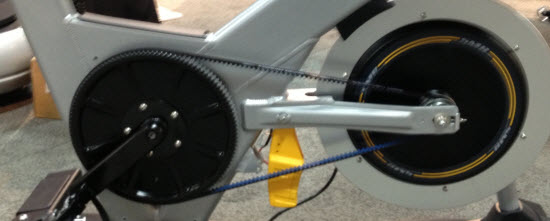
By using a belt, instead of a chain, FreeMotion has eliminated the noise problem… but all belts are not the same…
There are a number of popular Indoor Cycles using a belt drive system; Keiser M3, Livestrong/Tomahawk and the LeMond RevMaster. All of these cycles all use a Kevlar belt – perfect for most people, except for the cyclists in your class. For them, these Kevlar belts feel very foreign. They don't “feel” like a bicycle because chains create a vibration as it rolls across the sprockets and that vibration is missing from a super smooth Kevlar belt.
I'm sure that Gates did a bunch of research and testing when they developed the Carbon Drive system as a replacement for bicycle chains. Their success (I'm presuming here) would be dependent on creating a replacement for a chain that eliminated all the negatives; maintenance, wear, weight, grease and noise – while retaining the familiar feel of riding a bicycle. The “teeth” of the carbon belt, as it rolls across the pulleys, create a similar vibration to a chain = the “feel” of a bicycle, W/O any of the negatives of a chain.
My original objective of the Power blog here in ICI/PRO was to build the case for power precept upon precept, slowly but surely. Good idea, except for folks who already find themselves teaching on power bikes and are anxious to get to the meat & potatoes. So, as the line in Monty Python’s Holy Grail said (whilst preparing to throw the Holy Hand Grenade) “Skip ahead brother…”
The most fundamental principal in power training is that you can sustain higher power output for shorter periods. This is common sense of course, but when trying to train or “hone in” on power levels you will use for different types of riding outside, one needs to identify these time periods, and develop power based on the length of those efforts.
For example, outside of the long mountain passes in Colorado, or Europe, your standard “hill climb” will often be only 3 to 5 minutes. This is also met with generally a steeper grade than those more gradual, longer climbs, and thus there is a measure of power required to climb those that is significantly higher, and requires different training.
In addition, if you race (or simply want to just impress your friends at every opportunity), you may want to develop significant sprinting or break away skills. To do that, you will want power that is even higher than climbing power, but may only be needed for as little as 60 seconds. This may seem quite short, but it is often all that is needed to achieve a real break away, or triumph in a race ending sprint.
Consequently, we have built the Cycling Fusion Power Training system on 3 zones of power; Sustainable Power (7 to 20 minute efforts), Climbing Power (3 to 6 minute efforts) and Explosive Power (1 to 2 minute efforts). These ranges are quite large, and there are 7 power levels within each zone. Rather than bore you with all the details, let’s just jump in and conduct a class that provides a sample of each of these zones.
The class design below is based on the Keiser M3 bike, since it is what we use at my club (Global Ride Training Center) in Pittsburgh. Since we also speak specifically to how we can reset our power numbers, I’ve written this class specifically to this model, and thus I call the class: The Keiser Tour De Power. For those that do not have a Keiser M3, but do have power, simply replace the portion of this workout that speaks to resetting the bike to get your average power numbers for one of the zones, and it will work just as well on any other bike.
My friend Allen Jones from Epic Planet.tv – the company with the Epic Planet Indoor Cycling DVDs – has just launched a FREE Virtual Cycling Studio Program. It address a major pet-peeve of mine; getting a reduced price replacement DVD when you have one that's scratch, damaged or for what ever reason won't play.
I'll let Allen explain the program…
Virtual Cycling classes are taking the indoor cycling world by storm with instructors and studios all over the U.S., Canada, and Europe using epicRIDES to bring an exciting new dimension to their classes.
From Southern California to Maine… from Florida to Washington state… from Nova Scotia to British Columbia… and in Europe too… epicRIDES are wowing classes and giving both instructors and studios an exciting new way to differentiate themselves from the competition.
Here's what some indoor class students said about their virtual ride to Epic California – Mt. Baldy:
“I was really impressed. I usually close my eyes when I’m spinning, but I kept looking up to see the scenery. I have to admit I took the last climb to my '10' and that damn clock on the screen was way too slow!”
“The Mt. Baldy ride was outstanding, as this is a ride I have actually done, so I could really relate to it. I was able to make this ride feel very real, as the video was very well done and made me feel like I was right there, doing this painful ride again. Two thumbs up to you and the producers.”
If you are an instructor or studio owner using or planning to use epicRIDES for your classes, we want to encourage your efforts! To do that, we are launching the Virtual Cycling Studio Program, which will provide member instructors and studios MANY special incentives and benefits, including:
Discounts on DVDs and downloads
Disk replacement program
Discounts on indoor cycling clothing
More to come…
To become a member, just complete their online signup form. There is no charge or obligation.





 –
–