This post has been adapted from an article By Selene Yeager published on June 13, 2019 which can be found HERE.
The following is excerpted from Climb! by Selene Yeager–your guide to train for, conquer, and ultimately fall in love with hills. I (Joey) have read Climb! and I recommend the book, again both for indoor and out.
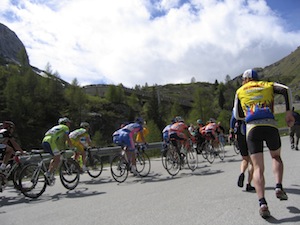
How does one train for a mountain bike stage race, a hard race where you have hour-long climbs, short grinders, and rollers all thrown into the mix, for 4 to 6 hours a day, day after day. The answer is simple, hill repeats and lots of them.
If you are not already doing hill repeats in your indoor classes, you should consider them. They are hard, they allow you to dial in your time at intensity, and they will build a stronger student. Not all repeats have to be the same, some can be level, such as 3 x 8-minute or 6 x 5-minute hill repeats where you have 24 to 30 minutes at threshold. Others can be crafted to mimic real-world conditions, where you’re hanging onto attacking riders or trying to stay away or make a break, like 8 x 3 minutes or 12 x 2 minutes, so the same time at even higher intensity.
These not only train your body to produce more power aerobically, better manage lactate, and produce more power at your threshold, but also bolster your mental reserves, because it’s just as challenging for your mind to blaze up the same lung-busting climb as it is for your muscles.
The following hill repeats are taken from an outdoor preparation plan that is designed to build climbing power. Generally, a workout like this is only done once or twice a week and on fresh legs. Also, though hill repeats are designed to be somewhat torturous, they’re not intended to bury you. These should be done at an 7-8 on a scale of 1-10, not a 9 or 10. Your speed, intensity, and/or power should be within the goal range on every repeat.
Uphill Sprint 20s:
Being able to surge and recover helps you hang with the group up climbs and gives you the reserves to power through undulating climbs that kick up into double-digit grades.
Do It: Design a ride that has a steady climb in the 10 to 15 minute range for duration. Begin the climb in HeartZone 4, climbing at your lactate threshold (LT) RPE of 7 to 8. After 2 minutes, stand up and attack at just below all-out sprint intensity, HeartZone 5, (RPE 9) for 20 pedal strokes. Sit and go right back to climbing at your LT. Repeat every 1 to 2 minutes (depending on your fitness) all the way up the hill. Perform the drill one or two more times.
Rock The Rollers:
To keep going strong through rolling terrain, practice 2-minute attacks.
Do It: Design a ride with short climbs that take about 2 minutes to crest. Wind up before you hit the climb, so you’re at LT (RPE 7 to 8) as soon as the hill starts. Climb at LT for 90 seconds, then go as fast as you can (RPE 9 to 10) for the final 30 seconds all the way to the top. Repeat four to six times.
Short Rest Repeats:
These classic climbing intervals simulate real-world climbing conditions where you often don’t have the luxury of fully recovering before you’re hit with the next incline.
Do It: Design a climb that takes about 10 minutes to climb. Roll into the climb and crank your intensity to your LT heart rate and/or power (RPE 8). Hold it there for 6 minutes. Recover for 3 minutes. Repeat for a total of four climb intervals.
Rocket Drills
As the name implies, these short intervals go from 0 to 60, like a rocket, to develop the explosive strength and power you need to punch up steep climbs without losing speed and momentum.
Do It: Design a short incline that takes about 2 minutes to crest. Begin from a standing or slow-rolling start (much as you would a race), on a count of three, explode up the hill as hard as you can (RPE 8 to 9) for 2 minutes. Recover for 3 minutes. Repeat 5 to 10 times.
I hope that this helps you in your next class design. I always try to bring a little of the outside in every time I ride......Joey
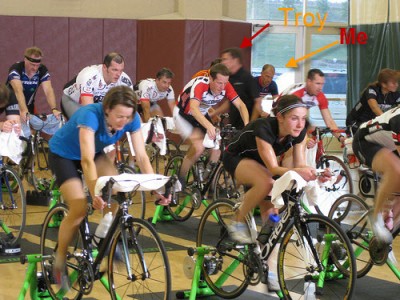
I was there! OK, but because I was talking to so many people I ended up in the back row, at the end of that row, but I did get close to Troy Jacobson, as he walked past, once…
A popular choice for Performance Tandems and Single Speed bikes.
Rules are not necessarily sacred; principles are. — Franklin D. Roosevelt
My cycling background revolves around the chain. My coach used to say, “The chain is sacred.” It vibrates, and that’s precisely what gives the bike its feeling of life. The vibration brings the rider a deeper sense of, and connection with, the bicycle. Without that vibration, without a chain, a bike is dead. I’ve believed, taught, and ridden this way since long before belts were introduced to Indoor Cycling.
If you had asked me back then about building a bike with a belt, I would have said without hesitating, “Don’t mess with the chain.”
Because of my background and the coaching I got, I can argue for the chain better than almost anyone. Those arguments, though, are philosophical, not focused on moving the industry of Indoor Cycling forward.
From my new perspective, working for a company (Indoorcycling Group, ICG) that makes a spectacular line of bikes with belts (LIVESTRONG), the conclusion is clear. The belt requires less maintenance, has fewer breakdowns, improves pedaling technique, does not allow for momentum-based recovery, makes the rider work more efficiently, is quieter, and is safer for new riders. It will save the club owner money, decrease liability, train participants more effectively, and make less noise.
No one on the management side of the club business would need to hear more to choose a belt. For economic reasons alone, the industry will go this way. It’s generally wise to ride an elephant in the direction it’s going. It seems foolish to push for a chain drive in light of that.
But here’s another thing to consider: 95% of the people who get on an indoor cycle won’t understand that “the chain is sacred.” They will notice only that the belt is quieter and smoother. This was the point that sold me. Although I tried relentlessly to find people who understood why I insisted that the chain is sacred, few people got it, almost no one felt it. Not even instructors who were currently teaching on chain-driven bikes.
Instructors whose jobs depend on the Indoor Cycling industry should not need any more convincing. Convincing club members who are used to chain-driven bikes, however, may take a bit more work.
The first thing I ask them to do is tell me what they like about bicycle riding. After they go on for a while, I ask them what they like about indoor cycling. That, too, goes on for a while. Regardless of the individual answers, the key point is that indoor cycling is quite different from riding outdoors: no need to balance, different movements, different hand positions, fixed gear, and more. There are many differences, all far more noticeable than the drive train.
Next, I ask them what other kinds of bikes they've ridden. Performance bikes only? How do they react when they see someone riding down the road on a cruiser in flip-flops? My point is a bike is a bike. You’re not a consummate rider if you fixate on what you think a bike should be. In fact, you’re less a cyclist than the overweight woman struggling on the hybrid. She has more grit. She’s happy just to be riding. THAT is a cyclist.
I ask them if they know which bike is the best in the world. It’s the one you’re on 🙂
Cycling is sacred, not the chain. I dig the vibrations and the sound of all the chains in a peloton as much as any roadie. But chains are secondary to the circular motion of the pedal stroke. The continuity of the circle is what creates the sense of peace that allows you to get outside your mind. The chain or belt simply permits the transfer of power to the forward motion. It’s the motion that makes you feel like you’re flying.
If you want to call yourself a cyclist, get past the chain. Respect all bikes. Find peace in a smooth circle with a belt and satisfaction in the increased work it puts your legs through without the free-spin of a chain.
With good instruction, a belt won’t detract from the class experience — and may very well add to it.
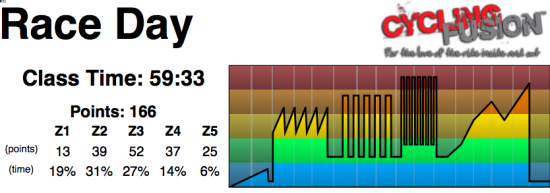
RACE DAY was another winner of our Ultimate Instructor Class Profile contest from Instructor Mark Peterson!
For the love of the Road Race! The inspiration for this ride was the recent Pro Cycling Challenge in Colorado but the ride is generic in the sense that you could do this ride as a stage of any Cycling Race. The objective of the ride is to educate my students on the sport of Bike Racing, entertain and to provide some of those moments of lung splitting, leg busting intensity that is Road Racing!
Mark is a detail guy and what made his contest submission unique is that he created it using the ClassBuilder iPad/iPhone App from Cycling Fusion.
The graphic at the top displays during the entire class. A marker moves along on the screen, helping everyone understand where they are and more importantly, what's coming next.
This was Mark's second visit to the Podcast. You can listen to ICI Podcast #190 — Virtual Class Ride Prep to learn his tips and trick to effectively using video in your class.
Star Trac had the new Spinner® Blade Ion on display at IHRSA. I rode one during Josh Taylor's 6:30 am demonstration ride this past Thursday. After the class I discussed the Ion's new features with Josh. I then got an overview of Spinning's new Spinpower™ education from Program Director Angie Sturtevant, which I'll share as a separate article.
Basics
The “Ion” differentiates this bike with Power from the conventional Spinner Blade. It uses the same chain drive and friction resistance system, found on all Spinner® Indoor Cycles.
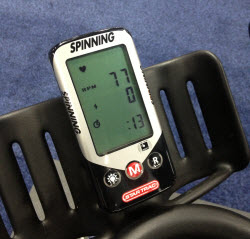
Console / Monitor
Very simple… and I'm a huge fan of simple, so right away I appreciated how easy it was to use the Ion's console. I was told they are making a few minor changes so the final version may look different. Working down from the top, the display shows:
Heart Rate
Cadence
Power
Elapsed Time
Just three buttons
Left button turns the back-light on/off. It doesn't time out because it doesn't need to preserve battery life. It will stay on until you want it dark or you stop pedaling. I might not have this completely right – but you get the point – the light will shine all class 🙂
Center button scrolls through screens displaying; real time and averages + calories
Hold down the Right button for 2 seconds resets the Elapsed Time – Josh explained that this button will also add a “digital marker” to any Ant+ enabled devise, identifying the beginning or end of an interval, similar to the “Stage” button found on other consoles.
Josh made the point during his demo ride that their console will show ZERO watts when there's no resistance, regardless of the cadence = this will show all of our “spinners” that they aren't doing any real work until they've added some load.
Free Registration Required to read the rest — Click Here. Opens in a new tab.
[wlm_ismember]
Measured Power
Strain gauge measures the amount of pull on the brake pad.
The Blade Ion measures power with a strain gauge connected to the brake pad – again more simplicity. This technique is actually over 100 years old and how the horsepower of early engines was measured; by measuring the force acting on the brake, as the flywheel tries to drag the brake around it's circumference.
If you have an NXT available you can see exactly what they are doing. Remove any resistance and start the pedals turning slowly. Now carefully touch the slowly turning flywheel with one finger. Feel how it wants to drag your finger along? Can you see how the harder you press against the flywheel, the more effort it takes to hold your finger in place? By measuring that force, the speed of the rotating flywheel and then doing a bit of math, we could calculate Power.
That Black Box contains the strain gauge and replaces the normal brake pad holder on the standard Blade or NXT – which begs the question; will they ever offer a retrofit power meter for older NXT's?
What about Calibration?
I was told that the Ion will be factory calibrated and that no other calibration will be necessary – which I find very hard to believe.
This isn't the right time to get into a lengthy discussion over what I see as fundamental differences between; how the Ion measures the amount of Power coming out vs. how FreeMotion (and also any bicycle crank arm/spider or pedal based power meter) is measuring the amount of Power the rider is putting into the cycle. Or if it's really of any value…
So I don't leave you hanging here, the factory calibration may indeed accurately display the amount of coming out of the Ion forever… but does that precisely reflect the amount of power the rider is putting into the cycle?
What I'm questioning is there's a lot of drive train (multiple bearings and the chain) between the pedals (work in) and the brake mechanism (work out). This engineering article describes the efficiency of bicycle chain drive system and how losses can vary between 2% and 20%. I'm sure Star Trac's engineers have a very sophisticated algorithm to work all this out on a new Ion – but what happens over time? Worn chains and bearings, sprocket alignment and chain tension will all have an effect. Potentially some of the Ion's in your studio could become favorites because they display a higher wattage, relativity to the amount of work introduced by the rider, simply because its chain is in better alignment. Does that make sense?
No Batteries Required
Angie said she likes this because it's “green” (no batteries to throw out) – this blue light is a very cool touch.
Hands down my favorite feature of the Ion is how it charges itself. Josh told me that it incorporates a smart charging system that will allow the batteries to discharge before recharging. That wire runs from the hub charging unit & cadence counter up to the handle bars.
Phone cord allows adjustment.
How it felt to ride & my overall reaction.
Adding a cool blue Instructor platform will be de rigueur for any studio with Blade Ions
Let me start by saying Star Trac makes a phenomenal Indoor Cycle. Solid and smooth – I'm sure Jeff Wimmer had his hands on these. They fit me perfectly – or after riding & teaching on them for all these years do I fit them perfectly? Either way they're very nice to ride… and you hear the yeah-but coming… but I've really become a fan of magnetic resistance over the past 4 years. I understand how Spinning's® brand goes to the “feel” of a Spinner® and that “feel” comes in part from a friction based resistance system. I prefer riding magnetic and was disappointed that the Ion still uses a friction brake.
I also felt weak/less powerful on the Spinner Blade Ion. Or said differently, for a given amount of effort, I was seeing a lower wattage number than I'm used to seeing from a recently calibrated FreeMotion or a Schwinn AC. You could add embarrassed to my list of feelings. I actually felt compelled to cover my readings while Josh was off the bike checking in with his class 🙁
Thinking it may just be me, I went directly to FreeMotion's area and jumped into a class with Cameron Chinatti. Nope, it wasn't me. There on a familiar cycle, I was seeing/feeling my normal ~250 FTP. So back to the Ion (different bike this time) but the same results. A similar effort/HR and only saw ~180 watts.
I talked to Angie about this and she suggested that you just can't compare the two, they're different. I've asked Angie to join me on the Podcast to discuss this in detail and will let you know if/when she'll come on as a guest.
Later that morning I also tried a little experiment that I've wanted to do for years…
What happens to your Power / Wattage when you accelerate from a set point, say; 100 watts @ 60 rpm to 90 rpm on friction based system, as compared to a magnetic system? Do they react the same way?
If you teach an early morning class, it is not unusual to skip a morning meal before leaving for the gym or club. If you have done this, then you’ve done fasted cardio. Maybe not fueling before a class is a necessity, or maybe, like myself, you just can’t stomach eating that early. Either way, there is a fair amount of buzz linking fasted cardio to weight loss and performance benefits. So, should you be exercising on an empty stomach? Here’s what the experts at bicycling.com have to say.
What Is Fasted Cardio?
Fasted cardio isn’t a hard concept to understand. “It literally just means doing a workout after not eating for some amount of time,” explains Lauren Antonucci, R.D.N., a board-certified specialist in sports dietetics based in New York.
Some people may claim they’re doing fasted cardio by skipping lunch and heading straight into a post-work ride, but the scientific literature specifies that the body needs a 10- to 14-hour period of not eating to be truly fasted, adds Meghann Featherstun, R.D., board-certified specialist in sports dietetics based in Cleveland. So, for most people, fasted cardio would occur first thing in the morning. 

What’s the point of exercising on empty? Once you’ve been in a fasted state for enough time, there’s no glycogen available for energy, and your body needs to find another source of fuel. Within a few minutes of starting a fasted workout the percentage of fat you would burn in that workout would be a little bit higher, says Antonucci.
The research is clear: If we exercise fasted, we tap into our fat stores as a fuel source sooner, so we’re running more on oxidized fat versus glycogen or carbohydrates, says Featherstun. People who ran on a treadmill in a fasted state burned 20 percent more fat than those who ate in one small study published in the British Journal of Nutrition. And people who consistently trained in a fasted state over the course of six weeks showed more endurance improvements than those who ate before working out, an older study published in the Journal of Applied Physiology found.
The Drawbacks of Exercising on Empty
People tend to latch on to those concepts, and see fasted cardio as a path to weight loss (you’ll burn more fat!) or enhanced performance (if you can tap into fat stores for long periods, you’ll never bonk!).
When it comes to weight loss, all that fat-burning potential does sound appealing. But in the end you are still be burning the same amount of calories for the workout, says Antonucci. If you’re eating within the nutritional budget determined by your training plan and weight loss goals, “burning a little bit higher percentage of fat is not really that important to your body weight over time or your body composition,” she says.
Keep in mind, your body doesn’t automatically burn fat instead of glucose in a fasted state; it could turn to protein instead. “Research shows that there’s an increase in muscle breakdown when we exercise fasted, so it could actually decrease our strength,” says Featherstun. Working out in a fasted state yielded twice the amount of protein breakdown in muscles than in a non-fasted state, according to a study published in the Strength and Conditioning Journal.
And about those endurance benefits… People were actually able to perform aerobically for longer after eating than when they fasted, a more recent meta-analysis published in the Scandinavian Journal of Medicine & Science in Sports found. As we all know, other research shows that fasting has negative impacts on the intensity and volume of training.
Any time you do any high-intensity workout, you’re going to burn a much higher percentage of carbs. “Not fueling beforehand just shortchanges your energy and ability to work hard,” says Antonucci. Plus, your rate of perceived exertion is much higher at a lower intensity when you’re exercising off fat versus carbs, says Featherstun, and you’re likely to finish fasted high-intensity workouts feeling terrible or hit a wall sooner in longer efforts.
So, should you do fasted cardio?
If you’d rather use your mornings to sleep in a little bit or you can’t handle the idea of eating early in the morning, sure, it’s okay to do fasted cardio. “Just make sure you’re only doing easy workouts when you’re in a fasted state,” says Featherstun. Cap those low-intensity rides at about 45 to 60 minutes, which is about how long it will take before your glycogen stores get low.
Otherwise, when it comes to really putting in the work, it’s better to exercise within one to three hours after eating breakfast. “When you’re properly fueled, it’s going to feel better mentally and physically,” says Antonucci.