I hate math, especially when I'm forced to do quick calculations in my head.
Figuring (forgive the pun) that many other people dislike math, I won't ask anyone to do any calculations in my classes. For example, I would never cue something to the effect of;now I need everyone at 85% of AT for one minute… and then we'll push up to 95% for the final 30 seconds! Against a background of loud, pounding music, at that point I've got my head up and I'm mouthing to you:
Wait… what are you asking me to do?
Won't do it. Instead I base my Life Time Performance Cycle classes on two numbers; PTP (Personal Threshold Power) and JRAP (Just Riding Along Power – AKA > Base Watts > VT1 / First Ventilatory Threshold Power). From these two rider identified threshold wattages, we can construct three meaningful power Zones;[wlm_private ‘PRO-Platinum|PRO-Monthly|PRO-Gratis|PRO-Seasonal|Platinum-trial|Monthly-trial|PRO-Military|30-Days-of-PRO|90 Day PRO|Stages-Instructor|Schwinn-Instructor|Instructor-Bonus|28 Day Challenge']
Recover zone – watts below JRAP
Perform zone – watts between JRAP and PTP
Improve zone – watts above PTP
That's all I need to coach and cue an easily understandable class, to a variety of riders. Regulars include committed endurance athletes, Cat 2 cyclists (A group riders), weekend warriors (B group) and lots of; “I'm not training for anything John… I just like your class” regular folks.
Using these three simple zones makes the cuing each task much easier to communicate and, without a lot of numbers and percentages flying around the room, much more actionable by my riders.
Now I need everyone in the upper part of their Performance Zone for one minute… and then we'll push up to the Edge of your threshold the final 30 seconds!
This is an expanded version of Dennis Mellon's Below/@/Above threshold cues he uses and similar to the well documented heart rate based concepts that makeup the Zoning Program.
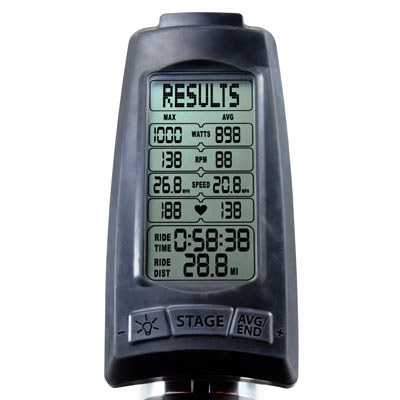
Using this system to cue wattage intensity, I've successfully taught this class for past two years – this is our third on the FreeMotion S11.9 Indoor Cycles. We do not have a Display Training system like Performance IQ or Spivi to project rider metrics on a screen and/or do the “math” for you to display percentage based power zones. The numbers on the console are what we have to work with.
Over this times I have had numerous (dozens maybe) participants thank me for NOT using percentages of “something” to communicate intensity levels of heart rate or wattages. That makes me happy and it really simplifies my job as the Instructor/Coach > Coach is a much better description of my role in these classes training sessions as I will typically ride side by side with them, rather than up front in the normal Instructor position.
NOTE: I still have control of my music when I'm riding with the group. See this post about using an inexpensive bluetooth receiver so your iPhone is wirelessly connected to the sound system.
Today's 75 minute session > Pinning Down Two Numbers
I you look at the song lengths of my playlist you'll quickly understand the class format >
A long (9-13 minute) song where we play around finding JRAP / Base Watts
Followed by a short (3-4 minute) track where we explore PTP
Rinse and repeat
The first track is of course a warm up that includes 3-4 x 30 second accelerations / openers near the end to get everyone ready to work.
Track #2 – the first PTP track is important. We'll use this average wattage for each of the four PTP efforts to follow. Everyone seemed to enjoy Billy Idol — Rebel Yell – 1999 – Remaster – maybe suffered a bit as well. At 4:47 there's plenty of time to explore PTP. We use the Stage button to reset the averages at the beginning of what I describe as; Your Best Sustainable Effort. It's normal for riders to miss-judge where they should be, so I'll often have everyone make needed adjustments and hit the Stage button again to reset the averages.
Track #3 is for finding JRAP / Base Watts. The very recognisable Peter Frampton — Do You Feel Like We Do – Live is perfect for this. We used the first few minutes of the long track to recover and then begins of dialing in the wattage that has everyone at JRAP/Base Watts. It's fast @ 108 RPM – I don't demand they follow it exactly, encouraging cadences above 90RPM. With one hand on the resistance knob, we add / subtract load in small increments… and then wait for our breathing response. I cue the feeling where you're just above “chatty” = you are first noticing you'd prefer breathing through your mouth.
My own unscientific research has be seeing JRAP / Base Watts ~ 65-70% of PTP. Sorry, there are those damn percentages I hate > I offer that just for your perspective.
If using VT1 / First Ventilatory Threshold Power or heart rate is new for you this series of posts have a bunch more detail. This video from ACE does a great job demonstrating VT1 / First Ventilatory Threshold.
I get questions; John, they're talking about heart rates here, not power, so how does this apply?
Heart Rate BPM's are just an indication of effort (how hard you're working). Watts are the same. You work “X Watts” hard, it feels like “Y RPE” and your HR is “Z BPM”. Does that make sense? It doesn't need to be any more complicated than that. Remember, I hate math 🙂
Rinse & Repeat
Self direction is a key component of how I coach my Performance classes. After all, I'm not going to be there with them on the road. So once everyone understands the drills and what what they're supposed to accomplish, I pretty much turn them loose.
Please let me know if you use this > or your questions.
This post has been adapted from an article By Selene Yeager published on June 13, 2019 which can be found HERE.
The following is excerpted from Climb! by Selene Yeager–your guide to train for, conquer, and ultimately fall in love with hills. I (Joey) have read Climb! and I recommend the book, again both for indoor and out.
How does one train for a mountain bike stage race, a hard race where you have hour-long climbs, short grinders, and rollers all thrown into the mix, for 4 to 6 hours a day, day after day. The answer is simple, hill repeats and lots of them.
If you are not already doing hill repeats in your indoor classes, you should consider them. They are hard, they allow you to dial in your time at intensity, and they will build a stronger student. Not all repeats have to be the same, some can be level, such as 3 x 8-minute or 6 x 5-minute hill repeats where you have 24 to 30 minutes at threshold. Others can be crafted to mimic real-world conditions, where you’re hanging onto attacking riders or trying to stay away or make a break, like 8 x 3 minutes or 12 x 2 minutes, so the same time at even higher intensity.
These not only train your body to produce more power aerobically, better manage lactate, and produce more power at your threshold, but also bolster your mental reserves, because it’s just as challenging for your mind to blaze up the same lung-busting climb as it is for your muscles.
The following hill repeats are taken from an outdoor preparation plan that is designed to build climbing power. Generally, a workout like this is only done once or twice a week and on fresh legs. Also, though hill repeats are designed to be somewhat torturous, they’re not intended to bury you. These should be done at an 7-8 on a scale of 1-10, not a 9 or 10. Your speed, intensity, and/or power should be within the goal range on every repeat.
Uphill Sprint 20s:
Being able to surge and recover helps you hang with the group up climbs and gives you the reserves to power through undulating climbs that kick up into double-digit grades.
Do It: Design a ride that has a steady climb in the 10 to 15 minute range for duration. Begin the climb in HeartZone 4, climbing at your lactate threshold (LT) RPE of 7 to 8. After 2 minutes, stand up and attack at just below all-out sprint intensity, HeartZone 5, (RPE 9) for 20 pedal strokes. Sit and go right back to climbing at your LT. Repeat every 1 to 2 minutes (depending on your fitness) all the way up the hill. Perform the drill one or two more times.
Rock The Rollers:
To keep going strong through rolling terrain, practice 2-minute attacks.
Do It: Design a ride with short climbs that take about 2 minutes to crest. Wind up before you hit the climb, so you’re at LT (RPE 7 to 8) as soon as the hill starts. Climb at LT for 90 seconds, then go as fast as you can (RPE 9 to 10) for the final 30 seconds all the way to the top. Repeat four to six times.
Short Rest Repeats:
These classic climbing intervals simulate real-world climbing conditions where you often don’t have the luxury of fully recovering before you’re hit with the next incline.
Do It: Design a climb that takes about 10 minutes to climb. Roll into the climb and crank your intensity to your LT heart rate and/or power (RPE 8). Hold it there for 6 minutes. Recover for 3 minutes. Repeat for a total of four climb intervals.
Rocket Drills
As the name implies, these short intervals go from 0 to 60, like a rocket, to develop the explosive strength and power you need to punch up steep climbs without losing speed and momentum.
Do It: Design a short incline that takes about 2 minutes to crest. Begin from a standing or slow-rolling start (much as you would a race), on a count of three, explode up the hill as hard as you can (RPE 8 to 9) for 2 minutes. Recover for 3 minutes. Repeat 5 to 10 times.
I hope that this helps you in your next class design. I always try to bring a little of the outside in every time I ride......Joey