It’s dinnertime, and I’m flying home to San Francisco from a Houston business trip. The flight attendant is bringing around the service cart and I’m about to order … milk. I never drink milk, so why now?
Let’s go back to how the day started. Fortunately, I had ordered eggs and oatmeal from room service. (This was a number of years ago, before we all became gluten-phobic.) Breakfast showed up at 7:00; so far so good.
I was in Houston in January for a meeting called by Sherry. The meeting started at 10:00 a.m. and was scheduled to last till 1:00. My return flight was at 2:30 p.m.
Sherry had promised us food. I should have been suspicious, because Sherry and I once had dinner at an airport, and hers was a plate of white-flour pasta and a plate of white rice. The only foods at the meeting were donuts, Danish pastries, M&Ms, Halloween-size candy bars, soft drinks and coffee. No refreshments for me, thank you.
At 1:00, a few of us got into Sherry’s car so she could drive us to the airport. Six hours without food had left me hungry, and I planned to get food at the airport. Unfortunately, unexpected traffic due to an event in town slowed us to a crawl. It was not going to be possible to get food before my flight. Maybe a pack of raw almonds? Almost every airport newsstand sells those.
Well, time was so short I had to run to the gate. When I finally stepped on the plane, they closed the door literally the instant I was on board. And then.
The flight couldn’t take off for an hour due to some problem or other. (Believe me, I had stopped caring.) Even when we were cleared to go, we couldn’t take off because the plane now had to be de-iced. We sat on the tarmac for 2 more hours.
So our 2:30 flight departed at 5:30. There was no meal service — it was an afternoon flight. A 2½-hour flight. After a 7:00 a.m. breakfast and nothing else, all I could think about was food.
Finally, the beverage cart appeared. I had already decided what to order. You might think I’d grab whatever I could get, but as I watched people consume Pepsi, ginger ale and apple juice, I knew that spelled nothing but trouble for a carb-sensitive like me.
The answer lay in finding food.
Food on a beverage cart. Are you thinking peanuts? So was I. But they had pretzels. White flour would have been worse than nothing. So my plan — at this point, was it Plan B or Plan C? Maybe D; it was a long day — was milk. Milk isn’t a beverage; it’s food. Usually, I don’t drink it, but this wasn’t usual.
Got milk? They had it — 2%, the only kind they serve on airlines. I had done the calculations (plenty of time to do arithmetic on the tarmac), and 2% was actually the perfect answer. It came as close to a 40-30-30 meal as I could get on the fly, although it was light on protein and a bit heavy on fat. Even though I don’t go around pushing 40-30-30 meals (remember The Zone?) on my clients, I do know that the effect of those percentages is stabilizing.
The key word is Stabilizing, and that’s the take-away here. In this case, stability refers to both blood sugar (glucose) and brain chem. In a semi-emergency like this, it’s tempting to use the situation as an excuse to grab anything edible, even things we should avoid.
But milk was a wiser choice, and in 20 minutes I felt a lot better.
Lately, I’ve been finding it necessary to go with Plan B often — so the best idea is always to have one. When it comes to food, a solid Plan B is absolutely vital. Carry envelopes of protein powder or packs of raw nuts with you, rather than fruit. Think stability. After all, we’re talking about your brain first, as well as the rest of you.
Stage races span the duration spectrum. Shorter stage races that are done over a weekend might feature a time trial and road race on Day 1, for example, then a criterium on Day 2. These points on fueling for stage races are culled from several sources — cycling books, cycling magazines, websites, and my coach.
Ideal fueling starts with Body Recalibration — not my term, just a fancy name for conditioning your body for recovery. Recovery should begin at least 6 weeks before race season. (An even better practice is to eat well year-round, but we have to start somewhere — and I’m well aware that this post is late in the season).
Start by eliminating junk — assuming any of you ever indulge in such stuff! Junk includes alcohol, sugar, caffeine, high-fat chips, and such. If you’re in the habit of fueling with sugar before and during trainings, it’s a good idea to eliminate that as part of this process.
My coach always said that endurance athletes never mind expending energy, but don’t want to waste it. Wasted energy refers to anything without a performance payoff. Having to detox from chemicals and junk like sugar wastes energy.
Next, add the good stuff. Eat foods in a natural state whenever possible (whole foods, rather than processed). Stress vegetables (3-6 cups a day), rather than fruit. Fructose is associated with lots of health issues and isn’t good fuel for training.
If it’s possible to eat organic, do. That’s less important if we don’t eat the skin. So organic nuts matter less, but organic apples are a big deal. At least stay away from The Dirty Dozen — the foods with the highest pesticide levels: apples, strawberries, grapes, celery, peaches, spinach, bell peppers, imported nectarines, cucumbers, cherry tomatoes, imported snap peas, potatoes. Three foods recently added to the list are kale, collards and hot peppers, so it’s a Dirty 15.
Eat the same types of foods that you eat during your training. Race day is not the time for nutritional surprises. Believe it or not, if you’ve been junking out all the way up to race day, you might as well eat that way for the races.
Don’t deplete carbs or skip meals, especially race-day breakfast. Eat some extra starches 1-2 days before the event.
The primary nutrition concerns in training and racing are:
– Replacing water. Dehydration reduces blood volume; increases heart rate and perceived exertion; impairs thermoregulation, mental performance, and endurance.
– Replacing sodium. Low sodium can result in disorientation, nausea, fatigue, seizures, or collapse. Salt your food instead of using salt supplements.
– Saving glycogen during the race so it’s there at the end when you need it. (This may be a good place for Dr. Joan’s Potato Goo…)
– Replacing glycogen after the race so you can perform well in the next stage. High GI starch and protein in a 3:1 or 4:1 ratio replace glycogen better than sugar, including fruit. Don’t eat fats right after the race. They slow carb absorption.
Eat 3 hours or more before the start of the race. If you’re not adapted to that, consider it part of Body Recalibration. Avoid eating 30-60 minutes before the start, which may be too close to the effort. Find a food combination that works for you, but avoid all-carb (especially all-sugar) meals. They can lead to reactive hypoglycemia in some athletes and cause bonking. Instead, include protein and fat.
Refuel within 30 minutes after your race. Always. Be fanatical about it. Glycogen replacement is maximized during that 30 minutes because glycogen synthetase is in its active form and facilitates peak storage. Eating within 30 minutes counteracts cortisol’s breakdown of muscle protein for energy and will reduce soreness — very important for the next stage. If you miss the 30-minute window, your muscles may be temporarily insulin resistant for several hours. That prevents best glycogen replacement and may interfere with your performance in the next stage.
Eat again 2 hours later and 4 hours later — or 3 hours prior to the next stage. If you race twice that day, stay aware of how many calories you’re expending and consuming. Many convenient devices are available that are worn on your wrist and provide this information.
Racing at over 20 mph while drafting may burn roughly 12 kcal/kg/hr. Without drafting, that could increase to 15 kcal/kg/hr. Gender, size, and muscle mass all affect those values. Cycling efficiency (good technique) can lower them. The more you ride overall, the less you may burn.
The goal during racing is to postpone fatigue, not replace all of the calories you’ve burned. Full calorie replacement should occur during recovery.
Refuel within 30 minutes after the last race of the day, especially if you have to race again the next day!
And keep in mind that these points may also help on days that you teach several classes.
There we were, toward the end of the day at a conference that featured lectures on health problems from eating gluten, health problems from free glutamate, and similar topics. The audience accepted the information enthusiastically — along with the slides that showed extremely long lists of foods that contain the offending substances. In other words, long lists of food to avoid.
Finally, late in the afternoon, I gave my presentation on sugar as a limiting factor in health. The previous speaker had run well over his limit, cutting my allotted time down to 32 minutes. It would be tight but still do-able; this was not a “tough room.” I began to go through my slides and deliver my teaching points.
A man in the audience asked if I was talking about “added sugar” or was including natural products like fruit. I answered that sugar did include fruit — and that fructose, the sugar in fruit, can cause a variety of health problems.
In fact, all of the negative health consequences of sucrose, a disaccharide that’s half fructose and half glucose, are attributed to the fructose in it, not the glucose. Even though you can find disagreements in science journals on virtually everything, no disagreement on this topic exists in the science lit. Researchers all seem to agree that fructose makes sucrose the junk that it is. (These points have been covered in my previous post, “Fructose: The Sugar No One Thinks Is Sugar”.)
Well, the man became angry and even left before the end of my short presentation. Believe me, I’d seen reactions like that before. Sugar is a topic I’ve presented on many times over the years (since 1990, in fact, when everyone was still obsessing about fats). Audience reactions to sugar information have often been strong, and that’s interesting because those were presentations, not personal consultations.
In a presentation, I have no idea what the audience members eat, so nothing can be taken personally. Or should be taken personally. But addiction isn’t rational or logical. One question in a short test for alcoholism is, “Have people ever annoyed you by criticizing your drinking?” The key word in the question is “annoyed”. Mess with someone’s addiction, and they get angry.
Maybe we should start asking fruit addicts if people have ever annoyed them by telling them fruit is sugar.
It has seemed lately that people don’t care about sugar addiction, including their own. Fairly recently, an obese woman told me that she knew she was addicted to sugar but was “okay with it.” That reminded me of the final criterion for substance dependence in the DSM-IV — which has been moved into first place in the DSM-V criteria for substance abuse disorder: Continued use despite adverse consequences.
The past decade or more has shown a nutrition awareness shift that actually harkens back to the 1970s. In the 1970s, science journals were filled with articles on the negative impact of sugar on health. Videos were available, and at least one popular book was written on the subject (Sugar Blues).
In the wake of this, the sugar industry — a powerful lobby in Washington — got busy, and, starting about 1983, three things happened.
1. Fat became the new dietary demon, and everyone started eating low fat this and nonfat that.
2. Sugar consumption between 1984 and 1999 increased by 25-45 pounds per person per year. (25-45 lbs represents the increase, not total consumption.)
3. Obesity in the U.S. became an epidemic.
No doubt the sugar industry was, and is, quite happy with those results.
Now we’re back to a more realistic evaluation of food. Fats are recognized as not being as bad as we used to think — and we know some of them are supremely healthful. Everyone knows that sucrose is junk. Researchers, at least, know that fructose is what makes sucrose junk.
But if all we’ve done over the past 15 years is switch our addiction to fruit, I’m not sure we’ve made any progress. Especially when people get just as angry when I advise them not to eat too much fruit as they used to get when I advised them not to eat sugar.
If you've ever had an idea for a new, fitness related product or service? Dream about building a company around your new widget and then selling your company to a larger company? If that sounds like you, you'll want to listen to this interview with fitness entrepreneur Sara Shears. Sara invented the Ugi ball to help her personal training clients train more frequently. After years of effort, she was able to sell her company Ugifit to Mad Dogg Athletics.
Rather than trying to explain Ugi to you – watch this short video to see it in action.
http://youtu.be/GxkBlo44XPA
Listen to Sara explain some of here entrepreneurial journey below.
I met with Sara at WSSC and took one of her 30 minute classes. It kicked my ass and the whole time I was suffering through Sara's class, I kept thinking how Ugi could be the perfect strength and balance compliment to a small boutique's cycling class.
Interested in training to teach Ugi classes? Here's the link to their website where you can find a certification training near you – or how to host a training at your club or studio. I'd love to know what you think about Ugi…
As fitness professionals, many of us find it is exciting when a member asks us for fitness related advice… but are you making the proper recommendations?
Do you really understand what she/he is asking?
Do you have enough information to respond in a way that will be motivating?
Or do you have the tendency to just launch into a long response, hoping that some of it sticks?
As a long-time sales guy, I've tried to learn the importance of asking the right questions, before offering a solution. Actually it's often a series of questions, before I'll consider responding. Last fall I talked about a total fail I had early in my career, when I tried to empress a potential customer with all my product knowledge, in this post.
Now that I finally have a device (my new iPad) to download ebooks, I'm putting it to good use. My latest read is The Psychology Behind Fitness Motivation: A Revolutionary New Program to Lose Weight and Stay Fit for Life by Health Psychologist Dr. Kim Chronister. In the book Dr. Kim describes the concept of a Motivational Interview – which sounds exactly like what I suggest you use, whenever you've been asked for help or advice from a member.
Motivational Interviewing for Exercise Motivation
An optimal technique that is supported by the research for exercise motivation is motivational interviewing (MI). When you are seeking the motivation to gain results (for a better body, sharper mind, etc. from regular exercise) motivational interviewing falls into the “what you need” category to get you “what you want”…results.
MI has been shown to be enhanced when MI is combined with other effective treatment methods such as cognitive behavioral therapy (which was discussed in the previous chapter). The technique of motivational interviewing can be used to improve a person’s motivation to change and it can be effective in facilitating behavioral change.
In a clinical setting, motivational interviewing is used by a therapist or other mental health or medical professional to help promote positive change in a client’s behavior. MI exercises are designed to help people recognize the need for changes in their behavior. As a first exercise, let’s say a motivational interviewer (i.e. psychologists, nurses, social workers, medical practitioners, physiotherapists, and dietitians) is meeting with a client trying to lose weight to alleviate chronic health problems. The motivational interviewer would emphasize the importance of the change, current information about why the client should make the alteration in his/her lifestyle, including many benefits. The motivational interviewer would then provide the steps and action plan to make these lifestyle changes. At the end of this chapter, you will be given tools based on the technique of motivational interviewing to help you in your personal fitness goals.
Near the end of the interview, Dr. Kim and I discuss her thoughts about a question I had; should Instructors take an active role in sales and marketing, especially Instructors who teach at a small studio?
What do you think? Should (or would) you be willing to sell/market/promote your studio's services to your participants? I'm not referring to you simply reading a few announcements before the start of class here. I mean communicating with members with the purpose of building rapport, suggesting upgrades, encouraging purchases, recruiting new participants… you know, selling what your studio has to offer.
Would you do that if you were rewarded financially?
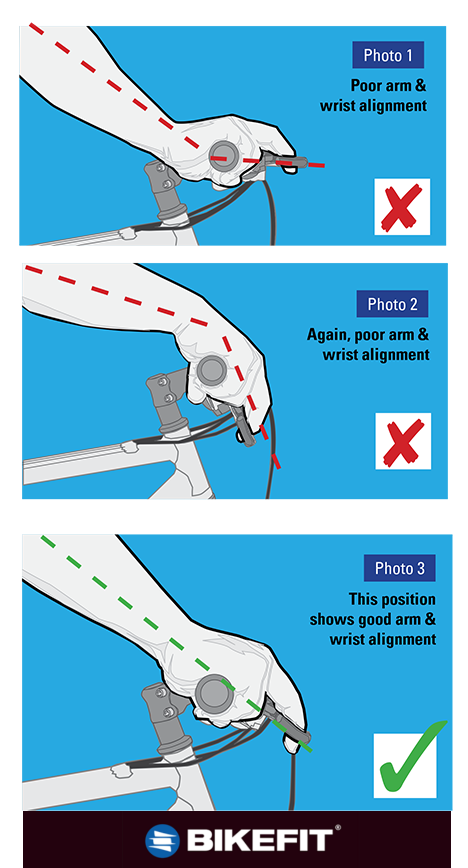
Paul Swift from BikeFit sent out an infographic showing proper wrist alignment – their example is for a mountain bike, but the concept is identical no matter what you're riding. If you've been to WSSC, BikeFit is the company who provides the very popular bicycle shoe cleat alignment / adjustment service.
Complaints about hand numbness are typically the result of riding with hyper-extended wrists. We've explored the need for proper hand position in detail here at ICI/PRO in these posts: