
by John | Jan 29, 2021 | Instructor Training, Master Instructor Blog, Product Reviews, Training With Power
NOTE: this was a previous review from 2013 that continues to remain accurate when applied to any of the magnetic friction Indoor Cycles available today.
Many Indoor Cycle manufacturers claim a connection with cycling outdoors:
100% Authentic – Spinning is authentic. It’s true to its cycling roots, yet refined to a simplicity that makes it the perfect program for any age or ability.
FreeMotion says; Drive System Mimics Outdoor Riding
The Schwinn® Authentic Cyclingâ„¢ Series is based on one simple principle: we believe that riding a bike indoors should feel as much like riding an outdoor bike as possible.
There are of course multiple similarities between riding indoors vs riding outdoors. Beyond the obvious differences, not needing to balance an indoor cycle for one, the claimed connection is that their Indoor Cycle feels like riding a bicycle outdoors.
But what does that mean? A feeling can be pretty subjective after all.
My review of the new Spinner® Blade Ion included a comment that I was a little disappointed that Star Trac continued with a friction resistance system, vs. the magnetic systems used by FreeMotion, Schwinn and Keiser.
I also teased you at the end of the post with:
Later that morning I also tried a little experiment that I’ve wanted to do for years…
What happens to your Power / Wattage when you accelerate from a set point, say; 100 watts @ 60 rpm to 90 rpm on friction based system, as compared to a magnetic system? Do they react the same way?
My apologies for the delay. I'm just getting to this today.
The ” little experiment” I conducted was something that I'd wanted to confirm/quantify for years, actually since I first started teaching on a Schwinn AC in 2010.
My early experiences riding/teaching with magnetic resistance, along with a discussion I had with Keiser's President Dennis Keiser, demonstrated to me that the amount of resistance created by the magnetic (Eddy Current) resistance system increased in lock step with a faster cadence / RPM. The faster you pedaled the harder (more force required) it was to turn the pedals.
Which is pretty much what you experience riding a bicycle outdoors, at speeds over 18mph. As you pedal faster (assuming you stay in the same gear) you and the bike move faster through the air. The faster you go, the more the resistance from the air pushes against you, making it harder and harder to turn the pedals.
There's a handy calculator to compute the amount of work it takes to overcome the resistance of the air here.
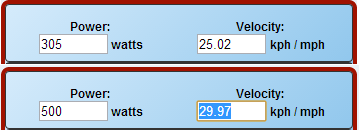
The difference in power needed to ride 25 mph vs 30 mph
So it takes apx. 300 watts to ride at 25 mph. To ride at 30 mph (just a 20% increase) you need to create over 60% more power. You can't make the power with additional leg speed – you're probably near your maximum efficient cadence already at 25 mph. To get to 30 mph you'll need to shift to a lower gear and push harder… A LOT HARDER!
Very different from the conventional friction system on an NXT – which (to me) feels like it gets easier to pedal, the faster I pedaled. In fact most of us can take what is a high level of load (at a slow cadence) and accelerate to the point where our legs spin-out and won't move any faster.
Side note: It's extremely rare to see someone riding with excessively high cadence on a magnetic resistance indoor cycle.
I've discussed this concept here in the past, but I couldn't prove or demonstrate it. I even went so far as contacting LOOK and Garmin to see if they would lend me a set of those new pedals with the built in power meter. They wouldn't and the crank arm from my FreeMotion doesn't fit on a NXT. It remained a mystery until now.
So while I was at the IHRSA convention, I finally had the chance to compare the new Blade Ion and the FreeMotion. With both cycles offering “measured power” I felt it would be a fair comparison; Magnetic vs Friction Resistance. Which best replicates riding outdoors?
Although I wasn't exactly “scientific” in my test protocol, nonetheless the results were very interesting.

Fun with graphs!
Here's what I did
My test was admittedly simple. After completing an early AM ride with Josh Taylor, I spent some time riding both the Spinner Blade Ion and FreeMotion S11.9. I began by establishing a steady 60 rpm cadence. Then I added resistance until the power meter showed 100 watts @ the 60 rpm. Then I accelerated to (and sustained) 90 rpm and took notes on what happened. I rode both cycles twice and the results were consistent. The blue Magnetic Watts line is more squiggly than the red Friction Watts line because I used the actual date set I downloaded directly from the FreeMotion's USB port.
I'd already tested the FreeMotion S11.9, so I knew that the 50% increase in cadence would result in a doubling of power. Perfectly consistent with my understanding of how Eddy Currents increase linearly with speed. A 50% increase in RPM = a 50% increase in resistance. Although math isn't my strong suit, it's easy to see how a 50% increase in Speed multiplied by a 50% increase in the amount of force required to turn the pedals = a 100% doubling in power/wattage. While not the same effect as what you'll find chasing down a breakaway at 27 mph, it is enough to force your students to work hard in a way that will help prepare them to hang with the “A” group.
The Spinner Blade Ion reflects the inherent weakness of using a friction pad with a heavy, perimeter weighted flywheel. The graph above clearly shows how the amount of resistance doesn't increase with additional speed – it actually goes down, validating what I had hoped to demonstrate. If it just stayed the same I should have observed 150 watts @ 90 rpm, I only saw 135 watts. So where did the other 15 watts disappear to? That's a math thing I'll leave to others smarter than me to answer. I will offer a guess that if I had continued on to 120 rpm, I would have seen a progressively lower increase in wattage vs what would be expected from a doubling of speed.
So what's this all mean?
Short answer – it's my opinion that magnetic resistance is superior in every way to a friction system. Besides being zero maintenance, the linear increase in resistance is much closer to what your participants will experience outdoors. Combined with the reduced inertia of the aluminum flywheel, magnetic cycles require more work to ride and force everyone to develop better pedaling technique. IMO the net results is that the members of your club or studio will (if they take advantage of it and you coach them properly) receive a more effective workout, that will translate to them becoming stronger outdoor cyclists.
So does that mean you wouldn't recomend the Spinner Blade Ion?
Not at all… it's an awesome cycle and that battery charger rocks. The purpose of this article was to demonstrate the differences so you can make an informed decision on your own. Besides, if you're a Spinning® studio, what other choice do you have?
P.S. If you're going to be at WSSC – I'd love for you to try and replicate my test on a Blade Ion for yourself. Then report back with what you find 🙂
Originally posted 2013-05-04 17:03:45.
by John | Jan 20, 2021 | Correcting Form, Instructor Training, Master Instructor Blog
Many (if not most of us) were taught some variation of; “scrape gum off the bottom of your shoe” and “try to push over the top” as the “proper” way to describe how to pedal like a “real” cyclist. But is that correct? If we really want our participants to pedal like a cyclist, is this the best way to cue proper/efficient pedaling technique?
My recently completed professional bicycle-fitting with Chris Balser the Bike Fit Guru says not necessarily.
I spent about two hours actually riding my VeloVie bicycle on a computrainer during my fitting. Not continuously and never at anything beyond a JRA level of effort. Early in the process Chris asked me; “where did you learn how to pedal?” Thinking that with way over 15,000 miles pedaling a bicycle, I've gotten to be a pretty good pedaler. So like most proud people I got defensive at his suggestion. Chris must of noticed it on my face because he quickly added; you're very smooth… but your ankle is all locked up. You are missing out on a bunch of power that's available if you'd #1) unlock your ankles and #2) focus on moving your knees through the greatest range of movement possible.
USA vs. EU pedaling techniques
To demonstrate what he was talking about he had me watch myself pedaling in a mirror from the side. My years of concentration on pushing over the top and scraping across the bottom showed Chris' observation was correct – I am smooth but my ankles were nearly locked solid with my foot at a right angle to my lower leg. That, he explained, was how people in the USA pedal.
Then he showed me a number of pictures of professional cyclists like this one of a very fast tandem team from the UK:
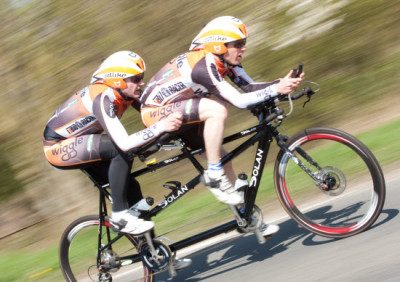
From http://magazine.bikeradar.com
Notice how high this captain's heel is as it crosses over the top? The idea here is that by allowing the ankle to flex and the heel to rise, you create a longer lever. Longer levers create more leverage and the force can begin earlier in the down stroke = more power. When you watch a cyclist using this technique, you'll see what Chris called “big knees” – the riders knees move in a very large plane up and down. It isn't just that their legs are long or that they're riding with long cranks. The exaggerated movement of their knees comes from the additional rage of motion allowed by the flexion of their ankles.
In this video, Joe Friel demonstrates the USA focus on “push over the top and scrap across the bottom.”
Former UK professional cyclist Rebecca Ramsay runs EasyCycling.com and her video below is an excellent example of what Chris describes as the EU pedaling technique. A closeup view of this technique in slow motion begins at the 2:00 mark. Notice how much flexion she has in her ankle as it crosses the bottom. Yes she cues the “scrape across the bottom” but no push across the top. With your heel elevated there's really no way to “push” forward… just down in a strong, fluid motion that I'm learning can create some much needed, additional power from my 52 year old legs 🙂
So who's right? Good question… but I'm not sure it's the right question.
A better question would be; which way of cuing, USA or EU, will be easier to understand by our students? Or would a combination / hybrid be helpful?
I've got two assignments for you to compete and report back:
#1 – Next time you're on a bike give this a try. Concentrate on what Rebecca cues as “a flick of the ankle” at the bottom. You may feel your calf contract slightly which you'll see in the video.
#2 – Watch a stage of the Tour De France. Pay attention to the vertical movement of the rider's knees and then let us know what you find.
Originally posted 2013-07-11 14:45:12.
by John | Jan 14, 2021 | Engage Your Students, Instructor Training, KEEPING IT FUN, Master Instructor Blog, Training With Power
Image from http://www.thesecretlifeofdee.com/
John, I'm still confused by this power stuff… where should I be riding? How many watts should I be seeing on my monitor, because I'm no where close to my body weight?
I get questions similar to this frequently from members. My answers has evolved over time:
- I used to give into the pressure; “please tell me a number” and would throw out a vague target – “your first goal could be seeing watts equal to your your body weight”.
- Later I revised it down a little; “what would be your desired, lean body weight?” “Let's try to reach that as an early power goal.”
But now I'm learning that throwing out watts = body weight (lean or actual) isn't as helpful as I intended. Sure for some it works. Those who are reasonably fit looking (read not overweight) and with a good fitness base. For others I've found I was asking them to work too hard, using a kind of formula that wasn't personalized for each individual. Which sounds is a lot like using the 220 – age for MAX HR 🙁
Now my preference is to conduct a short “Best Effort”, about a quarter of the way through class, to give everyone an understanding of a number they can work from. Not a true FTP or PTP, but it's been reasonably well accepted… but not by everyone.
Case in point: last Thursday after class I had the “how many watts should I be making?” discussion with a female member. She's a fit 50 year old and I would guess (I never ask) she weighs about 130lbs.
So I asked her what she normally sees during the “Best Effort” interval. “I average about 80 watts.” Which confused me… a lot actually. I would have guessed she could easily make more than 80 watts. I was stuck for an answer. Rather than guess at the reason, I started asking questions:
- Do you ride outdoors? No, not regularly.
- Are you a runner? YES!! Big smile.
- How would you compare running vs. cycling? Cycling is much easier. I'm getting to something here…
- Do you run in competitive events like a 5k, 10k, Marathon, etc…? Another YES !!! I love to compete!!!
- Do you run faster & harder in a 5k vs. a Marathon? Yes, of course I do – why?
- When you're riding in here with me, does your “Best Effort” feel more like a 5k or a Marathon? She stopped to think about it and then said; like a Marathon.
- Bingo!
I didn't need to say anything more. The look on her face told me she understood exactly where her confusion was coming from. Her perception of working hard was at her Marathon level of intensity = 80 watts was exactly right, figuring an aerobic level of effort. I had been making the assumption that when I asked for hard, everyone would work at the level I perceive as “hard” – which for her was different.
She ended the conversation with; so when you ask us for our “Best Effort”, I should be working at my 5k level of effort?
Exactly, or maybe a 5k where you're chasing one of your faster friends 🙂
Originally posted 2018-06-22 07:00:33.
by Jim Karanas | Jan 8, 2021 | Engage Your Students, Instructor Training, Master Instructor Blog

By Team ICG® Master Trainer Jim Karanas –
The experience of flow remains one of the least-understood phenomena in training. Yet it’s one of the richest, most memorable experiences we can help deliver to our students. Creating the circumstances though which students can experience flow in a training session is the topic of this article.
When I mention flow, people sometimes confuse it with being “in the zone”. That often relates to a brain release of beta-endorphin as a result of the activity. It’s a different phenomenon and not what I mean here. When you’re able to collapse what you’re doing down to a single moment and experience total immersion in it, you will feel flow. You’re completely involved in the ride for its own sake. There’s no ego, no awareness of time or distance. Every action follows seamlessly from the previous one.
You might be tired or in pain, but those things don’t distract you. You might not even notice them at times.
Recently, I led a five-hour ride at ICG® Academy in San Francisco. We rode an indoor 100 miles as a fall, base-building ride. The ten 30-minute segments were each built around a different 30-minute “Challenge” video on Myride®+. The plan was not to take any scheduled breaks or rest stops, and to roll from one world destination to the next. To be quick and efficient if anyone needed to get off the bike, but we were going to ride 100 miles. I calculated that, if the riders could average 85 rpm for the 5 hours, they would total 100 miles on their odometers.
I wanted to make this more challenging than an outdoor century.
There were 30-minute segments of pure hill climbing, where we would average 65-70 rpm. We had to compensate on the flat segments by turning fairly high rpm. That doesn’t sound hard until you understand that we were on belt-drive bikes with little or no momentum from the flywheel. 90+ rpm on a belt-drive bike takes a much bigger hit on your legs. We also had a heart-rate challenge. Early on, I had the participants commit to an average training heart rate that they would not go below.
I wasn’t making it hard for training purposes. I wanted to take everyone to a place where they could experience flow. This isn’t always possible in a 45- to 60-minute class.
After four hours, I looked around the room. Not one person was not experiencing flow. How did I know? I asked them if, at that time and for the first time that day, they felt as if they could ride for 10 hours. Everyone smiled and nodded. The discipline and fatigue created a state where they had to go beyond what they normally felt they could do. That’s when you experience flow: a state of non-reaction to fatigue and discomfort; a feeling of serenity; a loss of self-consciousness; a heightened awareness; a feeling of control over the situation and the outcome.
Once you’ve experienced true flow, you can feel it any time.
And that’s when you realize that flow is more than a beta-endorphin rush. You can sense it while walking on a busy street, winding your bike through traffic and stalled cars, in a conversation, in a business negotiation, in the supermarket shopping for food. Flow is working with what’s happening, as opposed to against it (see my previous post on Timing). On my road bike, I often notice that the farther away from home I go, the greater the feeling of flow. I simply stop thinking about things I have to do.
Psychologist Mihaly Csikszentmihalyi describes the mental state of flow as “being completely involved in an activity for its own sake. The ego falls away. Time flies. Every action, movement, and thought follows inevitably from the previous one, like playing jazz. Your whole being is involved, and you're using your skills to the utmost.”
Csikszentmihalyi spent time in an Italian prison camp in World War II. At age 16, he traveled to Switzerland, where he had the opportunity to listen to Carl Jung speak. The experience influenced him. He later explained, “As a child in the war, I'd seen something drastically wrong with how adults — the grown-ups I trusted — organized their thinking. I was trying to find a better system to order my life. Jung seemed to be trying to cope with some of the more positive aspects of human experience.”
Csikszentmihalyi's theory of flow has influenced people in a wide range of fields. Former U.S. President Bill Clinton and former British Prime Minister Tony Blair were reportedly influenced by his book Flow: The Psychology of Optimal Experience. Jimmy Johnson, former coach of the Dallas Cowboys, utilized Csikszentmihalyi’s ideas to prepare for the 1993 Super Bowl. His ideas have also influenced people in business, government, education and the arts.
Flow can occur in such diverse situations because it simply requires full immersion and involvement, energized focus, and enjoyment of the process. Clearly, that can apply to many activities.
Csikszentmihalyi calls flow “focused motivation”, deep focus on nothing but the activity. It works particularly well for cycling, brings consciousness to it, and can be created through the right combination of factors.
Originally posted 2014-12-24 06:24:37.
by Tom Scotto | Jan 5, 2021 | Master Instructor Blog
 Ok, we simply need to mention the word “test” and all kinds of things tighten up. Relax. For week 3 of instructor self improvement month, let’s look at how we are doing mentally and emotionally….”sit back on my couch and close your eyes”. Before you jump to a conclusion on either side of the spectrum, answer a few questions:
- How motivated am I to teach my classes?
- How excited am I about teaching this weeks profile or ride?
- Do I still get pumped by my music?
- Do I feel energetic during class or just getting through?
- Do I find myself taking shortcuts when planning class?
- Am I considering taking a break from teaching?
If you got through this interrogation and said “I’m motivated. I’m excited. I am pumped, energetic and plan every detail of my class and would NEVER consider quitting” then just tuck this article in your calendar and check back in a couple of months. However, if you hesitated or flat-out broke down in tears, then read on.
The truth is we usually don’t see it coming. Life is so fast and we are so busy that we get desensitized to how we are really feeling. Regardless, don’t panic. There could be a number of reasons you may not have answered the way you wanted on any of these questions. It could be that you need some fresh inspiration, some new music, a challenge or some rest. It really depends.
Don’t Rule Out Rest
Back in July, I wrote an article entitled “Taking Care of YOU” which focused on staying aware of your overall health and need for rest. We need to consider ourselves athletes and consider our classes as training sessions. Regardless of how hard you are working, and depending on how many classes you teach a week, your body will eventually get fatigued if you don’t take the time to rest.
Rest also rejuvenates the mind and soul. I have over 5000 pieces of music and over 60 individual ride profiles that I teach throughout the year. With rare exception, I do not use the same song in 2 different rides. The song goes with that ride and that is it. I also don’t repeat the same workout within a 6-8 week period, so basically I may not do the same rider or hear the same music for almost 2 months. However, at times, I get bored and tired of my music. Of course, I use that as an excuse to buy more, but honestly, that is often not the solution. What I’ve found 99.9% of the time is that I’m simply “tired”. Once I get some rest, EVERYTHING is again exciting and full of life. The music is pump’in and I can’t wait to get up at 4:30 AM to throw down.
Get Some Inspiration
How about that, the ICI/Pro Conference is next week! Yes, a shameless plug. But seriously, when was the last time you pursued some education and training for yourself? Sign-up for a workshop in your neighborhood, or better yet, take a trip (call it a professional retreat so you can write it off) and go somewhere exotic — for business of course. A cheaper option: get a sub for your class and take a class with another instructor. Take a class with another instructor at another club! Why not? Get out of your environment and see how the other half lives. Come on, we are flattered when someone asks to take our class. Instructors often have guest pass privileges so don’t be shy – “Hey, I’ve heard some great stuff about your class, are you able to get me a guest pass so I could experience it?” You’re as good as in.
Challenge # 1
Everyone knows I’m all about challenges so take that surprised look off your face. Try something different in class. Teach a totally different ride. Not into rock? Add some. How about teaching without music? Here’s one I had a ton of fun with (and my challenge): Ask your riders to build a ride for you. Yup. I asked them to create a ride with their own music and burn it on a CD. I gave them a date and said I would teach the first CD given to me when I walked into the room — no questions asked AND no prep. What a blast! Not only did it challenge the snot out of me, it was freeing AND gave me some insight as to what type of music and rides my class liked.
Challenge # 2
Ok, if you are more the athlete type (and want a cop-out for the first challenge), here is another way to determine and/or inspire you to get your edge back. Take a threshold test. I don’t care which one you do. It could even be a VO2 test or the Foster Talk Test. Go for broke. This can often have a 2-fold affect. First, you will see what kind of energy you have. If you are exhausted and can’t finish the test or put-out a sub par performance, you know your body is tired and you need some rest. Second, if it is just inspiration you need, blowing out the dust may just be what the doctor ordered. Besides treating ourselves to an endorphin high, pushing our limits can reinvigorate our conviction on the type of training our class wants and what it feels like to give it all. Then turn around and give one to your class while your in the mood.
——–
The bottom-line is that we bring a lot of ourselves into each class and each ride. It is not just the physical energy but emotional energy as well. In many ways, the emotional is more important. As you dig into all the aspects of what makes you a great instructor this month, take a deeper look into your motivation and inspiration and make sure you are still bringing and dishing out a healthy dose to your class.
Originally posted 2011-09-22 14:58:46.
by Jim Karanas | Dec 30, 2020 | Instructor Training, Master Instructor Blog, Zone based Heart Rate Training

By Team ICG® Master Trainer Jim Karanas
Now that more of your students wear heart-rate monitors (HRM) (see previous post “How To Get Your Students To Wear a HRM”), you must teach them how to use one.
An important first step is sometimes lost when introducing HRMs. Instructors immediately start estimating maximum heart rate and discussing zones. But the first measurement of intensity, how hard the students are exercising, must always be perception.
Relating perceived exertion to heart rate is a fascinating personal discovery for the indoor-cycling student. If it’s done correctly, the student will immediately ask at what heart rate he/she should be training. Then a discussion of training zone estimates makes perfect sense.
The following protocol, developed by Team ICG®, provides a template for a “first HRM experience” that the student won’t forget. Initially, you want the HRM to help the student link a given heart rate with a perception, which enhances awareness. The student feels his/her body go through changes in perceived exertion, along with a visible numerical progression.
Resting HR — 2 minutes
Once the students are wearing their HRMs, have them sit quietly on the bike. No pedaling, no talking, just sitting still. Tell them to breathe deeply, relax and see how low they can drop their HRs. This is not a true resting value, but shows them how relaxation and breathing affect their HR. It also gives them a numeric indication of how prepared the body is to receive training. It may well dictate an alteration of their plan for the day.
Warm-Up — 15 minutes
Roll the legs with no resistance on the bike. Feel the ease of motion, the momentum. Get into a rhythm with it: no effort, just smooth, continuous, even circles. Before taking the HR up, we want to accomplish two things. First, we must shunt blood to the leg muscles. Fifteen minutes of easy spinning will do that. Second, we want the students to sense what’s happening in the body as they get warm.
For the first 5 minutes, set the cadence at 90-100 rpm. Have the students increase the resistance just enough to feel as if their legs are working, without changing cadence. This isn’t much effort. Just bring the HR up slightly.
The first change in perceived exertion is an increase in body temperature. Assuming the room is appropriately cooled, the air temperature initially felt cool or cold. Ask them to notice the change — the air no longer feels cold — and note at what heart rate that occurred. Was it 5 beats up from resting? 10 beats?
For the second 5 minutes, have them make another small increase in the resistance. The second sensation in perceived exertion is awareness of breath. Their breathing pattern has not really changed. Their breathing is not hard or labored. They’ve just become aware that they’re breathing, something we’re unconscious of most of the time. At what HR did they become aware of their breathing?
For the third 5 minutes, bring on a little more resistance without changing cadence and raise the HR again slightly. Two things must happen here. They must notice that all momentum is gone from their pedaling. There’s a distinct point, especially on chain-driven bikes, where the sensation of momentum is replaced by effort. This is very visible to the instructor — the “looseness” is gone from the pedaling — however, it’s still not hard.
The other thing they need to notice is a sudden spike in body temperature. They now feel hot. We experience discomfort just before we begin to sweat because the cooling of evaporation hasn’t begun. What’s the heart rate when this happens?
Settle the cadence down to 90 rpm as they continue to work and begin to sweat. This is the next level of perceived exertion. At what HR did they begin to sweat? They’ll notice the hot feeling leave, then a cool sensation against their skin. They might feel perspiration on the brow, under the arms, or elsewhere.
Their warm-up is done.
As you can see, this isn’t an elaborate or complicated warm-up, just a gradual awareness process for the students. The next step is a heart rate ladder, again to connect the students with their perception of the effort.
Heart-Rate Ladder — 20 minutes
Now that the students are warmed-up, it’s time to take them through levels of greater exertion, while connecting their perception of the effort with the HR at which it occurs. Most of this work takes place seated, so give them periodic breaks from the saddle.
Level 1
Level 1 continues the intensity that they reached by the end of the warm-up. All feeling of momentum has been replaced by a feeling of effort. They’re aware of their breathing and have cracked a sweat.
Their HRs should be consistent. Tell them the first lesson of heart-rate training is stabilization. They should be at a HR that they could maintain for hours. Forget about mechanical difficulties, how the saddle feels, whether they need water, fuel, etc. Ask them to settle into a HR that — in terms of the effort level — they could hold for hours.
Maintain that intensity for 5 minutes.
It’s not uncommon for them to be unsure about whether they’re at the right level of effort. Tell them to check their HR, sense their effort level and ask themselves, “Could I maintain this for 1 hour? 2 hours? 3 hours?” If the effort is too high, they’ll have an internal reaction to the question and should adjust as necessary.
Keep the cadence at 90 rpm; this is important. Let them know that the HR they’re training at is called a target HR. Their job is to maintain that target at 90 rpm.
At this point, it’s helpful to explain what’s going on metabolically. Discuss aerobic vs. anaerobic metabolism and changes in the use of fat and carbohydrate as fuel.
As mentioned above, Level 1 is of the same intensity as the final part of the warm-up. From here, the progression builds to greater levels of effort, which will be covered in the next post.
Originally posted 2012-09-24 05:39:49.
