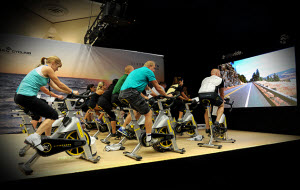
Video is taking over the world. Over 4 billion hours of video are viewed each month, and YouTube is the most-used search engine, after Google. Video is also changing indoor cycling classes everywhere. Like music, video engages our emotions. To reach a cycling audience with imagery and music creates a synergy that lifts indoor cycling to new levels.
Club owners seek something innovative. Cycling with video is enjoyable, entertaining, and a dramatic differentiation from the current indoor-cycling market. The number of emerging businesses that produce video attests to the impact it will have on indoor cycling.
As entertaining as video can be, however, the key reason people join clubs is to achieve their fitness goals and be educated in how to do that, not for entertainment.
Before writing the check, anyone investing in video programming must investigate the quality of education or coaching that accompanies the video product. This applies equally to live-instructor group classes and virtual group classes.
At ICG®, we believe it’s important to remember that video is JUST video. It’s an asset that can add to the indoor-cycling experience but will never dominate it. Even with the world’s best video, without proper coaching for the live instructor or excellent voiceover coaching in the virtual product, you’ll have:
Instructors continuing to teach to music only, or turning on the projector but never integrating video into their classes.
Virtually instructed classes projected to empty classrooms, and/or DVDs sitting unused in a box or drawer in the studio.
Quality instruction has always been the key to any successful indoor-cycling program. That won’t change with the addition of video. As long as facilities offer live-instructor classes, the instructors must first appreciate, and be energized by, what video brings to their classes. Once they support video’s benefits, they will sincerely recommend virtual programming — so long as that virtual class stands up to the quality of live coaching.
Bringing video to your cycling program is not a stand-alone purchase. Whether it’s to enhance live instruction, provide virtual classes, or both, it must be supported by online learning, as well as live education and training offered by your video provider.
Empowering instructors to use video in their classes demands technology that allows them to control the video as easily as they control their music. (DVDs just don’t make the grade in that regard.) It also requires an education platform that teaches them to integrate video readily into what they’re already doing — while producing a significantly enhanced experience for the members.
If a club offers both live classes with video and virtual classes, then the instructors must stand behind the virtual-class program and see it as complimentary to, not competitive with, their positions. Participants will typically follow the instructor’s lead. However, that alone will not motivate the members to participate in virtual classes.
For a workout video to compel people to train in a cycling studio with no instructor, the content can’t be good. It must be great. There’s no motivating instructor who knows your name, maybe no social interaction with other members. What works for a solo participant on a bike in front of a small screen may fail miserably in the group-cycling studio. This is even truer if the facility doesn’t employ instructors.
So the question is: What makes a virtual class compelling?
There are four dimensions to a successful virtual cycling class — Sensation, Flow, Challenge and Convenience.
Does the visual sensation grab attention? A compelling member experience must elicit strong, positive emotions. Is forward-motion video of beautiful destinations around the world more visually engaging than the world’s top master presenters sitting on bikes?
Does the workout flow? To be effective, a virtual class must be better designed than a live class. Members will come in and take an average class from a live instructor, but they won’t come in to take an average virtual class. Sound levels, content, matching voice and tone to the content, pacing — the sense of flow delivered through the interaction of voiceover cues and video must be better than with live instruction to be as effective.
Was the workout successful? The members will want to be physically challenged by the workout and mentally engaged by the information delivered. With no instructor and possibly no other members, what encourages the member to work hard? It comes down to quality recorded instruction, selection and use of music, music/video synergy, and editing.
Were the virtual classes offered at convenient times? Does the technology offer “auto” scheduling, where the virtual class and projector turn on and off at scheduled times? Dynamic club schedules that allow virtual classes to be easily added to, or taken off, the schedule based on participation will have a big impact on virtual programming success.
At ICG, we consider ourselves the leading authority in cycling with video. We believe indoor cycling is driven by instructor communication and motivation, plus social interaction. We believe instructors need education and training to integrate video skillfully and professionally into their classes.
We believe that virtual classes can rock and that instructors must support the classes.
Virtual classes must be visually stimulating. They must flow, provide a challenge, be offered at convenient times, and be better produced than a live class. We’re committed to developing better techniques and technologies to make future indoor cycling experiences more “real” as classes with video and virtual classes go mainstream.
Like always, there is no pat answer. It often depends on the instructor’s teaching style, the type of ride and the class’s expectation.
Teaching Style
I tend to break down the style categories as Coach, Trainer and Instructor.
The Coach is on the road with you, but is often not working at the same intensity because they are…well….coaching you. They are passing on wisdom, strategy and sports education while riders are pouring their guts out. To a cyclist, and those in the “cycling world”, this is very acceptable IF the “coach” actually knows what they are talking about, puts together a good workout, and can walk (or ride) the talk.
The Trainer is often focused on the here and now — “Let’s finish this interval…..Come on, you’ve got 3 more efforts to go….Don’t stop until you get to the top of that hill!” A trainer’s energy and motivation is not required from the bike, but from their direction and firm challenge to get the job done. It is acceptable for the trainer to be off the bike a good amount of the time as they instill determination (and fear) to drag every last drop out of their riders. Similar to the coach, the trainer needs to be the real thing. They are often sweating as they infuse energy into everyone within a 20-foot radius. It is tough work.
The Instructor is on the bike with their riders and usually suffering with them as well. They turn every pedal stroke, lead every charge and motivate by sharing in the pain. The instructor is often seen as one of the gang with the motto “we’ll get there together!” They are dripping in sweat (even the gals) as their breathy encouragement pushes riders to their limit.
So putting them in order of how hard they are working (on the bike), the Trainer is riding the least, the Coach is at a moderate intensity and the Instructor is at equal intensity with the class. All are absolutely acceptable. AND I would say that anyone teaching an indoor cycling class SHOULD embody the qualities of each of these styles and use them appropriately.
Type of Ride
Considering the teaching styles above, there would also be certain types of rides that would require more effort and intensity from the instructor. I may come off the bike during shorter interval-based workouts when riders could benefit from more personal attention such as helping them with technique. On longer steady-state efforts or long climbs, I may wander into coach mode (on the bike) to keep them mentally and physically engaged. On the hand, it would seem odd (at least to me) to be off the bike while teaching a virtual ride. It would be as if I was walking along the road as my class road by (unless of course I imagined I was Johan Bruyneel talking to riders from the team car….).
Class Expectation
In many respects, what the class expects is much a product of the teaching style and ride format you have established. If you want to find out if you are hitting the mark by riding at an intensity that is motivating, don’t only ask those that regularly attend your class. They are usually there because they like your approach. Ask the new riders what they thought. I would go as far as specifically asking if they prefer more of a Coaching, Trainer or Instructor led class and see how they respond.
Not So Inspiring (to me)
Of course, if you’ve got the above locked in, you are golden, but I’ve seen those that do not have the right teaching style for the job or are riding way too hard. The extremes would be the instructor who walks around the room in warm-up sweats holding a clipboard (trying to look like an athletic trainer), but lacks any energy or motivation. My knee-jerk reaction is to reach into my bag in search of my iPod and headphones. On the other end of the spectrum is the instructor that is working so hard that you can’t understand anything they are saying. They are even breathing hard during the recovery! This is distracting and detracting. I’m not getting good direction and the instructor appears more concerned with getting their workout than helping the class get where they need to be.
So, in conclusion, mix it up. Ask your class what they like and what inspires them. But above all, be genuine. If you’re trying to be someone you are not, it will stick out like a sore thumb regardless of whether you’re riding hard enough.
This is cool! Professional cyclist Alex Howes taught a class at the Peloton Cycle studio in Manhattan. This article explains how Alex taught what was only his second Indoor Cycling class. My guess is that he doesn't have a IC cert – not that it matters.[wlm_private ‘PRO-Platinum|PRO-Monthly|PRO-Gratis|PRO-Seasonal|Platinum-trial|Monthly-trial|PRO-Military|30-Days-of-PRO|90 Day PRO|Stages-Instructor|Schwinn-Instructor|Instructor-Bonus|28 Day Challenge']
He's a World Tour rider for Team Garmin Sharp, which means he races in the big international tours in Europe. This year, he placed third in the professional national road race championships in the US, and won a stage of the USA Pro Challenge in Colorado. In 2014 he finished the Tour de France, and last year, he completed the Vuelta a España.
Wednesday, he became a temporary spin[sic] instructor at the Peloton Cycle studio in Manhattan. It was his first time teaching a class and only his second time on a spin[sic] bike. You can usually find him doing six-hour training rides in Boulder, Colorado or his European base in Spain. He liked it though.
The author's description for the image above jumped out at me; We did a lot of standing work with high cadence, which is like running on a bike.
Is it just me, or were you also surprised that a Professional Cyclist would include high cadence out of the saddle work as part of a class he lead? I really wish I had known about this class because I was in NYC at the time. So even though I wasn't there, I am willing to formulate a hypothesis about why Alex chose to include this in his class: The stability of an indoor cycle creates a unique opportunity to train in a way that he felt would help everyone in his class – including himself. No one had told him that standing (a lot) with a high cadence (which by default can only be with light resistance) is wrong/contraindicated/inefficient/dangerous/etc… IMO Alex added these drills because they felt natural to him 🙂
Here's a short video showing his form.
This post got a strong reaction over on Facebook > It defies explanation how anyone could find fault with a Professional Cyclist guest teaching a cycling class… but they do. Incredible :([/wlm_private]
By Team ICG® Master Trainers Joan Kent and Jim Karanas
The training adaptations that derive from indoor cycling are well documented and ubiquitous. Still, when we speak with new instructors, they seem to appreciate hearing the information. Also, everyone describes the benefits slightly differently, and a change can help students understand.
So even though this is review for most of you, we thought a list of aerobic training adaptations, as we describe them at ICG®, would be worth covering. Some are cardiopulmonary, some vascular, some muscle-specific, or other.
Increased Tidal Volume Improved aerobic conditioning moves more oxygen to the working muscles. The first adaptation is breathing capacity, called tidal volume. The volume of air the lungs can move with each breath increases with aerobic training due to improved diaphragm strength and breathing technique. Higher tidal volume has also been associated with longevity.
Increased Blood Volume Blood is actually an organ that responds to training by increasing in volume. With increased cardiovascular training, the body produces more red blood cells and blood to increase its oxygen-carrying capacity and oxygenate body tissues. Increased blood volume also increases the capacity to remove metabolic waste, improve recovery and sustain a greater muscle mass.
Increased Stroke Volume Stroke volume, the amount of blood ejected by the heart per beat, increases. This adaptation tends to occur at “slower” heart rates, or at least at rates less than 160 bpm. Increased stroke volume indicates improved heart function. When people talk about “strengthening” the heart, this comes the closest to being the underlying mechanism. In pumping more blood per beat, the heart moves a greater workload. The strength-training equivalent would be using a heavier weight and slow repetitions, versus pumping a lighter weight quickly.
Enhanced Capillary Network* Capillaries are blood vessels with walls only one cell thick. They surround the muscle cells and deliver oxygen and nutrients. The capillary network becomes denser with aerobic conditioning. This results in a greater available surface area for the transfer of oxygen to the mitochondria within the muscle cell.
Increased Mitochondrial Size and Density* Aerobic training results in an increase in both the size and density of mitochondria. Mitochondria are subcellular structures that convert fuel to energy aerobically. They are the receptor sites in muscle cells for the molecular oxygen needed to power the Krebs, or citric acid, cycle and produce ATP. Mitochondria are the only sites in the body that burn fat — with the exception of the heart, which can and will use whatever it gets, including lactate.
Increase in Type 1 Muscle Fibers* Aerobic conditioning also increases the sensitivity of working muscle to the effects of insulin, in part by promoting the development of Type 1 muscle fibers. Type 1 fibers are high-endurance fibers that respond well to insulin. (Type 2b are better for explosive power but less sensitive to insulin.) Everyone knows that cardio training can reduce the incidence of heart disease, hypertension, stroke, diabetes, cholesterol problems, and more. Improved insulin sensitivity is a significant mechanism in that, because insulin resistance underlies these conditions. (More about insulin resistance in a future post.)
Increase in Fat-Burning Enzymes This applies specifically to hormone-sensitive lipase (HSL), which moves fat from storage to bloodstream for utilization. HSL is activated when the body needs to mobilize energy stores, and responds positively to catecholamines and ACTH. It’s inhibited by insulin and activated by the removal of insulin's inhibitory effects.
Items with an * are peripheral adaptations, specific to the working muscle. Thus, upper-body cardio training, such as arm cranking, will increase mitochondria, capillarization and development of type-1 fibers in the upper body in the same way that lower-body training affects the lower-body muscles involved.
Adaptations without an * are central adaptations that impact the entire body. Central adaptations permit a “transfer” effect, i.e., aerobic training with the upper body can improve aerobic performance using alternate muscles (in this case, the lower body). This was covered in Jim’s post on “The Best Cross-Training for the Indoor Cyclist.”
It’s important to address the impact of aerobic training adaptations on weight loss, because it’s a primary goal of many who attend our classes. A distinction should be made between aerobic training and cardiovascular training generally.
In cardiovascular exercise, the heart, lungs and vessels of the body work at an accelerated rate to sustain exercise. It includes aerobic training. Aerobic training adaptations improve the body’s ability to move oxygen to burn fuel for energy. Aerobic exercise has limited impact on weight loss because its built-in intensity ceiling becomes a limiting factor in several ways, the low calorie expenditure being only one. That’s why anaerobic training is also necessary.
A major benefit of aerobic conditioning with respect to weight loss is that it supports the body’s recovery from intense training. Trainers advocating only anaerobic work for weight loss often miss this point. Furthermore, as covered in many previous ICG® posts, training is about much more than weight loss.
Regardless, when it comes to the sheer pleasure of riding your bike, indoors or out, a well-developed aerobic system makes you feel fantastic.
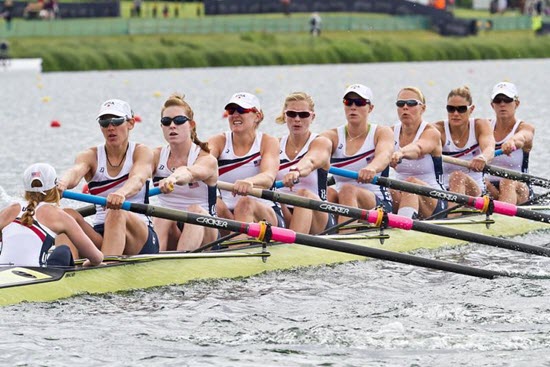
USA Women's Rowing Team – image credit boothbayregister.com/
If you’re about to start teaching a class that includes both cycling and rowing, here are a few tips.
Stay off the bike. To handle all the variables in a cycling/rowing class, you’ll need to be on your feet, moving around the room.
Will you warm up? On-bike stretches won’t work in a split class. Decide whether you’ll begin with a full-class stretch and warm-up, or have the participants take care of that on their own. Active Isolation Stretching is the most efficient in class — it warms the body as you stretch — but they all take up training time.
Pre-plan your trainings. You’ll need a specific and detailed rowing workout, along with your planned cycling workout. They don’t have to run parallel. That is, a 6:00 flat on the bike doesn’t have to run in sync with a 6:00 interval on the rowing ergometer (erg). They can if you prefer.
Feel the differences between the two workouts. Rowing workouts are often rigidly timed. That makes them effective and easy to cue. But some of the most unpleasant cycling workouts I’ve ever done were created by an instructor who was primarily a rower. His classes seemed to be created with a calculator and a slide rule (a what?). Instead, use cycling workouts that are similar to the ones you run now. Then you can mold your rowing workouts without alienating your riders.
Gear your music for the bikes. It’s less important to match music to a rowing drill, so keep handling your music the way you have been. There are exceptions — mostly performance-related — but generally this holds true.
Memorize the steps for setting the erg monitor. Concept 2 Models D and E use a complex procedure for setting time or distance. You’ll have to cue it every time. If you switch mid-workout from time to distance, be prepared to re-cue. Example: “Press Select Workout. Press New Workout. Press Intervals Time. DO NOT set the time yet! Use the Back Arrow to go back to the “tens” column. Set that for 1. Now use the Forward Arrow to get to the “ones” column. Change that to 0.” [At this point you have to cue setting the rest interval.] “Now press the check mark at the bottom of the screen.”
That lengthy description sets the timer for a 10-minute interval. If they set the “ones” column first to 0, it will default to an automatic “:20” (20 seconds). That messes up everything, and you’ll have to spend time changing it.
Note: The above cues are an illustration. You’re not done till you’ve set the rest interval (assuming you want repeating intervals). If you press the check mark midway through the process, you have to begin again. It will happen.
Don’t kill the Concept 2 people. All of the above is why the simple Model C was wonderful, but you’ll get used to the D/E. And you WILL remember the cues. I wrote the procedure from memory.
Always cue the rowers first. Let’s say you’ve decided to run the workouts in parallel format, which is easier for you. Separate the groups on their equipment. Cue the rowers while the riders roll their legs. Tell the rowers what to do during their warm-up (say it’s 10 minutes). Easy warm-up shortcut: Have them press “Just Row”. They row as instructed and stop when the computer clock reaches 10:00. While they row, you run a 10-minute bike warm-up. Once the warm-up is done, the riders roll and recover while you cue the rowing training — and setting the monitor.
This approach syncs the major changes for the two groups. The intervals will be of the same duration, but what the groups do during the intervals can be as similar or as different as you like.
Create a timeline. If you like multitasking, feel free to create workouts that don’t resemble each other at all. You may need some sort of timeline to track what’s happening. If you’re a spreadsheet geek, that approach will be fun for you. If you’re able to keep track of two different workouts mentally with no cheat-sheet, just go for it.
A timeline could be just a basic log with 3 to 4 columns. Minutes (0:00 to 30:00) go in the left column, rowing drills in the next, the cycling workout in the third column, and perhaps notes and prompts for you in the fourth column. Use a stopwatch. You’ll check your watch and know exactly what everyone should be doing at any given minute.
All of this planning makes improvising and modifying a lot easier. You have your plan, yet still feel ready to change whenever time or circumstances call for it.
At the 30-minute mark, switch equipment. The change will take a few minutes, so shorten the warm-up, but give everyone a chance to accustom the target muscles to the new activity for the second half of the class. Re-start your watch and repeat the body of the training.
If you can manage to do all of this AND deliver content — exercise physiology, technique, and training philosophy — your classes will be engaging and informative, and appeal to a broad base.
I hope these instructions are clear. I’d be happy to answer questions.
Growing up cycling and swimming, I never knew that without a flexibility regimen, the muscles would tighten more and more and, cumulatively, end up rigid. Rigidity, in the long run, decreases range of motion, which is detrimental to optimal performance. Performance aside, tight muscles affect how you feel in your body on a daily basis. Overly tight muscles can also lead to associated issues, such as chronic pain and unmanageable stress. All of this is avoidable, however, through integrating a yoga practice into your cardio training.
After swimming competitively in high school without much (if any) stretching, I already suffered from tight muscles by the time I entered college. I was lucky in college to take a jogging fitness class with Olympic runner Jane Kirkpatrick at UC Santa Barbara. Jane emphasized stretching for all her runners, and the benefits were immediately obvious.
It wasn’t till the end of college that I discovered yoga. Once I began adding yoga to my repertoire, my practices really began to bloom. Muscle tightness in the legs was not as severe. In swimming, my shoulders felt more fluid and the “clicking” sounds began to dissipate.
Fast-forward ten years: I find myself professionally offering this practice to casual and serious athletes in the San Francisco Bay Area. I began by teaching early morning indoor-cycling classes, followed by a yoga practice at Club One. (I’m now a RYT-200 Yoga Instructor.) I then teamed up with San Francisco’s first and only dedicated cycling and yoga studio — OMpower, home of ICG® Academy — to offer a class that integrates both practices in a single session. The students who have followed me on this journey all agree: Why haven’t they been doing this all along?!
With modern life crunching the amount of time people can spend away from home or work, a class that more or less offers two practices in the time of one extended practice simply makes practical sense.
Physically, participants receive the cardio boost and strength training for the lower body through indoor cycling, while strengthening the upper body, toning the core, opening the joints, and lengthening the muscle fibers through yoga.
Mentally, students energize themselves through the intensity of the cardio practice, and then relax with yoga.
Spiritually (and yes, there is a spiritual component), trainees push their boundaries and expand with cycling, while rooting and feeling a deep earth connection with yoga.
I could go on and on about the benefits of this practice, but I encourage everyone to take the experiential route. Try it for yourselves. It’s through our own experience that we discover whether certain practices resonate or “work” for us.
But if my experience has shown anything, it’s that this practice is the best balanced of them all.
Elliott Bringman, MA is a San Francisco-based athlete and yogi offering smart cardiovascular training through indoor-cycling, and yoga practices designed to strengthen, open, relax, and detox. Elliott is a Master Trainer with the Indoor-Cycling Group and is the creator of a number of hybridized spin/yoga programs. His welcoming, all-levels classes boost students’ aerobic ability for easy application to any number of high-endurance activities, while simultaeneously working the body through classical yoga-poses to build sustainable strength and flexibility. In addition to the physical, Elliott’s deep knowledge and dedication to both eastern and western traditions make his classes some of the most authentically uplifting and empowering around.