
by John | Oct 16, 2020 | Engage Your Students, Instructor Training, Master Instructor Blog, Training With Power, Zone based Heart Rate Training
Image from http://www.acefitness.org/prosource/71/
I just read a press release and accompanying article from the ACE – The American Console on Exercise PRO SOURCE magazine about their study to gauge the effectiveness of High Intensity Training (HIT).
Is Tabata All It's Cracked Up To Be?
“It seems like everything high-intensity is now called Tabata Training,” says John Porcari, Ph.D., head of the Clinical Exercise Physiology Program at the University of Wisconsin, La Crosse. “The original Tabata study was done on a bicycle, but people are now doing that 20-second/10-second format with resistance training, plyometrics, calisthenics…with almost anything.”
Because of all of this recent interest in Tabata-style workouts, the American Council on Exercise enlisted Porcari and his research team to gauge just how effective a Tabata-style workout really is.
THE BOTTOM LINE
“The great thing about Tabata is it’s a short workout–only 20 minutes–and it incorporates your total body, so it’s working every muscle group that you possibly can,” says Embert, referring specifically to the Tabata-style workout she designed.
You can download the article for printing here.
But what to do during the remainder of your 60 minute class?
There was a trainer at Life Time who told me years ago something I've never forgotten; First give them (your class) what they WANT… and then give them what they NEED.
The WANT he was referring to are very intense/anaerobic intervals. There's no secret sauce IMO at SoulCycle > they're just teaching very intense classes because they know that's what people WANT.
The NEED is for solid aerobic training. Not necessarily base building, but solid work below threshold HR / FTP.
There are a lot of serendipity going on here at ICI/PRO. A quick check back to our latest Audio PROfile is another – Bad A*s Intervals Audio Class PROfile from Schwinn Master Trainer Rachel Buschert Vaziralli could be a perfect work set you could add to an existing profile.
Instructor Kathy Palkaninec was a past winner of our profile contest and her profile follows a similar WANT & NEED format.
You may want to announce your intentions to crush them (WANT) during a 20 minute Tabata round that will start fifteen minutes into class. Don't worry about telling them what follows. Keep everyone focused on doing their best effort during the Tabatas.
Give everyone a full 5 minutes or more of complete recovery. It's during this time that I talk about the “Golden Hour” and how most of us have 90 minutes where we can really perform well, before fatigue really limits our performance. The Golden Hour doesn't begin for most of us until ~30 minutes in. At the end of the recovery we're only @ the 40 minute mark of a 60 minute class and I explain how we're only 10 minutes into our Golden Hour – just now ready to perform. It's here where you can coach them through a 10 or more minute sub-threshold effort (NEED) to conclude the class. Here's where you can put that stage button to work if you have one – encourage everyone to ramp up to a big number, Stage Button, now maintain it by keeping your instantaneous wattage at or above the average 🙂
Make sense?
Originally posted 2013-10-10 08:28:16.
by Cameron Chinatti | Oct 16, 2020 | Freemotion - Foundation Fitness, Master Instructor Blog

Of course, those of us at Stages Indoor Cycling believe the opposite to be true, (made you look, didn't I!) but we hear this all the time from people that haven't experienced a power-filled class the way it was meant to be. There exists an assumption that indoor cycling is moving away from fun and silently drifting towards a sterile, personality vacuum filled with muzak and boredom. Fortunately, it doesn't take long to convince people otherwise… just a content-rich, fun-filled ride.
In this two-part exploratory look at training with reliable metrics, we'll first discuss HOW to infuse data monitoring in your classes while keeping things fun and interesting. Then in Part 2 we will dive deeper into the physiological benefits and even the community benefits that these new tools can provide. For those of you that don't yet have immediate access to indoor cycles with data providing consoles, I think you'll find that the tips below apply to you as well.
To be fully transparent, I am the Director of Education for Stages Indoor Cycling and Foundation Fitness. Our team is responsible for the research and development behind the FreeMotion Fitness S11 series of indoor cycling bikes and power consoles. I will be approaching this specifically from the Stages Indoor Cycling methodology and in Part II will occasionally be referencing features on the FreeMotion power console.
I'm all about Super-7 lists, so… Here are my Super-7 ways to keep Power-Based classes interesting.
1.) Establish a goal and tell them why: Talking about data for the sake of talking WILL get boring really fast. Choose one particular metric to discuss because it will aid your participants in reaching– as I like to call them– “micro-goals.” Micro-goals can be anything, for example:
“For the next 5 minutes your goal is to give me a thumbs-up at the top of each minute. No thumbs-up means you're suffering and this 5 minute segment is about remaining in a place of comfortable, sustainable effort.”
Based on that particular micro-goal, the only thing they should be concerned with on the console is the TIME. They were not asked to base their efforts on ANYTHING other than a perceived effort. And that's okay!! Which leads us to the next point…
2.) Leave the kitchen sink at home: It's very tempting to talk about all the metrics on the console…ALL AT ONCE! Remember, no one is pressuring you to constantly speak about the numbers- this is unnecessary! In fact, it is rare that I ever focus on more than 2 pieces of data in a typical indoor cycling class, because people get easily overwhelmed. We have to warm them up to these concepts over time. Pick something that supports your micro-goal and stick to it.
3.) Luv ya, Don't ever change!: Did that just remind you of your middle school yearbook signatures? Well, it has merit when it comes to teaching- especially if you're already successful! Don't forget to be YOU! Not only is throwing in the kitchen sink overwhelming for your riders, but it has another dreaded side-effect: instructors forget to be themselves and do what they do best. Don't neglect your charismatic side! Tell them that funny story, sing along with your music (if you dare!), ask trivia questions… Basically continue doing the things that make you the unique leader that you were obviously born to be. The data at your disposal can never replace you: it simply increases your odds for more effective communication.
4.) Reduce the filler: 60 minutes is a lot of time to talk about… nothing. With quality information we can now reduce some of the fillers that creep into indoor cycling classes. I promise you, people won't mind if you reduce the number of times you…
- Count backwards from 8. (It ain't Sesame Street folks!)
- “Woohoo!” (That gets old quickly)
- “How we doing?!” (This come across as a cheap way to get them to respond. It only works once or twice before they tune you out.)
- “Give me more!” (More what?)
Don't get me wrong, there's nothing inherently bad about these group exercise idioms, but are they really motivating people the tenth time you've said them? Probably not. Once you reduce the fluff, you give yourself valuable time to discuss the task at hand, ask them work-inducing questions and give them a reason to want to achieve those micro-goals.
5.) Lather, Rinse, Repeat: There's no easier way to feel successful on an indoor cycling bike that measures power than to have multiple chances to reach your goal. Near the conclusion of a stage or interval, ask your riders to look at one piece of information and remember it. Give them ample recovery time and let them know that they get another shot at improving upon last time's performance. For instance,
“Get ready to rumble folks because we have a 5 minute stage coming your way, but don't fret; it's nothing that you can't handle, and I'll guide you the whole way. Towards the end of your 5 minutes, before we press the Stage button, I want you to focus on your total distance for this stage.” 5 minutes later… “How did you do? Do you remember the distance you covered? Great, because we get to do that exact same 5-minute stage again. No surprises from me! However, this time I want you to find a way to go just a little further. Could you increase your distance by 1/10 of a mile? Even more? Let's find out!”
Seriously, nothing is more motivating then knowing beyond a shadow of a doubt that you are capable of besting yourself!
6) Games, games and more games!: We've all done games in our classes: front row busts a gut for 30 seconds while everyone else is recovering, then the 2nd row goes, then the 3rd row…etc, but in order to truly be playing a game there must be an objective and there has to be a way to win or at least achieve said objective. The objectivity piece was always missing prior to bikes with consoles. Let the games begin! We'll do an entire post on games in the near future, but for a few examples of games you can check out the BIG RIDE that Pam Benchley and I taught on Saturday night of the ICI/Pro conference. Just remember, competition can get overly fierce very quickly amongst your participants. For this reason, consider integrating games as team efforts first.
7) Deliver Measurable Progessâ„¢: For those of you familiar with the Stages Indoor Cycling method, it will come as no surprise that I really, I mean REALLY stand behind this mantra. At Stages Indoor Cycling we Deliver Measurable Progress via Benchmarks. By assessing where you are today, you now have a means by which to achieve where you want to be 6-weeks or 12-weeks down the road. Functional Threshold Heart Rate testing is wonderful, but what if you could compare that alongside your ability to generate Power at Threshold?! Surprisingly it's very doable even in a large group setting. Of course, FTP/FTHR testing isn't for the Day-1 newbie off the street, but there are many other initial assessments that we can provide our participants that will show them where they are today and what to shoot for tomorrow.
Once benchmark assessments become a regular part of your programming, magic takes place! Participants start planning their workouts around these benchmarks as if they were training for an event, even if participating in a race or organized outdoor event has no appeal to them personally.
This all boils down to the “Susan and Bob” conversation from a few weeks back. It's true people come to your classes for a plethora of reasons, but I think it's safe to say that NO ONE would be disappointed if by coming to your classes they were able to do more work with less effort, endure more physically and emotionally, travel farther and go faster. If this helps them achieve their weight-related goals, what a wonderful side effect! If this breathes new life into indoor cycling as we know it – PRICELESS! And that, my friends, is far from BORING.
I'm so excited for Part 2! Your feedback regarding the Super-7 reasons above will dictate the direction of ‘Power Is Boring: Part 2.” Think of it as a “Choose Your Own Adventure” novel! Speak now or forever ride in silence. 😉
Originally posted 2011-12-21 04:00:19.
by John | Oct 13, 2020 | Big Box Instructor, Instructor Training, Master Instructor Blog, Training With Power

F430 pic from Wikipedia – pretty, isn't it?
As a followup to Part 1, a question for you;
Are you a Ferrari or a Peterbilt?
I have a friend, a very accomplished cyclist, who fancies himself a Ferrari. To look at Eddy you'd have to agree; he's long, lean and very sharp looking. But to ride with him may have you thinking more Peterbilt, than Ferrari. You see my friend is very strong and rides with a slow, powerful cadence. Many who ride with him remark; “the guy never shifts… he did the whole ride in one big gear.”
I'm finally continuing with this series, comparing the athletes in your class with the engine in their cars.
Let's explore the difference between small displacement > High RPM engines found in High Performance Sports cars and the large displacement > low RPM engines found in a Semi Tractor- Trailer or Lorie you see running down the highway. Then see if we can draw a a few correlations between them that would be interesting to the Gear Heads in your class… after all, if your class is anything like mine, you're beginning to see more men, now that it's getting cold outside.[wlm_private ‘PRO-Platinum|PRO-Monthly|PRO-Gratis|PRO-Seasonal|Platinum-trial|Monthly-trial|PRO-Military|30-Days-of-PRO|90 Day PRO|Stages-Instructor|Schwinn-Instructor|Instructor-Bonus|28 Day Challenge']
The F430 Ferrari is an incredible car. It will go zero to 60 in 4 seconds, a top speed of 200MPH and you can get one of your own for only $200,000 US. What moves this 3,200lb rocket, when you push on the “fly by wire” accelerator pedal, is a 4.3 liter gasoline engine that develops 483 horse power – once it is spinning at the maximum of 8,500 RPM.
A conservative choice for an engine in your new Peterbilt truck is a Cummins ISX15 diesel engine. This engine makes 485 horse power while turning a leisurely 2,200 RPM
So the F430 and the Peterbilt both have essentially the same horsepower (483 vs. 485) available to the driver.
What's the difference? Isn't Power… Power?
TORQUE
The Cummins engine creates 1,850 Ft Lbs of Torque, over 5 times that of the F430's puny 343 Ft Lbs, while only turning 1/4 the RPM. The Peterbilt needs all this Torque to move the combined tractor and trailer weight of a 50,000lbs up over a 6% grade. To create that Torque the Cummin's engine is massive (weighing over 3,000lbs – about the same as the whole F430) with huge pistons that are (you guessed it) about 4 times as large in diameter!
Torque in an engine is created by the force of combustion acting on the surface area of the piston. While there's a lot of other physics that go into the creation of Power, I'm reminded of an old racer's adage that goes something like; There's no replacement for displacement.
What's true in engines is true in humans… with all other things equal; bigger muscles can create bigger forces = more Torque. But Torque doesn't get you up the mountain – that's Power. So of two women of equal weight, the one with the biggest legs doesn't get to the top first.
The winner to the summit will be the one who can continuously make the most Power, for the duration of the climb.
My buddy Eddy, like most endurance athletes, is a student of himself. Over 10's of thousands of miles, he's learned exactly where his body makes the most Power, the most efficiently. In his case, he understands that his very strong legs work best while powering through at what many would say is too slow a cadence.
Fans of the Tour de France may remember the climbing battles between Lance Armstrong and Jan Ullrich – where the contrast between Lance's 90+ RPM and Jan's 60ish RPM had them climbing at the same speed = they (I'm assuming they have similar body weight) made the same amount of Power. The same Power that is, until Lance turned, looked, then accelerated to 100 RPM and dropped Jan due to his superior Volumetric Efficiency – ability of an engine to process Oxygen, by efficiently moving air through itself.
After all Lance Armstrong is truly a Ferrari – but that's a subject for another post.
A fun class you can offer (if you teach with Power/Watts) is to create a profile that includes a series of laddered efforts of increasing cadences – while maintaining a set percentage of FTP or some baseline wattage. The purpose of the class is to help each student find the RPM range where they are the most efficient, i.e are they a Ferrari or a Peterbilt?
Amy and I experience this every time we ride our Tandem. In His, Hers and Ours Audio PROfile we explore how different cadences can be used to create the same amount of Power, or ground speed, which is essentially the same thing.
You may choose to use only RPE or you could tie each step to a HR. Maybe you cue wattage as a multiple of body weight; Now everyone find their One Watt Per Lb wattage at 70 RPM. Now let's add 10 RPM and reduce resistance to stay at that wattage… after 3 minutes ask, what's the result? Do you feel like you are working harder? HR higher or lower?
This might be a fun exercise to use a few weeks ahead of an FTP assessment – where we first teach everyone their Natural Cadence (best efficiency) and then have them ride at that RPM during their assessment.
Sounds like a question for Cameron Chinatti – stay tuned…[/wlm_private]
Originally posted 2012-10-02 10:00:00.
by John | Oct 4, 2020 | Big Box Instructor, Instructor Training, Master Instructor Blog, Training With Power
If you're teaching with power, there's a good chance you'll have a participant ask you this simple question; how many watts should I be making when I'm working at my threshold? Same goes for any new studio or one that is upgrading to indoor Cycles with power/watts. You will be asked for a number from many of your riders. The reason is pretty simple, many people naturally want to know how they compare.
There are two schools of thought on if, or how, you should answer this question:
- There's the “Don't give them a number – ever” school that believes whatever you tell them could be wrong and potentially upsetting. You don't want to demoralize riders, or hurt their feelings, especially with a new rider with no/limited fitness, by suggesting anything. The recommendation is to respond with a question; how many watts did you see today? Then respond positively to any response.
- Then the “give them something to work with” approach. My preference is to start with the suggestion of one watt per pound or a little bit over 2 watts per Kg.
They're adults = tell them the truth… they can handle it.
Have you ever had someone lie to or mislead you, under the pretense that they didn't want to hurt your feelings? Did it make you feel valued and respected? If you have experienced a situation where you weren't told the truth, did you feel you would have acted differently, if you had been given accurate information?
Imagine for a moment you're a personal trainer and your client asks you this question; what percentage of body fat should I have? A common question I'm sure. Is the correct response; “what is your body fat percentage now?” And then to positively affirm what ever answer they give? I don't think so… do you? There are established ranges for body fat %, published by credible fitness authorities like ACE. Here's their chart.
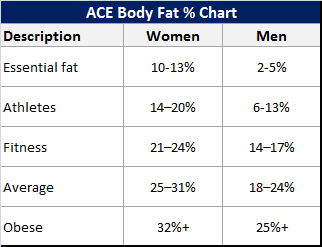
Let's see where you fall on this chart…
If your female client told you their body fat is 34% – would you smile and say; “that's great!” ? Of course not. You would probably suggest a diet and exercise program directed toward reducing their fat percentage down, with a goal to get into the average range. The person standing in front of you may not like hearing that they're obese, but don't they need to learn the truth so they can decide to do the work needed to change their body composition?
What about running a 5k? Or bowling for that matter? They both have metrics that define a reasonably achievable level of proficiency for an able-bodied person. Would it be wrong to suggest a goal time of 36 minutes (12 minute mile) for a 5K or 120 pin score in a bowling game?
Teaching with power for two years has me in the “give them something to work” with camp. And that something is a goal of one watt per pound of body weight*. I've asked multiple dozens of riders; “are you close to your body weight in watts?” Are they all there? No, but it's been very few. I'll bet if you were to privately poll your regulars, at the end of a 3-4 minute sustainable threshold effort, you would hear wattage #s around body weight.
At the end of the PST (Personal Spinning Threshold) assessment I did at WSSC, MI Janet Toussaint allowed me to ask the class this exact question. The majority agreed that their PST was at or above their body weight. Now a room full of fit Instructors may not be a representative sample, but it reaffirmed my experiences.
If you'd like to learn more about this concept – listen to this podcast where I first learned about it.
*I've heard other Instructors suggest using lean / goal body weight, which would reduce the number slightly. This calculator provided by ACE might be helpful.
Originally posted 2014-06-05 09:35:39.
by John | Oct 1, 2020 | Big Box Instructor, Class Work-Sets, Instructor Training, KEEPING IT FUN, Master Instructor Blog, Training With Power

Better late than never they say. It certainly applies to this season's Performance Cycle classes – now we're in full swing after some initial confusion that came from a sudden change on GFDH's.
We kicked off this past Sunday with an assessment to find the wattage numbers we will be using going forward. I like to use very simple terminology that minimises any mathematical computations.
The week before I described how we experimented with pinning down two numbers;
… Instead I base my Life Time Performance Cycle classes on two numbers; PTP (Personal Threshold Power) and JRAP (Just Riding Along Power — AKA > Base Watts > VT1 / First Ventilatory Threshold Power). From these two rider identified threshold wattages, we can construct three meaningful power Zones;
- Recover zone — watts below JRAP
- Perform zone — watts between JRAP and PTP
- Improve zone — watts above PTP
Today we added one more wattage number – their 20 minute FTP watts. As you can guess, riders should have a lower 20 min average than a 3-4 minute PTP / Best Effort and be above JRAP / Base Watts.
Wait John, you just said you only use the two thresholds in class.
What's the point of adding a third number?
Adding the third point of reference helps you draw a straighter line. At least that's what my high school drafting teacher taught me. It's much easier to draw between two distant points, if you add one in the middle = it helps you understand if you're on the right path between the two known points!
[wlm_private ‘PRO-Platinum|PRO-Monthly|PRO-Gratis|PRO-Seasonal|Platinum-trial|Monthly-trial|PRO-Military|30-Days-of-PRO|90 Day PRO|Stages-Instructor|Schwinn-Instructor|Instructor-Bonus']
The process of sustaining a 20 minute effort is helpful to many riders – it validates and reinforces the two threshold numbers and confirms that people are understanding my cuing.
Before/during and after these twenty minute efforts I tell everyone; this effort should fall between the two thresholds. Which you would think I shouldn't even have to mention… until you hear the confusion I heard after the effort was completed:
- I really surprised myself – my 20 min watts was the same as my 3 minute level!
- There must be something wrong with me – I couldn't sustain my base watts for the whole ride 🙁
Teachable moments here
In the first example; my 20 min watts was the same as my 3 minute level! I was able to ask him; “what does that say about your 3 minute effort?” He understood before I completed my sentence; “I'm not working hard enough!”
The women who told me I couldn't sustain my base watts for the whole ride also had a revelation and asked me; “Do you think I'm working too hard at my base level?” I didn't even need to answer her.
Do you now see the value of adding that third number?
A continuous state of observation
I asked my class on Sunday; how many of you are on a specific training plan? None. Not a single hand went up. This is very typical for my very diverse group of middle age men and women. Yes most ride outside – but their objectives aren't structured beyond not rolling over and hitting the snooze button. They come to my Performance Cycle class to get a nice combination of intensity and endurance work, in a fun group.
My object in this class is that everyone learn from observing their performance, make adjustments and observe again. Over time they learn exactly where they need be. When it's time to work hard – they WORK HARD and when they should work easy – it really is easy.
Make sense?
Here's my playlist –
I'll get the rest of the profile up later in the week if you want to try this in your class.
[/wlm_private]
Originally posted 2018-01-13 09:00:43.
by Joan Kent | Oct 1, 2020 | Master Instructor Blog, Zone based Heart Rate Training
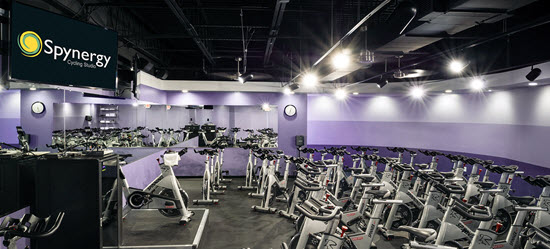
Bill Pryor's Spynergy Studio
By Joan Kent
Indoor cycling classes have become inextricably linked with dim lighting, and I’ve never understood why. Personally, I’m not crazy about training in the dark and will tell you why in a moment.
Studio lighting is one of the factors involved in creating the best class environment, along with music, video, voice, tone, cueing and more. Here are two scenarios from my teaching experience, in which the lighting differences span the spectrum.
In Studio A, the lights are always on and always bright. There’s no on/off switch in the studio because the lights go on when the club is opened. The master switch controls all.
In Studio B, the lights can be brought all the way up to a bright level, but the previous instructor, who had a huge following (okay, it was Jim Karanas), liked to keep the lights dim by flipping only the middle switch on the 3-switch panel. Needless to say, whenever I subbed for him, I made sure the lighting matched what everyone was accustomed to in his class.
The dimmer lighting was okay, but periodically one bank of lights, often on the far side of the room, would burn out, leaving everything on that side of the room just plain dark. It wouldn’t affect the participants close to the door because light outside the studio shines in on the near side of the studio.
We’d notify the front desk staff about the burned-out bulbs, and a short time later, we’d have lights — until they burned out once more.
By my last observation, though, that infamous bank of lights was out again and had/has been for a long time. It made me think about this topic. Apparently, no instructors have reported it to the desk. Apparently, no one has complained.
That last fact amazes me. Because of Jim’s teachings, everyone in the class uses a heart rate monitor (see How to Get Your Students to Wear Heart Rate Monitors). I always train with a HR monitor, mainly because of what I learned from both Johnny G and Jim.
So here’s the thing. In this studio, the bikes don’t have computers that light up and display HR. It’s virtually impossible to see a HR monitor on the far side of the partially lit studio. I’ve seen riders hold up their HR monitors, twist them around to catch available light, and keep track of their heart rates that way. What’s wrong with this picture?
Now I happen to find it difficult to train extremely hard in the dark. For a club anniversary one year, the theme involved decorating the studio like a spooky forest and turning out almost all the lights. Several people did complain that they felt nauseated. Guess I tend to feel that whenever I’m training really hard in the dark.
I had hoped the current instructors might take notice (read ‘take the hint’) when I started bringing a small flashlight to class with me to light my HR monitor on days that I ride on the far side. No such luck.
I have a feeling I’m in the vast minority on this — indoor cycling is almost always taught in dark rooms. Of course, in studios with bike computers that light up, much of this is solved. Still, if I had to choose between the glaring lights of Studio A and the darkness of Studio B, I’d go for the glare. I can monitor my HR easily and definitely feel better physically.
How do the rest of you feel about lighting? Which is most important to you — the atmosphere that goes with dimmer lighting, tracking heart rates, other factors? Please let us know, and thanks.
Originally posted 2014-02-13 10:09:37.
