by John | Feb 10, 2020 | Instructor Tips and Tricks, Instructor Training, Master Instructor Blog, Promote and Build Your Class

“Because that’s where the money is…” was famous American bank robber Willie Sutton’s reported answer to the question; “Willie why do you rob banks?”
I can imagine a similar conversation with an upscale restaurant owner; “so why do you cater to business people?” “Because they regularly entertain important clients and pay with expense accounts!”
Now that business people (and their prospective clients) are moving away from the two-martini lunch and adopting a more healthful lifestyle, expense accounts are paying for fitness classes.
Sweaty Wall Streeters Skip Booze for Spin-Class Meetings
Wall Street’s salesmen and dealmakers, whose expense accounts help fill downtown chophouses and box seats at ballparks, are now treating clients to a different kind of entertainment: high-end workouts.
Pre-dawn and afternoon classes at Manhattan fitness studios SoulCycle, Barry’s Bootcamp and Flywheel Sports are growing popular with bankers who want to bond without loading up on liquor and fatty foods, according to traders and salesmen. John Abularrage, head of Tullett Prebon Plc’s Americas unit, takes clients to 5 a.m. sessions at Barry’s Bootcamp in Tribeca, where they run on treadmills and lift weights to thumping dance music.
…
Bankers who sell stocks or bonds have long plied mutual-fund traders and hedge-fund managers with tickets, meals and drinks in the hopes that friendship — or at least familiarity – – will lead to more trades. Health-conscious clients increasingly view steak dinners as “three-hour ordeals,” said Chelsea Kocis, a 26-year-old former equity saleswoman.
“‘Let’s meet at 5 for a workout,’” she said, describing the way she’d invite out traders. “‘You can be home before your kids go to bed.’ That’s an enticing thing for a lot of people.”
They’re calling it sweat-working
New Yorkers have been wooing clients and forging business relationships in yoga classes and locker rooms for more than a minute, but after the New York Times introduced the term “sweatworking” to the public at the end of last year, the concept entered the serious spotlight.
And at the center of it all was Sarah Siciliano, an advertising production executive who has turned sweat-working into a branded business. Siciliano now has a website and a group of clients who work out with her two or more times a week. They spin, stretch, and make business deals.
CREATING BUSINESS CONNECTIONS OUTSIDE OF THE OFFICE HAVE BECOME TOO MUCH ABOUT EATING AND DRINKING, OFTEN TO EXCESS. THE CONCEPT OF SWEAT-WORKING IS THAT EVEN BETTER, MORE MEANINGFUL CONNECTIONS CAN BE FORGED WHEN A GROUP OF LIKE-MINDED PEOPLE WORK TOGETHER TO IMPROVE THEIR MINDS AND BODIES. IMAGINE IF ALL THE TIME WE INVESTED IN NOISY, CALORIE-LADEN, ALCOHOL-SOAKED NETWORKING EVENTS WERE PUT TOWARDS INVIGORATING, CLARIFYING, ENERGIZING ATHLETIC CLASSES AND EXCURSIONS.
Now you don’t have to wait for someone like Sarah to organize a group of like minded people and have them meet regularly at your club. You could do it yourself by using a free service like www.meetup.com.
I encourage you to visit meetup.com, search by your studio’s Zip Code and scroll through all of the results. I did a quick check for groups located within 5 miles of ICI/PRO member Joe Ducosin’s CycleQuest studio and found these groups…
Would any of these groups be interested in holding a meeting at your studio? I have no idea, but the group leaders are easy to contact.
Another option would be for you to form your own networking group that meets after your class for coffee. What types of business are prominent nearby? Who’s already in your class that would benefit from meeting more people?
Joe has a huge (6,000 employees) new health care provider moving in just up the road. I’ll bet there will be a steady stream of sales people visiting who may appreciate a sweat-working opportunity at his studio – and will pay for the privilege with an expense account 🙂
by Tom Scotto | Feb 4, 2020 | Master Instructor Blog
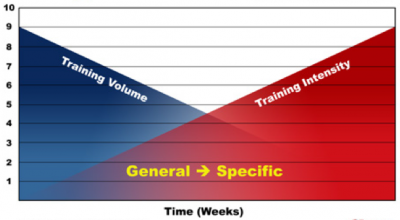 The purpose of my last article was to spur you on to start thinking about the approach to your classes at the beginning of the year. Being a coach, my natural tendency is to sway you toward a periodized approach. I was definitely very happy with the responses from the last article which could be summed up as “so, how do we do it?” As promised, here is a simple approach to early season periodization for indoor cycling that I have been using for the last 10 years.
Quickly….What is Periodization?
Periodization is a process of structuring training into progressive phases or blocks of time. In addition to the structure, there is a determined progression to the training from week to week and month to month. The progression manipulates a variation of Training Volume, Training Intensity and Training Specificity with a focus on the end goal (which could be anything from a pure fitness goal to preparing for a charity ride, century, cycling vacation or competitive event) or peak fitness. Although we are going to focus on the early season (or Base period), here is a simplified periodization plan I use for indoor cycling so you have a picture of how the Base period fits into the rest of the year:
- BASE Period: January – March
- BUILD Period: April — May
- PEAK Period: June — September
- TRANSITION Period: October — December
Keep in mind that how long and when each of these periods occur throughout the year is purely a function of the goals of a specific person or athlete. The above is a generalized approach I found suitable for indoor cycling classes.
Another DISCLAIMER
I’m going to reference 5 to 6 different ride profiles in the upcoming paragraphs. Unfortunately, I’m not going to be able to go into the details of each of these profiles for the sake of time and sanity. Each of these profiles could be an article or AudioPROfile in and of itself.
The Benefits of this Approach
Having a plan engages riders more because they often feel obligated to join in or continue. And it doesn’t matter which point a rider enters your plan. You may start your periodization plan in January and then get a new rider each week all the way through to March. No problem. Although each of the workouts is challenging, the overall intensities and specificity will be lower than usual, making it easy for new-comers to jump-in. The fact that they walked into a “plan” many times keeps them coming back because they don’t want to miss anything else. Plus, a periodized approach is a smart, proven training method which appeals to the cycling community as a whole and will draw more cyclists to your classes.
As a side note: Most of the classes I teach meet only once per week and thus there is only 1 training focus per week. The class that I have that meets twice a week gets the same ride twice. They appreciate a second chance at it, as they are often better prepared (mentally) to be successful the next go-around. Plus in the “real” world of cycling, many of these workouts/rides would be done 2-3 times during the week anyway.
The Plan
First I’ll layout the weekly plan and then I will give a brief explanation of each ride. Notice that in this plan, the same ride is not repeated for 6 weeks and the schedule takes you right into April.
- WEEK 1: Threshold Test
- WEEK 2: Aerobic Development
- WEEK 3: Leg Speed / Cadence Work
- WEEK 4: Muscular Endurance
- WEEK 5: Aerobic Endurance
- WEEK 6: Muscular Strength
- WEEK 7: Test / Review
- WEEK 8: Aerobic Development
- WEEK 9: Leg Speed / Cadence Work
- WEEK 10: Muscular Endurance
- WEEK 11: Aerobic Endurance
- WEEK 12: Muscular Strength
- WEEK 13: Threshold Test
Threshold Test
There are a number of ways to do a threshold test. My preference is the Foster Talk test which identifies 2 ventilatory inflexion points: VT1 (ventilatory threshold 1) and VT2 (ventilatory threshold 2). I’m going to use VT2 (or approximately 80% perceived effort) as the upper limiter on all of the remain class profiles below. Here is another method of performing a 20-Minute Threshold Field test posted on June 25, 2011 – http://www.indoorcycleinstructor.com/icipro-instructor-training/zone-based-heart-rate-training/is-a-20-minute-threshold-field-test-realistic-for-your-class-part-3/.
Another side note: I use the early part of the Threshold class to talk about proper form and technique while taking time to walk around the room and make necessary (wanted) adjustments.
Aerobic Development
This class consists of short aerobic intervals of 30 seconds to 2 minutes. It is easiest to break these intervals into sets using a 1 to 1 (work to recovery) ratio. The target intensity for each effort is VT2.
Leg Speed / Cadence Work
Another interval structure where the variable is now leg speed. Two common ways to structure these intervals is to either do a set of 1-2 minute efforts at 90 RPM, then do a set of 1-2 minute efforts at 100 RPM, etc. You can also approach it like a pyramid and design a set that starts with an effort at 90 RPM, then 100 RPM, etc. There are dozens of cadence drills one could use to build a nice varied class. Keep in mind that the speeds you target should be appropriate for your demographic of rider. The goal of these classes is to obtain the leg speed, while maintaining a smooth pedal-stroke technique, and without driving one’s heart rate above VT2.
Muscular Endurance
These are basically long climbs of moderate intensity ranging from 7 to 30+ minutes each. I tend to mix up the class giving them a climb closer to 7 minutes, than another at 14 minutes and yet another at 21+ minutes. It gives them a nice (duration) goal. The cadence range is closer to 65-75 RPM and heart rates should stay below VT2.
Aerobic Endurance
These are long steady-state efforts (with some gentle rolling roads) ranging from 4 to 10 minutes. This time the target intensity is VT1 or closer to 70% of their perceived effort. Like in most base building workouts, the stimulus is “volume” or duration and NOT intensity. And believe you me, if done correctly, are equally as challenging (physically and mentally).
Muscular Strength
Similar to the format of Aerobic Development, these are shorter interval sets of 30 seconds to 2 minutes, but the focus is on workload or heavy force on the legs. Cadence should range closer to 55 to 70 RPM. Be sure to caution riders who may have injuries before you introduce these. As always, rides should be instructed to work at their own pace and strength.
Test / Review
This is what I call a “Freebee”. I build a class consisting of 1 or 2 drills from each of the preceding weeks (same music and all) and present it as a test. “Let’s see how we have been progressing over the last 5 weeks. Take note of which drills are your strengths and which are you weaknesses. I’m happy to talk with you after class if you would like some guidance on how to adjust your training based on what you’ve learned.”
Rinse and Repeat
Yup, go through the previous 5 profiles again as you help your riders continue to build their fitness base. I like to leave the second threshold test to the very end. One generally gets a better result (or noticeable progress) after 10-11 weeks of focused workouts, and it is a great segue into the next phase of training.
Remember, BASE training is not boring but dynamic, varied and purposeful. Although the intensities are not near-max, the duration of time spent during each effort is longer and recoveries are often shorter (because…well…the intensities were not as high). Have Fun!
by Joey Stabile | Jan 22, 2020 | Best Practices, Class Work-Sets, Creativity Indoor Classes, Instructor Training, KEEPING IT FUN, Master Instructor Blog, Training With Power
Welcome to the The Weekly Ride by Cycling Fusion:
No more hunting for new music or counting out cues. Here is your ready to ride document, that can be displayed from your phone, or printed out onto cue cards. This ride is timed out, down to the second, to make your life as easy as possible!
(more…)
by Tom Scotto | Jan 3, 2020 | Master Instructor Blog
 Before we talk about how to get a beginner class started, the first question you need to answer is why? Not, why does my club need a beginner class, but why do YOU want to lead one (if this is your plan)? As an instructor starting a beginner class you need 3 main criteria: (1) The absolute desire to work with new riders, (2) the ability to teach appropriate classes for beginners and (3) excellent foundational knowledge of bike setup and form and technique.
Working with beginners is very gratifying but it does take a special individual to have the patience to work with those who may not have the conditioning or who arrive needing all kinds of help and have tons of (basic) questions. Many people never enter indoor cycling classes because they are intimidated by what they’ve witness through the class door of the studio (instructor yelling, riders sweating profusely and everyone limping out of the room). You will need to help beginners feel comfortable and confident that they will not only survive the class, but actually enjoy it. These classes REALLY need to be designed for beginners. This does not mean we do the same drills as our regular classes, just at a lower intensity. Some riders may have trouble (or are not confident) standing, while others may find pedaling above 60 RPM a challenge. Many beginner riders I’ve witness struggle to remain comfortable on the bike regardless of how hard they are working.
One of my biggest pet peeves is bike setup, particularly when working with beginners. This is often their first experience on the bike and it should be positive and pain-free. A few months ago a new rider entered my class (not a beginner class). I asked if she needed help with her setup because I saw her sitting in a very odd position. She told me she was experiencing some knee pain after a few classes. Once I corrected her position and gave her some pointers on proper posture, she confessed that she had taken 2 other classes earlier in the week and those instructors setup her bike in a much different position. She was also given some incorrect instruction on form, including straddling the stem of the handlebars when standing (she used a blunt sexual reference inappropriate for most audiences). So whether you are a fitness director recruiting an instructor for a beginner class or THE instructor, please make sure you are grounded in the fundamentals so we start our aspiring riders the right way and the safe way.
So now that we’ve got that off the table, what is the best way to start a beginner class at your club? I’m going to present a few tips to put you on the road to success, but also look forward to our indoor cycling community (YOU) to share experiences.
(1) What I the best time of day?
I’ve seen late morning indoor classes (9 — 10am) receive good attendance. However those who attend at this timeslot are often stay-at-home parents that do not have a desire to join the primetime classes. The best conversion rate (beginners who become indoor cycling enthusiasts) has been seen from classes that are offered just before the primetime class. For example, a 6:00am beginner class before the regular 6:30am class or a 5:30pm beginner class just before the 6:00pm evening class. The back-to-back beginner to regular class combo has proven successful for a number of reasons: (1) most do not require a separate instructor since the instructor for the regular class is often able to arrive early (for some extra $$ as well), (2) beginners who become confident and conditioned can stay and try to take the regular class and (3) “advanced” riders can take the beginner class as a warm-up and for more saddle time. NOTE: please advice advanced riders (especially those who dress in full pro-team clothing) to sit in the back so they don’t intimidate the newbies.
(2) Advertise with the Right Words
When you promote these beginner classes, it is important not to insult nor frighten people. Make sure you don’t advertise the class as “for those people that can handle a regular class”. Instead focus on what they will learn and/or experience. Also, don’t send them running in fear because the flyer posted at the club lists “Threshold Management” and “Anaerobic Capacity” as some of the benefits they will get from this neuromuscular, cardiovascular class. What da….?? Yeah, those training terms may arouse us, but a beginner will assume that if they don’t understand the description of the class, they will certainly not understand what is going on once they get their. Use general fitness and cycling terms. Keep it simple.
(3) Dress Down. Make sure the photos and advertising you use to promote the beginner class is not littered with pro cyclists or riders digging into “the suitcase of pain”. It doesn’t need to include pictures of people in lawn chairs on the deck of a cruise ship either, but just take time to consider the apprehension people can have to the perceived intensity of a class and lean towards a “fun workout”. On a side note, the instructor teaching the class should also dress down. I do recommended cycling shorts, but maybe a non-cycling top (but still athletic) to put new riders at ease.
(4) At Cycling Fusion, we have found that 30 minutes is the perfect amount of time for a beginner class. 30 minutes is long enough for those without the conditioning to feel like they’ve received a good workout while keeping them from fatiguing (physically or mentally) in a position they are not yet used to.
So, go and start that beginner class. Give them a good workout, start them off the right way and have fun!
by Joey Stabile | Dec 26, 2019 | Audio PROfiles, Best Practices, Class Work-Sets, Creativity Indoor Classes, Instructor Training, KEEPING IT FUN, Master Instructor Blog, PRO/Playlists, Training With Power
Welcome to the The Weekly Ride by Cycling Fusion
Welcome to our new era of The Weekly Ride, you get:
- Full Ride PDF
- Apple Music Playlist
- Spotify Playlist
- File to Download the Ride directly into My Fitness DJ (Yes, no Programming)
- The Ride will be available for purchase in the iClass Builder Store (No Programming)
- A Podcast of the ride being delivered by a master instructor.
(more…)
by Tom Scotto | Dec 6, 2019 | Master Instructor Blog
 Short of provoking a sexual harassment suit, this maybe the best way to get your class excited about what you have in store for them.
I’m grateful because my riders often take the time to leave comment cards at the club’s front desk after class and my group fitness directors continually share the feedback with me. One “positive” comment that has been consistent is that members feels that I “set them up for success” from the start. When pushed further, they said, “Tom always tells us what his goal for us is and then how we are going to accomplish it”.
I — MUST — HAVE — AN – OBJECTIVE
As an indoor cycling instructor, I’m a slave to my coaching tendencies. Simply put, I can’t design a ride unless I have a clear objective. Because of my cyclist tunnel vision, I consider indoor classes either a training session or event (something we have trained for). So before I start selecting drills or music, I first determine my overall goal for the ride. Am I trying to help them develop some aspect of their fitness (if so, what is it)? Is the goal to climb to the top of a feared moutain? Are we racing in a stage of the Tour de France or a local criterium? I can’t help myself — I MUST HAVE A PURPOSE! Fortunately, this seems to be viewed as a positive.
Do You Have An Objective For Your Class?
Instructors often mistake all of the tedious work that goes into a profile as the objective. I do not doubt that a tremendous amount of time was invested in creating our ride profile, but more specifically, was the class designed around an objective. To find out, ask yourself, “What is the purpose of this ride? What does it produce or help my riders achieve?” Unfortunately, an answer of “to develop general fitness” usually doesn’t cut it.
Do You Explain the Objective To Your Class?
I proctor numerous auditions for instructors and sometimes sit in on classes (usually spying). In most cases, I’ll take a moment to talk with the instructor afterwards to introduce myself and ask a few questions about the ride. I’ve been pleasantly surprised to discover that many instructors have some cool objectives for their ride, but never told the class. They were equally surprised that riders would be interested in that level of detail. “Absolutely, it demonstrates not only a purpose for the ride, but the amount of thought and planning that went into designing it. Your class wants to know what to expect (physical demands), as well as, what (long-term) value it will provide.”
A Sample From This Week’s Ride
Here is the objective I communicated to my class for this weeks leg speed development ride:
“One key element of cycling fitness is steady, fast and powerful leg speed. Since we are in our base training mode, this is a perfect time to focus on it. We are going to approach this by first performing a drill that helps engage more muscle followed by a series of drills that trains the brain to send the signal to the muscle quicker so we can pedal faster and stronger.
Keep in mind, as you look at today’s profile (I hang an 11”x17” color laminated chart for each class) you will see a number of consecutive drills before we receive more substantial recovery. So pace yourself. Finally, remember that leg speed is a skill that must be trained. Be patient as you develop your own leg speed. It takes time.”
———————————
If you are in the habit of creating classes with a specific focus or training objective, make it known to your riders AND reiterate after class the value they received. If you have not been approaching your rides with a specific purpose, I want to encourage you to start. You don’t have to be “Joe Coach”, but it should be something that can be explained to your riders. Practice saying your objective out-loud and to yourself. If you are finding it difficult to come up with an objective for an existing class, well…. you may want to revisit the profile and tweak it until you can explain its purpose.
Just to clarify, “fun” is not a purpose, but rather how you deliver it. So Have fun! Really!