
by Joey Stabile | Nov 21, 2017 | Best Practices, Class Work-Sets, Instructor Training, KEEPING IT FUN, Master Instructor Blog, Training With Power
Welcome to the The Weekly Ride by Cycling Fusion:
No more hunting for new music or counting out cues. Here is your ready to ride document, that can be displayed from your phone, or printed out onto cue cards. This ride is timed out, down to the second, to make your life as easy as possible!
(more…)
by Joey Stabile | Nov 8, 2017 | Best Practices, Class Work-Sets, Instructor Training, KEEPING IT FUN, Master Instructor Blog, Training With Power
Welcome to the The Weekly Ride by Cycling Fusion:
No more hunting for new music or counting out cues. Here is your ready to ride document, that can be displayed from your phone, or printed out onto cue cards. This ride is timed out, down to the second, to make your life as easy as possible!
(more…)
by Joey Stabile | Nov 1, 2017 | Best Practices, Class Work-Sets, Instructor Training, KEEPING IT FUN, Master Instructor Blog, Training With Power
Welcome to the The Weekly Ride by Cycling Fusion:
No more hunting for new music or counting out cues. Here is your ready to ride document, that can be displayed from your phone, or printed out onto cue cards. This ride is timed out, down to the second, to make your life as easy as possible!
(more…)
by Jim Karanas | Oct 30, 2017 | Master Instructor Blog

By Team ICG® Master Trainer Jim Karanas
The demand for our product is there. The market for our product consists largely of club operators. Yet the factors we believe make our product special are no longer clear to our customers.
The product is Indoor Cycling and all of its trappings: brand, bike, service, ancillary products, training, continuing education — everything in a club's indoor cycling program. At ICG®, for example, we believe we have a great product, and I can tell you precisely why. But all directors will tell you the same thing about their product. What I finally realized is that the things I believe make ICG unique are not generally recognized by the market as a whole.
Indoor cycling has become commoditized. A commodity is “a class of goods for which there is a demand that is supplied without qualitative differentiation across a market.” That means the market treats the product as nearly equivalent no matter who produces it.
Club operators know they have to offer indoor cycling to be competitive. Yet many of the factors that matter to us as instructors don’t necessarily matter to others. Cycling movements. The number of hand positions. Cadence ranges. Beat Match vs. Freestyle. RPE, heart rate or power. And my favorite, Q factor.
The market doesn’t care about these things the way we do. Some of these may influence buying decisions from time to time, but they’re often trumped by sales relationships, service and timing. The club operators want to know if they can get a good product at a good cost, if the company will be there when they need help, and if they can get the product as soon as they need it.
Last week, Team ICG® posted an opportunity for ICI-PRO members to access our online continuing education service. It's free. It will save you money and provide you with a service that improves the product you offer (your class) to your customer (your club's indoor cycling director).
Like it or not, our classes are also commoditized. Do you believe that those who hire us as instructors really care which education curriculum we present? Most indoor cycling instructors present a combination of what they’ve learned over the years. The principles we’ve accumulated have become our own. As long as our employer knows we’re certified under a governing body and presenting techniques that keep the members safe, do you really think they see a difference in which name they put on their program?
If you do, you’ll contradict what I’ve written and won’t believe that indoor cycling is a commodity. You’ll still think differences between cycling programs are more important to clubs than sales, service and timing.
Save
by John | Oct 23, 2017 | Best Practices, Class Work-Sets, Instructor Training, KEEPING IT FUN, Master Instructor Blog, Training With Power
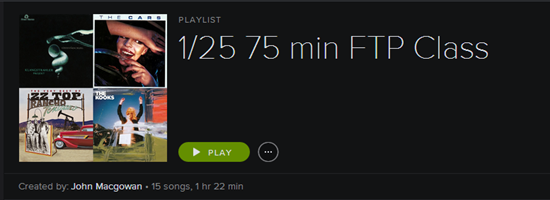
Here's the profile I used a while ago in our Performance Cycle FTP assessment.
[wlm_private ‘PRO-Platinum|PRO-Monthly|PRO-Gratis|PRO-Seasonal|Platinum-trial|Monthly-trial|PRO-Military|30-Days-of-PRO|90 Day PRO|Stages-Instructor|Schwinn-Instructor|Instructor-Bonus|28 Day Challenge']
1/25 75 min FTP Class
Klangstrahler Projekt — Extremely Well
At 10:47 Extremely Well is a perfect warm up song. Plenty of quiet early to give you time to announce the class format – followed by a number unique changes that you can use as a personal cues to initiate a change in intensity.
The Cars — Just What I Needed
Time for some openers – everyone knows this song, so load up the resistance @ 62 RPM and have them surge along to different segments. The objective is to have everyone up to threshold once of twice before the last 30 secs that is use as a short recovery.
ZZ Top — La Grange
Let's find your Best Effort! Have everyone find the 80RPM cadence and then add gears during the 30 sec intro. I start the timed three minute Best Effort at the intensity change in the song at 0:34. Stage button and then encourage everyone by asking; “is this really you… at your best? [This is also a great time to be off the bike, working the room.]
The Kooks — Junk of the Heart (Happy)
This happy go lucky track is a fun reset/recovery. No purpose here, just fun 🙂
Moby — Extreme Ways (Bourne's Ultimatum)
We're getting serious now! I use this 100RPMish track to have riders dial in and observe JRAP/Base Watts. Find the cadence and then gradually add load until you feel your HR begin to creep above VT1 (just above chatty) and then recover slightly. I have them repeat this a number of times, always observing the connection between RPE/HR & the watts they're maintaining.
20 Minute Assessment
I remind everyone how they've found two numbers already, now well find the third that will really validate the others. This 20 minute assessment should flow smoothly from the earlier base watts we were in during Extreme Ways.
Black Sabbath – Planet Caravan Remix download this remix to have for this playlist. Right Click > Save As
Planet Caravan is slightly slower @ 94RPM. Establish this cadence and find the watts that you feel will be your Best Effort over twenty minutes. This # will of course be somewhere between the Base watts and the three minute Best Effort.
Ted Nugent — Stranglehold
Slower at 75RPM – request the necessary changes, while staying locked into your average. We've moved more of the work to our legs = breathing will become slightly easier.
Golden Earring — Radar Love
Back to 100RPM to give our legs a break.
The Kooks — Ooh La – another fun reset & recovery
Klangstrahler Projekt — Take A Breath and Safri Duo — Snakefood – 13 minutes of steady JRAP/Base watts (they should all know exactly where to go by now) and I just let them ride – cuing occasional out of the saddle time.
America — Sandman – 5 Minute Best Effort – or – additional JRAP/Base work if they already appear cooked 🙁
This 80 RPM live track has an awesome lead in you can use for a one minute recovery. Have everyone dial in the wattage of their choice and cue your start at the 1:10 [you'll hear it] for this last 5 minutes of hell!
[/wlm_private]
Recover and Cool Down
Selah Sue — This World
Passenger — Let Her Go
Lana Del Rey — West Coast – Rob Orton Mix
Save
Podcast: Play in new window | Download
by Joan Kent | Oct 16, 2017 | Health and Wellness, Master Instructor Blog

By Joan Kent
My last few posts have dealt with aspects of sugar addiction, including sugar’s effect on health. It’s important — you want to be healthy, right?
Still, I’ve avoided one topic because it’s almost guaranteed to alienate people — fructose. The sugar found in fruit. It’s nasty. We’ll get to the details on that soon enough.
Some people are surprised that fruit could be bad. After all, it’s natural. And whenever people talk about healthful eating habits, it’s one of the first things mentioned. “Eat lots of fruits and vegetables!” As if they’re equal. Fruits even come first in that recommendation.
I might agree with the recommendation in part, but would suggest limiting fruit servings to 1 or 2 per day. A serving is half a cup, or a medium-size fruit. Not much fruit, compared with vegetables. (You can go crazy with those veggies.)
I’ve always balked at “Five a day.” Once upon a time (pre-1991), the Basic Four Food Groups consisted of Meats, Milk Products, Grains, and FruitsandVegetables. The original 1991 Food Guide Pyramid was developed to give us a better idea of the relative proportions to eat. The second tier from the bottom was divided unevenly, into 2-4 fruit servings and 3-5 vegetable servings. Apparently, that was too nuanced, too specific. And so the slogan “Five a day” was coined, referring to the minimum number of servings of each and blending them back together, as in the Basic Four.
(I can’t even count the clients I’ve had who were more than happy to get their 5 a day from fruit and skip those pesky vegetables altogether. But I digress.)
The fructose takeover in beverages and prepared foods was designed to cash in on the lower cost of fructose, and the image it had as a “healthy sugar”. Sucrose (granulated table sugar) was seen as unhealthful. Yet fructose has negative health implications, some more serious than others. All of them contribute to a negative picture overall.
What does fructose do that’s bad for our health?
It’s cariogenic, so it causes cavities. It triggers sugar cravings in susceptible people.
It’s frequently malabsorbed, leading to abdominal complaints (bloating, flatulence, diarrhea). Many people are unable to completely absorb fructose in the amounts commonly found in high-fructose corn syrup products.
Due to rapid utilization by the liver, fructose has multiple metabolic effects. Long-term fructose use can lead to high triglycerides, an independent risk factor for heart disease.
Fructose can also decrease glucose tolerance and raise insulin levels. (If that sounds as if it could lead to insulin resistance and diabetes, you’re right.)
Whether people start with triglyceride issues or not, these changes are the expected results of increased fructose. People who respond to fructose normally show these changes at intakes of around 20% of total calories. Carbohydrate-sensitive people can show these negative responses to as little fructose as 7% of total calories.
Carbohydrate sensitivity is defined as exaggerated insulin secretion to sucrose, but fructose and other carbs can trigger the high insulin, as well.
Sucrose can cause many of these same effects. Sucrose is a disaccharide, half glucose and half fructose. ALL of these sucrose problems are attributed to the fructose in it, not the glucose. And no debate on this exists in the science journals.
So everyone agrees that fructose is what makes sucrose the junk that it is.
Fructose is ineffective as a pre- or post-workout fuel, and it actually does even more health damage than the stuff I’ve listed above. For example, both fructose and the sweetener sorbitol (converted to fructose in the liver) accumulate in the lens of the eye in diabetics, causing osmotic damage.
Let’s end instead by pointing out that even trending sugars can be junk. That includes agave, maple syrup, dates, and acai berries.
Getting away from fructose is a wise and healthful course of action. Because it may be difficult, though, cutting back on fructose could be seen as the final frontier in conquering sugar addiction.
Save
