
by Jim Karanas | May 4, 2017 | Master Instructor Blog

This is the last of our re-publishing of of past articles from Team ICG® Master Trainer Jim Karanas.
Pyramid training is a method typically used by strength athletes and body builders. A session starts with high reps and low weight and incrementally adds weight while reducing reps per set.
Pyramids are typically described as ascending or descending. Descending pyramids are also called reverse pyramids: you warm up, then start with your heaviest weight. From there, you decrease the total load, while trying to do a few more repetitions. Triangle (or up-down) pyramids include both ascending and descending pyramids.
Pyramids are less commonly used by cardiovascular athletes, although they’re strongly recommended by many pros. Ascending pyramids are the only type discussed, and the format involves decreasing time with increasing intensity. An example is a 4-3-2-1 ascending pyramid: 4 minutes easy, 3 minutes moderate, 2 minutes hard, 1 minute very hard. Descending and triangle pyramids are seldom referenced.
In previous posts, I’ve referred to ascending and descending pyramids as ladders and referred to a triangle pyramid as a pyramid. I change the nomenclature here simply to align with how other trainers refer to these training patterns.
The infrequent use of pyramids in indoor cycling always amazed me. Rowing introduced me to structured cardiovascular workouts. I rowed competitively on the water in the ‘70s and competitively indoors in the ‘90s. Rowing ergometer workouts investigate every possible variation of pyramid training and provide a useful template for indoor cycling instructors. With that, you can create an almost endless variety of trainings.
Whether or not you have a computer on your bike, you have four primary variables: cadence, resistance, intensity, and time. In cycling, most ascending pyramids use only time and intensity. The interval gets shorter and the intensity (RPE, HR or power) goes up. This overlooks many potential training opportunities. What about time and cadence? Interval gets shorter and cadence goes up.
What if you involved more variables? How about time, cadence and intensity? Interval gets shorter, cadence goes up, but RPE, HR or power output has to stay the same. This requires a subtle adjustment in the resistance as well as a greater integration of breathing to facilitate relaxation. The result is greater efficiency at high cadences.
How about an ascending pyramid to build strength at higher RPM and improve the ability to spin a harder gear? Time and resistance stay constant but cadence increases. Perform three 1-minute intervals with a fixed resistance and ascending cadence (80-100-120 or moderate, fast, faster). You can also put three of those pyramids together and add in ascending resistance. After each pyramid, you increase the fixed resistance level for the next pyramid.
How about a reverse pyramid to facilitate strength development? The intervals get longer as the cadence decreases, but intensity must increase. This requires massive addition of resistance, as the slower RPM will tend to drop the HR or reduce power. Increasing intensity while cadence is slowing requires a very hard gear. Increasing duration as this happens is quite challenging.
Up-Down (triangle) pyramids are by far my favorite. An 11-minute triangle consists of intervals that are formatted 3-2-1-2-3. How about cadence going up and down (80-100-120-100-80) while intensity goes up and down? I rarely see people coach the down side of this kind of pyramid effectively.
One of my favorite ways to coach this pyramid is to extend a super-threshold effort. First, these 11 minutes are done after extensive warm-up. The ascending and descending portions of the pyramid are performed at different intensities. I’ll use HR percentages of max just for an example: 75%, 85%, 90%, 88%, 86%. As the super-threshold effort begins to induce muscle failure, you drop the HR just enough to squeeze out the next interval.
You can vary this. How about using the same ascending pyramid for HR but with a fixed cadence at 100 RPM? On the descending portion, you maintain the 90% HR but drop the cadence (90 and then 80 RPM). The slower cadences will very likely make 90% impossible for most people when sitting, so you move everyone to the standing position. 90% is possible when jogging at 90, as well as 80 RPM, but you’ll have to increase the resistance as you drop the cadence to 80. Brutal.
The variations are endless. For those who haven’t had the benefit of training on an indoor rowing ergometer, I’d strongly suggest reviewing the rowing workouts available on the Concept 2 website (www.concept2.com). You’ll find many workouts that are easily adaptable to indoor cycling.
Originally posted 2015-01-22 05:09:42.
by Chuck Cali | May 2, 2017 | Best Practices, Engage Your Students, Instructor Training, KEEPING IT FUN, Master Instructor Blog, Training With Power
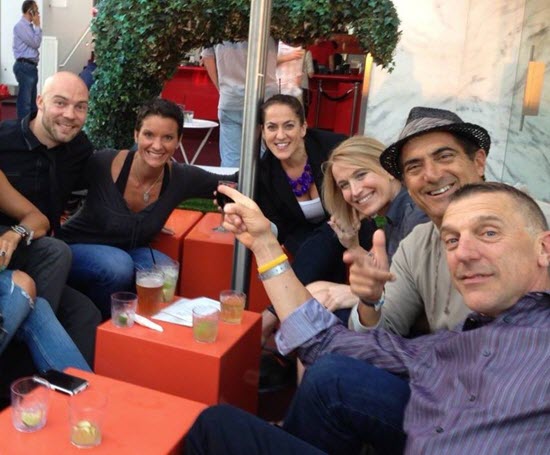
That's me in the hat – with the MI team from ICG.
I taught my last class today. My last ride so-to-speak. It all started seven years ago. I had been Spinning® for years. That day our regular instructor asked me to lead her class. She was just too sick.
To me – a pilot – it was like being asked to safely land an airliner because the pilots were incapacitated. Truth be told, I was far more prepared to land a 747 than lead the class. But I did it, and that is where my ride as indoor cycle instructor began.
Penning this post for ICI/PRO is – for the most part – where it ends. A memoire of sorts that highlights milestones of my journey from certified but lost, to Master Instructor, what I learned along the way about our craft and our industry.
Realizing the joy of being in the front of the studio, I took the first of countless certifications the next month. A one day, eight hour class. Leaving that afternoon I realized what I didn’t know.
I knew that to be the instructor I wanted to be, would require more than eight hours. So I did what all red blooded Americans do, a Google search on teaching indoor cycling.
Lucky for me John understands search engine optimization. ICI/PRO was top of the list and my life as an instructor changed.
Back then John was publishing ‘podcasts’ and posts talking about something he called Indoor Cycling 2.0. What?? I was in my car a lot in those days with my iPod plugged into the radio. I listened to it all trying to figure the best way to integrate such wisdom into my teaching.
There were guest speakers who discussed everything from music to very cycle specific training.
There were posts from this guy, Gene Nacey, who had started a company called Cycling Fusion. Gene wrote a book back then about training with power. The forward, written by Sally Edwards. Who were these people and why are they always talking about heart rate, power and cadence?
ICI/PRO offered class profiles with music suggestions. I found these very helpful but they had names like muscular strength or climbing power or aerobic volume training. It was all very overwhelming.
I realized what made it so overwhelming was that I had not really been educated. That my eight hour class hardly scratched the surface of what ‘training’ on an indoor cycle was really about.
My experience taking classes was just the opposite. My favorite instructor never did any of this stuff. I had reached a defining moment. Indoor cycling version 1.0 or 2.0.
I chose 2.0 because it had the education I yearned for and the structure that seemed missing from the classes I took. I had always been a fan of heart rate. Moreover, the new bikes at the JCC – where I was trying to land a sub job – measured heart rate and had power meters. I knew that seemed like the perfect combination but – at the time – had no idea why.
I got the sub job and a fair amount of opportunity to teach in those early years. I began my quest to get better through education. My sub classes (all I had at the time) were – unbeknownst to them – my guinea pigs.
Having read Gene’s Power Training Book there were some questions. I had found a way to land a ‘regular’ class in prime time by offering to do a power training course. I had questions, so I called him.
Gene is the quintessential professional. He always gave freely of his time to answer my questions. But he warned me, “Chuck where you are going you will discover a culture, the culture of indoor cycling. Good luck.” But more on that later.
Later that year he was doing the official launch of his new company, Cycling Fusion by hosting a summit of some of the most nationally regarded indoor cycle instructors. I’m not sure where I found the nerve, but I offered to kick off the summit suggesting that I was representative of the new 2.0 instructor. To my surprise Gene said yes.
The rest is history. My relatively short, but incredibly intense career really began at that summit, west of Denver high in the Rocky Mountains at Keystone Ski Resort. Why? I met Sally Edwards. Talk about unbridled energy. Sally – the only person ever inducted into both triathlon halls of fame – epitomizes it.
Suffice it to say that when I ran into Sally at the Denver airport after the summit I knew I was home. John led me into the room, Gene opened the window and Sally was the sunshine that poured through. There are not enough words to describe the learning one experiences working with Sally Edwards.
But if Sally was the sun shining on my personal learning crusade, Jim Karanas was the fresh air flowing through the open window.
Jim was indoor cycling 2, 3, 4 and 5.0 way before anyone ever heard of a ‘podcast’. Sadly, Jim left us a while ago, but his legacy lives on in all of those he touched. From Jim I learned to put the icing on the cake. That at the end of the day, it was not about me or just about heart rate or power, cadence or cycle specific training. It was about bringing to class the ability to touch each rider such that they were sure I was teaching class just for them.
When I made the choice to give up leading classes I did it with the knowledge that I had met my own challenge – to understand the whole of indoor cycling yes, but to touch the people who trusted me in a positive manner. How did I know? Simple really, rider feedback. Additionally, I had grown past the place where I was committed to only one way. I was comfortable teaching outside the keep-it-real philosophy that had governed my every thought for so long. I knew that Indoor cycling 2.0 was only a pass to explore and learn, not a rigid protocol to vigorously defend. That my job was not to suppose I knew what my riders needed, or how they got it, but to provide for them what THEY thought they needed that day. I can do that. I have done that. I am content. I have moved on but I have not forgotten.
In the coming weeks I will give John some additional posts written but never submitted. Posts that take a close, perhaps inside look at the realities of our industry. Fruit for thought or maybe, fuel for a fire.
It has been my privilege to have met and worked with so many great and talented individuals.
I wish you all well!
Originally posted 2015-02-08 14:30:39.
by Tom Scotto | Apr 30, 2017 | Master Instructor Blog
 In my last article I focused on the implications of making adjustments to the drivetrain (seat height, fore-aft, tilt, etc.) to compensate for issues and limitations surrounding the upper-body and cockpit.
Drivetrain … Cockpit….. are these “technical” terms in the cycling industry? No, not really. They are however terms that have been used for years when we want to refer to an area on the bike and not a specific part or movement. For example, I could say that we are going to discuss the impact of handlebar height, handlebar fore-aft position and posture to address comfort and performance, but it is much easier to lump the whole thing together as the “cockpit”.
SIDE NOTE: Keep in mind that indoor bikes are often limited in their adjustments. On a real bike, in addition to handlebar height and fore-aft position, the following would be considered: handlebar width, angle, position of brake levers, reach, drop and type of bend.
4 Considerations for Handlebar Position
As always, there can be multiple factors which contribute to each consideration, but here are some basic principles to give you a starting point in helping riders make the best decision and adjustment.
Comfort: Many riders (both indoors and outdoors) find handlebars that are set low to be uncomfortable. This can be due to weak core muscles, poor posture, back and spine issues, and simply because it is not something they are accustomed to. Raising the handlebars can relieve pressure, relax tight muscles and provide a more upright and comfortable position.
Performance and Power: Relatively speaking, handlebars that are lower can help riders gain more power and better performance. Besides aerodynamic considerations, deeper torso flexion can provide better gluteal and hip flexor activation often resulting in a more efficient pedal stroke and more powerful down-stroke.
Flexed Spine: When the fore-aft position of the handlebars is too close to the rider (cockpit too short), riders may have the tendency to hunch (curve or flex their spine). This can put their back and spine at risk particularly when they are using large amounts of resistance. Adjusting the fore-aft position to lengthen the cockpit can help neutralize and relax the spine and surrounding muscles.
Over-Extended: When the fore-aft position of the handlebars is too far away from the rider (cockpit too long), riders can find themselves reaching, hyper-extending the spine and in deep flexion at the hips. This over-extended position can cause lower back pain, shoulder pain, strain on the neck and leave riders with fatigued arms. Adjusting the fore-aft position to shorten the cockpit will relax some of the aggressive angles and allow the arms and core muscles to support the upper body.
In many cases you will find yourself both adjusting the handlebar height the fore-aft simultaneously to get the desired position. Also, don’t assume that more aggressive settings (in either direction) are necessarily wrong. I’ve seen road cyclists and triathletes that are comfortable and safe using a very low handlebar position, as well as, a rider recovering from back surgery with their handlebars appropriately in the highest, closest position.
Determining The Optimal Cockpit
Our first concern is always safety which is why the first question we should ask any rider before we suggest or make an adjustment to their bike is “Do you have any injures that may be aggravated by riding?” Knowing this information upfront can save you from putting a rider in a risky position plus allow you to help them make better decisions as to what may be best at this time.
Handlebar Height
Assuming we have no physical concerns, it is simply a matter of comfort vs. power. When I setup a rider for the first time, I prefer to place their handlebars level with their seat (often referred to as “neutral”). This can sometimes be a challenge with shorter riders because the handlebars on some indoor bikes cannot be adjusted that low. Do what you can. If a rider feels uncomfortable, raise the handlebars in small increments. If a rider feels they are too high or wants more power, lower their handlebars in small increments. I’ve talked to instructors who feel that the handlebars should never be lower than the seat. I’m not sure where they received that information, but it is incorrect. It is not uncommon for outdoor riders (particularly road cyclists and triathletes) to have their handlebars more than 4 inches below the level of their seat. Consider the safety and needs of the individual rider and avoid making up rules.
Handlebar Fore-aft Position
Many of the bikes we use indoors may still not have the ability to adjust the fore-aft position of the handlebars. Even though, you still may be able to make suggestions for where a rider should grip the handlebars based on what you observe. As I mentioned in my previous article, this is the reason we should avoid numbered hand positions.
To determine the optimal starting point for handlebar fore-aft position, have the rider (seated) bring their foot and pedal to 12 o’clock keeping their ankle relaxed. Have them place their elbow to their kneecap with the end of their arm (hand and wrist) on top of the handlebars. The other hand should be gripping the handlebars and providing support.
Simply observe the alignment of the wrist and the crossbar of handlebars. If the crossbar is more than a fingers-width in either direction, you can suggest making an adjustment (keeping the above considerations in mind). You may find yourself incorporating a combination of hand position and handlebar position depending on what range of adjustment is available.
My Strong Opinion
I’m certain no one is surprised as I’m also certain I’m preaching to the choir on this one: “there are no short cuts when dealing with the variables and complexity of the human body in motion”. Certifications and individuals that advocate specific settings and positions will often find themselves wrong, and worse, lead others astray or toward injury. However, I’m comforted knowing that all of us at ICI/Pro default to knowledge. Doing something right requires understanding, where following rules…not so much.
Originally posted 2011-12-29 12:36:14.
by Jim Karanas | Feb 16, 2017 | Master Instructor Blog

With over 1800 articles in our archives there's a good chance that our ICI/PRO members may have missed some of our best stuff. So every Wednesday we are republishing some of our favorite articles and podcasts – enjoy!
By Team ICG® Master Instructor Jim Karanas
What is Beatmatch?
A beat is the regular, rhythmic unit of time that makes up music structure. Beatmatch matches cycling cadence to the beat of the music, so that one leg pushes down and the other pulls up every time there’s a beat.
When cycling in time with the music, each beat matches up with one pedal rotation. The beat always occurs on the same leg, and the offbeat, the unaccented beat between counts, always occurs on the other. Beatmatch can be done in three ways: 1 beat = 1 rotation, 2 beats = 1 rotation, or 1 beat = 2 rotations.
Beatmatch can give rise to strong aversions. “Aerobics on a bike!” “You’re putting the students in a box!” “Let the students find their own rhythm!” These comments support a Freestyle approach to music, which I too support — but not all of the time.
What’s Good About Beatmatch?
Matching cadence to the beat teaches timing. It makes the pedal stroke smoother, more consistent and fluid. It can help students who lack an innate sense of rhythm FEEL rhythm. It‘s a powerful tool for teaching effort and commitment. It’s ergogenic. I think it teaches how to ride more efficiently.
Say the class is riding at 80 rpm, and you cue them to add resistance without changing cadence. An untrained student will unconsciously slow the cadence, which offsets the work. It’s a typical response by someone who has not yet learned to put out, or build, effort. Beatmatch can help prevent that slow-down.
Or have more advanced students jog at 95 rpm for 5 minutes. That’s challenging. Many, when near exhaustion, can’t maintain the cadence. Looking at a computer won’t help much, but keeping up with the beat can be more effective.
I think of timing as our interaction with the world. With good timing, there’s “flow”. The world seems to work: watch a bike messenger weave through busy urban traffic. Bad timing is the opposite, out of sync. We hit every red light on the ride home. The most basic lesson in developing good timing is consistency. If we’re unaware of our inconsistent timing to begin with, how can we ever sense flow? Musicians develop consistency by using a metronome. That’s Beatmatch.
Other benefits of Beatmatch include greater sensitivity to gear selection and cadence, finding the rhythm at which you create power effortlessly, and a stronger connection with your bike.
When Is Freestyle Beneficial?
Freestyle uses a range of cadences for whatever terrain you’ve cued, so the pedal stroke is not always in time with the music. There are advantages to this approach under certain circumstances. For one thing, Freestyle’s easier on the instructor. If you can’t find the perfect music, you can cue by feel, nuance and cadence range.
More importantly, Freestyle can help students. If the student isn’t yet fit enough to handle fast cadences, especially standing, Freestyle permits success. If the student isn’t strong enough to handle very slow cadences with high resistance at high heart rates, Freestyle permits success. When the pattern calls for lots of changes — e.g., from seated to standing and back with resistance changes at frequent intervals — Freestyle permits success.
While Beatmatch can be mentally exhausting because of the structure and constant need for control, Freestyle allows the student to relax and focus more on heart rate and terrain changes without counting. It may evoke emotion more easily because it demands less vigilant attention.
Emotion Revisited
Slid Fluke
L.A. Woman Billy Idol
This Is Us Mark Knopfler & Emmylou Harris
Stevenson George Winston
I’ve played these four songs, listed last week, for hundreds of instructors and asked for their emotional responses. The comments never vary.
“Slid” is great electronic music, but no one can pair an emotion with it. That’s typical with Electronic, Techno or Dance music — good workout music that doesn’t generate much emotion.
When I play Billy Idol, most of the instructors smile and often don’t know why. Rock ‘n’ roll just makes people happy.
“This Is Us,” a country rock song, is usually described as love, warmth, affection or sincerity. A good country song is like a hug.
Last, I play “Stevenson” by George Winston. It’s 1:57 long, classified as New Age, and on the Hurricane Relief Benefit collection that raised money for Katrina survivors. To start, people may chat, but within seconds the room is silent. To describe their emotions, they use words like sad, upset, depressed.
Stevenson Palfi was a documentary filmmaker who made a name for himself among the jazz musicians of New Orleans, his primary film subjects. He took his own life after losing everything in Katrina. The song ends abruptly and feels unfinished, like Stevenson’s life. It may leave you raw, sad and contemplative.
If your class is truly about delivering an experience, music can bring both emotion and structure. When selecting music, don’t always go for the obvious workout music or the ambiguity of Freestyle. The same song can be perfect for a tough Freestyle climb or a hard flat road in Beatmatch. Try music that makes you feel. See what impact Beatmatch can have. Use unexpected music at unexpected points in the class.
Be courageous.
by Jim Karanas | Feb 13, 2017 | Master Instructor Blog

By Team ICG® Master Trainer Jim Karanas
Body Language
Remember from Part 1 that teaching indoor cycling is a form of public speaking, which itself is an art. Employing some public speaking skills will impact your class dramatically. Great public speakers know that much of their impact comes from body language, including stance, gestures and facial expressions.
Stance
When you teach, a strong, disciplined position on the bike is essential for building credibility, expressing your emotions, and connecting with your students. Nothing discredits an instructor more than moving poorly — rounded back; hunched or protracted shoulders; no fluidity when changing positions; sitting up constantly, often unconsciously, to recover. You’ve lost the class before you’ve started.
Being strong on the bike is not just about your monster CV system. Your ride position, like a public speaker’s stance, must be solid to project confidence in front of a class. Students respond to instructors whose bodies are alive and disciplined. If someone filmed you while teaching, you might be amazed at how your posture sometimes portrays the opposite of what you tell your class to do.
Gestures
Use your hands to gesture every so often. On a bike, your hands belong on the handlebars, but you can keep one hand connected and use the other to emphasize a point or express emotion.
Sit up occasionally and use both hands as a public speaker would. When sitting up, I tell my students to keep their hands on the handlebars unless they need a back break.
Get off your bike at times, not only to work with individual students, but also to stand closer to the class and gesture with your entire body.
Facial Expression
Eye focus is the most important element of facial expressions, particularly to communicate sincerity. Don’t just look around the room as you speak to maintain general eye contact. Nothing connects you to your students better than focusing on one student long enough to deliver an entire phrase without looking at anyone else.
Pause when you finish and let it sink in for a moment.
This connection between you and one student can rivet the entire class. What did he say? Why didn’t she say that to me? The technique contributes significantly to comprehension and retention by giving the listener, and anyone else who tuned in, time to process the message.
Most instructors lose their facial expressions while teaching and “solidify” into a single look. Relax your face right from the start, and always greet your class with a smile. You won't smile throughout the class, but smile at least at the appropriate moments, like when you crack a joke that was actually funny. Somber and serious can be effective too, depending on training intensity.
It isn't natural to sit on a bike in front of a group. It's unusual and odd, so don’t try to be natural. Be larger and more powerful. It takes effort, skill and practice. Work on your body language to make the most of every class you teach.
Media Support
Steve Jobs was the maestro of using media with his public presentations. In 2005, he called Madonna on iChat after she signed an exclusive deal with iTunes and displayed the call on a big screen — a great use of media to enhance a presentation. Check the link: http://everystevejobsvideo.com/tag/madonna/
As instructors we can use voice, music and video to deepen our class presentation experience.
Voice
Our tone of voice shows our students whether or not we care. It tells them whether we’re in fun mode or feeling excitement, passion and enthusiasm about teaching. If the members think our class is boring, it may have nothing to do with the workout or music selection, but with a monotone that sounds dull.
Here are some suggestions for making classes more impactful through tone of voice:
- Pause before emphasizing an important word or concept.
- Speed up your speaking to show excitement.
- Tell a story. This will translate to your vocal quality.
- Define a moment in your class that might be considered a pinnacle: “Everything we’ve done to this point has prepared us for the next 2 minutes!”
Music
In public speaking, music is often used as background when participants enter a room to set the mood for a meeting or event. How much attention do you give to the music you play as your class enters? The proper music gets people in the right mood to work and adds a touch of drama to your class.
What do you play as the class is leaving? Music can reaffirm a pleasant atmosphere as your students exit.
Avoid turning music on or off suddenly. It should always fade in or out slowly.
This post is not about how to use music when you teach, but to expand on your use of music to set the right mood for the class before it begins and when it’s over. That’s what great public speakers do.
Video
Effective use of video to enhance our classes is a prime directive at ICG®. Forward-motion video can make your class more absorbing and exciting. Beautifully filmed, high-energy video that showcases destinations from around the world entertains and engages.
Remember, however, that video should never dominate your class. That important job is always left to you, the instructor. Video is just another asset that supports your class profile.
At its best, public speaking is flawless talk in a compelling sequence that persuades through command of the language. It’s well structured, well delivered, informative, educational and entertaining. Striving to be better public speakers can make us better indoor cycling instructors.
John's note: We're highlighting some of Jim Karana's past articles this week.
by Jim Karanas | Feb 12, 2017 | Instructor Training, Master Instructor Blog
 By Team ICG® Master Trainer Jim Karanas
More than anything else, members attend our classes for someone to work them out, to train them. My primary evaluation of a class is always whether I got a workout. I tell new instructors all the time to keep that in mind: with just the mindset of the typical class attendee, you’ll give a satisfactory performance.
With that said, we all know that a class can be so much more. When you approach class design and instructor performance as a form of public speaking, which they are, you may recognize the level of artistry to which teaching can be raised. The Presentation Secrets of Steve Jobs gives an idea of how some people prepare(d) for a public address.
Public speaking is an art. So is teaching an indoor-cycling class. Regard it as an art, no matter what your level of instruction, and you’ll be on a better path.
In public speaking, there are five basic elements, often expressed as, “Who is saying what to whom using what medium with what effects?” Does that sound familiar?
If we study the volumes that have been written about how to become a confident, compelling public speaker, the impact on our class presentation will be epic.
I’ve been involved with some form of public speaking since the 1980s, when I first joined Toastmasters. I was teaching aerobics then but didn’t draw a parallel between the two activities until much later in life. The following are a few speaking strategies to consider that parallel the Art of Teaching Indoor Cycling.
Plan Your Communication Appropriately
This goes beyond planning your workout and is completely separate from preparing your music or video playlist. Structure what you’re going to say during class. Apart from workout cues, which messages are you going to deliver? Exercise science? Training philosophy? Bicycle facts? Don’t just deliver these randomly. Plan how and when you’ll introduce this part of your presentation. Public speakers frequently use a tool called the 7 C’s of Communication: Be Clear, Concise, Concrete, Correct, Coherent, Complete and Courteous. There are variations on the 7 C’s that also include Credible and Creative.
Let’s say you’re teaching an endurance class and want to discuss the benefits of aerobic conditioning. I recently listened to an instructor do this. She spewed all the information during the first 10 minutes of class (not concise). She constantly talked over lyrics (not courteous). She was only about 75% correct in what she said and left out certain elements that could have connected the dots (not complete). She was clear in what she said. She also said it with authority (concrete) but rambled, not presenting the info in an organized fashion (not coherent).
Still, it was much more than many instructors take the time to do.
I was engaged and got a good workout. Clearly, this instructor understood the value of messaging during classes. It might have been the first time she presented it. She only needs to work a bit more on her presentation of this information to improve her overall communication.
Practice
Practice makes perfect. You probably won’t say something well the first time you say it (the example above). To practice, you must seek opportunities to speak in front of others. Repeat the same messaging in different classes you teach; don’t forget about it after you’ve said it. Before that, however, you must practice it plenty of times alone. As you practice, keep tweaking and re-tweaking your words until they flow smoothly and easily. You will often see me speaking out loud while driving.
Engage Your Audience
When you speak, try to engage your audience. This makes you feel less isolated and keeps everyone involved with your message. Force yourself to slow down by breathing deeply. Don't be afraid to gather your thoughts. Pauses are an important part of conversation and make you sound confident, natural, and authentic. Look at the students while you’re speaking and make eye contact. Speak to them directly.
I mentioned above that the instructor spoke over lyrics. I’m surprised at how many instructors speak over vocals in a song. I feel this is discourteous to the class because it’s confusing to listen to, but could even be considered discourteous to the artist. Learn your music so you can speak effectively in the interstices between the vocals — or insert an instrumental song when you want to deliver your message. This point was covered in my previous post on cueing.
Next week, we’ll discuss the importance of posture on the bike (body language in public speaking) and the use of various media (audio, video and voice tonality) to enhance your classes even more.
John's note: We're highlighting some of Jim Karana's past articles this week.
