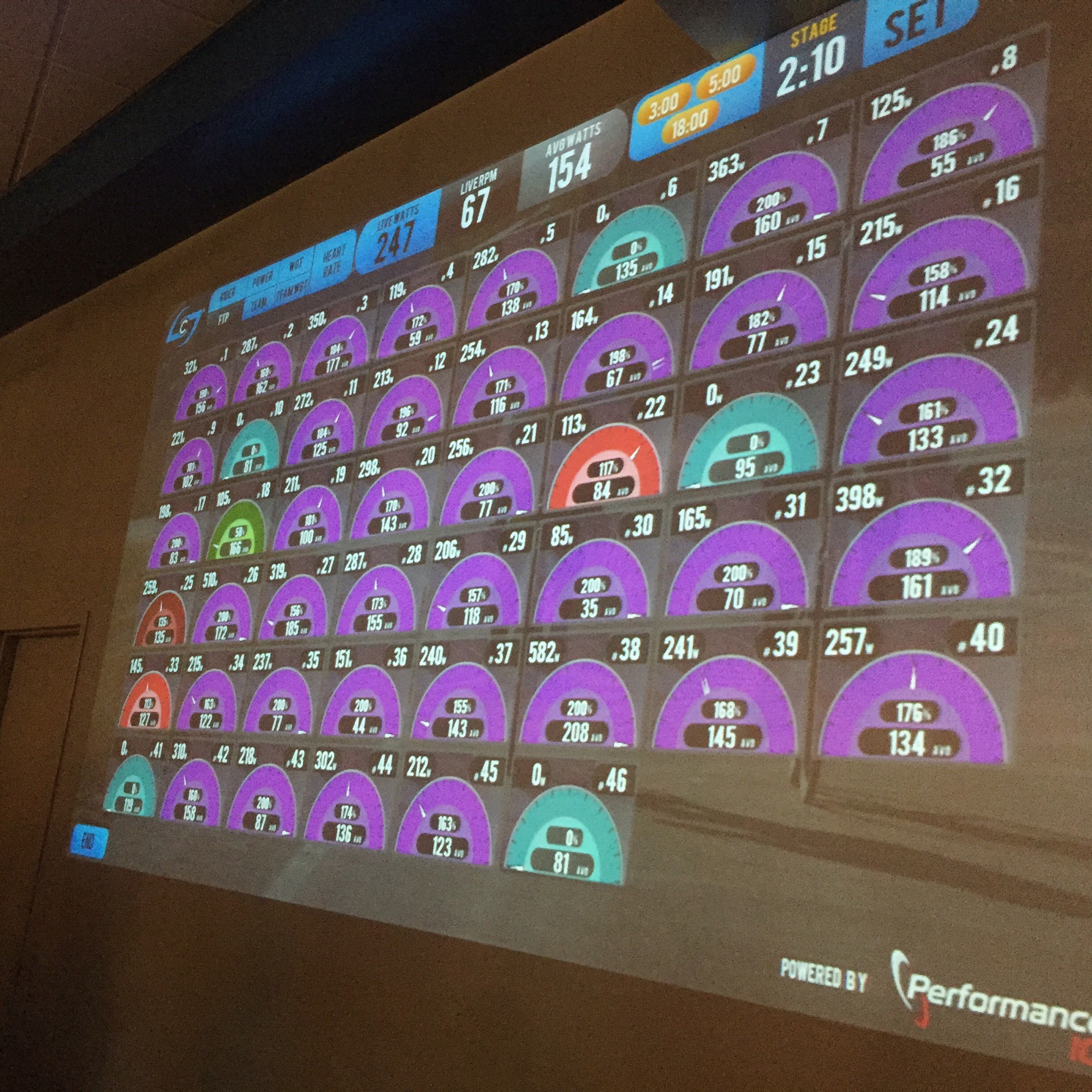
We're looking for a Performance IQ Rockstar that we can develop into a Master Instructor – joining me to conduct PIQ Instructor trainings.
Master Instructor Qualifications
Are you super experienced at teaching Indoor Cycling classes where Performance IQ Display Training is a focus of the class?
Do you feel you have the passion and personality to enthusiastically transfer your knowledge and experience to other Instructors?
ICI/PRO is planning to develop, and then contract with, a Master Instructor to conduct workshops at North American (and potentially international) club and studio locations, beginning this fall 2016. The successful candidate will partner with me – Master Instructor Dennis Mellon.
If you've wanted to become a Master Instructor, this could be an awesome opportunity for you. My initial exposure here at ICI/PRO really advanced my career and lead to my current Master Instructor position!
Qualifications:
You’re recognised as a ROCKSTAR instructor, consistently filling your Indoor Cycling classes
You hold a current ACE/AFAA Group Fitness or Personal Training certification
You have a current Indoor Cycling certification from one of the established brands
You teach regularly scheduled Indoor Cycling classes at a club/studio that uses Performance IQ — and this is important — your supervisor is willing to be a reference
You have a thorough knowledge of zone based Heart Rate and Power training principles + you apply these consistently in your display training classes
Your classes are an effective mix of conventional and rhythm & movement formats; i.e. cycling specific training meets SoulCycle
Excellent computer skills — you’re the go-to person whenever there's an issue and who’s helping others learn to use PIQ at your studio
Written communication comes naturally to you
You have weekend (Friday — Sunday) travel flexibility
We're tentatively planning our first Performance IQ Display Training workshop for the middle of September at the Greenwood Athletic club in Greenwood Village, Colorado.
This is a contract position and the successful applicant will be compensated per training + travel expenses.
Please email me directly with your resume and a cover page to Dennis Mellon at dennismellon@me.com
This is the first installment of a new series of posts I'll be sharing on all aspects of the States SC3 indoor cycling bike. The Stages SC3 has taken the indoor cycling world by storm and I believe it's important for all instructors who use this bike to have a clear understanding of all it's amazing features. Those who don't use this bike can also learn from many of its features. The science is the same no matter what bike you use.
I'm going to start with an overview its console than in future posts I'll explain the metrics that are displayed line by line.
Below is a video narrated by Stages Director of Education Cameron Chinatti that overviews the Stages SC3 Console.
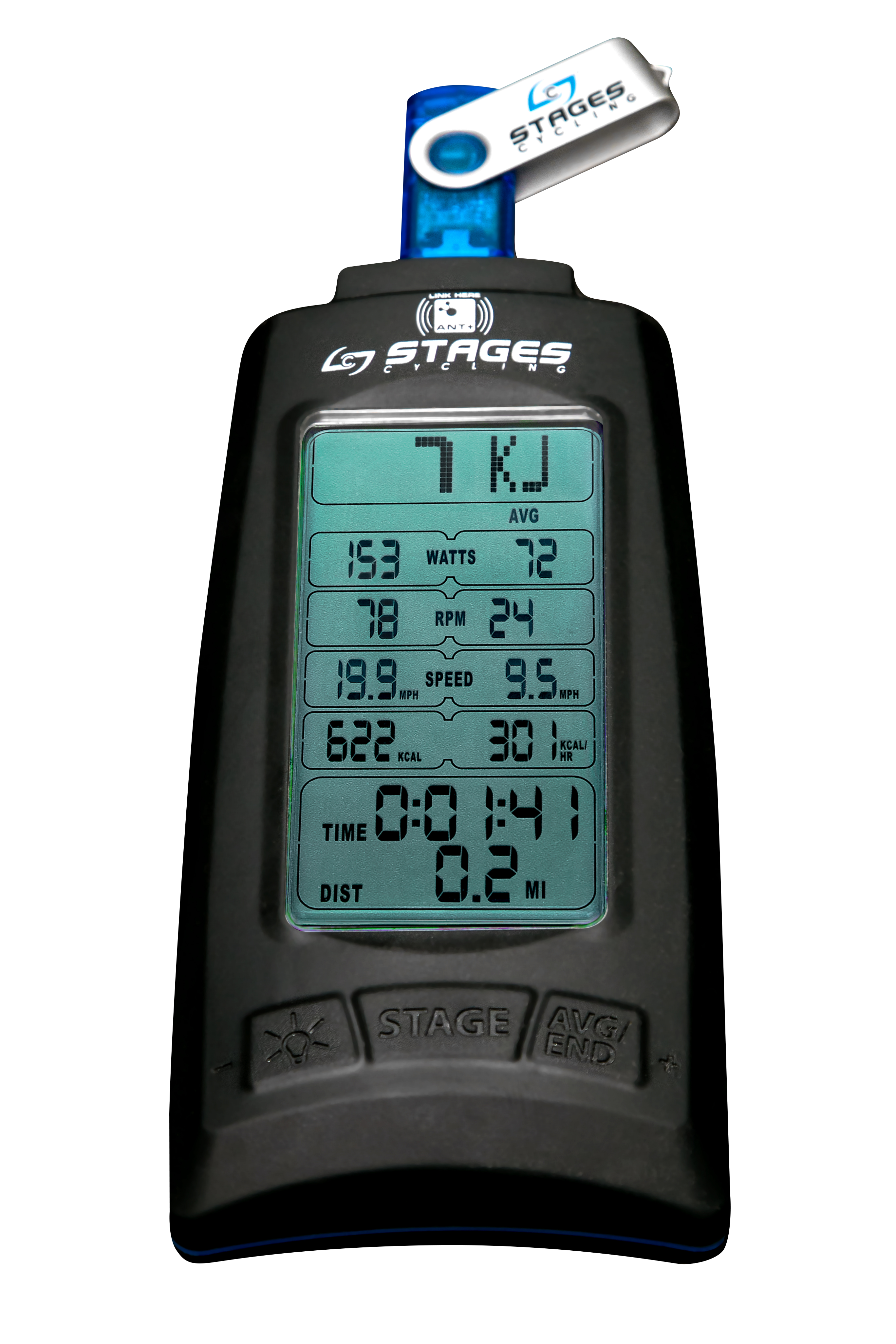
Whether you’re riding indoors or outdoors, cumulative cycling efforts are often measured in kJs (kilojoules). For example, at the end of a Stages Indoor Cycling workout you’ll see total kJs on the Stages Power Console on the RESULTS screen. After a ride outdoors on your bike, you may also see total kJ’s on your cycling head unit. So, what is a kJ and why should you care? We’re glad you asked!
Let’s start at the beginning. We’ll explain this KJ thing in terms of a workout on the SC3 Stages Indoor Bike and Stages Power Console. Basic mathematics comin’ atcha, consider yourselves warned.
What is a Watt?
A watt is a standard international unit of power. More often than not it is represented in horsepower. In fact, 1 horsepower = 746 watts. Try to generate 700+ watts. It’s a fun experiment and rather quickly you will realize that yes it’s true, a horse is more powerful than you.
The Stages Power Meter and Console will measure and display the user’s power output in watts. To get this wattage we need movement (RPMs) and force. On the Stages bike, force is measured when the rider steps down on the pedal. As you turn the resistance dial to the right you have to work harder to step down on the pedals, thus more force is generated.
This product of movement and force = WATTS. With us so far?
Now what if you could take all those little watts and add them up over the total time of your ride to see how much energy was expended? You can do just that, if you convert to kilojoules.
1 watt = 1 joule applied for 1 second
1000 of those joules = 1 kilojoule (KJ)
In other words…
kilojoules = watts X seconds / 1000
Now let’s look at kjs to kcals:
The last conversion in our chain of interrelated metrics is converting kilojoules (work over time) to kilocalories (food energy required to do the aforementioned work).
At Stages Cycling we choose NOT to think of calories as the enemy and in fact we’re growing a bit weary of superfluous calorie conversations. Instead we have chosen to give you the straight facts and the straight science.
So first, let’s answer a question that we get asked all the time:
“Why do you call it “kcal”? Can’t it just say “Calories?”” Funny you should ask, there’s a Trivial Pursuit-worthy answer for that!
A calorie- sometimes called a “gram calorie” or “small calorie” (note the lower-case “c”)- is a unit of energy. In fact, it is the amount of energy it takes to raise the temperature of 1 gram of water by 1 degree Celsius. But it turns out that, metabolically speaking, the calorie unit isn’t very practical due to its small value. In nutritional contexts kilocalories- also known as “large calories” or Calories (the upper-case “C” is important)- are preferred. As you might guess, 1 kilocalorie is equal to 1000 calories, or 1 Calorie. Interestingly, the large Calorie is not officially recognized as an international standard unit of measurement. However, in spite of its non-official status, the large Calorie is still widely used as a unit of food energy in the US, UK and some other Western countries. If you travel abroad or purchase any packaged imported food you may notice that within the European Union, both the kilocalorie (kcal) and kilojoule (kJ), another unit used to describe energy, appear side-by-side on nutrition labels.
“Wait, what? How am I supposed to wrap my head around that? Besides I thought kilojoules were watts added up over time?!”
Keep in mind that energy is energy, regardless of its units. We’re simply going to take the work that you put into the bike and convert it into its equivalent energy in Calories (kcal) rather than kJ. A benefit to using the Stages Power Meter with the Stages console is that all these energy and power measurements become readily available! And now, the last step in the chain, the secret sauce, and the moment you’ve all been waiting for: converting kJ to kcal!
Here are some fun figures:
4.186 kJ = 1 kcal = 1 Calorie
Standard assumption of human mechanical efficiency = 22%
I know what you’re thinking, “Where does that 22% come from?”
As it turns out, the human body is amazing, but it’s not very mechanically efficient. The efficiency of human muscle has been measured (in the context of rowing and cycling) at a whopping 18-26%. This means that only 18%-26% of the energy available to the muscles is actually translated into doing work- the rest is lost as waste. For our calculations we simply chose the median point, which is regarded in the fitness equipment industry as the standard assumption of mechanical efficiency, also known as the best approximate value.
The Stages console uses the following formula to convert the kJ value to the kcal value:
kJ / 4.186 / .22
First, the kilojoules value is converted to the kilocalories equivalent (4.186 kilojoules = 1 kilocalorie). Then, this value is divided by the standard assumption of human mechanical efficiency (22 percent). The result is the approximate amount of food energy used.
Your homework assignment- should you choose to accept it- is to do a ride on the fabulous Stages bike with Power Console and take two pictures at the conclusion of your ride. One picture with the kJ info showing at the top and another with the kcal info at the top. When you have a spare moment try out the equation above and you’ll be amazed, it’s Math-magical!
You can learn more about Power, the Stages Power Meter and the Stages Indoor Cycling bike at the Stages Cycling website.
You don't find opportunities to ride and learn from the experts everyday, let alone for FREE!
Join Stages Indoor Cycling, Director of Education, Cameron Chinatti and Master Educator, Dennis Mellon and learn…
Best Power Practices
Video Rides to remember
Stages Special Edition of Performance IQ
Power zone training
and more!
Here are the descriptions and form links to register for each:
–
8:30-10:00 – Oh no! Not the Power Police – Led by Cameron Chinatti: It’s official: consoles and power measurement for indoor cycling are here to stay. But with every new piece of equipment comes ‘creative’ misuses and abuses. Avoid getting caught by never committing a crime in the first place! You’ll learn the most common crimes against consoles, then get ready to ride as we explore our top-ten best power practices. These Simple Setsâ„¢ will give you hours of new ride content and provide priceless aha! moments for your participants. Join Stages® Indoor Cycling to see how easy it is to use today’s data to achieve tomorrow’s goals.
11:00-12:00 -Head Up to Get Down! – Led by Cameron + Dennis Do you want to know that you’re doing exactly the right amount of effort? Join Stages® Indoor Cycling for a ride with our Special Edition version of Performance IQ Heads Up Display, better known as Stages IQ. A quick 3-minute assessment is all you need to determine your Power Rx – the most important piece of ride data you’ll ever need! For the first time ever your entire class is doing exactly what they need to get better and see the results they’ve always wanted.
1:30-2:30 -Show Me – Led by Dennis Mellon:If a picture is worth a thousand words, then a video is worth a million! Since the inception of indoor cycling, instructors have been talking and talking in an attempt to set the scene for their riders' indoor journey. Let’s stop talking and start showing! What is the speed of a sprint finish or the increased pulse of an epic ski run? Let’s dance to the beat of your favorite artist and experience the POWER of your favorite band playing a live concert. Through the use of video and the new Stages SC3 Eco Screen there is no course that cannot be ridden and no metric that cannot be evaluated to take your riders on the most epic fitness journey ever!
3:30-5:00 – Oh No! Not the Power Police + SIQ – Led By Cameron Chinatti:It’s official: consoles and power measurement for indoor cycling are here to stay. But with every new piece of equipment comes ‘creative’ misuses and abuses. Avoid getting caught by never committing a crime in the first place! You’ll learn the most common crimes against consoles, then get ready to ride as we explore our top-ten best power practices. These Simple Setsâ„¢ will give you hours of new ride content and provide priceless aha! moments for your participants. Join Stages® Indoor Cycling to see how easy it is to use today’s data to achieve tomorrow’s goals.
My coach, Jim Karanas, used to say that athletic performance triggers the ego. It brings forward conflict, discomfort, anxiety, self-defeating thoughts, and doubts about what’s possible and what’s not.
In athletics, you do what’s necessary. You have the above thoughts without reacting to them — and stay with the event. The athletic objective is to learn to be nonreactive to distractions, including pain.
Giving up sugar can also bring forward discomforts — withdrawal symptoms, cravings — plus the anxiety, doubts, and self-defeating thoughts that may go with them. Like the athletic distractions, none of them is permanent.
You do what’s necessary to eliminate them and stay with the plan.
One difference is that, in athletics, it helps not to derive an identity from your performance. That identity, my coach said, is just ego.
In contrast, I say, what’s good about going through the process of quitting sugar is the sense of identity you develop when you do it. Your identity shifts.
You become The Person Who Doesn’t Eat Sugar, and things change.
– You stop finding sugary foods tempting. They’re Not Food.
– You consciously stop putting junk into your healthy body.
– People stop trying to persuade you to eat what you’d rather avoid.
– People stop giving you gifts of tempting sugary treats.
It’s not that the foods don’t look or smell appetizing. But they don’t bother us because we view them as something we simply don’t eat.
They’re no longer who we are.
Brain Chemistry Puts a Space Around Sugar
Eckhart Tolle, who wrote The Power of Now, talks about putting a space around pain, thoughts and memories — especially negative ones — by staying present in the moment.
Basically, that’s becoming nonreactive.
Once addictive foods — like sugar — have been removed from your diet, the right foods you’ve added along the way can, and will, enhance dopamine and improve your focus.
Meanwhile, serotonin will put a space around what’s happening — and make you less reactive — by literally increasing the time between thought and action.
The non-reactivity holds true whether the trigger is external — seeing chocolate cake, smelling freshly baked cinnamon buns — or internal — having a taste that triggers the desire for lots more.
I talk to my clients about stability, which applies to both brain chemistry and glucose.
When both are stable and even, my clients are able to make decisions about food, instead of reacting to every treat.
They make decisions, instead of succumbing to junk they know won’t do them good, just because they can’t resist or think they have “decision-making fatigue.”
Once my clients are stable, I know they’re on the ‘Zen path’ — as described in my last post — to making clear decisions about food and sugar.
Most IC instructors have the client’s best interest at heart. We may not all agree on every point, but we do want our participants to do well, get the results they seek, and feel great. That probably goes not just for how they work out, but for what they eat, as well.
It’s a safe guess that most instructors wouldn’t mind at all if their class participants stopped doing the following things — immediately and forever.[wlm_private ‘PRO-Platinum|PRO-Monthly|PRO-Gratis|PRO-Seasonal|Platinum-trial|Monthly-trial|PRO-Military|30-Days-of-PRO|90 Day PRO|Stages-Instructor|Schwinn-Instructor|Instructor-Bonus|28 Day Challenge']
1. Eating “Good For You” Foods They Hate
The feeling of deprivation can make us do strange things with food. Feeling deprived can result from eating so little food that they’re always hungry, always thinking about food, always ready to gnaw the legs off the furniture.
We know it’s a binge waiting to happen. But there’s more to it.
Several years ago, during an appointment, a frustrated client stomped her foot at me and demanded, “Joan, do you ever enjoy eating?!”
My answer was an enthusiastic, “Yes, of course.” It’s true that we might need to give up certain foods — including some of our favorites — to get the results we want.
But let’s look at the good news. There are always foods we can and do enjoy that will fit into our food plan — even if we stop eating sugar, for example. Plenty of delicious foods are out there that don’t contain sugar.
The main point of this, however, is to get your participants to avoid eating foods they hate. Please. They shouldn’t eat them because they heard how “healthy” they are. They shouldn’t eat them because they read about the antioxidants they contain.
They shouldn’t keep eating them because they’re worried about their health. Chances are you can find a different food for them that contains the same healthful nutrients as that hated food. In a food they won’t hate.
Most importantly, if they don’t like what they’re eating, they’ll feel deprived — as surely as if they were skimping on quantities and semi-starving throughout the day.
Eating foods they hate is just another binge waiting to happen.
2. Using Food As Their Entertainment Or Reward
How do we use food for entertainment or reward? We eat when we’re bored. We eat to procrastinate on that work project we dread starting. We eat to take a break from that work project we started but aren’t enjoying. We eat because we got through a killer cycling class that morning. We eat because we had a great day. We eat to celebrate hitting our weight loss goal that week.
Feel free to fill in other favorite entertainment or reward uses of food.
In the early days of an athletic training program for which I was the nutritionist, a participant refused to follow the nutrition guidelines for the program. Her rationale was simple: She worked out hard and was entitled to eat whatever foods she wanted. Who could argue with that? We all get to make our own decisions.
When her training coach took weight and measurements at the end of the program, though, it was disappointing for her. Hers had all increased. It was a shame, too, because she probably would have performed better athletically if she had followed the food plan.
It seems unusual that we’d eat more food — or eat junk — when things go well. But, to use just one example, endorphins (beta-endorphin) may be released when mood is “up” and positive.
Beta-endorphin affects the brain’s satiety center. It makes us want to eat more. It doesn’t matter whether the original trigger was positive or negative.
When we’re ‘up,’ it’s not surprising that we want more of that up feeling. And we may end up eating foods that trigger the release of more endorphins.
More sugar, please.
3. Using Food As Their Primary Stress Reliever
What does it look like when we eat to relieve stress? We eat when we’re frustrated. We eat at the end of a bad day. We eat in the middle of the bad day. We’re much more likely to go for junk food when we’re stressed.
Eating when we’re stressed might seem like a minor issue, but any stressed-out moment is a bad time to eat. The digestive system basically shuts down — reduced production of saliva, lack of peristaltic contractions throughout the digestive tract, and other stress changes. It all means the body isn’t ready for food.
Because foods change brain chemistry, they can change our mental/emotional state. When our moods are low, it’s almost an instinct to look for something that will lift us out of that low mood state.
Even animals do it. Researchers have said that animals don’t eat for calories or nutrition per se, but for “optimal arousal.”
That’s why food choices when we’re stressed go in the direction of big brain-chem changes. Sugar is often used as a stress reliever because it triggers changes in brain chemicals that are felt readily.
But other comfort foods are used — frequently in large quantities: mashed potatoes, mac & cheese, spaghetti, biscuits, grilled cheese sandwiches, chips.
If your participant’s favorite comfort food isn’t on this list, it’s probably still a state-changer.
State changing is the key. They won’t binge on broccoli when they’re stressed — unless it’s smothered in cheese or sauce. That’s because broccoli doesn’t change brain chem, but those toppings will.
You’d probably prefer that they avoid these stress-driven, high-calorie blowouts.[/wlm_private]