The USA Women won the World Cup finals in soccer yesterday!
The US team coaches are using heart rate training, aka Heart Zones Training, extensively in their preparation for what lead to this victory.
I wanted to share with you an article released yesterday about how that training is accomplished using training load points and player position specificity – and comments that I made in that regard in the article. You can read it here.
While members of the U.S. team will no doubt play their hearts out during the Women's World Cup final against Japan, a coach on the sideline will be receiving real-time data about their actual hearts.
Credit forward-thinking coaches who embraced sport science to improve performance: Each U.S. player wears a heart rate monitor — not unlike one you'd find at your local sporting goods store — when she trains and plays games.
But what makes these special is where the information goes and how it's used. Whereas a commercial monitor (or “wearable”) is designed for information to go to a wrist unit, an iPhone or iPad, and be used by the individual, for the U.S. women, there is a receiver that simultaneously collects the heart rates of 28 athletes to be analyzed by a coach.
[That “receiver” is the same as what's used to connect participants to the Display Training systems in cycling studios – John]
“What evolved [with the technology] was the ability for coaches to not only record the data, but be able to see it live,” says Josh Simonsen, a training specialist for Polar, the company that supplies the U.S. team with its heart rate system.
The data shows how hard a player is working, and can help a fitness coach determine everything from individualized training programs to deciding how much rest a player needs after a tough game. “If you take the women's national team, they're all fit. But it comes down to what type of fitness each player has,” Simonsen says.
What type of position an athlete plays also makes a difference, explains Sally Edwards, a heart rate expert and founder and CEO of Heart Zones, a fitness technology company. “In team sports, each player's position has unique physiological requirements, so the forward on a soccer team has to have different training than a defender,” says Edwards. “Some positions might need quick acceleration. Others might need endurance late in the game.”
With the use of sensor technology, a training program can be tailored to each player to make the fit even fitter.
If you'd like to learn more about this technology and how it could improve your team's performance, Use this contact form to request more information.
Sally
Sally Edwards, Founder and Head Heart
Heart Zones, Inc.
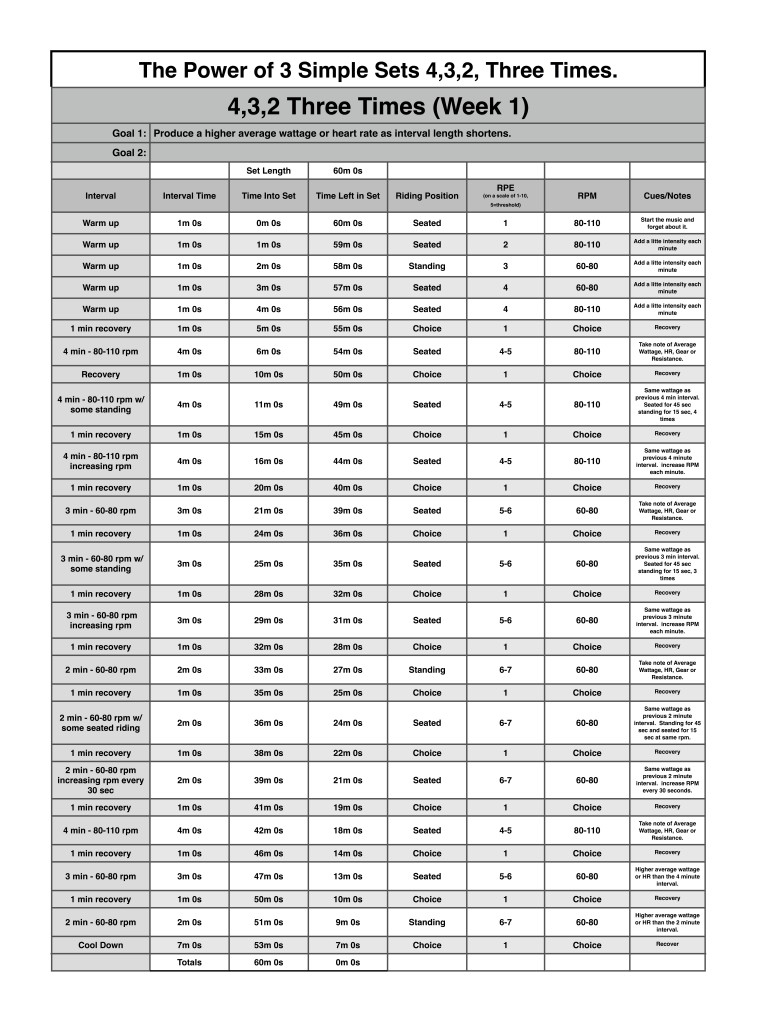
Last month I started this “Keep it Simple and Progress” profile post. In my classes this has been a huge success! Many riders have excitedly shared with me their wattage and/or resistance improvements. It's so rewarding to see and hear how we, as instructors, are changing lives through health and fitness everyday.
I've been using this 3 week progressive training technique, with great success, for many years as a coach, personal trainer, athlete and group exercise instructor. When I'm in a coaching situation I'll have my athletes work through a 3 week progression then take a week for recovery so they can “unload” all the accumulated training stress. In a group exercise setting, where you don't know the exercise consistency of your participants, a recovery week my be frowned upon. To incorporate this sound and proven training techniques in my indoor cycling world I'll set up progressive profiles for 3 weeks and on the 4th week I'll do something completely different. This 4th week is where I'll experiment with new music or video or use an old profile, maybe I'll even have my class cover their consoles and we go “Old School” and ride by perceived exertion only. I tell the riders that have been very consistent with their training the previous 3 weeks that it is time to take it easier and let the body recover and rebound from the straining stress of the previous 3 weeks. This is the time for them to enjoy their fitness level and have fun in class and not to worry about their metrics because we are going to get back to serious training very soon.
In order to provide the members of ICI/Pro with my class recordings, I'm always teaching one week ahead of these posts. This allows me time to experiment and perfect the profiles before I provide them to you. It also lets me hear the feedback and reaction of my class. I'm still amazed at the adaptive ability of the body. In week 1 of most progressions I usually hear how difficult the workout was. This makes sense because the body has not experienced these exact training stresses before. Then in week 2 after the body has had some time to adapt to week 1 the workout is not such a “shock” to the body, but I make some subtile changes to the workout so that the body still needs to adapt as we progress to week 3. Week 3 is, by far, the most difficult of the progression, but since we have taken “baby steps” from week to week this workout is doable. Progression is the only scientifically proven method to safely and effectively improve fitness. There has been a lot of talk in the media about “Muscle Confusion”. To be frank, “Muscle Confusion” is BULLSHIT and I challenge you to find one scientific study the proves it effectiveness. I'm working on another post on “The Myth of Muscle Confusion”, I'll let you all know when it's completed.
As many of you know I am a Master Educator for Stages Indoor Cycling and at our Stages University workshops one of our topics is the creation of “Simple Sets”. Next week I'm going to discuss using the technique of “Lather, Rinse and Repeat” on a micro and macro scale to help make you an even better instructor.
[wlm_private ‘PRO-Platinum|PRO-Monthly|PRO-Gratis|PRO-Seasonal|Platinum-trial|Monthly-trial|PRO-Military|30-Days-of-PRO|90 Day PRO|Stages-Instructor|Schwinn-Instructor|Instructor-Bonus|28 Day Challenge']
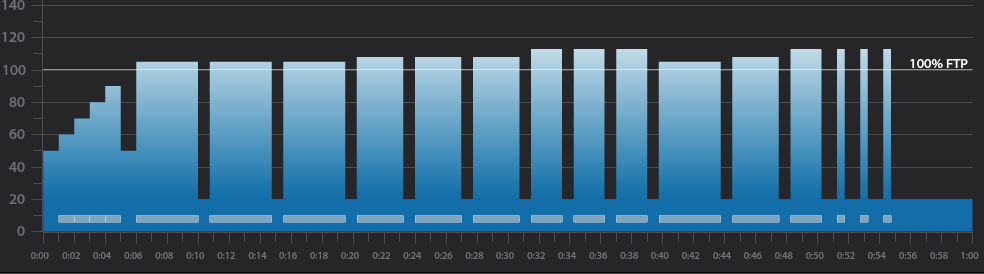
Below I have provided a snapshot of this new profile provided by Trainer Road.
Trainer Road Profile (If you're Trainer Road Member join my Team to get this and all profiles)
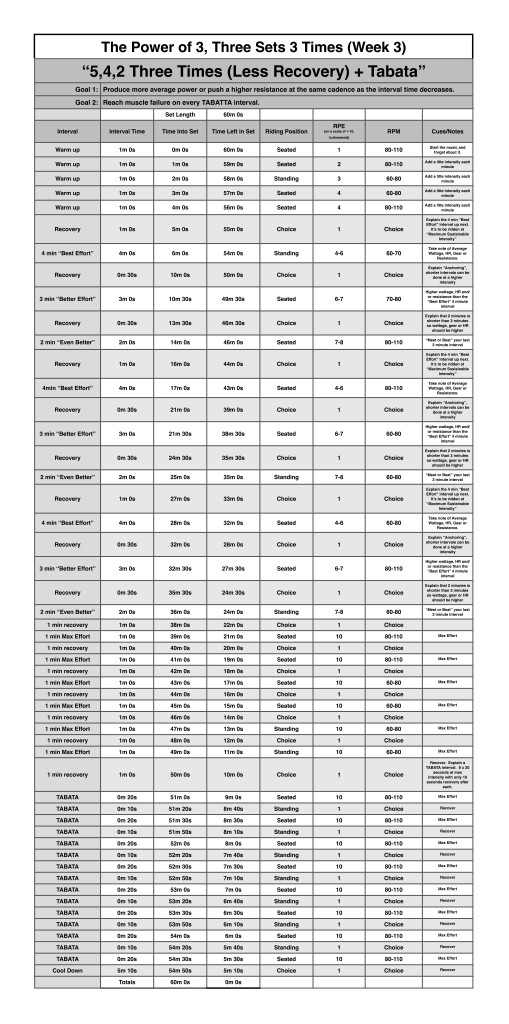
Here is the 3rd post of my new “The Power of 3 – Keep it Simple and Progress” profile feature on ICI/Pro. My goal with these profiles is to show how easy it can be to create just one profile every 3 weeks and with some subtle changes in riding position, RPM, interval and recovery duration as well as a new playlist each week theses workouts will “feel” different but the similarity of each ride will help class participants increase their fitness in a scientifically proven way.
This week I reduced the rest in the main sets and added two more 1 minute max efforts.
[wlm_private ‘PRO-Platinum|PRO-Monthly|PRO-Gratis|PRO-Seasonal|Platinum-trial|Monthly-trial|PRO-Military|30-Days-of-PRO|90 Day PRO|Stages-Instructor|Schwinn-Instructor|Instructor-Bonus|28 Day Challenge']
Trainer Road Profile (If you're Trainer Road Member join my Team to get this and all profiles)
As a nutritionist, I find that my food is under scrutiny all the time. Recently, I attended a weeklong seminar that had nothing to do with nutrition, but my food was still scrutinized.
Every morning started with a different fitness activity. Afterward, the instructor gave us breakfast guidelines, recommending that we eat just fruit “because it’s easy to digest.”
I know better than to start my day with a plate of sugar, so I went to the buffet and put together a meal that was appropriate for me.
Because this will be relevant in a moment, here was my breakfast:[wlm_private ‘PRO-Platinum|PRO-Monthly|PRO-Gratis|PRO-Seasonal|Platinum-trial|Monthly-trial|PRO-Military|30-Days-of-PRO|90 Day PRO|Stages-Instructor|Schwinn-Instructor|Instructor-Bonus|28 Day Challenge'] spinach, walnuts and a poached egg. The buffet didn’t have poached eggs alone; they were part of the eggs Benedict. But I simply eat around unwanted foods, so I ate the egg and left the English muffin and Canadian bacon on my plate. No sauce.
A woman in the seminar walked over to my table and said I wasn’t complying with the fitness instructor’s guidelines. She pointed her finger at each item on my plate, one at a time, and criticized it. This happened while I was still eating my meal.
If you’re thinking it was inappropriate for her to do that, I agree. Perhaps to my discredit, I objected to her behavior, and explained my objection to the fitness instructor’s guidelines to start the day with sugar.
What can we take from this? (Other than not to criticize other people’s food while they’re eating!)
– Know your nutrition needs. These may be different from your likes. Know what you need to thrive and feel good. Seek out those foods, no matter what.
– Don’t let other people’s guidelines steer you away from the foods you know are best for you. The myth that fruit is healthful persists. Many people still have no idea that fructose — the sugar in fruit — is arguably the most unhealthful sugar. Stay with what works for you, no matter what.
– Navigate a buffet carefully to find what you need, especially vegetables. I found the spinach for my breakfast at the omelet station. Diced tomatoes and mushrooms were also there. If there are no salads, a burrito station can provide lettuce, tomatoes, peppers and more. You get the idea. Find vegetables, no matter what.
– Know how to find what you need on a restaurant menu. Friends laugh at me because my meals “always look the same.” They do: protein, vegetables, complex starch, healthful fat. Do I care if my friends laugh? Absolutely not. I just want the meal I want — and have learned to create it, no matter what.
For example, I’ve ordered two salads for my main course when the menu offered nothing better. In the south, I’ve ordered fried chicken and scraped off the breading with my fork. Keep your needs in mind and forget the rest — including the House Specialty! It’s frequently a high-fat, sauce-laden extravaganza that might make you feel ill afterward.
– Pay attention to how you feel after a meal — both good and bad. If everyone else felt good after a meal but you didn’t, that food wasn’t for you. If you felt great, try to duplicate that meal as closely as possible at other times and places.
– Remember your protein needs above all. Keep it as lean as possible. The fitness instructor told us protein is overrated — but he knew nothing about foods and brain chemistry.
If you’re a sugar addict who’s trying to stay away from sugar, protein is key. It will help you survive and thrive as you give up sugar. If you need to carry envelopes of protein powder with you, do it. I’ve done that many times. Get your protein, no matter what.
– Don’t worry about the opinions of others. You deserve to eat right and feel good. No matter what![/wlm_private]
On April 10th I attended a “Cycle 360” certification workshop at Colorado Athletic Club Monaco in Denver, Colorado. Wellbridge, the parent company of Colorado Athletic Club, has seen the huge success of programs like Soul Cycle, Flywheel and Full Psycle and decided to create a “Rhythm” style class of their own in an attempt to create a boutique cycling studio experience inside a big box club. Cycle 360 is a total-body indoor cycling class that combines cardio and strength conditioning that is meticulously choreographed to the music. This type of class is way out of my comfort zone!
I'm a degreed and certified personal trainer with over 25 years of fitness experience and a Master Educator for Stages Indoor Cycling, I'm the “Power Guy”, the “Technical Instructor”, I choose music for “energy” not choreography. So, I decided to go into this training with an open mind and challenged myself to figure out how I could make this style of class work with my skill set and teaching approach.
When I arrived at CAC Monaco for this 3 hour workshop I was surprised to see it was “sold out”, 35 instructors had given up their Saturday afternoon to be part of this new program. I was also amazed by the “energy” and “buzz” throughout the room, these instructors were excited to be part of something new and cutting edge. I've been managing, training and teaching in large “big box” facilities for most of my fitness career and I am always frustrated with their inability to adapt or adopt new fitness trends in a timely manner. I'm so tired of hearing, “It's not in the budget for this year” or “Our members don't like change”! I got the feeling that the instructor staff at CAC appreciated the fact that the management saw there was a need to adapt their programming and moved on it quickly.
After some quick introductions we transitioned into a 45 minute Master Class which consisted of a Warmup, Cycle Section, Strength Section (Biceps, Shoulders and Triceps), a second Cycle Section followed by a second Strength Section (Push-ups and Core) and a Cool Down. The cycling sections were choreographed to the music and had a Johnny G feel to them, with some jumps, runs, and music mapping. The strength sections were done with light dumb bells and to my horror to the beat of the music. I'm an indoor cycling instructor, not a Step instructor, a 32 beat count means absolutely nothing to me. This 32 beat count stuff was going to take some getting used to, but it wasn't too bad. With all the talk about how dangerous weights on the bike are I was expecting CAC to have an ambulance waiting in the parking lot, but all 35 of us made it through the class without dislocating our shoulders, blowing out our backs or needing to schedule ACL surgery and we had a great time using the bike as our exercise tool.
After a short break we got back together and went over how to put together a Cycle 360 class profile. We went over the class design, suggested weight exercises and spent a lot of time on music theory. We were taught that every class should follow the same structure of ; Warmup, Cycle Section 1, Strength Section 1 (Biceps, Shoulders, Triceps), Cycle Section 2, Strength Section 2 (Push-ups and Core) and a Cool- Down. We then went over some strength exercises that can be done on the bike. I'm not a fan of weights on the bike, but I did appreciate that all the exercises taught were very simple and, I felt, safe to be done on the bike. This was followed by a music theory lesson. We discussed the structor of a song ; Introduction, Verse, Chorus and Bridge and how choreograph movements to each part. I found this very informative, most instructors already use music this way but don't understand the theory behind it.
We then broke up into small groups and each group designed a Cycle Section and Strength Section to be taught to the whole group. Every group did a great job taking what we learned in the last 2 hours and demonstrating it to everyone, it also gave us all some teaching ideas to take to our first class. I was pleasantly surprised to see how many exceptional instructors are working at Colorado Athletic Club. I also realized that there is a whole other world of instruction out there. I use metrics like heart rate, watts and revolutions per minute to motivate and get the most out of my class participants there are many other instructors that use the magic of the music and movement to motivate their classes. I would like to find a way to bridge that gap so participants can have the fun of a Rhythm class and the effectiveness of a power based class, I think we could call it a “Power Party!”
Every workshop I have ever attended has given me new ideas and made me reconsider the way I teach. I'm always looking for ways to improve and change, sometimes things don't work and I throw them out sometimes things “stick” and they become part of my new teaching style. Ever since the Cycle 360 workshop I have been listening to music in a whole new way, trying to pick out the Introduction, Verse, Chorus and Bridge of every song I hear and methodically putting together a playlist and choreography for my first Cycle 360 class. Then I heard DJ Scott Melker's, The Melker Project 3 and it all fell into place.
Scott is a world renowned DJ and was Music Director for Flywheel Sports between 2010 and 2014, he knows music AND indoor cycling. Scott has been working on a new project called ADHD Radio where he releases a new 45 minute set every 2 weeks. ADHD is the perfect way to describe Scott's DJ style, he is constantly mixing and overlaying every known music genre in a style that just works. I have found that Scott's mixing style works perfectly with the “Rhythm” style indoor cycling classes that are popular today. With a new song being mixed in ever 30-40 seconds it's easy for instructor and participant to hear and feel the music and energy change.
When I first heard The Melker Project 3 I immediately knew it would work for me. The only problem was there was ALOT of language that would not go over well in the clubs that I teach in. If you work in a club where anything goes then use the original, it's awesome! I, on the other hand had to use my very limited DJ skills to try to cut out the bad and mix together the good. I think I did an okay job, but you can definitely hear the difference between my mixing ability and Scott's. I hope Scott isn't offended that I had to chop up his work, I absolutely respect an artist's vision, this was a situation where I felt this mix was so good that I wanted to share any part of it that I could with my class.
[wlm_private ‘PRO-Platinum|PRO-Monthly|PRO-Gratis|PRO-Seasonal|Platinum-trial|Monthly-trial|PRO-Military|30-Days-of-PRO|90 Day PRO|Stages-Instructor|Schwinn-Instructor|Instructor-Bonus|28 Day Challenge']
As you can see I did not put together a profile for this mix because there is no need for one. My recommendation is to come up with 2 or 3 variables and cycle through them with every song change. One example of what I've used is to start seated with a RPM of 80-100, then transition to seated with a RPM of 60-80 then transition to standing with an RPM of 60-80 and repeat for as long as you want (the clean version of the song is 23 minutes long), I usually go for about 10 minutes. Another example would be to simply alternate between seated and standing riding with every song change for your chosen interval length. You could also have participants spin up with every song change; start at 80 rpm, increase to 90 rpm, then 110 rpm and start over for the length of the interval. I'm lucky enough to teach with power, I'll have my class set a wattage goal for each interval and have them keep their wattage in that range throughout the interval no matter what position or cadence.
The Melker Project 3 (Clean), to download Right Click > Save As / Save Target As to download. Open in iTunes and then you'll see this in your Spotify Local File folder.
The Melker Project 3 (Original), to download Right Click > Save As / Save Target As to download. Open in iTunes and then you'll see this in your Spotify Local File folder.
Recording of me teaching this ADHD set in a class on a Spinner Blade Ion, Right Click > Save As / Save Target As to download on PC or Download Linked File As on Mac. Open in iTunes and then you'll see this in your Spotify Local File folder.
I've been using this mix and ADHD teaching style for one of my class sets for the last 2 weeks and a very interesting thing has happened. First, people love it and secondly people are able to average a much higher wattage when they are changing positions every 30-40 seconds than when holding a position for 8-10 minutes. Something to think about.[/wlm_private]
Caffeine is a drug that can be used in appropriate ways, so it has definite value. This post covers a few uses of caffeine.[wlm_private ‘PRO-Platinum|PRO-Monthly|PRO-Gratis|PRO-Seasonal|Platinum-trial|Monthly-trial|PRO-Military|30-Days-of-PRO|90 Day PRO|Stages-Instructor|Schwinn-Instructor|Instructor-Bonus|28 Day Challenge']
Ergogenic Aid
Much has been written about the ergogenic benefits of caffeine, particularly for endurance athletes, so it’s unnecessary to go into detail here.
Bottom line, caffeine can help athletes work harder and generate more power, often without feeling the extra effort. They may not even realize they’re putting out more effort, although the power increase could be as much as 3%.
It’s a good idea to get accustomed to caffeine in training before using it during a performance event, whatever that may be. My advice has always been, “No surprises on race day.”
Know how caffeine affects you and how much you can safely consume without upsetting your stomach or causing anxiety, irritability, high heart rate, or insomnia.
Brain Chem and Caffeine
When we drink coffee or tea, caffeine occupies the brain receptors that are normally occupied by adenosine. Adenosine inhibits the release of dopamine and norepinephrine — two brain alertness chemicals — to prevent an over-release of them.
When caffeine ‘takes over’ the adenosine receptor, adenosine can’t inhibit dopamine and norepinephrine, so those two chemicals are disinhibited. We feel alert and may notice improvements in memory, mood, energy, reaction time and general cognitive function.
Protein can also make us feel alert.
Why Do We Need Protein When We Can Just Drink Coffee?
The two mechanisms of action are completely different. While caffeine uses (and eventually depletes) stored brain levels of dopamine and norepinephrine, protein provides the amino acids that the brain uses to make more. The amino acids are tyrosine and phenylalanine.
If you haven’t been eating much protein for a while, you might find yourself drinking more coffee. Or you might discover that you get less effect from any caffeine you have because brain stores are already depleted.
On the other hand, if you systematically and consistently eat more protein foods, you might find you don’t need or want as much coffee or tea because your brain keeps making — and releasing — dopamine and norepinephrine.
(Sleep restores dopamine, too, but that’s a separate topic.)
Health Benefits of Coffee and Tea
Recent research has shown beneficial effects of coffee consumption. Coffee contains antioxidants and has been found to reduce the risk of type 2 diabetes, endometrial cancer, skin melanoma, multiple sclerosis, Alzheimer’s, and heart disease.
The benefits of green tea have long been known. It contains powerful antioxidants, can reduce anxiety, and can improve dental health. Like coffee, it may also reduce the risk of Alzheimer’s, type 2 diabetes, heart disease, certain cancers, and Parkinson’s.
Caffeine As a Pain Reliever
It’s less frequently mentioned, but relieving pain could be considered another benefit of caffeine. Norepinephrine and dopamine both trigger an analgesic effect. Plenty of potent pain-killing substances are available, but caffeine could be seen as a more natural pain reliever, especially in light of the health benefits listed above.
Unsweetened Is Better
Do I need to mention that sugar could reverse most of the beneficial effects covered in this post? Limit fancy coffees with exotic names. Sticking with the basics is a healthier choice.[/wlm_private]