Life Time Fitness is hiring! If you've always wanted to teach Indoor Cycling or Group Fitness, at one of their 100+ beautiful upper-end big box clubs, this is could be your big chance 🙂
They (LTF) are all about member experience. The equipment (awesome sound system/twin big-screens for video + FreeMotion S11.9 Indoor Cycles with power) and their studios are fantastic. Their pay is respectable and you aren't forced to use music that's provided for you like at LA Fitness.
What should you do?
First, so you know, I know LTF 🙂 I'm lucky to live smack dab in the middle of four Life Time locations – with regularly scheduled Indoor Cycling classes with them since 2008.
#1 Read through these articles. We've helped dozens of Instructors get hired by Life Time
Our Mission is to provide an Educational, Entertaining, Friendly and Inviting, Functional and Innovative experience of uncompromising quality that meets the health and fitness needs of the entire family.
Don't take knowing this mission statement lightly – it's not optional. YOU WILL BE ASKED TO RECITE IT AS PART OF ANY AUDITION.
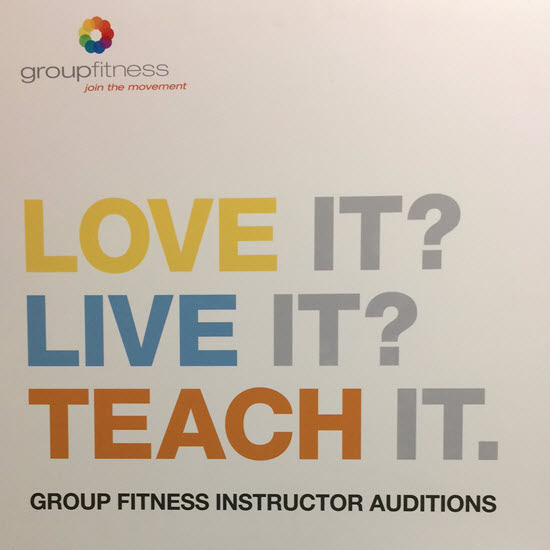
#3 Go to your local club location and find the the sign that looks like the image at the top of this page. It will include information about the audition schedule, name of the Dept Head running the auditions, etc…
NOTE: Some locations might not have immediate openings, but I wouldn't let that stop you from attending and showing your stuff!
#4 I'm big on taking bold action, so I'd recommend finding a way to meet with the Group Fitness Dept Head, before the audition day, in person > if at all possible. You might ask the front desk if he/she is available right now.
If yes, then introduce yourself and expressing your enthusiasm for being part of her/his Instructor team. Ask an open ended question like; “what can I do to prepare for the audition?” and then listen. Now isn't the time to sell yourself… unless you are asked a specific question. Be respectful of their time and say so; “I know you're a very busy person, my objective to let you know who I am and that I'm very excited for the audition on ___________ and look forward to seeing you again then.
That's it, unless she/he appears to have more time for you. Be very careful not to ask anything beyond advice.
If no, ask when would be the best time to call and what number. They work crazy hours, so I'd call at different times until they answer – I wouldn't suggest leaving a message or emailing. Call until you get through. Tell them about your interest in teaching for them (again, NO SELLING) and then ask if you could meet them for two minutes to introduce yourself in person. Give two very specific days & times – DO NOT ASK; “what would be a good time to meet?” Busy people hate it when they're asked that… but they love when you give them a solid time that they can easily say yes/no to. Then follow the above.
No worries > they'll train you! Life Time realises that they need to develop/train people passionate about fitness, to become Instructors, through their Life Time Academy.
Group Fitness Instructor Training Overview
The Life Time Academy Professional Fitness Specialist program provides a unique educational experience of on-line, in classroom and hands-on learning, integrated with practical experiences that prepare graduates to succeed as a Professional Fitness Specialist in their respective area of emphasis.
The emphasis of the Group Fitness Instructor Program provides a quality educational experience that prepares graduates to succeed in the area of group fitness instruction, whether they are new to the industry or expanding their skills.
Topics covered in the Life Time Academy Group Fitness Instructor Training (GFIT) 50-hour program meet or exceed all the required standards set forth by the American Council on Exercise to achieve certification as well as the practical skills to lead a best-in-class group fitness experience.
With an 8-week curriculum, totaling 50 contact hours, the instructor-led coursework consists of approximately 30 hours of online study (reading, videos, activities, assignments and quizzes), 16 hours of in-club lab class time and 4 hours of practicum.
Curriculum includes:
Exercise Science Foundations
Essentials of Group Fitness
If you don't have a certification, I would ask the GFDH during your intro meeting for their advice for getting your training. LTF has multiple workshops throughout the year where you can receive the training you need.
Good luck and let me know when you're successfully on the schedule!
Was it just me, or did that last Instructor never make eye contact with you, either?
Amy and I were both participating at a teach-back assessment a few months ago, for Life Time's new Evolution Signature Indoor Cycling format. There was a handful of Instructors trying out and we all assumed the role as a “participant”, while we waited our turn on the Instructor bike.
It wasn't only you John, was Amy's response. That guy looked everywhere but directly at me… At first it was a little weird – his focus kept switching from the floor > ceiling and then at alternating walls on either side of the room. After a while I felt kind of dismissed,by how he seemed to purposefully avoid directly looking at me 🙁
Amy and I discussed our experiences with the guy, in the car on our way home. We both felt like he had all the right words = technically he sounded like he knew what he should be saying. But he had ZERO connection with his riders. Now I know this was probably an extreme example, but;
How effective are you at making eye contact with your riders?
If I came to your class, would you look at me?
Would I see you making eye contact with others in a meaningful way?
Take a moment and reflect back on your last class. How many people do you remember connecting with?[wlm_private ‘PRO-Platinum|PRO-Monthly|PRO-Gratis|PRO-Seasonal|Platinum-trial|Monthly-trial|PRO-Military|30-Days-of-PRO|90 Day PRO|Stages-Instructor|Schwinn-Instructor|Instructor-Bonus|28 Day Challenge']
Johnny G is a master at connecting with his audience of riders. Watch this short segment of him presenting. Pay particular attention to how he scans the faces in the room.
Make connections the objective of your class
I've featured presentation coach Alexa Fischer here in the past because she is a master communicator. She has a new blog post that expands on the video below, where she explains:
For me, winning over your audience has nothing to do with seeing everyone in their birthday suits. It has everything to do with making a genuine connection, in the exact same way you would when you meet a new friend in a cafe. In today’s video, I share my surefire strategies for keeping my audience engaged.
As the late, great Maya Angelou said, “I’ve learned that people will forget what you said, people will forget what you did, but people will never forget how you made them feel.”
The same is true for when you are on stage.
Click here to see Alexa's other video > and by all means, join her email list. She's sending out good stuff every week that I find very helpful.
Look up here at Me… not the video!
If you frequently play video in your classes, you're probably creating a connection problem with your participants. They are focused on the big screens, not you. For some of your members that will be OK for you to be an unseen narrator, while they watch what's happening on the video.
But many riders won't. They need you to make them feel important, if only for an instant, where you connect and flash them a quick smile or some other acknowledgment.
Random thought: does it make sense to whiten your teeth? Would your smile be more impactful, especially to those riding way in the back, if it was whiter/brighter?
So how do you get people to pay attention, so you can connect with them, when you're playing a video?
Check your lighting.
Maybe it was because I was a little self conscience, but early in my teaching career I wouldn't turn on the stage spotlights. I normally kept the studio lights down low. But over time (and watching other Instructors teach in the same room) I learned that I retained people's attention longer, if they could see me clearly. Having two focal points in the room, #1 the screen(s) and #2 YOU, should help direct your riders attention.
Make a change
Did you see how Johnny G maintained the room's attention, by asking them to sit up? How about suggesting in your next class, “this is a good time for a water break / toweling off.” Then watch what happens. Catch people following your lead and reaffirm those who do with a nod or a tip of your water bottle.
Ask questions
It's very natural for people to turn toward the person asking a question. Why? I think we instinctively do this to try and gather more information. I feel open ended questions (can't be a Yes/No response) work best. If you really want to get eyes up on you, ask a question that references something that needs to been seen to be understood and then point/demonstrate without giving any additional cues until you have their eyes-forward. Maybe something like; is your pedal stroke smooth like this? Then demonstrate the action while scanning the faces of the room for recognition.
Bring up the room lights
If you have a really dark studio, bring up the room lights for the cool down. It's here when you can really try to connect with each rider – or – try and develop a surrogate; have everyone turn, face each other and congratulate their neighbor!
When John asked me to document my trip to IHRSA 2015 I thought it would a quick and easy post about the trip and what I saw while I was there, but when I finally sat down to write this post I realized what a “long strange trip it has been” and it starts long before I boarded Southwest Airlines flight # 4812 from Denver to Los Angeles last Wednesday.
I started working in the fitness industry way back in 1992 at The Sports Training Institute in New York City. I had just graduated from State University of New York College at Cortland with a degree in Physical Education and a minor in Coaching. The problem was that there weren’t any new teaching jobs available, so I thought for the time being I could work as a trainer, make some money, enjoy the big city and wait for some PE positions to become available. The problem was that personal training is addicting, you are surrounded by like minded highly motivated fit people all day. Your fellow trainers become great friends and training partners and you clients, many who are very smart and successful people, become your mentors and this is something that is very hard to leave. So I didn’t I went “All In”. I completed an ACSM, American Council of Sports Medicine, 4 day workshop, passed the certification test to become an ACSM Health Fitness Instructor and went down the road of changing lives through fitness. I spent the next 3 years commuting from my family home in the upstate town of Highland Falls NY to the city, a 60 minute train ride, every day. It was exciting, our gym was one of the most respected training facilities in the city, we saw actors, politicians, professionals athletes and many more of the rich and famous everyday, not a bad gig for a 23 year old kid.
I was still living at home was because in my junior year of college my mother had passes away after a 2 year battle with lung cancer, so after graduation I decided to go back home and help my father take care of things at the house and help raise my 2 younger brothers. Now it had been almost 5 years since her death, my family had moved on from this tragic loss and I felt it was time for me to get on with my life and I had a big decision to make, I was either going to move into NYC or move away and start a new life in another state. For some reason Colorado had always intrigued me maybe it was the songs of John Denver or the fact that I had taken up triathlon and Boulder Colorado was and still is the Mecca for multi-sport athletes. I contacted some of my Pi Kappa Phi brothers, whom had moved to Colorado after graduation, asked if I could crash at their apartment until I found a job and my own place and set a moving date for the day after Christmas 1995.
I rolled into Denver around New Years Eve and was ready to make a go at a new life, I filled out employment applications at every gym and health club in the area. This was in the days before the internet so you couldn’t just perform an google search for the best health clubs in an area. I was lucky enough to be awarded a Personal Training position at what I later found to be and still believe is the best health club in the Denver area if not the country, Greenwood Athletic Club. This place was big and beautiful, everyone was so fit, healthy and happy. I felt like I had landed a dream job!
The next 6 months, at Greenwood, was probably the most important and impactful of my entire adult life. First, I met my wife, Blair. She had come to Greenwood after back surgery and needed some rehab and training exercises and as luck would have it I was given her contact information to set up her training sessions. After our first meeting I was hooked but not being “that” kind of trainer I simply didn’t feel it would be professional to ask her on a date, so what I did was give free session after free session until she finally got the hint and SHE asked me out. We were married in July of 1996 and now have twin 15 year old boys, Seth and Christian. During this time I also met a group of highly motivated and inspiring triathlon training partners. This was a group of people who made me believe that no goal is impossible. I had never dreamt that I could complete an Ironman distance triathlon, but with this group believing in and helping me I have now reached the finish line in 8 of these 140.6 mile events. Now I take great pride in helping other triathletes go farther than they ever imagined possible.
The final and most important event as it relates to this post, because obviously meeting my wife was the most important event of this 6 month period, was the introduction of Spinning®. I’ll never forget how excited our GM, Steve Krum, was when he returned from IHRSA the year Johnny G launched the Spinning® program. Steve wanted Greenwood Athletic Club to be the first club in Colorado to have this program and started recruiting instructors the minute he got back in the club. Being a competitive triathlete and personal trainer Steve thought I would be a good fit for this amazing new program. Before I could help launch the indoor cycling program at Greenwood I was offered a position as Fitness Director at the Sports and Fitness Center at the Jewish Community Center of Denver. I was excited to offered this management position and felt like this was the next step in my fitness career but I was really going to miss Greenwood and felt like I was missing out on the launch of fitness’s next “Big Thing”. It took me 2 years of prodding and negotiating with my General Manager and Executive Director to finally bring indoor cycling to the JCC. I got certified through Maddog Athletics, began teaching 3 classes a week and so began my indoor cycling journey.
From my very first class I was hooked. It just felt right, it was the perfect forum for me to share my love of fitness, riding, coaching and music. It also let me utilize the skills I had been taught while majoring in physical education. Class after class I worked to improve my presentation skills, refined my cueing, searched for the most motivating music and experimented on the perfect work to rest ratios for an indoor cycling class setting. As new technology emerged I embraced it; cd burners, mp3 players, iPods, laptops, video, clipless pedals, cadence meters, heart rate monitors and then finally power meters and heads up displays. My goal was to use every new technology to make my classes more motivating and engaging. I also went to every training I could find and afford. To me the Master Instructors were like Rock Stars, they had huge followings, cued perfectly, used all the new technology and were just great instructors. I always learned something new at every training. I thought it would be cool to be one of them, to also share this love of indoor cycling with other instructors, but I told myself I wasn’t articulate or charismatic enough to ever break into that top tier group of instructors. So, I took all this new knowledge, from every training, and used it to teach the best classes I could. Class after class and year after year I worked to become the best instructor I could be. After about 10 years of teaching, training and managing, I could sense that my time left at the JCC was short. The new Executive Director had a completely different vision for the the Fitness Center than mine and I figured it was time to move on.
Prior to leaving the JCC I had been in contact with some of my old friends that were still working and/or working out at Greenwood Athletic Club and they put me in contact with all the right people. They all gave me stellar recommendations and when I eventually left the JCC I was able to hit the ground running with positions as Personal Trainer, Masters Swim Team and Triathlon Coach and Indoor Cycling Instructor. I had always hoped to eventually make it back to Greenwood, I figured I would go do my time in the “minor leagues” and eventually get called up the “majors”, but life in “minors” was comfortable and easy, I had developed a great system of management had an exceptional staff working for me I also had a steady following of training clients and solid group of indoor cyclist that came to my classes. Life in the “majors” was a lot different, Greenwood is considered one of the best health clubs in the country, they have the best of everything; staff, trainers, group exercise instructors, equipment and a beautiful facility. If I was going to survive here I was going to need to really step it up! I was and still do wear a lot of hats at Greenwood but for the sake of this post I’m going to focus on indoor cycling.
Through the years I had developed my very own teaching style. I like my classes to “flow” from one interval to the next, one position to the next and one song to the next. I also like to build on what we do early in the workout throughout the class profile. I had been teaching this way for years and many of my riders at the JCC had been riding with me through this evolution so they just got it. The new riders at Greenwood had never experienced anyone who taught this way and my first few classes were a disaster. As anyone who has ever worked in the fitness industry knows, members don’t like change. I was told that my class was just too complicated, the members just want a killer workout. I was terrified I was going to lose my classes, I had worked so hard to be good enough to work at this club now I might get sent back to the “minors”. I was confident that my unique style would be successful but I realized that it might be too much too soon at this new club so I took a step back started with much simpler profiles and slowly started layering in my progressions. After a short time I began to develop a following and eventually was filling my classes like the other top instructors at Greenwood.
One day one of my riders approached me after class and told me about a long business trip he was going and how he wished there was a way I could record my classes so he could take them with him when he was on the road. This got me thinking and before long I had purchased a digital audio recorder and the necessary cables to hook up to the mixing board in the cycling studio. This was the birth of “Dennis Mellon’s InCycling Podcasts”. At first I just recorded my classes and would transfer them to a thumb drive for anyone who wanted them, then I built a website, www.dennismellon.com and made each class available to stream, but then I learned about podcasting and realized if I formatted each recording properly they could be available for download in the iTunes Store. Once my podcast was approved by Apple and available in the iTunes Store I needed to figure out a way to market it and get more followers to move up the charts, this is when I started looking into social media. I read a few articles on how to market with social media, created a Twitter and Facebook account and was a on my way.
One of the techniques used to create a large social media following, especially with Twitter, is to search for like minded people and “Follow” them. Proper Twitter etiquette is to “Follow Back” anyone that “Follows” you. In a very short time I had a few thousand “Followers”. Another technique used to increase your social media presence on Twitter is to “Re-Tweet” the posts of some of the “Power Users” on your “Follow” list. I had been listening to every episode of the Indoor Cycling Instructor Podcast hosted by John Macgowan and as an industry leader I figured he was someone that I should be “Re-Tweeting”. After a few weeks of re-tweeting all of John’s posts I received an e-mail from him that simply read “Why aren’t we working together?” I e-mailed him back and we set up a time to talk.
During this initial conversation John and I spoke about teaching experience, styles and just about everything indoor cycling. We agreed on much more than we disagreed on. John asked me if I would be interested in submitting a class profile and that next week we would record my class description of this profile and it would be available to the members of his website. I was so nervous, this was my opportunity to show the world the teaching style that I had been refining for over 15 years. The profile I presented was named “A Little Bit of Everything” (https://www.indoorcycleinstructor.com/icipro-instructor-training/music/icipro-podcast-287-little-bit-everything-audio-class-profile/). My playlist employed a new song selection technique called “Harmonic Mixing” which requires each song to be in a harmonically compatible key so songs sound like they flow together, which fit perfectly my flowing profiles. John loved it! He even recorded a podcast with me where we discusses this new music mixing technique. I felt like I finally hit the “Big Time”, I was contributing to the “Premier independent resource for Indoor Cycling Instructors around the world.”, hits to my website were going through the roof and I was getting e-mails from around the world from people telling me how much they enjoyed the class recordings that were available on my podcast “Dennis Mellon’s InCycing Podcasts”. Life was good! The recognition was rewarding, but what was most satisfying was hearing how I was helping other instructors improve their classes and receive that coveted compliment “That was the best class I have ever taken”.
John and I started working together more and more and one day he asked me if I had ever considered being a Master Educator/Instructor. I think I laughed at the question, I told him of course I’ve thought about it and would love to be that elite class of instructors who train other instructors, but there was no way I would ever get the opportunity and that I didn’t think I was good enough. John assured me that I had what it took and that many of his contributors had gone on to be Master Educators/Instructors, I told him it would be great if that happened but I wasn’t going to get my hopes up. Then one day I received an e-mail from Laurel Mylin, GM at Stages Indoor Cycling asking if we could set up a time to talk. Laurel and spoke for quite some time about education, experience, Stages Indoor Cycling, we also spoke for a while about the new Spinner Ion Blade that Greenwood had just purchased and the new Spin Power Program that I had just completed. As our conversation was winding down I thought about what John had said about so many of his contributors becoming Master Educators/Instructors and I figured I should let Laurel know I would be very interested if there was an opportunity. Laurel said that they had been watching me for while and that there may be an opportunity with Stages and that something “REALLY BIG” was going to be happening with the company in 2015. She told me she would pass my information along to Cameron Chinatti, Director of Education and I should be hearing from her soon.
After talking to Cameron on the phone, observing her present multiple times and Cameron watching me instruct, I was hired on with Stages Indoor Cycling as a Master Educator. This is a great honor and huge responsibility. I now have the opportunity to shape the direction of indoor cycling for years to come, an activity that has been part of my identity for so long. I know it’s just a bike that goes nowhere, but it has helped so many people reach fitness and weight loss goals they never dreamed were attainable or maybe the time spent in on this bike that goes nowhere is the best part of someone’s day, never dismiss the power of the ride.
So, last Wednesday, as I sat awaiting take off of Southwest Airlines flight # 4812 from Denver to Los Angeles I had a tear in my eye as I thought about all the people who helped me and all the hard work it has taken to get to this new chapter of my life and fitness career.
In Part 2 I’ll write about the actual IHRSA 2015 experience.
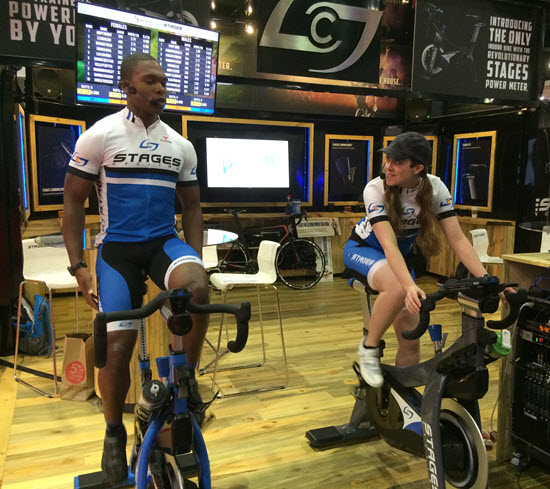
Stages Master Educators Dunte Hector and Cameron Chinatti leading the morning ride at IHRSA
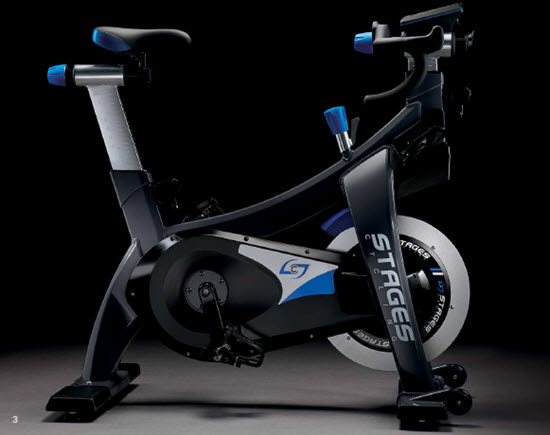
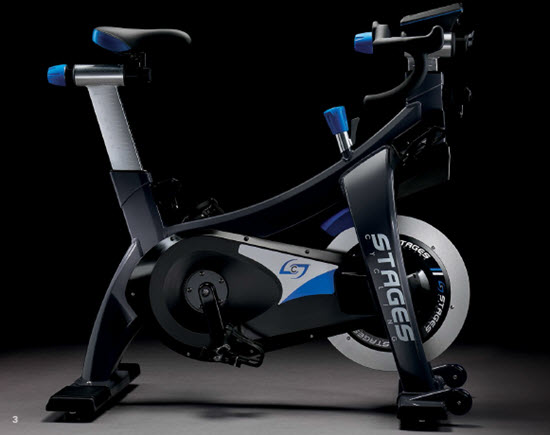
IHRSA 2015 was the first public appearance of the Stages Cycling SC3 Indoor Cycle. This was a total surprise to me and I have no idea how Stages Master Educator Dennis Mellon was able to keep his mouth shut for so long. We talk weekly and it must have been killing him not to be able to tell me about their latest project 🙂
Going forward, I feel it's important to disclosure that Stages Cycling sponsored (paid) my and Amy's travel to, and lodging in, Los Angeles to take part in the launch of their new Stages SC3 at IHRSA 2015.
If parts of the Stage SC3 look familiar, there's a good reason. The engineers who designed this Indoor Cycle have a long and storied history of product development with indoor cycles and power consoles. It was explained to me that the design criteria for the SC3 was; take all of the engineering team's collective experience and build the ultimate, commercial Indoor Cycle. Did they succeed? Let's find out…
The Basics
Frame – Aluminum… and lots of it. This is a very solid/substantial IC > perfect for studios with big, powerful riders – or – those offering unconventional classes with a lot of movement.
Drive – CarbonGlydeâ„¢ drive system. Yes, this is the same Gates belt as other manufacturers are using, but there are fundamental differences with the other components of the drive train, that give the SC3 a very different feel. Because they don't run the belt under tension (there's a tiny bit of slack you can feel as you move the pedals back and forth) the SC3 is noticeably quieter than the Schwinn AC and it's tensioned Gates belt. It also retains a slight, chain-like vibration, but doesn't buzz like the AC. Stages is so confident in their drive system that they offer a 10 year warranty on the CarbonGlydeâ„¢ belt. Correction: Stairmaster's engineer Travis Vaughan alerted me to my error describing the Schwinn AC's Gates belt as “tensioned” – which it's not. I didn't intend to infer that they used a tensioner like what's used with Poly “V” belts. Instead I should have described the differences as; the AC runs it's belt taut (zero slack) vs. the SC3 which, when properly tensioned, has a very small amount of slack.
Resistance – Magnetic > surrounding an aluminum flywheel. Screw style adjustment and includes the new Stages SprintShiftâ„¢ three position lever . More on that below.
Handlebars – Road Bike Style Drop Bars – there's a reason that handlebars on road bikes haven't changed over the last 100 years > these fit us (humans) the best. Please don't ask me; “butwhere is position #3 John?” It's standing, with your hands surrounding the brake hoods, exactly where your hands belong when you're out of the saddle 🙂 It's here where you have the most leverage to power through a steep climb and it eliminates the temptation to “over reach” while seated.
Saddle – nice. Not too narrow… and not to wide/fat. Forgive me for saying it this way, it's very close to (might be exactly the same as) the saddle on the Schwinn AC > we have one on the back of our Trek Tandem. Amy loves this saddle and it's been comfortable for her for thousands of miles. Trust me on this one… I'd have heard all about an uncomfortable saddle.
The Power Meter
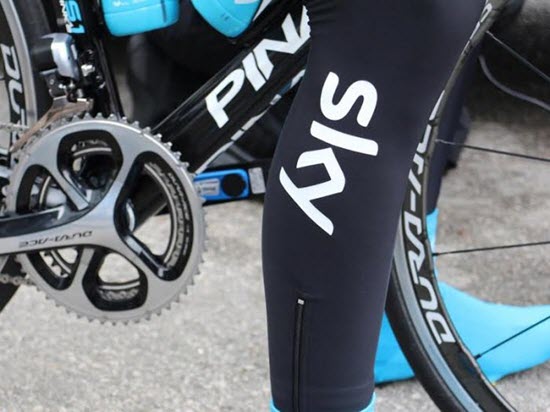
Good enough for TDF winning Team Sky Professional Racing Team
The heart of an Indoor Cycle that features power measurement is, of course, the power meter. The new SC3 is using the same technology used by Team Sky – winners of two Tour de France bicycle races and they're going to continue to use these power meters in 2015.
I could devote an entire article on just this topic and will have more as part of the ride portion of this review. In the interest of time I'll give you the important bits:
2,000 hours of battery life using two AA's – yes the display console is self-charging.
Same hardware, design, and accuracy found in the Stage Power® meter, which is used by professional cyclists’ and used in the world’s most famous cycling races, including the Tour de France.
ANT+â„¢ and Bluetooth – so it will connect with your iPhone or Android without any adapters.
Supposedly accurate to +/- 2.5%. I say “supposedly” because I have no way to verify their claims – but I bet Team Sky does 🙂
Display Console
It's important to separate the power meter, from the display console. Although most studios will choose to purchase their new SC3's with the new Stages EcoSCRNâ„¢ console, you don't have to. The Stages power meter will work with any Bluetooth or Ant+ device, like an iPhone or Garmin. You could also choose to wirelessly connect the Stages power meter directly to Display Training systems from Performance IQ or Spivi.
Here's a short video showing it in action during one of the 60 sec challenges.
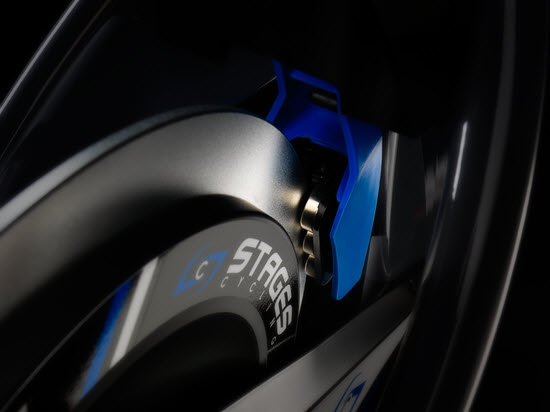
The EcoSCRNâ„¢ console is self-powered = no batteries to replace ever… that's the Eco part 🙂
No exposed wires > I was told they've very neatly packaged the cable that connects the flywheel generator to the console = a long life of raising the handlebars up and down.
Constant backlight if you choose 🙂
Stage button to record intervals > there's also a nice feature that your averages remain displayed for 5 seconds after you end a stage.
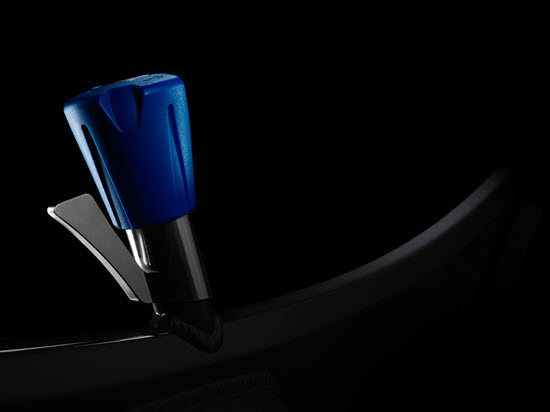
Stages SprintShiftâ„¢ is a three position “shifter”, that provides course adjustments quickly. I want to describe it as a sort of cruise control, where you flick your finger and instantly resume your previous speed/resistance level.
Think of doing a repeating series of intervals. We cue everyone to add load, ride the segment and then recover. Now repeat it again. With SprintShift you can set your initial load with the lever full right. Move it left for recovery and then return back to the exact resistance instantly, by moving the lever all the way to the right.
There's some interesting physics at work here. If you use the SprintShift at lower resistance levels, the amount of change between each level remains relative & realistic. But start with a big gear and the changes are incrementally larger.
There are multiple ways you could incorporate this in your class and we'll find more over time. I'll describe a relay race we did in the ride part of the review where it was very helpful > we won! I'm sure Cameron and Co. will have some fun suggestions for using SprintShift when I interview her in the next few weeks.
If you've ever fought over a stubborn screw type seatpost of handlebar adjuster, you'll enjoy these new FitLoc cam style adjusters. Watch the video and you will see how quick and easy they are to operate. Also, they've kept the weight of the bars low, so it takes very little strength to raise them, using only one hand.
I'm here with Amy at IHRSA 2015 and need to thank Stages Cycling for sponsoring our attendance this year 🙂
We'll be riding these brand new SC3 Indoor Cycles later today (they're still packed in a semi) and will be communicating my initial reactions tomorrow.
For immediate release, March 11, 2015, Boulder, CO– Stages Cycling® extends its brand with the launch of Stages Indoor Cycling and the new SC Series–a line of commercial and high-end retail indoor cycling bikes, which bring an array of breakthrough features to redefine the category of indoor cycling.
The SC Series launches with two models: the flagship, SC3, with many innovations, including the Stages Power® meter–the same power measurement system that reshaped the outdoor cycling power meter category. A second model, the SC2, is the same in all respects but does not include the Stages Power meter.
The SC Series bikes share two never before seen concepts, which have patents pending: SprintShiftâ„¢ and FitLocâ„¢. SprintShift is a dual-action resistance adjustment, which pairs a traditional micro-adjust dial with a three-position macro-adjust lever. The SprintShift lever allows large, consistent jumps in resistance for intervals and rest. FitLoc replaces the standard twist-to-lock pop-pin height adjustments with a new cam operated pop-pin, making fit adjustments for height lightning fast.
These new innovations are paired with the accuracy, consistency, and reliability of the pro-peloton-proven Stages Power meter on the SC3 model, which sports Stages new rider-powered EcoSCRNâ„¢ console. EcoSCRN uses a hub dynamometer, rather than batteries, to make it the ultimate bike for a data driven studio or cyclist. The Stages Power measurement system provides unprecedented accuracy in power measurement, enabling studios the ability to now train their clients ‘indoors and outdoors’ with the same technology.
“The SC Series has the potential to be a benchmark,” said Pat Warner, the product director for Stages Cycling, who spent 20 years working on indoor cycling bikes in the Fitness industry prior to Stages. “We’ve addressed every major issue we’ve ever seen with an indoor bike. SC3 is certainly worthy of our ‘flagship’ status, with features like Stages Power, SprintShift, FitLoc, and our RoadBarâ„¢. But we’ve also nailed the basics on these bikes, and we’re confident that the ride feel, lack of maintenance, and reliability of the bike will be the features that actually set the benchmark for both the facility owner and the instructor.”
Both of Stages Cycling’s flagship SC3 and SC2 bikes utilize the new CarbonGlydeâ„¢ drive system. CarbonGlyde builds on the unparalleled reliability and lack of maintenance offered by Gates® Carbon Driveâ„¢ carbon fiber belt, with a 5:1 gear ratio and high-inertia flywheel to provide for one of the smoothest, most realistic rides available indoors.
“Stages Indoor Cycling is a new company and new brand,” said Jim Liggett, the general manager of Stages Cycling. “We will be attractive to club and studio customers who are seeking to expand their base business within their Indoor Cycling group exercise offering. Our success with Stages Power has passed the test of professional cycling and we offer this, tested, Stages Power meter to indoor athletes. We feel the combination of a completely new bike with uniquely new features, and our Stages Power meter, allows facilities to offer their members the next category breakthrough. Stages Cycling is a company rooted in cycling. Our goal is to help create indoor cycling athletes who can achieve their dreams in fitness or in cycling.”
“We also realize that–while we know and do power better than anyone in the Fitness industry–some cycling studios have a different focus. So we’re bringing the SC series to market with two flagship bikes, one with the Stages Power meter, and one without, so that we’re prepared to meet every indoor rider, and every indoor facility on their own preferred terms.”
Stages Cycling will show the SC Series bike line for the first time publicly in Los Angeles, at the Los Angeles Convention center on March 12 and 13 at Booth 2735 in IHRSA 2015 International Convention and Trade show.
The Stages SC Series bikes will be available both commercially and at retail for home use. For sales information contact:
For North America / Canada Sales inquiries, please contact: Les Wiehe 435-659-9114 lwiehe@stagescycling.com
For International Sales inquiries, please contact: Paddy Murray 781-206-4376 pmurray@stagescycling.com
For Stages Cycling University / Instructor Training, please contact: Cameron Chinatti 615-499-6029 cchinatti@stagescycling.com
For further press and product information, please contact: Laurel Mylin 503-866-8157 lmylin@stagescycling.com
–end–
Stages Cycling® LLC, based in Boulder, CO, with staff having well over 100 years of combined experience in the Commercial Fitness and cycling industries, launched the Stages Power® meter at Interbike in September 2012. The Stages Power meter immediately made waves in the power measurement category. Stages Indoor Cycling delivers the metric that works for every rider, every instructor, every athletic club and every cycling program.
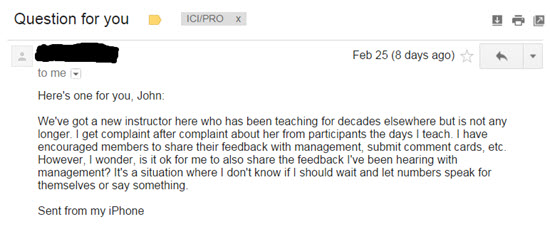
I got this email last week – but I can't divulge who it's from for reasons you'll understand.
Here's one for you, John:
We've got a new instructor here who has been teaching for decades elsewhere, but is now only at our club. I get complaint after complaint about her from participants the days I teach. I have encouraged members to share their feedback with management, submit comment cards, etc.
However, I wonder, is it ok for me to also share the feedback I've been hearing with management? It's a situation where I don't know if I should wait and let numbers speak for themselves or say something.
Sent from my iPhone
Dear Sent from my iPhone,
I'm big on teammates respecting and supporting each other. So my short answer would be along the lines of the Golden Rule:
Do unto others, as you would have them do unto you
> leaving you with two possible choices:
Say nothing to management
Speak to the Instructor privately after taking her class and express your observations
I happen to know Sent from my iPhone personally. She teaches at a very upscale club, whose members are professionals. I'm sure they have high expectations for Instructors = their concerns/complaints are probably valid*.
*I say probably valid, but you can never be sure. I'll never forget years ago I had female members tell me about a “horrible” new instructor. So I went and took her 9:30am class > which was filled with housewives. It took me exactly 3 minutes to figure out what was driving all the complaints. The new Instructor was; young, thin, attractive and had a very “perky” personality. There wasn't anything wrong with her class, except that she had the misfortune of replacing a very good looking male Instructor 🙁
IMO Saying nothing is always best
Staying out/away from situations like this is the best tactic you can take as a professional. It will also demonstrate your character as a solid human being. Unfortunately, there are plenty of people who live for the drama and attempt to drag you into what would amount to throwing your teammate under the bus.
I don't feel what another Instructor does, or doesn't, do is any of my business. I hear stuff about other Instructors and classes all of the time. I try to keep my responses limited to, “I'm glad that you enjoy my class”.
Flip this around. How would you feel if another Instructor was “reporting” on you, based on comments from others?
Hearsay is inadmissible in courts for a reason
Hearsay, which literally means; “I heard him say…” is a form of gossip. Gossip that is often destructive to others and deadly to a small team of Instructors, or co-workers of any type.
If I was an owner or manager and another Instructor came to me with “concerns” they've heard from members, I wouldn't listen to them and my opinion of this person as a fitness professional would go down. Then I'd probably begin to wonder what he/she is saying about me, when I'm not around 🙁
We all need to be able to trust and depend on each other. Amy and I travel frequently = we needs subs. We are totally dependent on the comradery of our team to cover classes. If I heard that another Instructor was trash-talking me, or another on our team, I sure won't go out of my way to help them.
Why are you telling me this?
A good question to ask yourself, am I doing something to cause these comments?
I'm always curious when I hear that person “A” felt it necessary to report to person “B”, about person “C”. I don't feel that's normal. Something is causing person “A” (your reporting member) to come to you about one of your co-instructors. Any idea what it could be?
For example > are you telling riders during class, “I'll never tell you to do _______________ in class because its; dumb/unsafe/contraindicated/will cause your hair to fall out/etc…?
If you are, what's the purpose of saying it?
If you feel you need to get involved… get involved
There's nothing wrong with acting on the concerns you're hearing, to decide if they're legitimate. But you need to experience them first hand… as in go and take the class yourself.
After hearing for years about the untrained Instructors and dangerous classes being taught at SoulCycle, from people who have never set foot in a SoulCycle studio, I spent the money, took two classes, and reported on what I experienced in this series of articles. NOTE: There's a reason that studio fills nearly all of their 60 weekly classes (with 60 bikes) in a city that's 80 and sunny nearly every single day > Santa Monica, CA.
Stay incognito and keep an open mind
If you came to take my class, (and I don't know you) I would prefer that you acted like any other member. Please don't tell me, “Hi. I'm one of the Instructors here at XYZ Fitness!” Most of us will feel/act different when we know one of our peers is watching us.
Jump on a bike in the middle of the studio and do your best to be one with the class. If everyone is doing rhythm presses, except you, you'll stick out like a sore thumb. Worse if you just sit there motionless, with a defiant look on your face.
Take a few mental notes… some positive and some you felt were negative.
Then before you approach the Instructor, you need to do some honest soul searching.
Is it really my place to critique this Instructor?
What was really so bad about the class?
Did the participants enjoy the class?
What positive result will come from expressing my unsolicited opinions?
If you can get beyond all of that and still feel you need to pursue this with the Instructor, I can't help you.
My instinct is to stick with and support my teammates.