
by John | Aug 9, 2014 | Best Practices, Instructor Training, Master Instructor Blog, Mental Toughness

In Jennifer Lintz's last post; Use YOUR Workout as Inspiration for your Next Class , Jennifer talked about using your personal workouts and build a class around them. Makes sense to me… because I've experienced something, I can more accurately describe the feelings, intensity, frustration, etc…
I follow communication expert Alexa Fischer (she was featured on Podcast #296) and she's frequently sending out short videos that seem to always get me thinking. This week's email was on using thought bubbles vs. a script, when presenting:
When you are giving a speech or filming a video, I can appreciate the desire to communicate exactly what you want to say through a carefully crafted script. But let me ask you… Do you prefer watching a person reading a script or sharing their thoughts from their heart?
I used this technique in my class yesterday. Here are the thought bubbles I used to bring last Saturday's century ride inside:
Tour de Tonka – that's what the ride is named. I asked if anyone else participated (there were 6,000+ riders) or, if they were driving, were they forced to sit and wait while the mass of riders rode past. I told this personal story during the warm up:
Two years ago I offered to sub a Saturday 8:00 AM class on the day of this event. I wasn't running late, but let's just say I hadn't left myself much extra time. The last stoplight I hit is the corner where the club is located. It's also an intersection where the Tour de Tonka riders cross. So at about 7:50 I'm first in line at the stoplight, waiting while the cop is waiving hundreds of riders through. Light turns green, cop's still waving. I can see the club from where I'm sitting – cop's still waving. At around 7:55 I'm panicking – there appears to be no end of riders and the cop seems content to keep us waiting at the light, as he waves the cyclists through. So out of desperation I go through a very awkward series of multi-point turns to get pointed the opposite direction. I found a place to park two blocks away and with just minutes until the class was supposed to start, I'm running down the street barefoot (I'm one to eschew shoes in the summer) with my gym bag, the cop yelling at me as I dart through the line of bikes, on my way to the club's parking lot.
Distance's – you can ride as short as 15 miles… all the way up to 100 miles, a full (not metric) century.
As a (somewhat proud) cyclist, there's only one response you want to give when asked; “did you ride the Tour de Tonka?” “Yep (standing a little taller) – the century. Reporting any other distance tends to feel like a disappointment, and your body language will normally reflect this. I added this as a bit of foreshadowing, which you'll understand in a few minutes.
Matt and the rollers – That's Matt as in Matt Finnesgard, one of the riders in our group. He's in his mid 30's and a very strong. Oh, and he rides with no technology… not even a speedometer.
Our normal position in the pace-line is front and center. Tandems are best up front. Besides making a nice hole in the air, for the riders behind, all of our mass makes it difficult to react to changes in speed easily. 100 miles can make for a long pull. After the 30 mile rest stop, Matt offered to pull us. A nice gesture on the face of it, as long as the roads are relatively flat. They're not. The next section we rode was pretty much continuous rollers. I know he wasn't doing it on purpose, but Matt didn't slow from his steady 23 mph when the grade became positive. He just keeps a steady cadence and it was killing us to keep up. Here's where I had everyone doing 30 second intervals; just below PTP and then above. Some were load based with steady cadence… and some where accelerations from 80 rpm to 100 rpm and back again.
Old Market – a long, two section climb at the 98.5 mile point in the century.
The Tour de Tonka begins at the Minnetonka High School, which is only one mile from our home. The route goes right past our neighborhood – Old Market is only a few blocks from our house. It turned out to be a pretty hot day, 93° and Amy and I were pretty much toast as we approached the turn, that if we took it, would have us home and quickly in the shower and a nap. It would also have us about a mile and a half short of the full distance. It's hard to describe how tempted we were and we quickly discussed ending our ride then and there. “Who would know if we bailed early?” I asked. We were alone at this point. “We would.” was Amy's response. “You're right.” “We can't honestly tell someone; we did the century – if we really didn't 🙁
So up Old Market we went. Amy and I can did the whole thing + they had some fantastic pizza at the finish. My class got to replicate the two sections as 45 secs climbing above threshold, and the final 45 secs of the class with an all out effort, out of the saddle struggling to make it to the top.
There was of course more to the story that filled the hour.
Do you have a similar story you could present to your class?
Here's my playlist
by Joan Kent | Aug 4, 2014 | Health and Wellness, Master Instructor Blog

Photo © Team CSC & Tim De Waele
Stage races span the duration spectrum. Shorter stage races that are done over a weekend might feature a time trial and road race on Day 1, for example, then a criterium on Day 2. These points on fueling for stage races are culled from several sources — cycling books, cycling magazines, websites, and my coach.
Ideal fueling starts with Body Recalibration — not my term, just a fancy name for conditioning your body for recovery. Recovery should begin at least 6 weeks before race season. (An even better practice is to eat well year-round, but we have to start somewhere — and I’m well aware that this post is late in the season).
Start by eliminating junk — assuming any of you ever indulge in such stuff! Junk includes alcohol, sugar, caffeine, high-fat chips, and such. If you’re in the habit of fueling with sugar before and during trainings, it’s a good idea to eliminate that as part of this process.
My coach always said that endurance athletes never mind expending energy, but don’t want to waste it. Wasted energy refers to anything without a performance payoff. Having to detox from chemicals and junk like sugar wastes energy.
Next, add the good stuff. Eat foods in a natural state whenever possible (whole foods, rather than processed). Stress vegetables (3-6 cups a day), rather than fruit. Fructose is associated with lots of health issues and isn’t good fuel for training.
If it’s possible to eat organic, do. That’s less important if we don’t eat the skin. So organic nuts matter less, but organic apples are a big deal. At least stay away from The Dirty Dozen — the foods with the highest pesticide levels: apples, strawberries, grapes, celery, peaches, spinach, bell peppers, imported nectarines, cucumbers, cherry tomatoes, imported snap peas, potatoes. Three foods recently added to the list are kale, collards and hot peppers, so it’s a Dirty 15.
Eat the same types of foods that you eat during your training. Race day is not the time for nutritional surprises. Believe it or not, if you’ve been junking out all the way up to race day, you might as well eat that way for the races.
Don’t deplete carbs or skip meals, especially race-day breakfast. Eat some extra starches 1-2 days before the event.
The primary nutrition concerns in training and racing are:
– Replacing water. Dehydration reduces blood volume; increases heart rate and perceived exertion; impairs thermoregulation, mental performance, and endurance.
– Replacing sodium. Low sodium can result in disorientation, nausea, fatigue, seizures, or collapse. Salt your food instead of using salt supplements.
– Saving glycogen during the race so it’s there at the end when you need it. (This may be a good place for Dr. Joan’s Potato Goo…)
– Replacing glycogen after the race so you can perform well in the next stage. High GI starch and protein in a 3:1 or 4:1 ratio replace glycogen better than sugar, including fruit. Don’t eat fats right after the race. They slow carb absorption.
Eat 3 hours or more before the start of the race. If you’re not adapted to that, consider it part of Body Recalibration. Avoid eating 30-60 minutes before the start, which may be too close to the effort. Find a food combination that works for you, but avoid all-carb (especially all-sugar) meals. They can lead to reactive hypoglycemia in some athletes and cause bonking. Instead, include protein and fat.
Refuel within 30 minutes after your race. Always. Be fanatical about it. Glycogen replacement is maximized during that 30 minutes because glycogen synthetase is in its active form and facilitates peak storage. Eating within 30 minutes counteracts cortisol’s breakdown of muscle protein for energy and will reduce soreness — very important for the next stage. If you miss the 30-minute window, your muscles may be temporarily insulin resistant for several hours. That prevents best glycogen replacement and may interfere with your performance in the next stage.
Eat again 2 hours later and 4 hours later — or 3 hours prior to the next stage. If you race twice that day, stay aware of how many calories you’re expending and consuming. Many convenient devices are available that are worn on your wrist and provide this information.
Racing at over 20 mph while drafting may burn roughly 12 kcal/kg/hr. Without drafting, that could increase to 15 kcal/kg/hr. Gender, size, and muscle mass all affect those values. Cycling efficiency (good technique) can lower them. The more you ride overall, the less you may burn.
The goal during racing is to postpone fatigue, not replace all of the calories you’ve burned. Full calorie replacement should occur during recovery.
Refuel within 30 minutes after the last race of the day, especially if you have to race again the next day!
And keep in mind that these points may also help on days that you teach several classes.
by John | Jul 22, 2014 | Best Practices, Instructor Tips and Tricks, Instructor Training, Master Instructor Blog
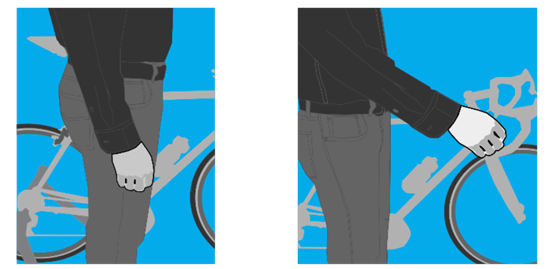 Paul Swift from BikeFit sent out another infographic showing proper wrist alignment, this time for road bikes. We published his previous email that highlighted proper wrist alignment on a mountain bike. Notice in the image above how the curve of the handlebar drops matches the natural, straight wrist position?

I see this problem a lot on our group rides… Set up incorrectly (bars rotated down too far) causes the hinged wrist shown above, left. Where this becomes obvious is the additional arm movement needed to grasp the brake levers – there shouldn't be any 🙁
With your hands on the brake hoods, your wrists should be straight for best comfort and control. In this position you should be able to rest your fingers on the brake levers. Rotating the handlebars and/or brake hoods upwards helps improve alignment for more comfort and better control.
Cuing wrist position in class, or on the road, will be appreciated by your participants.
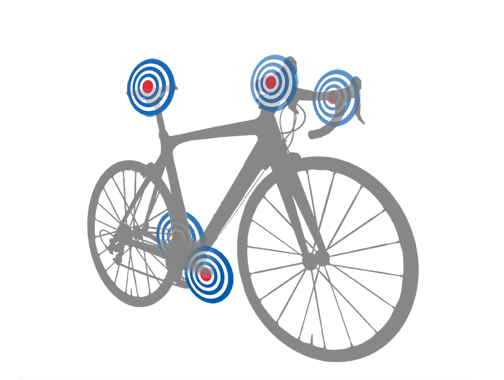
Remember bike fit is not about the bike, but where you touch the bike.

Click image for more information about BikeFit
by Joan Kent | Jul 21, 2014 | Health and Wellness, Master Instructor Blog

By Joan Kent –
It was, as the saying goes, déjà vu all over again.
There we were, toward the end of the day at a conference that featured lectures on health problems from eating gluten, health problems from free glutamate, and similar topics. The audience accepted the information enthusiastically — along with the slides that showed extremely long lists of foods that contain the offending substances. In other words, long lists of food to avoid.
Finally, late in the afternoon, I gave my presentation on sugar as a limiting factor in health. The previous speaker had run well over his limit, cutting my allotted time down to 32 minutes. It would be tight but still do-able; this was not a “tough room.” I began to go through my slides and deliver my teaching points.
A man in the audience asked if I was talking about “added sugar” or was including natural products like fruit. I answered that sugar did include fruit — and that fructose, the sugar in fruit, can cause a variety of health problems.
In fact, all of the negative health consequences of sucrose, a disaccharide that’s half fructose and half glucose, are attributed to the fructose in it, not the glucose. Even though you can find disagreements in science journals on virtually everything, no disagreement on this topic exists in the science lit. Researchers all seem to agree that fructose makes sucrose the junk that it is. (These points have been covered in my previous post, “Fructose: The Sugar No One Thinks Is Sugar”.)
Well, the man became angry and even left before the end of my short presentation. Believe me, I’d seen reactions like that before. Sugar is a topic I’ve presented on many times over the years (since 1990, in fact, when everyone was still obsessing about fats). Audience reactions to sugar information have often been strong, and that’s interesting because those were presentations, not personal consultations.
In a presentation, I have no idea what the audience members eat, so nothing can be taken personally. Or should be taken personally. But addiction isn’t rational or logical. One question in a short test for alcoholism is, “Have people ever annoyed you by criticizing your drinking?” The key word in the question is “annoyed”. Mess with someone’s addiction, and they get angry.
Maybe we should start asking fruit addicts if people have ever annoyed them by telling them fruit is sugar.
It has seemed lately that people don’t care about sugar addiction, including their own. Fairly recently, an obese woman told me that she knew she was addicted to sugar but was “okay with it.” That reminded me of the final criterion for substance dependence in the DSM-IV — which has been moved into first place in the DSM-V criteria for substance abuse disorder: Continued use despite adverse consequences.
The past decade or more has shown a nutrition awareness shift that actually harkens back to the 1970s. In the 1970s, science journals were filled with articles on the negative impact of sugar on health. Videos were available, and at least one popular book was written on the subject (Sugar Blues).
In the wake of this, the sugar industry — a powerful lobby in Washington — got busy, and, starting about 1983, three things happened.
1. Fat became the new dietary demon, and everyone started eating low fat this and nonfat that.
2. Sugar consumption between 1984 and 1999 increased by 25-45 pounds per person per year. (25-45 lbs represents the increase, not total consumption.)
3. Obesity in the U.S. became an epidemic.
No doubt the sugar industry was, and is, quite happy with those results.
Now we’re back to a more realistic evaluation of food. Fats are recognized as not being as bad as we used to think — and we know some of them are supremely healthful. Everyone knows that sucrose is junk. Researchers, at least, know that fructose is what makes sucrose junk.
But if all we’ve done over the past 15 years is switch our addiction to fruit, I’m not sure we’ve made any progress. Especially when people get just as angry when I advise them not to eat too much fruit as they used to get when I advised them not to eat sugar.
by John | Jul 19, 2014 | Deezer, Instructor Tech Help, iTunes & Spotify Training, Master Instructor Blog, Music, Spotify
I'm hearing from Instructors outside of the USA who are switching from Spotify, over to Deezer.
Hi,
I have had Spotify for a long time now and have created lots of different playlists. I have recently just converted into using Deezer, however, it would be much easier for my Spotify playlists to be on Deezer instead!
Is this possible? If so, how do i do it?
Thanks
Cydnie.
Cyndie we created an ICI/PRO playlist conversion tool for just this occasion 🙂
Here's the steps to convert your Spotify playlist to one Deezer can play.
Step #1 Open and log in to Deezer in a new tab – clicking this link will do that for you. Note: Deezer is different from Spotify in that Deezer is a web application, vs. Spotify, which is a program that you install on your computer. Yes I know that Spotify also has a web version… I never had much luck using it and suggest you install the full program if you want to run Spotify on a laptop.
Step #2 Clicking this link will open our conversion tool in another tab. Scroll down the page and you should see that you're logged in to Deezer and a Please enter Spotify URI dialog box like this:

If you don't see this click the Log into Deezer link or refresh the conversion tool page.
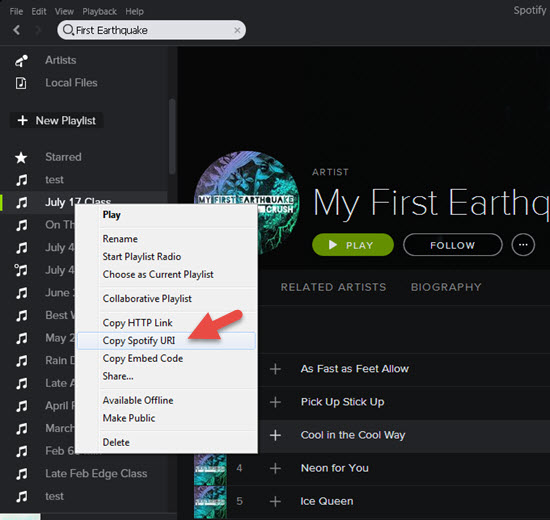
Step #3 In Spotify, Right Click the playlist you want to convert and select Copy Spotify URI.
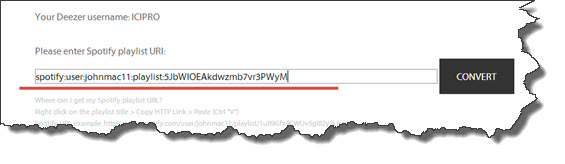
Step #4 Back at the conversion tool, Paste the URI you copied and click Convert. It will look like this:
Step #5 Success! Click the link to see your new Deezer playlist 🙂

A few notes:
- Despite a lot of programming time, we weren't able to get Deezer to carry over the name of the playlist from Spotify. Renaming the Deezer playlist is a snap using the edit option shown below.

- Check your new Deezer playlists for accuracy > differences between each service's music library and Meta Data = not every playlist will convert perfectly.
Any other questions?
Feel free to contact us like Cydnie did – we're happy to help.
by John | Jun 28, 2014 | Correcting Form, Instructor Training, Leading Group Rides, Master Instructor Blog
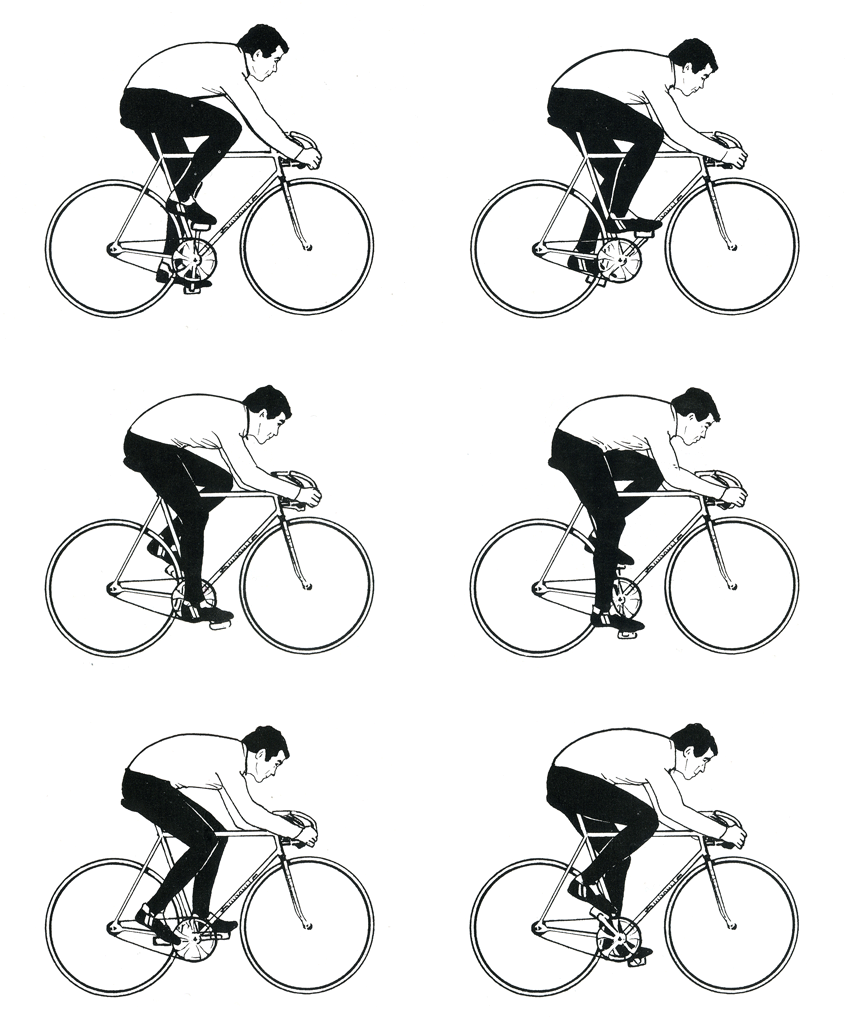
Beyond the obvious fitness benefits Indoor Cycling provides to our outdoor riders, there's an overlooked skill that will make your participants smoother and safer riders in a pace-line… riding fixed-gear Indoor Cycles teaches us to pedal constantly – i.e. not starting and stopping while riding.
It's rare that you'll ever have your class stop pedaling. We start turning the cranks and don't stop until the end 45 minutes later. Not surprisingly this steady/consistent pedal stroke is the mark of an experienced cyclist. Pedaling without stopping will also prevent you from hearing me calling out from behind you, in a somewhat irritated voice; Pedal, Pedal, Pedal!
At this speed you only get one chance.
Riding in a paceline at speed is a magical experience. Sailing along at 20 mph with your wheel 12″ or less from the person ahead. You feel their draft dragging you along, as the group members take turns sharing the work of pushing through the friction of the air. As long as everyone rides smoothly and consistently, it's all good. But “things” happen over a 40 mile ride; dropped water bottles, lost or distracted concentration, garbage on the shoulder – lots of “things” that will cause one of the riders in front of you to slow suddenly. Exactly how you react can make the difference between just another “thing” that happened on today's ride or you painfully ending up on your head 🙁
I've seen a lot of rear-end collisions and nearly always it's the rider behind who gets the worst of it.
@ 20 mph you are travelling ~ 29 feet per second. That 12″ gap between you and the rider in front represents 1/29th or 0.034482 of a second. So let's say you're JRA (Just Riding Along) and everyone in front slows very quickly. There's very little time (just a fraction of a second) to; perceive the change in speed and then react, before you hit someone. A fraction of a second may sound like a short period of time, but your brain can do a lot – especially if you've conditioned/trained it to respond correctly.
Brakes are for slowing… Pedaling is for going
Spend as much time leading and riding with cyclists in a paceline as I do and you start noticing the small differences that identify experience levels. Observing how closely a rider is willing to follow, consistently maintaining the distance to the rider ahead, is what tells me if you've done this before. When I see someone who's not comfortable following closely, it's almost always because they are attempting to control their speed by first stopping their pedals. Trouble is that bicycles coast…
Bicycling.com has an article that describes what they call the 9 rules of riding in a paceline.
MICROADJUST It's nearly impossible for everyone to put forth equal amounts of effort, especially on undulating terrain. You need to make adjustments along the way to prevent what Ignosh calls the Slinky effect, where the line alternately bunches together and becomes strung out, with big gaps. “It's better to make two small undercorrections than one big overcorrection,” he says.
“Think of it like driving: You don't slam on the brakes, then hit the gas; you moderate your speed.” To do that in a paceline, try one of these techniques:
Soft pedal: If you feel like you're getting sucked into the rider in front of you, take a light pedal stroke or two to adjust your speed accordingly.
Air brake: An easy (and safe) way to trim speed is to sit up and catch some wind. It'll slow you down a notch without disrupting the rhythm of the line.
Feather brake: Gently squeeze the brakes while continuing to pedal. You can scrub speed while shifting up or down as needed to alter your pace.
Note that none of these 5 techniques involves stopping your pedals.
New/inexperienced/poorly trained riders typically do the following in a panic situation:
Sense the change in speed > {stop pedaling} > realise that wasn't enough > grab a handful of brake > overlap the wheel ahead or hit the rider's wheel. The time spent between the {stop pedaling} was their allotted 1/29th of a second to react and prevent the collision. Having survived this mistake a few times, the rookie rider will increase the gap {adding additional time} until they learn what's causing the problem.
Experienced riders have learned to skip the {stop pedaling } and instead quickly apply (feather) the brakes lightly, while soft pedaling. In a panic, their hands are already doing what their supposed to be doing and can continue to add pressure to the levers as needed. Collision prevented 🙂
I've discussed this in my classes and have used it to break up the monotony of a long long tempo flat at Threshold. I'll ask everyone to close their eyes and visualize the scenario I described above…
You're tucked into a fast group this morning. Your hands are lightly resting on the hoods, fingers at the ready on both brake levers. Sensing the lead rider slowing you feather the brakes just enough to maintain your 12″ gap between wheels, while softening the pressure in your feet just a fraction. Keep this level of effort until the group accelerates again – your response to this surge is perfect.
With any luck you'll have taught them a valuable skill that could keep them safer in a group ride. Or at least save me from have to call out; Pedal, Pedal,Pedal!
Riding a fixed gear bicycle is a common training technique among outdoor cyclists, for the exact reason.
