
by Joan Kent | Jun 9, 2017 | Master Instructor Blog
By Team ICG® Master Trainer Joan Kent
What does mind/body training mean to you? Which activities count as mind/body training? Yoga and t’ai chi almost certainly. Weight lifting? Why or why not?
Some would submit that almost any activity can be a mind/body workout, depending on how it’s approached. So maybe it’s best to ask what a mind/body approach is.
Jim Karanas and I wrote a post some time ago (The Tao of Training, parts 1 & 2), outlining the differences between exercise and training, and suggesting that the primary distinguishing element of training is consciousness. It’s a short leap from that to a discussion of mind/body training, since bringing conscious to an indoor cycling class would most likely make it a mind/body activity.
It’s almost impossible to discuss the mind/body approach without including focus. When some (maybe most) people exercise, their focus is not on what they’re doing. They may be thinking about work, calls they need to make, plans for the weekend, anything but the workout. This type of focus is called “dissociated.” It takes no practice because it’s our default whenever we’re not disciplined. Dissociated focus, I was taught, has no place in training.
It recently came to my attention that dissociated focus is actually taught in indoor cycling certifications. It’s a method of getting cycling participants to work harder by taking their minds off the discomfort of hard cycling. Because my first certification was quite some time ago, this surprised me. What I was taught to do is keep my focus on exactly what I’m doing. That type of focus is called “associated.”
Associated focus can be external or internal. External focus includes anything going on in the room: the instructor’s voice, the sound of pedals turning, whatever’s in your visual field. Internal focus pertains to what’s happening in your body: sweating, body temp, the feel of clothing against skin, heart rate, breathing.
Associated focus may be wide — taking in as much information as possible regarding what we see, hear, feel and so on — or it might be narrow — zeroing in on one thing, such as the pedal stroke or even one segment of the pedal stroke, e.g., the upstroke. In either case, the key is not to attach a thought process to it, but to “go sensory” and experience it through our senses.
I was taught to approach hard training by being aware of all that’s happening — in the muscles, with heart rate, with the breath, and more — but not to think about any of it. Jim loves to say we defeat ourselves mentally long before we’re defeated physically. He teaches us to feel everything, and then transcend it. “It’s not that it doesn’t hurt, it’s just that it doesn’t matter,” he said one day during tough, big-gear climbs. I immortalized the saying on a boxful of t-shirts.
As great as transcendence sounds, it didn’t always work for me. I would find myself “striving” to get into that transcendent state, then striving to stay there. The striving itself was antithetical to the state. It also linked “good” or “bad” with whichever state I was in at any moment. If I felt discomfort, was I doing it wrong?
My solution came from a non-cycling environment, a workshop with Zen master Genpo Roshi. I modified one of Roshi’s techniques, and discovered the key to keeping my focus associated during hard efforts. (For those who might want to try it or teach it, it’s helpful to practice first during moderate-intensity cycling.)
The Zen behind this is No Attachments, No Aversions.
Visualize a triangle superimposed on your body. The lower left corner is the part of you that feels the discomfort or pain and reacts to it: “This sucks. If it hurts now, what will it feel like in 5 more minutes? Why did I come in today?” And so on.

The lower right corner is the part of you that transcends the pain/discomfort and rises above physical limitations.
Now bring those two points together at the apex of the triangle, directly over your head. Clear your mind of thought, and train with absolutely no preference.
With no preference, there’s no striving to reach the transcendent state. One moment you might transcend the discomfort. There’s no attachment to that, no holding onto it because it’s better. Experience it for as long as it happens.
The next moment, you might find yourself feeling the pain, or reacting to it. If that occurs, there’s no resistance — either to the pain or to the reaction. Experience it with no aversion and let it pass through. Whatever happens is absolutely okay.
The state of No Preference is the ultimate mind/body state, or more accurately the no-mind/body state. In a very real sense, there is no emotion, just energy. Appreciate it; let it happen and pass through.
Using this technique, I can stay connected, associated with what’s happening. Because any state is okay, I don’t strive, fight the moment, or resist what is. I never feel I’m doing it wrong.
When students started asking me to run through “the triangle” during classes, including classes I subbed for Jim, I knew it worked for others, too.
This method is in the moment and fully conscious. There’s no fear of difficulty, because it truly doesn’t matter. Whatever happens is okay.
If you try this, please let me know how it works for you.
Originally posted 2012-11-19 05:22:53.

by Joan Kent | Jun 8, 2017 | Health and Wellness

As most of us have discovered, mistakes can be valuable if we learn from them. Here are a few mistakes a recent client made that may help you.
Getting Back On Track vs. Cutting Calories
What do you do after a ‘lapse’ in eating one day (or night)? The best thing is to go right back to your healthful eating program – but that’s not always what happens.
Recently, I worked with a client who would skip eating the next day to make up for the previous day’s binge. No matter how many times I told her not to, she kept doing it.
Of course, we should back up a little to look at what was happening. Her binges typically started with eating sugar because she “wanted it.” That statement was always made with a smile on her face, as if wanting sugar was an automatic reason to eat it.
She would eat some sugar 2 days in a row, then binge the next night. Because her binge often included non-sugary items too, she didn’t think it was related to wanting sugar.
Then she’d skip eating to make up for the binge. Obviously, she was thinking about calories – but brain chemicals, glucose and hormones actually figured into the situation strongly.
By fasting the next day, she was essentially letting her now “unstable” brain and glucose run the next day’s meals and food preferences.
Instead
She could (and should) have started the day early with a solid, stabilizing meal – or, at the very least, some protein. The rest of the day should have looked just like her “good” days, with no compensation for the lapse.
How Do I Know It’s a Craving?
The same client used to tell me she didn’t have cravings. But she didn’t recognize “wanting sugar” as a craving.
I did ask her to explain what a craving felt like or looked like in her mind. She described thinking about the food over and over, and even feeling as if she could already taste it in her mouth.
Yes, that seems like a craving, and a strong one. But wanting a food that’s not on your food plan and eating it just because you want it, regardless of consequences? That also sounds like a craving.
Instead
This client needed to expand her definition of “craving” so she’d be more aware of the next one.
FWIW, she had already purchased liquid B-complex to handle cravings, but never used it. Why not? She didn’t think she had cravings.
[For those not aware of the nutritional magic of liquid B-complex, it can take away a craving within a few minutes. It gives the brain the B vitamins it needs. Those vitamins serve as co-factors (catalysts) in the formation of the brain chemicals that will stop the craving and prevent its return, usually for quite some time.]
Instead
If she had used liquid B when she wanted sugar instead of eating some, that would probably have prevented the binges.
There’s Junk, and Then There’s … Junk?
Finally, this client used to worry about what she called “things” in her food. She avoided foods with guar gum and other additives. No criticism there – staying away from junk is always a smart idea.
But I had to wonder why she didn’t apply that strict standard to sugar. Eating sugar is trouble on many levels.
It’s linked with diseases and directly compromises the immune system.
It can trigger cravings – for more sugar or for other kinds of junk food.
And it can shift our food preferences away from healthful foods – like vegetables! – and toward foods loaded with sugar or not-so-good fats. That’s all because of the brain chemicals triggered by sugar – and the junk they makes us want.
Instead
She could and should have avoided all junk on food labels – guar gum, MSG, high-fructose corn syrup, and of course, sugar.
This client’s mistakes were persistent and sabotaged her progress for a long time. The good news: with my coaching, she learned from the mistakes and changed her behaviors. She did make excellent progress, but could have made it sooner without the mistakes.
Please benefit from these mistakes. And if I can help you with these or other food issues, I’d love to help. Just visit www.FoodAddictionSolutions.com/Coaching for your free Eating Empowerment Consult. Find out how easy it can be to make simple tweaks that solve big problems.
by John | Jun 8, 2017 | Best Practices, Instructor Tech Help, Master Instructor Blog, Spotify
ICI/PRO member Dr. Marc Schlosberg is one of those Early Adopters you've no doubt heard discussed in the media. This group is quick to experiment with and embrace new technology. Marc was one of the first Instructors to use Spotify in his classes and he joined me on the podcast to discuss this (at the time) exciting new option for delivering music to our classes. Marc sent me this email yesterday, providing his comments related to my conversation with Chris Hawthorne on Podcast #303
Hi John,
I was listening to the latest podcast and heard about the Spotify syncing issues. I have a couple of suggestions/solutions. I think the reason rebooting all units works to fix syncing is that the newest versions are then installed on all devices. I believe syncing problems develop when Spotify updates and there is a version mismatch. You don’t always know this is the case or sometimes it’s difficult to track that one device has updated, but you haven’t checked the others. Simply shutting Spotify down, checking for updates and updating it, then restarting the program should solve the problem. You have to do this with all the devices you use.
Another roadblock to syncing is lack of space on a device. It won’t tell you you’re out of space, but won’t take individual tracks offline — they stay grey rather than green. It’s a good idea to switch playlists to online only after you’ve used them to preserve space (except for those you always like to have in your back pocket). You could also delete unused apps to make room. My iPhone is 16gb and I’ve run into this problems (and 16gb used to be an unimaginable amount of space). It’s probably less of an issue for those with 32gb and up or Android devices with huge plugin memory — unless the memory is full.
Whoa — it looks like Spotify updated their iPhone interface yet again while I was writing this.
Hope this helps.
Take care,
Marc
Thanks for this Marc! Your suggestion that available storage maybe limiting the number of “off line” playlists is a good one and begs the question; “how can I tell how full is the memory on my iPhone?”
There are a couple of places that will show you how much space/memory you've got left. My preference is to go to: Settings > General > Usage… where at the top you'll see how much room there is for a few more playlists.
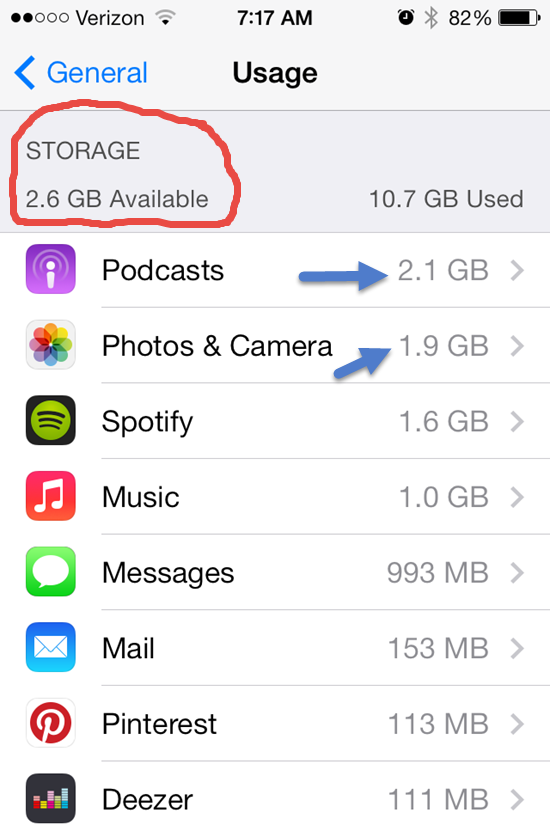
This also shows you all the other memory hungry Apps on your phone. One common culprit is your camera's memory and all those pictures and HD videos. Downloading them to your computer and then deleting can free up some space.
Depending on your settings, Podcasts download automatically and can quickly crowd out your favorite playlists. Open your Podcast App select a specific Podcast > Settings > Episodes to keep and select a number to save (Last 2 / Last 5 / ect…) instead of All.
Do you have any other tricks you can share?
Originally posted 2014-04-04 07:53:40.
by John | Jun 5, 2017 | Best Practices, Instructor Training, KEEPING IT FUN

Over the last couple of days I've remembered a few points that didn't make it into either part 1 or part 2 of my SoulCycle articles that I wanted to share today.
3 pound hand weights can get really heavy
[wlm_private ‘PRO-Platinum|PRO-Monthly|PRO-Gratis|PRO-Seasonal|Platinum-trial|Monthly-trial|PRO-Military|30-Days-of-PRO|90 Day PRO|Stages-Instructor|Schwinn-Instructor|Instructor-Bonus|28 Day Challenge']
I failed to complete part of the weight segment in the first class. I'm not kidding 🙁 Amy was right there next to me when I was unable to finish (I can't remember exactly what exercise) and had to drop my arms and rest, before I was able to continue. I didn't pick them myself, those little 3 pound weights were already there on the bike for me – given the chance I would probably grabbed something larger.
Our Instructor (Heather) had us with a lot of load on the flywheel and sitting up straight and tall. We went through multiple, high repetition series of shoulder, bicep and tricep exercises. I'd guess it was 5 or so minutes total and I worked to failure of my shoulder muscles before the end.
Something to consider…
But you can't gain strength with those little weights! That's what I've heard expressed by multiple “experts” that light weight/high repetition exercise has no value. I was discussing this with a former SoulCycle Instructor and his response to me was along the lines of; wait… so riding a bicycle has no value either? Isn't the act of pedalling a bicycle, with its high repetition and relatively low force, exactly the same as what we are doing with small weights in class? Why would one be “good” and the other “bad”?
The fact is that many women don't want to build muscular size – they only want to tone their upper body and rarely go near a weight room. SoulCycle obviously understands this = that's why they offer these exercises. Poke your head into any Group Fitness “Sculpt” class and you'll see a room full of women using similar sized weights – often while sitting on something unstable, like a Bosu or exercise ball.
They know their music… I mean REALLY KNOW THEIR MUSIC!
Yes, I mentioned this in the original article > When I compare how well both SoulCycle Instructors knew their music, as compared to my rather A.D.D. (feeling the need for something new every week) approach, I'm thinking I have a lot to learn here. In both classes it was uncanny how each Instructor was able to pre-cue every significant change in the music > or at least it seemed that way. The net effect was powerful and very impressive 🙂
Question: what, exactly, is wrong with using the same playlist for multiple classes? In the pre-digital music days, I watched Amy painstakingly create cassette tape playlists. She would use each for a month or more and then recycle her favorites months later. After a few classes she would know the ebb and flow of each song perfectly + what track was to follow. My (and maybe your) need to deliver new music every week (or class?) has me scanning my iPhone or crib sheet for what's coming next > is this a climb or a fast flat? What's going to follow? Does your class really need new music every week? Or is that just an insecurity of yours… one you'll need to get over? [/wlm_private]
This was surprising to me John!
I received a bunch of emails and read multiple Facebook comments, all expressing the same basic sentiments; your observations are the exact opposite from what I've heard others say about SoulCycle. Why haven't I heard this perspective before?
Good question!
Why do you think much of what you've read/heard about SoulCycle is negative? I have my ideas, but I prefer to hear yours below >
Are you an independent thinker when it comes to conducting an effective, entertaining and motivating Indoor Cycling class? If so please consider joining us here as an ICI/PRO member where everyone is welcome – no matter where, our how, you choose to teach!
Originally posted 2014-10-25 14:17:30.

by Christine Hawthorne | Jun 4, 2017 | Instructor Training, Music
Every instructor needs to have songs like this week's favorite track in their library. Keep this one in your flat road folder and take it out when you are looking for a longer flat road to ride on. Though they've been around for quite a while, I've just recently found Nahko and Medicine for The People and their song Black as Night from their 2013 album Dark as Night. I love the lyrics: “I believe in the good things coming…”.
Riders will even out at around 97 rpm. *If you edit, watch for a few explicit lyrics at
1:19 and 5:09 (nothing a little ‘talking over' won't fix!)
Black as Night by Nahko and Medicine for The People iTunes link
by John | Jun 4, 2017 | Instructor Training
Now I feel very important 🙂
Keith at Cadence Revolution used my intro to Podcast #128.
Check it out
http://cadencerevolution.com/index.php/2009/08/cadence-revolution-128/
Originally posted 2009-08-11 17:34:05.
