In a previous post Be the Leader they expect, I expressed that our students are expecting us to be the Leader in our classes.
Some of you might be thinking; OK John; this is easier said, then done.
Maybe you haven't seen yourself as the “Leader” of your class, instead you have considered yourself as part of the group. Or perhaps you are a bit new at the teaching game and are questioning your ability to assert your position as a leader. There's no shortage of big egos out there and being a leader can take a lot of energy to maintain… so it's not surprising that some of us may have let our leadership skills slip a bit due to simple fatigue.
But what if there was a different way to becoming a leader? One that doesn't require a huge amount of confidence, knowledge, effort or charisma?
Start with WHY
If you truly would like to be the Leader of your class I suggest watching this video presentation from author Simon Sinek: How great leaders inspire action. The concept is that people will follow you based on a shared belief… you just need to communicate it! I will be expanding on this concept in future posts.
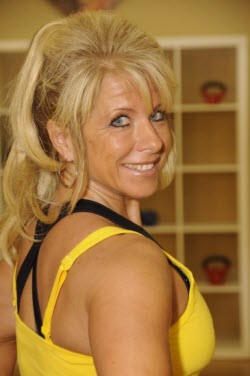
My guest for this episode of the Podcast is Studio Owner Leslie Grosshauser.
Leslie launched S & L Tri-Cycle Fit Studio on the first of the year. I was excited to learn from her about a number of decisions she made, to differentiate her offering from other fitness competitors.
Key among them were the purchase of Schwinn AC Performance cycles and the Performance IQ on-screen display system of each rider's Power and Heart Rate metrics.
Here's more about Leslie Grosshauser
Leslie has been teaching and training in the fitness Industry for over 25 years. Inspiring the world to workout and have fun are the key ingredients in all of Leslie’s program. Leslie has a wide variety of experience ranging from Managing and Directing Group Exercise and Personal Training in Hospital based centers, National Fitness Chains and small Boutique studios.
Leslie loves the world of competition and that is why she is so passionate about S&L Tri-CycleFit studio. Leslie has always had a vision to create a place where people can get a great workout, have fun and fulfill their competitive edge. Leslie has been teaching indoor cycling for over 15 years, loving every minute of the ride, she has created several creative formats to keep people smiling and coming back for more!
Leslie is currently a Master trainer for Polar Electro, The Cardio GX Program, she is also a Master Trainer and Presenter for the Hollywood workout “Piloxing”, Leslie is also a Fitness Educator/Presenter for SCW Fitness Education where she presents several of her own programs and educational seminars around the United States. Leslie has presented at several of the major Fitness industry Tradeshows such as IHRSA, Club Industry, Athletic Business Conferences and several others. Leslie has presented Internationally for FreeMotion Fitness where she launched the Group Free Motion program that she created.
Leslie was the 1999 National Aerobic Champion and also competed in the world of Body Building. Leslie loves the connection that the group classes create and that is why she has dedicated her life to designing fun group exercise programming.
It can be intimidating and awkward to instruct an indoor cycling class when not on the bike. Our bike seat can become a security blanket — a comfortable, happy place. However, getting off the bike and mingling with our riders can enhance their experience and allow them to draw closer to us as their instructor or coach. I find it to be an excellent way to engage riders and keep them focused on the objective of the class while adding a more “personal touch” to an otherwise group format. Here are 3 ways you can start to mingling with the crowds during class.
Introduction and Warm-Up
I love starting class OFF the bike. It gives me a chance to pace the room and stir up some energy as I introduce myself, learn who is new, and explain the objective of our time together. It is not uncommon for me to spend the the first 3-5 minutes of the class nowhere near my bike. As I’m rambling on about all of what we will experience, I randomly say “hey” to people as I pass their bikes. I also find this an effective way to bring an overly energetic class to order. Instead of trying to get their attention from the instructor bike (usually farther away), I’m in the crowd and in their face (strategically close to those with the greater tendency to continue chatting once class has started).
Recovery Time
Some instructors may find it easier to be off the bike during times of recovery. One usually doesn’t have to keep track of detailed timing and cues for 2-5 minutes and can feel free to move around the room. Similar to the introduction and warm-up, I use recovery times to explain what’s ahead. As I’m talking and moving around the room, I will often pause next to a rider and give them some encouragement “Abby, you looked like you were really focused during that last drill, how are you feeling?”. Abby may say “yeah, that was tough, but I was able to hang on until the end”. I would then say something to include the entire class like “Abby, you certainly got the most out of it. So how about everyone else? How are we doing?”. Remember, as the instructor, you are standing in the middle of the class. This puts you in the action and better connects you to your riders.
During Drills
In many of the surveys I’ve conducted, a greater percentage of riders prefer to see the instructor on the bike during hard efforts. It is motivating and an example of good form and technique. I don’t often get off my bike during climbs or when visualizing a road or certain terrain (feels like I’m being left behind), but I do find getting in amongst your riders during intervals can be very motivating. Instead of being in an educational mode, I go full-bore into coach mode. For example, during a 3-minute strength interval, I’ll walk from rider to rider “Joe you are crushing it! Keep your foot on the gas!”…. “Anita, you are a machine…unstoppable…unwilling to back down! You’ve got this!”….”Alright everyone, we’ve only go 45 seconds left, dig down deep and finish what you’ve started!”. Again, you can use a combination of personal encouragement and group motivation.
EXTRA: Get Physical
I will often make direct contact with my riders as I walk around the room. Sometimes it is as simple as solid eye contact as I stand in front of their bike. However, other times I may put my hand on a rider’s shoulder as I’m giving them some words of encouragement. Obviously, you as an instructor need to be comfortable with this and be aware of those who may want their personal space. In general, I usually reserve physical contact for my “regulars”. Those who attend often and who I’ve spoken to on an individual basis. 99.9% of the time, if you act with the proper intentions, it will be received as positive personal attention and yet another way to draw yourself into your class. However, if you are uncertain — DON’T DO IT! If you want to give it a try, choose one of your best friends in class to be your first victim.
Get off your bike, get in your class and get connected!
My biggest mistake with sugar was actually a series of several mistakes. Are you making them, too?
First was my Mindset Mistake: I resisted the idea of having to give up sugar. Yes, I knew I was addicted to it but was sure I wouldn’t have to quit.
Second was my Approach Mistake: I started looking for loopholes. Believe me, no one ever looked harder for a sugar loophole than I did, so I can say with confidence there isn’t one. But I didn’t believe that back then!
Third was my Behavior Mistake, which of course was a direct outgrowth of the first two: I used Sneaky Sugars. A new and popular item at that time was “all fruit” jelly – as if that wouldn’t have an addictive effect on me. I’d buy and eat it by the jarful. Another was a fake ice-cream-type dessert that had me at “hello” – hooked on the first spoonful.
Yikes.
Many trending sugars are available now, showing how sneaky the food industry can be, along with some old faithful entries: agave, coconut sugar, maple syrup, honey – and Organic Sugar. ‘Cause that doesn’t affect the brain; it’s organic….!!!!
If I could start all over, I’d be more Zen about sugar: No attachments. No aversions.
I’d accept that my addiction meant needing to give up sugar – and give it up much sooner.
I’ve never regretted quitting sugar but do regret the time I wasted – and the frustrations I caused myself – by not facing my addiction to it for real, once and for all. No one knew this stuff back then.
If you’re somewhere in the sugar Mindset / Approach / Behavior labyrinth and would like some help, perfect! That’s what I do. Just visit www.FoodAddictionSolutions.com/Coaching and request your free Last Resort Nutrition® Consult. Find out how easy it can be to get on track and move toward better health, more energy than you’ve imagined – and a life without cravings.
In the somewhat belated – but always relevant – spirit of Independence Day, what’s your freedom worth to you? Freedom from sugar and from cravings may be the greatest gift I can give you. Just go here.
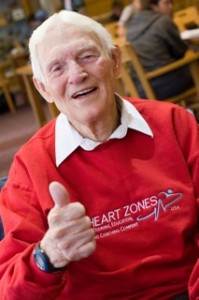
Paul Camerer, AKA Pink House, is walking proof that (220 – your age, shoe size, mailing address, phone number … or anything else) will not give you an accurate Maximum Heart Rate number to base your training zones. Paul is 91 (92 this December) and regularly rides at 30 or more beats above his “Age Predicted Maximum Heart Rate”. The guy is precious and I had the privilege to interviewed Paul back on Podcast #18 when he was only 90.
Here is an update about Paul from Sally Edwards' blog.
Pinkhouse (aka Paul Camerer) almost 10 years ago, started the first “garage gym” named after the color of his east Sacramento home. Today, he is nearing his 92nd birthday and he wanted to continue to demonstrate that maximum and threshold heart rate do not decline with age as many believe. Pinkhouse is but one example that the age-adjusted formula 220-age=maximum heart rate is useless. Don’t use this formula.
The picture to the right is taken of the final average heart rate from today’s ride using the “Gymbotron”, a device that displays heart rate on a screen or wall. Pinkhouse rode 20 beats above what the max heart rate formula would calculate (220-91=129 bpm). He averaged 149 bpm for 52 minutes. That is he rode 20 bpm above his calculated maximum heart rate. The point Pinkhouse is demonstrating is that his maximum and threshold heart rates have not dropped a beat over the last 30 years that we, the Heart Zones Training certified trainers, have measured it.
Jim graciously invited me to attend one of his classes at Club – One in San Francisco while I was in town. I recorded his class with my iPhone like I did for Podcast # 173 with the intent to show how easy it will be for you to record your class, how helpful it would be to hear How You Sound and to give you a reference to compare How You Sound with an experienced Master Instructor. Here's Jim's 45 minute Playlist
To Heal (Underworld)
Amma (James Asher)
All or Nothing (Dirty Vegas)
Silent Snow (Parov Stelar)
Fire and Mercy (William Orbit)
These Are Days (10,000 Maniacs)
PHD (The Crystal Method)
Souka Nayo (Baaba Maal)
All My Days (Alexi Murdoch)
Here it is as a Spotify Playlist (one substitute – Silent Snow N/A)





 Paul Camerer, AKA Pink House, is walking proof that (220 – your age, shoe size, mailing address, phone number … or anything else) will not give you an accurate Maximum Heart Rate number to base your training zones. Paul is 91 (92 this December) and regularly rides at 30 or more beats above his “Age Predicted Maximum Heart Rate”. The guy is precious and I had the privilege to interviewed Paul back on

