What if you could get inside the minds of your students? It’s common to hear compliments from your regulars about what you are doing well, but what about the students who come once and decide never to return? Last week, we explored the importance of preparation, which opened up a great discussion about our responsibilities and how much is too much to expect of the instructor. This week, we'll examine a different type of rider and a different type of issue.
Imagine that you are unpacking your gym bag after class. There is a note sitting on top. It says…
Dear Cycle Instructor,
Hi. My name is Emily. I came to your class last week – the one where you played that great Rihanna remix and had us do those really hard intervals. My legs are still shaky that class was so hard! I'd never done any kind of cycling before. It was cool. I loved your music and I thought class was fun. But, I dunno, I just really felt left out of the whole thing. Do I have to come more times before I feel like I belong? I guess I was sitting kind of towards the back, but that was because I didn't want anyone to watch me make a fool of myself. Was I so far in the corner you couldn't see me or something? You gave shout outs to everybody in the front row. They are probably your friends. Plus, you didn't even know my name, so I guess you couldn't. At one point you came over and gave a high-five to that kind-of heavy lady. She was doing a good job – it was cool that you cheered her on. I think that would have been great to get a high five from you. I mean, you are really motivating and everyone likes your class. I can see why they do. You are intimidating, but in a good way, especially when you said you were watching the athletes to be sure they don't cheat. I'm no athlete, that's for sure. Maybe that is why you skipped over me? I promise I was doing the best I could. I just really had no idea what I was doing.
So, I'm not sure whether or not I will come back. I'll probably give it another try, because it was fun. If I do, though, it would be so great if you could, you know, say hello or something. I mean, not anything huge or anything. You don't even have to like be my friend or whatever, I mean obviously we aren't friends yet, but just, I guess a little acknowledgement would be good. Just a “hey” or whatever. I guess what I am asking is, could you please help me feel welcome?
Thanks for considering,
Invisible Emily
How would you respond to Emily? What advice do you have for this instructor?
This week I have the extraordinary privilege to be working from my balcony in Punta Cana. I have never been to an all inclusive resort before, and it is quite the experience. The grounds are beautiful, you can go to any of the many restaurants or bars on the property, and there always seems to be a smiling face nearby ready to wait on your next need.
Last night we attended an outdoor band that was playing and there were six younger people that were hired by the resort to provide entertainment and get the crowd dancing etc… While all of them were great dancers, the lead young man was simply incredible. His feet were light and fast, and yet somehow thoughtful and deliberate. He was smiling from ear to ear, and seemed to be having as much fun doing his job as we were joining him on the dance floor. As talented at this young man was, one of his gifts seemed to be the ability to dance with a wide range of partners (guests that he would engage) and have them seem comfortable and loose. You could see the transformation in the people in only one minute: they went from thinking “oh, no, I can't dance with him, he is too good” to relaxing and enjoying themselves and then going back to their tables only to return to the dance floor with their spouse or partner.
It really got me thinking about customer service and how that impacts our industry and profession. Yes, being an indoor cycling instructor is, well at least should be, a profession. We have customers (riders) and it is really our job to guide them through this fitness experience that we have (hopefully) spent time and effort creating. In many ways, we should be presenting an image similar to this young man's for not just our riders, but all of those that are in the club or studio.
As with any great performer, his performance moved me, and has me thinking….Am I providing a high quality performance for my riders and most importantly, am I providing that experience to most of my riders or only just a few? As with most instructors, I have a core group of 10 or so people (about a third of the class) that seem to be in all of the classes I teach. They are all cyclists (they ride outdoors) and they work hard, they work very hard. They are inspirational to teach to and certainly in the midst of a very tough set they help to get me to the other side. But what about the other 20 or so people in that room? I am reaching them? Is my class actually fun and enjoyable, or has it become a 60 minute grueling experience?
I have often heard group exercise instructors talk about the class they just delivered and the gist of the conversation always seems to revolve around “killing” the people, or it being the “hardest” class they have had or something similar. Very rarely, if ever, do you I have pleasure of hearing about how they had the entire class pedaling to the beat and enjoying themselves. I am not sure that I myself have ever measured the success of one of my classes by the number of smiles I have seen on the participant's faces; but perhaps I should. Some, well really most, of my riders will never be on a triathlon course, so I should be mindful about training them like they headed there in three weeks.
So I challenge you, take a few moments and think about your next class. Are you providing great customer service? Are you including most of the riders, and not just your hardcore following? Are your riders having fun? As for myself, when I return I plan to taking the time to be sure that I am dancing with all of my customers, not just the cyclists!
On Wednesday March 11th around 2:00pm I arrived in LAX to take part in my first IHRSA as a Master Educator for Stages Indoor Cycling. I was so excited that I went straight to the convention center to help the Stages team finish setting up our booth. I had been to the IHRSA convention before but never as an exhibitor. This time I got to see what happens “backstage” before all booths and exhibits are shipshape and the red carpet is laid.
As I walked into the Los Angeles Convention Center the place was buzzing with activity as all the exhibitors were putting the finishing touches on their booths, some of the Stages team had been setting up since Monday morning. Our booth is a reconditioned shipping container, that was bound for the landfill, and it’s floor and stage are built out of Colorado beetle-kill pine. Most of the heavy lifting had already been done but we still needed to lay down our floor, test the audio/visual system, check and recheck all our bikes and make sure everything was spotless for this so very important new product launch.
I also got to spend some time with my friend John Macgowan whom I credit with getting me noticed and hired by Stages Indoor Cycling. John is one of the most influential voices in indoor cycling and Stages was so confident that he would approve of their new indoor cycling bike that they sponsored his trip to IHRSA and gave him an exclusive first look. John and I talk weekly, but I was sworn to secrecy about this new bike so it was with great relief that I could finally share it with him. Here are the links to John's review of the new Stages SC Series Indoor Cycling Bike; Part 1, Part 2.
After the Stages team dinner we all made our way over to the IHRSA Opening Reception. For the past few years I have been very active on social media and “met” many smart and passionate people, some of them were here at IHRSA and I wanted to officially meet as many of them as possible. As I worked my way around the room catching up with some old friends and meeting new ones I saw John and Amy Macgowen chatting with the self proclaimed spokesperson for KEEPING IT FUN Indoor Cycling, Karen Casler. Karen may have been the most influential personality in indoor cycling this past year. She is the founder of CB CycleBarn in San Clemente California and has found a way to bridge the gap between Rhythm and Technical indoor cycling classes. The staff at CB Cycle Barn has taken the motto of “Give them what they want AND what they need” to a whole new level. Karen and I had been corresponding through e-mail and social media for some time now so it was great to finally meet her. When I learned I was going to be in California for IHRSA I contacted Karen to see if I could get a spot in one of her classes to experience the magic they were creating at The Barn. After a few conversations she invited me to not only take a class, but to teach one as well. Karen's energy and passion for fitness and indoor cycling are infectious, the rest of the evening was spent discussing how we can change lives on a bike that goes nowhere with John, Amy and Karen.
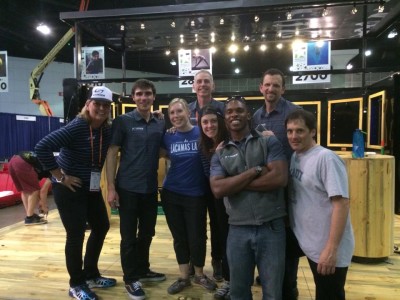
Early Thursday morning the Stages Education/Presenter team of Cameron Chinatti, Pam Benchley, Dunte Hector and I arrived at the Stages booth long before the rest of the team to discuss how we were going organize and present our early morning workouts. The Thursday morning workout was going to be for just the Stages team. The bike was so new that most of the team had never ridden it and we wanted to give them some saddle time as well as an opportunity to ride together as a team and burn off some of the pre-launch anxiety. This a very fit and competitive bunch so when you include the accountability of power and the ability to race with technology like Performance IQ you can expect to see some superhuman efforts. Some of our team ended up laid out on the floor recovering from max efforts, it was so much fun. After the ride we all gathered together for for short talk with our owner Jim Liggett. Jim spoke about the long process of building and bringing this bike to market. He also spoke about how hard it must have been for each of us to keep this amazing new product a secret for so long and that now it was our time to climb to the top of the cycling world, to show the world that we believe we have built the best indoor cycling bike in the industry. It felt like we were “popping the cork”, all that pent-up energy was about to finally be released. We all excitedly rushed back to our hotels to get cleaned up and ready for “The Show”.
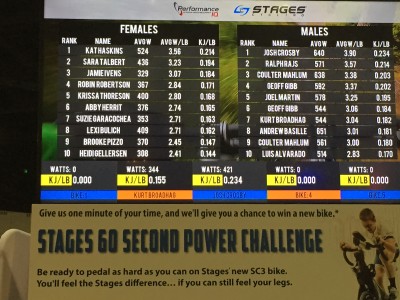
The doors opened for the IHRSA attendees at 10:00am and the rest of the day went by like a blur. So many people, so much excitement, so much energy. We were't sure what to expect, but the positive feedback was so much more than expected. People loved the bike! The team at the Stages booth included the engineers who built the bike, the sales people who sell the bike, the education team who teach on the bike and the owner who paid for everything. There was not a question asked that could not be answered. Our marketing team also came up with a brilliant idea to keep the buzz around our booth throughout the day, The 60 Second Challenge! This challenge was very simple. The convention attendee, male and female, who could produce the highest 1 minute average wattage handicapped by weight (watts/kg or watts/lb) would win a Giant bike complete with a Sages Power Meter. Every few minutes we had attendees stepping up to the challenge and the entire Stages team, equipped with cowbells and clappers cheered them on, this made for a huge crowd around our booth for the entire day. By the end of the day we had all lost our voices, our feet were hurting, we were tired, dehydrated and hungry but we loved every minute of it and all agreed the day was a HUGE success. After a bite to eat and a few celebratory toasts it was time for bed. Tomorrow we had another early morning and the eduction team had two sold out early morning workouts to show the world just what could be done on these new bikes.
Cameron, Pam, Dunte and I were once again some of the first exhibitors to enter the convention hall. We knew this was a big day for all of us, this was our chance to show all the industry decision makers how this new bike was going to change the way people looked at indoor cycling and especially how to use power to create a fun and effective class experience. Our classes were a huge success, we did some basic sets and drills that showed everyone the special features of the bike, but we also included some relay races that got everyone really fired up and pushing it. Our two classes were sold out, but we also had at least 30-40 more people just observing the workouts, all in all we felt like the morning was another huge success. After a bunch of high fives and hugs we ran back to the hotel to shower and get ready for another day of proudly showing off the bike we believe will change the way we look at indoor cycling.
Friday was much like Thursday, lots of 60 Second Challenges and short demos, but it was a little slower and that gave me some time to explore the rest of the exhibits in the convention hall. I work for Stages Indoor Cycling but I teach indoor cycling at multiple locations and on many different bikes, though I would love it for all the facilities I instruct at to to purchase the new SC Series bikes I also know this is not a reality and this was my opportunity to check out the changes each manufacture was making to their bike. The changes I found were subtle but welcome like console improvements, handlebar shape, belt drives and pedals. The one technology that most every manufacturer was embracing is heads up displays like Performance IQ and Spivi. I believe this is the next “Big Thing” in indoor cycling and in a future post I'll write about my experience with Performance IQ at CB Cycle Barn.
As the show wound down we awarded Josh Crosby and Kat Haskins The 60 Second Challenge winners performed our last few demos for prospective buyers or other exhibitors who where only now getting a chance to check out our bike. It was now time to break down our booth. Many companies call in a group of laborers to do the grunt work for them, not the team at Stages, we all put on our work gloves and got busy. After about 3 hours the stage, booth, bikes and everything in it was packed up and ready to go to the next show and we were all ready for dinner and drinks.
My first experience at IHRSA as an educator/presenter was not all glamor and glitz, but I wouldn't change a thing about it. I'm so excited to part of the Stages team that is so passionate about cycling both indoors and out and to be working in an industry that has to the power to change lives every day.
Which also happens to be the National Flag of Romania
PROFILE DESCRIPTION
This profile is an introduction to effort management that can be delivered by any indoor cycle instructor simply by relating effort to a color through the use of verbal descriptors.
OBJECTIVE
This profile introduces to our riders the concept that heart rate and breathing change with exercise intensity. That these changes are sensed by comparison to verbal descriptors and are related to a simple color coded three zone aerobic exercise system called ZONING.


 What if you could get inside the minds of your students? It’s common to hear compliments from your regulars about what you are doing well, but what about the students who come once and decide never to return? Last week, we explored the importance of preparation, which opened up a great discussion about our responsibilities and how much is too much to expect of the instructor. This week, we'll examine a different type of rider and a different type of issue.