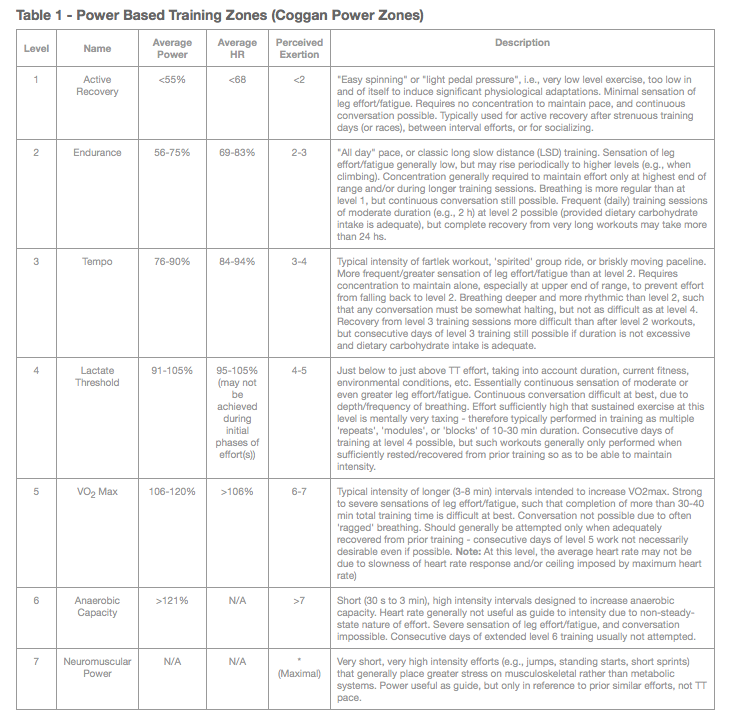
I have been receiving an incredible amount of positive feedback about these progressive profiles, so I have decided to provide ICI/Pro members with two profiles per week starting in September. In order to keep it Simple and keep it Progressive I'm going to provide a profile every Wednesday that focuses on intervals that are @ or Above Threshold (Zones 4,5 and 6) and on Saturday or Sunday I'll post a profile that focuses on intervals that are @ or Below Threshold (Zones 2,3 and 4). Heart Rate, Power and RPE zone descriptions are available below.
Through my years an endurance coach and indoor cycling instructor I have seen my athletes and class participants make great gains by following a progressive program for 3 weeks then using the 4th week for recovery or a “free” or non-technical workout. In order to stick to this plan I'll be providing 3 weeks of @ or Above Threshold workouts followed by a “Free-For-All” workout. I'll also be providing 3 weeks @ or Below Threshold workouts followed by a FTP (Functional Threshold Power) or FTHR (Functional Threshold Heart Rate) workout. I believe the testing profile is VERY important to show riders the gains they are making as well as finding new and REAL numbers to work with for the next month.
Most, but not all, weeks I'll also be providing a 65 minute mixed music set that can be used with these profiles.
Below you'll find Week 1 of September's @ or Above Threshold Keep it Simple and Progress indoor cycling profile.
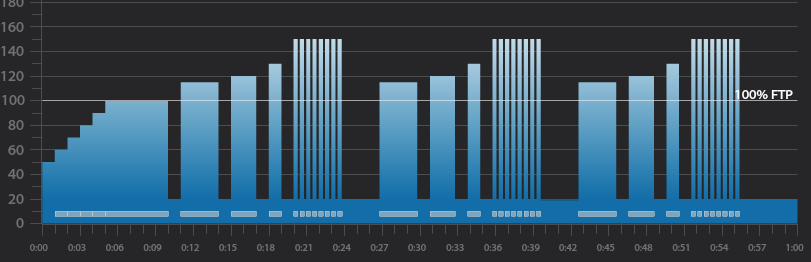
Workout Basics:
5 minute warmup
5 minute benchmark ride to find “Maximum Sustainable Wattage”
1 minute recovery
3 minute interval
1 minute recovery
2 minute interval
1 minute recovery
1 minute interval
1 minute recovery
Tabata Interval 8×20 seconds with 10 seconds recovery after each
3 minute recovery
Repeat the above 3,2,1 minute intervals 2 more times
5 minute cool down
5 minute “Maximum Sustainable Wattage” Test
Settle in to a 5 minute interval at 80-110 rpm.
This interval should be ridden at a maximum sustainable intensity.
if riders know their threshold they can spend this 5 minutes riding at it.
At the end of the interval take note of average wattage or HR or be aware of the RPE.
3 minute interval goals and specifics:
Ride for 3 minutes Seated at 80-110 rpm.
Complete the interval with an average HR or Wattage that is greater than the 5 minute “Maximum Sustainable Wattage” Test
1 minute recovery or reset
2 minute interval goals and specifics:
Ride for 2 minutes Seated at 80-110 rpm.
Complete the interval with an average HR or Wattage that is greater than the previous 3 minute average.
1 minute recovery or reset
1 minute interval goals and specifics:
Ride for 1 minute seated at 80-110 rpm.
Complete the interval with an average HR or Wattage that is greater than the previous 2 minute average.
1 minute recovery or reset
Tabata goals and specifics:
8 x 20 seconds “ON” w/ 10 second rest
Ride the 20 second intervals in a seated position at 80-110 rpm. Rest in a standing position
3 minute recovery or reset
3 minute interval goals and specifics:
Ride for 3 minutes standing at 60-80 rpm.
Complete the interval with an average HR or Wattage that is greater than the 5 minute “Maximum Sustainable Wattage” Test
1 minute recovery or reset
2 minute interval goals and specifics:
Ride for 2 minutes standing at 60-80 rpm.
Complete the interval with an average HR or Wattage that is greater than the previous 3 minute average.
1 minute recovery or reset
1 minute interval goals and specifics:
Ride for 1 minute standing at 60-80 rpm.
Complete the interval with an average HR or Wattage that is greater than the previous 2 minute average.
1 minute recovery or reset
Tabata goals and specifics:
8 x 20 seconds “ON” w/ 10 second rest
Ride the 20 second intervals in a standing position at 60-80 rpm. Rest in a standing position
3 minute recovery or reset
3 minute interval goals and specifics:
Ride for 3 minutes Seated at 60-80 rpm.
Complete the interval with an average HR or Wattage that is greater than the 5 minute “Maximum Sustainable Wattage” Test
1 minute recovery or reset
2 minute interval goals and specifics:
Ride for 2 minutes Seated at 60-80 rpm.
Complete the interval with an average HR or Wattage that is greater than the previous 3 minute average.
1 minute recovery or reset
1 minute interval goals and specifics:
Ride for 1 minute seated at 60-80 rpm.
Complete the interval with an average HR or Wattage that is greater than the previous 2 minute average.
1 minute recovery or reset
Tabata goals and specifics:
8 x 20 seconds “ON” w/ 10 second rest
Ride the 20 second intervals in a seated position at 60-80 rpm. Rest in a standing position
Cool Down
[wlm_private ‘PRO-Platinum|PRO-Monthly|PRO-Gratis|PRO-Seasonal|Platinum-trial|Monthly-trial|PRO-Military|30-Days-of-PRO|90 Day PRO|Stages-Instructor|Schwinn-Instructor|Instructor-Bonus|28 Day Challenge'].
Trainer Road Profile (If you're Trainer Road Member join my Team to get this and all profiles)
Let me start with a clarification. This post is not about missed business opportunities or client fees. It’s about the disappointment of not getting to serve prospective clients with needs that were tailor-made for my expertise, for one reason or another.
Helping people get results is something I’m committed to doing. Not to be able to do so when I know how effectively my guidelines and suggestions could turn things around for them is disappointing, even frustrating.
Here are a few examples. Maybe you have a few similar examples of your own, participants who dropped out before they could benefit from your program.
Missed Client #1
A self-described sugar addict contacted me to schedule an appointment. During the appointment, she revealed her health and mood issues. She had many.
In general, clients like this don’t actually have 100 things wrong with them. More typically, they have one or two underlying problems that may manifest through multiple signs and symptoms. In this woman’s case, it seemed obvious that how she was eating was the cause of virtually all of her problems. I was certain we could have effected a dramatic change in her health and wellbeing.
The appointment was scheduled for an hour, but I let it run about 45 minutes over that because she seemed to need to talk. By the end, I was quite pressed for time, so I made a single, easy-to-follow food suggestion. I then sent her a carefully outlined plan of how we’d work together.
Her reason for not working with me was the cost, no chance to discuss payment options.
Missed Client #2
Clients who’ve had success with my system refer others to me, which I greatly appreciate. Yet sometimes I don’t get a chance to work with those referrals.
One successful client was able to bring his diabetes, erratic glucose, high triglycerides and high blood pressure under control by following my guidelines.
He wanted his friend, also diabetic, to get similar benefits, so he told the friend about me. Unfortunately, he added, “She’ll tell you to stop eating sugar.”
The friend’s response was, “I’m not ready to do that,” and that was the end.
In actuality, I would never tell a new client to stop eating sugar. There are quite a few steps I’d have him or her take first before we even looked at any sugar problem.
Could I have helped this diabetic gentleman? I have absolute confidence that the answer is “yes.” But I never even met him so it was a non-starter.
Missed Client #3
Carol (not her real name) recently signed up on my website for nutrition coaching. She described her problem in ways that I knew would respond to my system:
– negative reactions to sugar and white flour
– powerlessness over those foods
– a pattern of skipping meals till she was starving
– symptoms of ADD, anxiety, persistent fears, negative thinking, irritability
– a possible learning disorder.
“I always feel like I’m hanging on by a thread,” she wrote. “I’m 49 and OVERWHELMED.”
The items on her list would have responded extremely well to changes in food — and the results could have been life changing. I contacted her initially by email, and followed up with a phone call. She never replied.
These are only a few examples out of many, sparked by year-end ruminations. If I hadn’t had such success with other clients this year — and believe so strongly in what I do — it would matter far less.
Maybe you specialize in power training, or functional strength training on the bike. Maybe you’re a superb personal trainer in addition to being a superb indoor cycling instructor. Maybe you’ve had similar disappointments with some of your participants.
End-of-year disappointments aside, what’s great about what we do is the number of people we do get to help — and that, of course, is the best thing to focus on for the holidays, and going forward into the new year.
Following up on the topic of winging it… reposted from April 9 2013 – John.
What if you could get inside the minds of your students? It's common to hear compliments from your regulars about what you are doing well, but what about the students who come once and decide never to return? Imagine that you are unpacking your gym bag after class. There is a note sitting on top. It says…
Dear Instructor,
I regularly take your Thursday class, which is scheduled to begin at 5:30. Every week, before I can even consider coming to class, I must pack my gym bag on Wednesday night, arrive to work early on Thursday morning, and arrange for someone else to get my kids from school. But that is just half of it. To actually participate, I must also leave work early, fight downtown traffic and get in line before the rest of the people who want to ride too. To say that I put a great deal of effort into being on a bike each Thursday is an understatement.
Last week, you arrived in the studio at 5:33. Class did not begin until 5:41, but it ended promptly at 6:25. In the 44 minutes of riding we fit in, you interrupted or skipped the music 4 times. You changed your mind about what we were doing 3 times. You made 6 excuses and gave 0 apologies.
I could understand if once you ran late or had a mishap with your iPod. But this has happened before. It is becoming evident that you do not care about your class as much as I do. I have to work my butt off just to be there, so I find it upsetting that you don't put any time or thought into planning. I don't think I am asking too much when I say, please do not come to class unprepared. It is frustrating when I have worked so hard to beat traffic, but you arrive late. It is insulting that you are still arranging your playlist during the warm up. And how can this workout be effective when you change the plan (if it can even be called that) whenever a new song comes on?
You should know that you will not be seeing me in your class in the future. I will be contacting management to explain my concerns. I have to show up to my job prepared. Is it too much for you to do the same?
Sincerely,
Prepared Patrick
This is an example of a pretty serious student who has particular needs and high expectations of his class. Are his concerns valid? How would you recommend this instructor respond?
John, I'm still confused by this power stuff… where should I be riding? How many watts should I be seeing on my monitor, because I'm no where close to my body weight?
I get questions similar to this frequently from members. My answers has evolved over time:
I used to give into the pressure; “please tell me a number” and would throw out a vague target – “your first goal could be seeing watts equal to your your body weight”.
Later I revised it down a little; “what would be your desired, lean body weight?” “Let's try to reach that as an early power goal.”
But now I'm learning that throwing out watts = body weight (lean or actual) isn't as helpful as I intended. Sure for some it works. Those who are reasonably fit looking (read not overweight) and with a good fitness base. For others I've found I was asking them to work too hard, using a kind of formula that wasn't personalized for each individual. Which sounds is a lot like using the 220 – age for MAX HR 🙁
Now my preference is to conduct a short “Best Effort”, about a quarter of the way through class, to give everyone an understanding of a number they can work from. Not a true FTP or PTP, but it's been reasonably well accepted… but not by everyone.
Case in point: last Thursday after class I had the “how many watts should I be making?” discussion with a female member. She's a fit 50 year old and I would guess (I never ask) she weighs about 130lbs.
So I asked her what she normally sees during the “Best Effort” interval. “I average about 80 watts.” Which confused me… a lot actually. I would have guessed she could easily make more than 80 watts. I was stuck for an answer. Rather than guess at the reason, I started asking questions:
Do you ride outdoors? No, not regularly.
Are you a runner? YES!! Big smile.
How would you compare running vs. cycling? Cycling is much easier. I'm getting to something here…
Do you run in competitive events like a 5k, 10k, Marathon, etc…? Another YES !!! I love to compete!!!
Do you run faster & harder in a 5k vs. a Marathon? Yes, of course I do – why?
When you're riding in here with me, does your “Best Effort” feel more like a 5k or a Marathon? She stopped to think about it and then said; like a Marathon.
Bingo!
I didn't need to say anything more. The look on her face told me she understood exactly where her confusion was coming from. Her perception of working hard was at her Marathon level of intensity = 80 watts was exactly right, figuring an aerobic level of effort. I had been making the assumption that when I asked for hard, everyone would work at the level I perceive as “hard” – which for her was different.
She ended the conversation with; so when you ask us for our “Best Effort”, I should be working at my 5k level of effort?
Exactly, or maybe a 5k where you're chasing one of your faster friends 🙂
Instructor Kathy Palkaninec contributes The Vicious Cycle, her Audio PROfile which was one of the winners of our Ultimate Instructor Class Profile contest.
Kathy teaches at MindBody Trendzin Cooper City, FL and she begins her profile like this:
Objectives and Interests:
This ride was created after researching metabolic conditioning sequence and how to burn stubborn body fat. I found the Ultimate Cardio Sequence by Shaun Hadsall. His explanation and sequence based on science inspired my “vicious cycle”. The name of the game is Intensity first. The protocol of this ride is based on the following: Once the heart rate is elevated in the warm up, the training goes into the “fight or flight” mode with short intense bursts over and over.
The Catecholamines are the hormones released by the adrenal glands in response to stress. Being part of the sympathetic nervous system they force the release of free fatty acids into the blood stream. These short bursts will create the famous” after burn” that can potentially increase metabolic rate up to 48 hours after exercise. Science has proven that free fatty acids do pour into the bloodstream after such high intensity training. However, research shows that these fatty acids, if not removed from the blood stream, will move to another place in the body and again re-store as fat.
For years I have taught classes that were physically challenging to participants but when I started to bring more than the Physical Dimension of Wellness to my classes, MAGIC HAPPENED.
Dr. Bill Hettler, the co-founder of the National Wellness Institute (NWI), created a model named, The Six Dimensions of Wellness, in 1976. His idea of Wellness was not merely just the absence of disease, but living a life in which you become more aware and make decisions towards a more successful existence.
The dimensions from Dr. Hettler’s model are;
Physical
Social
Intellectual
Spiritual
Emotional
Occupational.
These 6 Dimensions when fully obtained can be thought of as a wheel, the more full your wheel is the better life may be, the less full the wheel is the harder life may be. Knowing this as a Fitness Professional, I made it a point to bring more than just the Physical Dimension to each of my classes and saw an improved mood and performance from members.
Below are a few ways to implement some of the Dimensions of Wellness into your classes and getting your participants to living more successful lives!
Social Wellness: I start each of my classes by having participants near one another introduce themselves and share their goals with each other, during the Warm-up. This really creates a sense of community and connection that might not be there unless you initiate it to happen.
The first time I tried this in class there was a silent pause and a look of hesitation of those in the room. I quickly followed up my request by sharing a stat that I read in Forbes Magazine, stating that those who share their goals with others, are 75% more likely to accomplish those goals than those who do not. This lit the fire and soon my classes were celebrating each other’s successes and helping hold each other accountable.
Physical Wellness: During the class it’s crucial you create a sense of connection with the body, whether it is Heart Rate, Perceived Exertion, or simple stating where and what they should be feeling. This help will get your participants engaged and understanding what’s happening PHYSICALLY rather than just going through the motions.
Whenever you get a chance during your classes, tell your participants exactly what they should be feeling so they know they are accomplishing the goals you have set.
For example, when I am teaching a Standing Attack Drill, I will prep the class by saying, “think of the word ATTACK, it’s strong, it’s powerful, and it’s aggressive! If you attack with those words in mind, your legs will start to warm, your breathing will become heavy, your heart rate will rise and when you finish this attack, you will be breathless and that much harder to beat! Let’s Roll!”
Your riders will now be able to connect with physical signs and feedback from their own bodies, which will be a great way to keep them engaged and working hard no matter if they are a beginner or a well-seasoned athlete.
Emotional Wellness: Towards the end of classes, I usually have a track where I give full control to the riders. I have a set directive for the drill and try to evoke an emotional attachment to their work effort and goals. I will ask again and again, “Is this the best you can do? Is this as hard as you can work, if so KEEP GOING, IF NOT MAKE THE CHANGE! BE BETTER!” I try to create a sense of pride and worthiness to their work and show them not just how PHYSICALLY strong they are but EMOTIONALLY.
This is all about song selection and coaching. The best example I can give that I use in my classes is the song, Breakn’ a Sweat by Skrillex & The Doors (Zedd Remix). The drill is simple; it’s a seated climb up the hill that scares you, the one you can BARLEY make it to the top of, the hill that when you get to the top, you feel victorious. The gear choices are up to you but the RPM’s must never go below 65. Ever rider will have a different idea of what this hill looks and feels like. It then becomes the instructor’s job to coach their team of riders up this hill and make them believe every second of the way that they can do it.
Spiritual Wellness: Finally at the end of class, during the Cool-Down, I always have participants turn to their neighbors and give them a good-job or some words of praise for their work. The Cool-Down to me has 2 parts to it, first to bring recovery and relief to the body through a controlled ride and stretches, and second to feel a strong sense of pride for the effort and work they did during class.
As soon as the last beat drops and the work part of the class is over, I always tell my class to turn to their neighbors and commend them for their effort during class. I also always make sure that the song or songs that I use for Cool-Down provide motivation or inspiration, like the song, I Lived, by One Republic. The lyrics talk about taking chances and, my personal favorite, OWNING EVERY SECOND! As the leader of your class, assure your team of riders that the effort they put in is one they should be proud of and feel good about.
Since the implementation of these techniques I have seen a steady retention and full classes. When you start to introduce these Dimensions into your classes, be authentic and go in wholeheartedly, and you too will see MAGIC HAPPEN!






 Following up on the topic of winging it… reposted from April 9 2013 – John.