
by John | Jun 13, 2014 | Instructor Training, Music

You haven't heard it yet, I just finished recording an interview with Stages Indoor Cycling's Master Trainer Cameron Chinatti where we discuss participant evaluations; your riders telling you what you are great at and what you need to improve on. I know that at times I over communicate, cuing everyone on things they've heard multiple times before. Trust that they'll know what to do and let them do it.
This week's track, a remix of Ellie Goulding's How Long Will I Love You is one you don't need say anything over. If you listen carefully there's a subtle plug for us dads – fitting as Father's Day is this weekend.
I'm thinking it could be perfect as a second track, following your intro. Turn up the volume and ride 🙂
https://soundcloud.com/henry-krinkle/ellie-goulding-how-long-will-i
Here's an alternate version that may fit as well.
https://soundcloud.com/unitedubstep/ellie-goulding-how-long-will-i-love-you-aznar
The original could be your closing track… or this version if you need a bit more intensity. Click over and like their FB page – then scroll down for the free track.
https://soundcloud.com/solarheavy/ellie-goulding-remix

by John | Jun 13, 2014 | Instructor Tech Help, Instructor Training, iTunes & Spotify Training, Music, Spotify

Does Spotify seem to take forever to load on your iPhone? Did it close abruptly (crash) when you hit ‘play', act sluggish or is just not as responsive as when it was new? It may have bonked. Here's how to nurse your prized device back to life…
Wikipedia describes bonking as
In endurance sports such as cycling and running, hitting the wall or the bonk describes a condition caused by the depletion of glycogen stores in the liver and muscles, which manifests itself by sudden fatigue and loss of energy. Milder instances can be remedied by brief rest and the ingestion of food or drinks containing carbohydrates. The condition can usually be avoided by ensuring that glycogen levels are high when the exercise begins, maintaining glucose levels during exercise by eating or drinking carbohydrate-rich substances, or by reducing exercise intensity.
Your iPhone, or other portable device, can experience the bonk as well. No, not because the battery is low, or you haven't fed it enough GU, but from a depletion of available system memory (RAM – Random Access Memory). This results in slow operation, freezing / crashing Apps and mysteriously frustrating actions that have you wondering why you're not using CD's anymore 🙁
Two types of fuel
As a fitness professional you no doubt are aware that your body stores two types of energy; sugars (glycogen) and fat. Regardless of your fitness level, during a long period of exercise the limited amount of stored glycogen you have is consumed. If you don't eat carbohydrates before they are exhausted, you'll bonk. Interestingly, your body can't access the energy in your stored body fat quickly enough to prevent bonking, even though you have all the fat calories needed to keep you going for days. Yes, with proper training you can improve fat usage, but watch the Tour de France next month and you'll see very fit cyclists eating frequently during each stage.
The energy that fuels your iPhone is memory:
- System memory (RAM) which runs all of the phone's operations – a small amount @ 512MB (one half GB)
- Storage memory – that's the amount of memory you choose when you bought your iPhone; 8GB, 16GB, 32GB, etc… that holds your offline Spotify music files, iTunes tracks, videos and pictures.
Your iPhone bonks when it runs low on available RAM – none of the 32GB of storage memory you paid extra for is available to help out. You don't see it, but there are a bunch of processes running continuously on your phone, eating small bits of RAM. Typically this happens when you have multiple Apps running in the background or you have too many Apps looking for updates (push notifications) or GPS location updates. You can't add any additional RAM – so the solution to prevent bonking is to free up RAM – by closing unused Apps and turning off unneeded functions will free up some additional memory.
Step one – Close Unused Apps
Did you know that clicking the Home button doesn't actually close an App? It doesn't. There's a good chance that every App you've ever downloaded and opened is still quietly running, consuming the much needed RAM to run Spotify properly. Powering down your iPhone doesn't close them either – each App needs to be closed manually.

Double click the home button and then swipe up to close Apps.
Here's how…
- Double click the ‘Home' button quickly and you'll see thumbnails of the Apps currently running.
- Scroll left/right to select an App to close.
- Swipe the thumbnail up to close it – there's no reason not to close all of them.
Step two – Do you talk to Siri?
Besides it being annoying, Siri is a bit of a RAM hog. If you're not on speaking terms, turn her off. Settings>General>Siri
Step three – Reboot Regularly
Whenever you're tired, does it seem like your mental processor doesn't operate as sharply as it does after a good night's sleep? After a long day your brain's RAM has a bunch of “stuff” running in the background that it collected during the day; problems at work, anxiety about a future event, what to get your dad for Father's Day… stuff. The best way to clear it is an 8 hour horizontal reboot.
Computers are no different. They collect “stuff” as they work, reducing the amount of RAM needed for Spotify to crossfade between songs. NOTE: cross-fading streaming tracks is actually a very neat (and memory intensive) trick.
So when was the last time you powered down your iPhone and give it a rest? I've asked people this question and mostly been told that the only time they've rebooted their phone is when the battery goes dead. Same goes with your computer, Mac or PC – they all benefit from regularly being turned off. Wait until it has completely powered down and then bring it back to life 🙂
Step four -Turn off unneeded services
Every neat little thing your iPhone does requires RAM…
- Do you really need to instantly see every new FB comment displayed on your home screen? Turn a few off: General > Settings > Notification Center.
- Location tagging is a bit creepy. Does Shazam really need to know where I am? I don't think so. Turn off all of the nonessential location tags: General > Settings > Privacy > Location Services and scroll down to see who's tracking your location. I only have Facebook (for checking in) and Google Maps turned on.
There are multiple ways to reduce RAM usage beyond this list – these should be a great start to prevent your iPhone from bonking anytime soon!
by John | Jun 11, 2014 | Instructor Training, Spinning Class, Training With Power
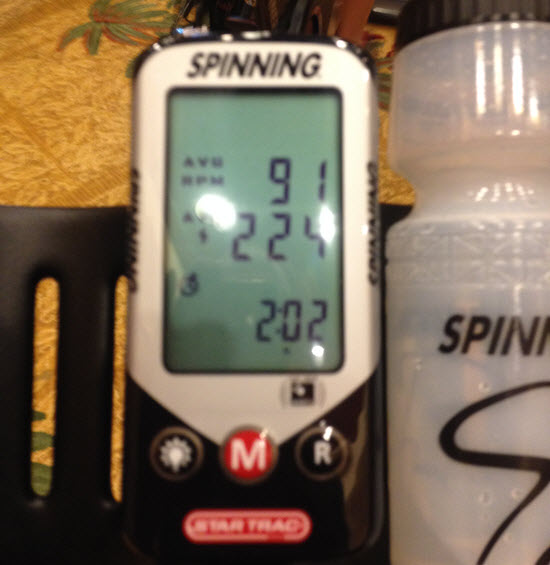 At WSSC I had the opportunity to complete a PST (Personal Spinning® Threshold) test – which is (their words) the key to Spinpower success. I couldn't agree more as knowing your maximum sustainable power or Heart Rate, and then building training zones around a known metric BPM/Watts is crucial to effective training. Here's some notes on this session and the discovery process MI Janet Toussaint lead us through to determine our Personal Spinning® Threshold.
PST is something we can change
Janet's session included a lecture period before we climbed on the Blade Ions for the PST test. During her presentation she made three very profound points that I feel are important for anyone teaching with power, to convey to their participants…
- It is possible to change/raise/improve your PST. You maybe familiar with the statement; if you can test it you can improve it. In the past the Spinning program was based on Maximum Heart Rate – a number that doesn't change no matter how hard you train. Yes you can become more efficient at Fat utilization, except that's difficult to measure without a metabolic cart. Sustainable power at threshold (PST) is something you can easily see changing and that can be very motivating.
- PST is based on Maximal Efficient Effort – key word being efficient, as in where efficiency drops off during the graded intensity ramp test. This isn't a test where COME HELL OR HIGH WATER I'M GOING TO PUT UP THIS HUGE WATTAGE NUMBER!!! Janet made the point a number of times that you have to be careful not to let these assessments become a competition, where people are trying to prove something.
- Your PST is specific to this sport – actually Angie Sturtevant made similar statements. The wattage you see as a PST only applies to a Spinning class – not your road bike with a power meter. I would add that it also only applies to the specific brand of Indoor Cycle.

I snapped this picture showing the ramp test protocol used to asses the PST used to create the 6 power zones in the SpinPower program.
Constants and Variables
The constant during this test is cadence/RPM which doesn't change during the test. Janet suggests you not mandate a cadence, instead ask every one find “where they hang out” = natural cadence. What will vary will be the amount of resistance, and the resulting changes in HR and perceived exertion/RPE.
- Start everyone warming up in zone one, finding that natural cadence for 10 or more minutes. Include a few brief accelerations – but not too intense or long.
- Every two minutes you'll add resistance / ramp up. How much? Janet recommends 10-20 watts from women and 15-30 watts for men.
- After you've added the new ramp, push the reset button to record your average for that ramp – remembering the previous ramp's wattage.
- When you can't maintain your cadence, for the whole two minutes, you're done. Your PST is the watts from the last fully completed ramp.
- How many ramps is the right amount? Janet explained that there is no “right amount”. You need to run the assessment until everyone has completed the test. There were some questions about this and it sounds like you should see at least 4 ramps until failure. Less than that probably means that the rider is adding too many watts with each ramp.
My experience during the test was as I got closer to PST, I wanted to reduce the size of each ramp's increase. I also knew very quickly when I wouldn't be able to finish a ramp. My numbers are in the image above. I couldn't complete my last ramp of 240 watts, which actually isn't that far off what I'm used to seeing as my threshold on the FreeMotion bikes I teach on at Life Time.
Thinking about conducting an assessment like this in your class? I would suggest that you practice on yourself first, so you understand what your riders will be experiencing.
If you are teaching on Spinner Blade Ions I would love to talk to you. Please contact me.
by John | Jun 9, 2014 | Instructor Training

Yes, he's a marketing tool 🙂
Question sent in from a future Spinning® studio owner.
Hi John,
I was wondering in all your travels have you heard of an indoor cycling studio that has done research on what are the best marketing tools for a new studio? There are so many. I think my marketing list contains around 45 different ways to market a business. It would be cool and cost effective to know which marketing tool brings awareness to a fitness business as this. If I had an answer to that I would obviously strategize to put more capitol towards the tool that brings the business. We have different ideas on how to market initially using promotions/discounts/etc. We don't plan to open our studio until late summer and we just found out that another studio is going in the next town to us approximately 3.5 away.
Any input would be appreciated.
Thank you – Nancy
Nancy provided me some additional detail, explaining that she's waiting on some local permitting approvals. Once they're cleared she's purchasing a room full of Spinner® Blade Ions. She's installing Performance IQ and LiveEdit is building her website which will integrate with MindBody, provide the bike reservation system and deliver all of the performance metrics to each rider.

I passed Nancy's question on to our resident marketing expert, Courtney Lee for here thoughts. Here's her response:
While I haven't heard of any research on what is best these are some of my initial thoughts and things I would do if I were opening my studio. Social media is great but should be a complimentary tool to more brick and mortar approaches at first and then you can switch over to social media more when you're following is in place and actively engaging.
- Try not to discount the actual price as that can discredit the value – instead word it such as “Bring a Friend and You RIDE FREE – a $30 value” or something like that. “Buy 10 Rides & We'll add a bonus Thank You Ride for FREE (a $30/value)”
- Social media is excellent, HOWEVER, we can not count on Facebook to deliver our message to everyone without paying to play essentially. Think direct – is there a local bike shop, coffee shop etc where the target market hangs out? Get in there and connect, offering a SELECT few a VIP Ticket (again – stating the value on it) to the first ride. You're creating exclusivity by offering VIP tickets and making it feel like a big event (which of course it is!).
- Highlight your “difference maker” from the competition. Do you have extra showers? A super easy booking system? Member perks at local businesses (where you swap discounts for say the employees of the coffee shop and they do the same for you etc).
- Depending on the geographic area a direct mail post card may reach the most households for the most cost effective price. List your highlights here and also say something like only 40 VIP seats for the first ride event – CALL TODAY! Then talk about the VIP event and all the things you'll have. Spend some budget and have these professionally designed – it's your image, the first impression! Typically around $50-$120 for design depending on hours spent in proofing.
- Create a big open house style event where you find the locals who are well connected in the community. Host a special pre-opening screening for these people and make it amazing. Let word of mouth do the best advertising for you. Create a swag bag for attendees where they could receive 5 complimentary guest passes – have their names on them so you can track the success.
- If you don't already have them – invest in some large window signs and/or decals saying you're coming. Create the hype – be different – get noticed. I would also add that the signs include We're Hiring Instructors! John
- Create strategic relationships with other small business in the area. Have them promote you and talk you up to their clients. Once you open you can return the favor.
- Remember, go direct to the source. If you're target audience is moms, find a local moms group – sponsor one of their events, offer to give a presentation on fitness for moms. Then mention the daycare room that your facility has – and that it's FREE – your 930am, classes will be packed 😉
- If you've got an awesome logo have some inexpensive car window decals made and hand them out to your friends, potential clients. Any promotion of your logo is a good thing at this point!
If I had to pick two things I would go with the direct mail post card and the partnerships with other surrounding business.
Hope that helps – I may get a few more as the coffee kicks in 😉
I would add that the key to any form of marketing is consistency – there's a reason you instantly recognise the Geico Gecko – you've seen multiple Gieco Insurance commercials featuring his humorous exploits. So I would consider who my target market will be (think focusing on small niches) as Courtney suggests, pick a few tools and them stick with them.
What's worked for you?
by Joan Kent | Jun 9, 2014 | Engage Your Students, Health and Wellness

By Joan Kent –
As you’ve no doubt heard, saturated fats are no longer considered the health problem they once were. It turns out that the connection between saturated fats and heart disease, cholesterol, and atherosclerosis is far weaker than we thought.
These days, everyone is pointing to sugar, and blaming sugar for the very health issues that used to be blamed on fats — the diseases above, as well as hypertension and more. Those health conditions have more to do with inflammation. And sugar and other highly insulin-triggering carbs promote greater inflammation than sat fat.
No argument from me, of course. I’ve been blaming sugar for those conditions for over 20 years and have written a number of posts on those very subjects.
The main difference lies in the huge number of arguments I used to get, compared with how few I hear now. In 1996, for example, I recall participating in what I was told would be a “panel discussion.” (I was lied to about the format. It turned out to be a debate, and I was up first so the other speaker could have the last word. Ah, memories!) Anyway, the other speaker stood up at one point, held out his arms like an orator and intoned in his deepest horror-movie voice, “FATS ARE BAD!”
In the years since, I’ve sometimes wondered if taking such a hard line on a now-disproven point ever made him feel as ridiculous as he looked and sounded with his arms waving as he channeled Vincent Price. But I digress.
Currently, we know that unsaturated fats are associated with numerous health benefits. Omega-3s (polyunsaturates) are known for their anti-inflammatory properties. They’re cited for their ability to reduce the risk of cancer, the complications of diabetes, and the incidence of depression, bipolar disorder, dementia, and more. Omega-9s (monounsaturates) have long been credited with the ability to prevent and even reverse various heart disease risk factors.
Even saturated fats have their benefits. Butter and raw, organic coconut oil both contain lauric acid. Lauric acid has been shown to benefit hair and skin, and to have antiviral, antifungal and antibacterial effects. When it turns to ketone bodies, lauric acid can reduce epileptic seizures in children and improve brain function in Alzheimer’s patients.
There’s an interesting health point, though, that’s less widely known and differentiates saturated and unsaturated fats. Saturated fats have been shown to contribute to weight gain to a greater degree than unsaturated fats.
If weight management were always “calories in / calories out,” that couldn’t be so. All fats provide 9 calories per gram. But this has to do with hormones. Sat fats trigger insulin secretion, and unsaturated fats do not. Insulin is a fat storage hormone. Also, a combination of saturated fat and insulin-triggering carbs will promote a synergistic boost in insulin that neither would generate alone.
Yet to further complicate the issue, coconut oil appears to be associated with weight loss.
So what recommendations can we take from all of this? Well, nothing earth-shattering. If you eat saturated fats, eat the better kinds — organic coconut oil and butter, rather than bacon or battered, deep-fried foods. Let’s continue to go easy on the traditionally bad sat fats and the foods that contain them.
When I was a kid, every baked potato I ate was as bright yellow as a rain slicker because of all the butter I insisted on glopping on it. Sure, it might be less likely to give me heart disease than we used to be told, but it’s obvious that restraint and moderation might still be a good idea. And I don’t know about you, but the older I get, the more my hips and thighs demand that….
by John | Jun 6, 2014 | Music, Spotify

With younger daughter home for the Summer, it's not uncommon from me to get in my car and turn on the radio tuned to a foreign (to me) station. Great for accidental music discovery 🙂 Going through my tagged tracks this AM in Shazam and wanted share a few with you.
Let's start with the track Sleeper Agent — Waves from the band Sleeper Agent. I can't remember exactly where I was when I first heard it – I just know that I was calling up Shazam, thinking this would be a fun, fast flat with a fun Summer vibe that I felt me class would enjoy. It's on the upper edge of too fast @ 115RPM – do you thing your class could follow it and stay smooth?
Next is another flat from The Cab — Lock Me Up @ 95RPM. This song has a very powerful, driving beat that would make a fabulous 3 minute “Best Effort” opening threshold segment. Looking for a great “Big Finish” track? One Of THOSE Nights @ 105RPM plugged in at the end of your class will motivate everyone to leave whatever they have left there in your class, where it belongs, once they complete the final 20 sec sprint at the end. If you have time I'd spend some time sampling the rest of The Cab‘s albums – good stuff.
Deadmau5 — Seeya is also on the cadence edge @ 110RPM – have to use this because it's just awesome and at over 6 minutes, there will be suffering!
If you ride/work along with your class, this track as a great message about how you're all together until the top of this 70RPM climb Bassnectar — You & Me (feat. W. Darling)
Florence + The Machine — Dog Days Are Over isn't new – but I wanted to use it in my next playlist as soon as it came on.
https://soundcloud.com/partyben/florence-the-machine-dog-days-are-over-party-ben-utilitarian-remix
Do you have any recent discovery's you'd like to share?
