Image from http://wattbike.com/uk/guide/bike_fit/general_wattbike_cycling_position_and_setup
Myth #9 – Handlebar height isn't really very critical on an Indoor Cycle.
An alternative of this myth is; handlebar height should always be set to where it's most comfortable.
When the enemy is the wind… the drops are your friend 🙂
Every cyclist in your class knows how important it is to be as aerodynamic as possible. They realize that something like 80% of the energy needed for them to ride their bicycle on flat ground, at 20mph, goes to over coming wind resistance. Add a stiff headwind that has you wanting to crawl inside the paint on your bike and it's probably more like 100%… or more if that's even possible
Reducing your frontal area has the greatest impact on aerodynamics, smaller = better. So many cyclists have a goal to get as low as comfortably possible on the bicycle. In fact road bicycles have a special bend in the handlebars specifically designed to help a cyclist ride low & comfortably… the drops.
Trouble is that very few people use them because they don't have the lower back or hamstring flexibility needed to get low and stay there comfortably.
So why not help our cyclists to develop some additional flexibility… or maintain the flexibility they developed over the summer?
As a fitness professional you realize that gains in; strength, endurance and flexibility all come over time. Please forgive the pun here but any desired change will only come when we stretch beyond what is comfortable/easy/normal.
Indoor classes are the perfect place to work on flexibility for a number of reasons. The limited time (45-60 minutes) is long enough to help, while not as intimidating as the thought of committing to a 4 hour group ride with low bars.
Here's how you can help everyone get down low.
If your club has the Livestrong / Tomahawk Indoor Cycles you can encourage your riders to spend time in the drops.
Lead by example by keeping your bars low, demonstrating good form and then make mention that you are doing this on purpose to help increase your flexibility.
Encourage everyone to observe where they have their bars set and then ask the question; “would your outdoor riding improve if you could spend more time comfortably in the drops?
Use Periodization – suggest a series of small changes over time.
Consider partnering with a personal trainer to lead post class stretching that focuses specifically on the hamstrings and lower back.
Incorporate a short stretching segment into your class. Now that I'm teaching longer endurance classes I'll have everyone stop and stretch at the 15 minute mark when we are all warm – and yet not fatigued.
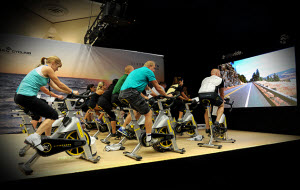
Video is taking over the world. Over 4 billion hours of video are viewed each month, and YouTube is the most-used search engine, after Google. Video is also changing indoor cycling classes everywhere. Like music, video engages our emotions. To reach a cycling audience with imagery and music creates a synergy that lifts indoor cycling to new levels.
Club owners seek something innovative. Cycling with video is enjoyable, entertaining, and a dramatic differentiation from the current indoor-cycling market. The number of emerging businesses that produce video attests to the impact it will have on indoor cycling.
As entertaining as video can be, however, the key reason people join clubs is to achieve their fitness goals and be educated in how to do that, not for entertainment.
Before writing the check, anyone investing in video programming must investigate the quality of education or coaching that accompanies the video product. This applies equally to live-instructor group classes and virtual group classes.
At ICG®, we believe it’s important to remember that video is JUST video. It’s an asset that can add to the indoor-cycling experience but will never dominate it. Even with the world’s best video, without proper coaching for the live instructor or excellent voiceover coaching in the virtual product, you’ll have:
Instructors continuing to teach to music only, or turning on the projector but never integrating video into their classes.
Virtually instructed classes projected to empty classrooms, and/or DVDs sitting unused in a box or drawer in the studio.
Quality instruction has always been the key to any successful indoor-cycling program. That won’t change with the addition of video. As long as facilities offer live-instructor classes, the instructors must first appreciate, and be energized by, what video brings to their classes. Once they support video’s benefits, they will sincerely recommend virtual programming — so long as that virtual class stands up to the quality of live coaching.
Bringing video to your cycling program is not a stand-alone purchase. Whether it’s to enhance live instruction, provide virtual classes, or both, it must be supported by online learning, as well as live education and training offered by your video provider.
Empowering instructors to use video in their classes demands technology that allows them to control the video as easily as they control their music. (DVDs just don’t make the grade in that regard.) It also requires an education platform that teaches them to integrate video readily into what they’re already doing — while producing a significantly enhanced experience for the members.
If a club offers both live classes with video and virtual classes, then the instructors must stand behind the virtual-class program and see it as complimentary to, not competitive with, their positions. Participants will typically follow the instructor’s lead. However, that alone will not motivate the members to participate in virtual classes.
For a workout video to compel people to train in a cycling studio with no instructor, the content can’t be good. It must be great. There’s no motivating instructor who knows your name, maybe no social interaction with other members. What works for a solo participant on a bike in front of a small screen may fail miserably in the group-cycling studio. This is even truer if the facility doesn’t employ instructors.
So the question is: What makes a virtual class compelling?
There are four dimensions to a successful virtual cycling class — Sensation, Flow, Challenge and Convenience.
Does the visual sensation grab attention? A compelling member experience must elicit strong, positive emotions. Is forward-motion video of beautiful destinations around the world more visually engaging than the world’s top master presenters sitting on bikes?
Does the workout flow? To be effective, a virtual class must be better designed than a live class. Members will come in and take an average class from a live instructor, but they won’t come in to take an average virtual class. Sound levels, content, matching voice and tone to the content, pacing — the sense of flow delivered through the interaction of voiceover cues and video must be better than with live instruction to be as effective.
Was the workout successful? The members will want to be physically challenged by the workout and mentally engaged by the information delivered. With no instructor and possibly no other members, what encourages the member to work hard? It comes down to quality recorded instruction, selection and use of music, music/video synergy, and editing.
Were the virtual classes offered at convenient times? Does the technology offer “auto” scheduling, where the virtual class and projector turn on and off at scheduled times? Dynamic club schedules that allow virtual classes to be easily added to, or taken off, the schedule based on participation will have a big impact on virtual programming success.
At ICG, we consider ourselves the leading authority in cycling with video. We believe indoor cycling is driven by instructor communication and motivation, plus social interaction. We believe instructors need education and training to integrate video skillfully and professionally into their classes.
We believe that virtual classes can rock and that instructors must support the classes.
Virtual classes must be visually stimulating. They must flow, provide a challenge, be offered at convenient times, and be better produced than a live class. We’re committed to developing better techniques and technologies to make future indoor cycling experiences more “real” as classes with video and virtual classes go mainstream.
Like always, there is no pat answer. It often depends on the instructor’s teaching style, the type of ride and the class’s expectation.
Teaching Style
I tend to break down the style categories as Coach, Trainer and Instructor.
The Coach is on the road with you, but is often not working at the same intensity because they are…well….coaching you. They are passing on wisdom, strategy and sports education while riders are pouring their guts out. To a cyclist, and those in the “cycling world”, this is very acceptable IF the “coach” actually knows what they are talking about, puts together a good workout, and can walk (or ride) the talk.
The Trainer is often focused on the here and now — “Let’s finish this interval…..Come on, you’ve got 3 more efforts to go….Don’t stop until you get to the top of that hill!” A trainer’s energy and motivation is not required from the bike, but from their direction and firm challenge to get the job done. It is acceptable for the trainer to be off the bike a good amount of the time as they instill determination (and fear) to drag every last drop out of their riders. Similar to the coach, the trainer needs to be the real thing. They are often sweating as they infuse energy into everyone within a 20-foot radius. It is tough work.
The Instructor is on the bike with their riders and usually suffering with them as well. They turn every pedal stroke, lead every charge and motivate by sharing in the pain. The instructor is often seen as one of the gang with the motto “we’ll get there together!” They are dripping in sweat (even the gals) as their breathy encouragement pushes riders to their limit.
So putting them in order of how hard they are working (on the bike), the Trainer is riding the least, the Coach is at a moderate intensity and the Instructor is at equal intensity with the class. All are absolutely acceptable. AND I would say that anyone teaching an indoor cycling class SHOULD embody the qualities of each of these styles and use them appropriately.
Type of Ride
Considering the teaching styles above, there would also be certain types of rides that would require more effort and intensity from the instructor. I may come off the bike during shorter interval-based workouts when riders could benefit from more personal attention such as helping them with technique. On longer steady-state efforts or long climbs, I may wander into coach mode (on the bike) to keep them mentally and physically engaged. On the hand, it would seem odd (at least to me) to be off the bike while teaching a virtual ride. It would be as if I was walking along the road as my class road by (unless of course I imagined I was Johan Bruyneel talking to riders from the team car….).
Class Expectation
In many respects, what the class expects is much a product of the teaching style and ride format you have established. If you want to find out if you are hitting the mark by riding at an intensity that is motivating, don’t only ask those that regularly attend your class. They are usually there because they like your approach. Ask the new riders what they thought. I would go as far as specifically asking if they prefer more of a Coaching, Trainer or Instructor led class and see how they respond.
Not So Inspiring (to me)
Of course, if you’ve got the above locked in, you are golden, but I’ve seen those that do not have the right teaching style for the job or are riding way too hard. The extremes would be the instructor who walks around the room in warm-up sweats holding a clipboard (trying to look like an athletic trainer), but lacks any energy or motivation. My knee-jerk reaction is to reach into my bag in search of my iPod and headphones. On the other end of the spectrum is the instructor that is working so hard that you can’t understand anything they are saying. They are even breathing hard during the recovery! This is distracting and detracting. I’m not getting good direction and the instructor appears more concerned with getting their workout than helping the class get where they need to be.
So, in conclusion, mix it up. Ask your class what they like and what inspires them. But above all, be genuine. If you’re trying to be someone you are not, it will stick out like a sore thumb regardless of whether you’re riding hard enough.
I was off to teach a class on Friday and always listen to my playlist on the drive over and all the songs were skipping. I tried rebooting my iPhone and still no luck. Luckily I had my iTunes playlist on my phone and did another profile for class. The problem is still there and the Spotify site is no help in solving this issue. Have you heard of this problem? I am ready to cancel my account …… Any ideas?
It sounds like these playlists haven't been set to Available Offline
Spotify works so well when connected to a wireless network you get the impression that all the music is right there on your device. Make the setting change shown here so your playlist is ready to play.
I recommend always turning your iPhone to Airplane Mode when you are teaching so your class isn't interrupted by a call.
Whenever I solve a problem for myself I stop and think, “I wonder of other Indoor Cycling Instructors have this same problem”. So I make a video to show you what I've done. Let me know in the comments if this was helpful to you. Here is the link to the free online calculator.
Master Instructor Tom Scotto ends the year with another excellent Audio PROfile. ICI/PRO members can look forward to another 12 NEW PROfiles in 2012.
“This is one of my favorite rides because it puts us under some “good” stress for long periods of time. We are going to be targeting a very uncomfortable level of intensity — just above our endurance effort and below the point we start to become breathless. It can be tough because, mentally we either want to shut it down or step on the gas and blow up. Neither is an option.”
“For those of us that know our thresholds, we are going to be working between ventilatory threshold 1 (VT1) and ventilatory threshold 2 (VT2).”
“Before you get prideful and think this is not going to be a hard ride, keep in mind that very little recovery will be provided in order to keep this steady level of stress on our body. Usually I tell you to take some time to recovery if you over-shoot your ability, but today I want you to take a different approach. During this ride, if you over-shoot your ability, I ONLY want you to back down a little bit and see if you can re-establish your effort. If not, back down a little bit more until you can stabilize.”
“One last note to those of you that are outdoor riders building base. This is a great workout to assist in your aerobic conditioning but NOT a substitute for those long hours in the saddle. 60- minute indoor cycling classes are not the place to building that kind of endurance so make sure you are getting your saddle time in addition to this class.”