Recently, I wrote about a friend and mentor of John's not wanting to group ride anymore. Andrew can no longer lead A level rides, due to an illness, and would rather not ride in a group if he cannot lead it. You can read about Andrew here:
I initially suspected that Andrew's decision to no longer ride in a group primarily came from a place of pride. I think that pride is definitely part of his decision, but there is probably more to it. I am sad for him and even more sad for all the new and underdeveloped riders that desperately need his mentoring/leadership and training. He helped mentor and train John to become an excellent road rider and leader.
John and I just completed our 14th MS 150 on our tandem. We have the honor and privilege of pulling our team 150 miles on paved trail and road each year. Our team likes riding behind ‘the bus' – as our tandem is referred to, because we ride a straight line, a consistent pace and we ride with our team's safety as top priority. I like riding in front because………it's the safest! I trust John implicitly and he respects my need for more caution than he would normally ride with when he is on his own.
Last Saturday we experienced our first life threatening crash on our team. Thankfully, our teammate will recovery fully from a fractured skull, broken collarbone, broken ribs and burst eardrum. The two riders that were behind him will also recover fully from their broken collarbones. As is often the case, our teammates devastating crash has caused me to reflect on group riding and ask the following questions: how much do I trust and respect my fellow teammates? With my life? Am I willing to ride anywhere other than the front of the team? If not, why? What can we do to build more trust and respect? Where do pride and safety intersect on the road?
Are you a veteran leader out there, or a newer rider that needs to learn the safe ways of the road? Either way, our riding stature and position comes with a responsibility to ourselves and fellow riders.
I fully admit it feels great to lead our team and be able to hold a line and decent speed for 150 miles, so there is some pride involved…no doubt about it. I hope and pray I will know when I can no longer ride effectively for my group and bow out- either to lead a slower group, or to ride in back of a team I trust and respect with my life and John's.
Ride safely everyone!
John adds:
This was really scary. Hearing the sounds of bicycles and bodies hitting the ground, just a few dozen feet behind us, was really unnerving. Now that I know our team member is OK (he's home recovering) I'm still struggling with understanding what happened.
We were JRA (Just Riding Along) about 70 miles into the first day's 75 mile ride. This section is an old railroad bed paved trail. Amy, me and “The Bus” were in our normal position up front, with eight of our team and an unknown number of “opportunists” strung out behind us at ~ 22mph. We crossed a shallow depression that crossed the trail (felt like a bump) that had been spray-painted white to highlight it – one of hundreds we had experienced that day. There were multiple callouts; “BUMP”, as we rode across it… and then the sounds of chaos & crashing.
Amy is the person you want with you in a situation like this; cool, calm and instantly in control. She ran back after we'd stopped and had 911 dialed before she reached the three riders on the ground. “IT'S ONE OF OURS!!!” she yelled back to us. Our team mate was on his back, unconscious, his helmet shattered. Two others were sitting, moaning, holding their arms – both with broken collarbones.
Julie was the girl friend (I think she was, not sure exactly) of broken collarbone #2. She must have had a bunch of first responder experience. After seeing her boyfriend was in pain, but not in need of her attention, she quickly attended to our team mate. She directed us to hold him still when he regained consciousness. She sat and stabilized his head until the first responders arrived 30 minutes after Amy's call.
Once the paramedics arrived and took over, the thought occurred to me that he's going to want to know what happened. It's very common to lose some or all of your memory of the time that precedes a head injury. I asked the two other riders if they could tell what happened. The one directly behind thought he had tried to bunny hop the bump and just flipped over the bars, the other saw nothing. Once our team mate went down there was nothing either could do. Both hit him, flipping over and landed on their shoulders. Broken collarbones are very typical in a fast, group ride crash – you may remember Tyler Hamilton winning a stage of the 2003 TDF after breaking his in a crash.
Near as I could reconstruct; after talking to the other two involved and examining his bicycle (nothing failed), the best explanation was that he had one hand off the bars when he hit the bump – and probably a light grip with the other. We'd already ridden 70 miles and (although very fit) he has lower back pain that causes him to sit up and stretch frequently by reaching back with one arm. The bump caused the remaining hand to slip off the bar and the momentum carried him over the front of his bike.
His helmet saved his life. It shattered, absorbing the energy from the impact that would have surely killed him. His was the third broken collarbone that day and his three broken ribs were no doubt caused by the impacts of the two riders who hit him.
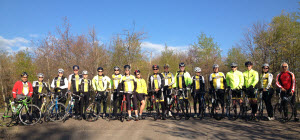
Now that we know he'll be OK, our team leader is framing a chunk of his helmet, along with our group picture, as a memento of the ride.
Our family was watching a movie the other night (Side Effects with Jude Law, Channing Tatum and Catherine Zeta-Jones. It’s a great psychological thriller!) A fantastic song came on as the credits were rolling and I am incorporating it into my profile this week.
Thievery Corporation’s ‘Forgotten People” from their 2008 Radio Retaliation album is a quick flat road (3:13, 97 bpm) to use for soft pedaling and recovery, or sprint work.
Here’s hoping you enjoy this song as much as we did!
Sometimes I never know what I'll find when I look for a free version to offer you. After striking out on Forgotten People (which was too good not to share) I clicked the related artists tab and discovered Air and in specific Air — Alone in kyoto.
Try out these remixes.
Based on what's being described, iTunes Radio won't work for your class. Unless you just want to hit play and work with whatever iTunes decides to deliver to you.
iTunes Radio (from what I can see) is really just Apple's version of Pandora. Give them a song or genre of music and iTunes Radio will serve a streaming radio of suggested songs.
I found a good explanation at zdnet.com of why Apple isn't offering a streaming catalog like Spotify or Google's new Google Play music services.
1. It's less like to cannibalize its iTunes music sales. A buy button is prominently displayed in the upper-right hand corner of the iTunes Radio now playing screen putting you just a touch away from being able to purchase a track.
2. It was a much easier sell to the music labels. I'm sure that the buy button in the upper-right corner was a significant part of Apple pitch to labels.
3. It was easier to close deals with three major music labels (which came down to the wire) as opposed to getting deals with all of the labels representing the 26 million plus tracks in the iTunes Store's massive music library.
Personally, I'd rather have a “catalog” (or hybrid) music streaming service from Apple (imagine, every track in the iTunes store being free to listen to!) over a “radio” service, which is why I don't see canceling my Spotify subscription any time soon. Ever since I've bought into the catalog streaming model, I've purchased very few individual tracks (although I've still purchased a few pre-release albums and live recordings) — which is probably the exact reason why Apple (and the labels) opted for iTunes Radio on Monday. I hope that Apple eventually expands it's music subscription offering, but judging by how long it took it to secure deals with three music labels (iRadio has been rumored since September) I'm not optimistic.
We all rely on music as a tool. Tools are used for building things and it's common to describe our practice of creating profiles as; “I'm building my class”. Most of us put a bunch of effort into; “building our playlist”. Track selection is often by BPM or song length. We categorize and file/store our music in ways designed make the selection quicker and easier, i.e. flats, climbs, etc…
In my workshop at home I do the same thing. I have a big tool box with a bunch of drawers. Each drawer has a specific type of tool (sockets, wrenches, screwdrivers), many are arranged by size (1/4″, 1/2″, 10mm, 14mm), or purpose (Phillips Head, Straight Blade, Allen Head).
I'm a self-professed “Tool Guy” – Tim Taylor was one of my favorite TV characters of all time. Tim understood it's “all about the tools”. My Grandfather was often accused (by his wife) of “spending 5 hours to design and build a tool that would save him 2 minutes, on a job he'd only do once.” So I come by this naturally 🙂 Whenever I need to build/fix/repair or create something the first thing I do is find the tools I'll need for the job. And no, I'm not beyond spending an afternoon/day/month designing a tool to solve some problem I'm having. Case in point is my Red Pedal Tool for studios using the red Schwinn triple link pedals. That took about a year from start, to a finished product.
My class preparation probably isn't much different from yours [wlm_firstname]. I start with a basic “plan” and then I select different tracks based on their value as a tool; “I need a 6 minute song @ 150 BPM for this climb I have planned” isn't any different from; “I need a 14mm end-wrench to remove the lawnmower blade, so I can sharpen it”.
The resulting playlist is very functional, very Indoor Cycling 2.0. But I'm learning can also be a bit sterile – dare I say soulless?
This morning a long-time member said hello to me, as I was leaving the club after my 6:00 am class. Her comment stopped me in my tracks; “I so wish I had taken your class this morning John… everyone was saying how great the music was”.
That's not something I hear very often, to be truthful, almost never. What was different this morning? I didn't use a playlist of my own creation. In fact the playlist I used didn't even fit what I had planned. The BPM was all wrong, efforts started in the middle of the songs – and often continued through track changes. There was nothing right about any of it (Rick Springfield?) – the musical equivalent of using a butter knife instead of a proper screwdriver… and yet they loved it.
By Jennifer Lintz, Registered Dietitian and ICI/PRO Member Soigneur
There is no question that in the group fitness studio – whether it be cycle, strength, yoga or some other modality – music matters. The right song placed at the perfect spot in a class can heighten the overall experience for participants.
Unless that song is too loud.
Or not loud enough.
That brings me to my question.
How do you as an instructor determine a volume that is “just right?”
From the time I began teaching in 2008, I can recall several ways music volume was addressed by management.
In a couple of facilities, I remember being asked to use my “best judgement.”
In other places, there was a “do not cross line” next to the volume knob.
And, in one location, music was never really mentioned … at all.
It was not until I started my current teaching position that I was exposed to a more objective method for monitoring music volume:
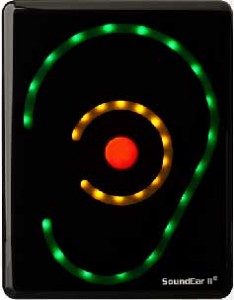
As you can see, there are three rings of color on the SoundEar. The outside edge of the ear is green and – when lit – indicates music volume is in a safe range. The middle ring lights up in yellow when volume starts to approach the maximum, and a red dot in the center becomes bright when volumes have exceeded the limit. In our situation, the SoundEar is set to recognize maximum volume as 85 decibels. This limit was set to promote both the safety of instructors and members. And, yes, I do feel that 85 decibels is loud enough and conducive to exercising in the “zone.”
In our facility, the Sound Ear is located on the back wall of each studio so that the instructor can easily see it while teaching. While I can't speak for other instructors, I really appreciate the tool. The SoundEar helps me keep my music within ranges that I know are safe for anyone in the room. Disclaimer: Ear plugs are always available in the studio for participants who prefer a little lower decibel level, but I don't see them being used very often.
The SoundEar has truly cleared up the gray area for me and quickly lets me know when my music is too loud AND when I have wiggle room to crank things up, if I feel the urge.
I rarely hear comments from participants about music volume, and a member has yet to say anything to me about the device mounted on the wall. In fact, I have a hunch a majority of folks don't even know it is there. Quality assurance measures are in place, too. Our supervisors regularly drop in on classes throughout the year to make sure we are abiding by volume policies and respecting members' safety.
I know it is impossible to please everyone with regard to sound levels, but I appreciate the SoundEar and have noticed that comments about music volume have been few and far between over the past year.
What are your thoughts on monitoring music volume? Do any of you use a similar device? Would you find it helpful to use/have something similar?
Have you ever felt as if your legs weren’t recovered enough for the day’s training? Do you ever look for quick ways to bring your legs back to full capacity, e.g., ice, massage, cross-training, stretching, so you can work hard again?
This post is about glutamine and its effects on recovery.
Glutamine is an amino acid, one of the most abundant amino acids in the body. It’s released when muscles contract. A long, hard training can deplete glutamine by 25% to 30% or more.
The significance of this is that glutamine is a fuel used not only by muscles, but also by immune cells. The immune system manages recovery of all types: illness, injury, surgery, and training. Glutamine is a fuel source for cells that line the GI tract, which guards against microorganisms that cause disease. In addition, glutamine facilitates glycogen synthesis, which is highly important after training.
For both optimal health and optimal recovery, glutamine needs to be replaced after training.
The obvious way to replace glutamine is through food selection. Since glutamine is an amino acid, many protein foods contain it. Examples of glutamine-containing proteins are: beef, fish, chicken, pork, eggs, egg whites, milk, yogurt, ricotta cheese, and cottage cheese.
Some vegetables also contain glutamine: Brussels sprouts, carrots, celery, kale, parsley, spinach, cabbage and others. Raw vegetables work better than cooked.
Glutamine can also be found in fruits: apples, apricots, avocado, bananas, cantaloupe, dates, figs, grapefruit, oranges, papaya, peaches, pears, persimmon, pineapple, and strawberries.
The long fruit list doesn’t contradict my previous posts that recommend minimizing sugars, including fructose, the sugar in fruit. I suggest limiting the number of fruit servings per day to one or two, and choosing your fruits from the above list to help with glutamine replacement.
Other foods that contain glutamine are: beans, soy, peanuts and other legumes; wheat, barley, beetroot, corn, nuts (small amount).
If you’ve been training hard enough to feel that you’re not recovering fully — even with these foods in your training diet — you might want to go with a glutamine supplement. I’m most familiar with glutamine powder, although it’s also sold in tablet form. If you use a supplement, try taking 1 heaping teaspoon (5 grams, the usual recommended dosage) before bed. Mix the powder into about an ounce of water and drink it, then drink a full glass of fresh water. Glutamine powder has worked well for me, but I’d like to hear from you if you give it a try.
One of the benefits of taking glutamine before bed is that it can trigger a release of human growth hormone. HGH is a complex topic, but it has been shown to have immune benefits and to aid in cell and muscle recovery.