Taking a break from endlessly waiting on hold with multiple service providers, I scrolled through “My Tags” on Shazam. You may enjoy these two:
Cracker — Low is a great flat @ 86 rpm that you could squeeze between to climbs. It worked for me last night 🙂
Switchfoot — The Sound [John M. Perkins' Blues] is fast, 104 rpm that (it you time the transition) you can use to signal a downhill breakaway that starts with someone jumping at the summit. I've been having fun working my class at a set wattage, cuing changes in load and cadence at different points to retain that big number!
At the beginning of every class we teach is an activity called “warming up”. Since the warm-up seems inadequate in many indoor cycling classes, I felt a review of the process would be beneficial to have on record.
During warm-up, we try to bring the expected working muscles to a state of readiness. To many, this means an easy roll of the legs while gently increasing resistance and/or cadence.
As an aging cyclist, I have made warming up a practice unto itself. Each warm-up is specific to the workout I have planned. It varies depending on what we do, and lengthens in accordance with the difficulty of the training.
Warming up properly on the bike should accomplish the following things:
Increase blood flow (thus oxygen and fuel) to the working muscles.
Increase aerobic metabolism in the working muscles.
Stabilize breathing and heart rate.
Decrease the viscosity of the working muscles.
Increase the speed of contraction of the working muscles.
Improve coordination among muscle groups.
Prepare the students mentally before initiating difficult training.
Increased Blood Flow
The average person does not have enough blood in the body to support a maximal level of effort in all the muscles at the same time. The body must “shunt” blood to where it's needed to provide the oxygen and fuel necessary for increased activity.
Have you ever noticed when you press intensity early in the training that the muscles feel as if they’re anaerobic, even though your heart rate is not yet high? The body hasn't had enough time to shunt blood to that area to increase the oxygen available for the increasing rate of metabolism.
Increased Aerobic Metabolism
When the muscles are not engaged in exercise, ATP derived from glycolysis and ATP from oxidation are in a specific balance. Although anaerobic production of ATP yields waste products, it's done at a rate that allows the body to clear them from the muscles so there's no feeling of discomfort.
As the level of activity begins to rise, it's our anaerobic metabolism that initially increases to satisfy the greater demand for energy. Once the muscles begin to work with greater efficiency and more blood is providing increased oxygen, the body shifts to producing more ATP via aerobic metabolism. This is when we feel a sudden sensation of greater balance and muscular efficiency, despite a significantly higher heart rate.
Stabilization of Breathing and Heart Rate
Once the body has shifted as described above, a notable regulation of breathing and heart rate occurs. Rhythmic breathing increases the oxygen that can be delivered to the working muscles. To a certain degree, this happens naturally. It also stabilizes the heart rate as long as the intensity remains constant.
Decreased Muscle Viscosity
Viscosity refers to the degree of “stickiness” in the muscles. The body lubricates muscle fibers during warm-up, reducing viscosity and preparing them for the force we’re about to apply. Insufficient warm-up may not allow time for this lubrication of the muscles. When stimulated through exercise, inactive muscles initially perform small, irregular contractions with incomplete relaxation. Once viscosity has been reduced, the contractions become stronger and relaxation more complete.
Increased Speed of Muscular Contraction
Warming up properly increases the speed of neural impulses. That enables the muscles to contract more quickly in response to the work effort and improves efficiency and ease of movement.
Improved Coordination
Coordination basically refers to firing the right muscle fibers at the right time for a given physical task. Correct timing and sequencing from large muscles to smaller ones lead to optimal force.Cycling-specific exercises that engage muscles in the same movement patterns that they will later perform will improve technique and prepare the body for the unique demands of a particular indoor-cycling workout.
Prepare the Student Mentally
I’m often surprised when someone — instructor or student — considers warming up to be only physical. A similar approach should be taken regarding mental preparation. Instructors can guide students through specific thoughts, words, images, and feelings and prepare their minds for the upcoming workout. This mental preparation occurs in conjunction with physical preparation, so the students warm up body and mind together.
So, in five minutes or so, we have to shunt blood, ramp up aerobic metabolism, stabilize our breathing, lubricate the muscles, fire the muscles more quickly, practice technique, and prepare everyone mentally for what we are about to do for the rest of the class. Five minutes is the standard length of warm-up in the average indoor cycling class.
A five-minute warm-up is often considered the minimum necessary before activity. Note that I did not say “performance”. A proper warm-up can take as much as 20 minutes out of a class, depending on your ride profile.
My point is to consider the warm-up as important as the training. Plan it as intricately as you do the training. The right sequence of movement, music, cues and intensity can prepare students and instructors alike to train as they've never trained before.
It was the most painful class I've ever taught. Not painful in the; “John, your class was so bad it was painful.” I mean PAINFUL… my feet were killing me for the entire hour. Here I was riding with my Sidi shoes, sans insoles. Earlier in the week I had transferred my prized Superfeet Blue Insoles from my old shoes (with Delta cleats that fit the bike at Life Time) to my new Sidi Mega's (I use LOOK Keo cleats on my VeloVie bicycle) and had forgotten to switch them back 🙁
It didn't help that for the full 60 minutes of class I berated myself for being an idiot. Why was I wasting my time switching inserts between shoes (adding yet more additional stress to my life) when I could simply order a second pair (in about 10 seconds) online with my Amazon.com prime membership?
I have really crappy feet. They're quite wide, the left foot has almost no arch and both are pronated to boot – please forgive the pun. It doesn't matter what I'm wearing; street shoes, running shoes or cycling shoes – they all give me trouble.
So here I was, riding with nothing in my shoes. No cushion, no support, no nothing. Just the hard flat bottoms of the shoes. Oh, and the little depression in the center, right under the ball of my foot, where the cleat connects which felt like it was growing the whole class.
Over the years I have experimented with a bunch of shoe insoles. I worked for Shock Doctor for a spell as a sales rep and was able to try their full line of replacement insoles. I wore them for years until I was introduced to Superfeet by a member at the club. They are now my favorite and difference between a comfortable 2+ hour ride and having my feet scream at me from mile-one on.
So when I got home I logged onto amazon.com, did a quick search and hit the one click purchase button. Two days later the nice UPS guy shows up with a little box. Problem solved and it took me a total of less than a minute… that is if you don't count the 60 minutes of agony I suffered in class.
Amazon Prime costs $79.00 a year, which may sound like a lot until you consider the value of your time. In the past, if I had decided to purchase something I would; A: jump in the car, drive somewhere burning $4 gas, get there and hope the store had what I needed. Or; B: go one line, search for a product, check a bunch of sites to see which had the lowest price, go through the checkout – only to get torqued off when I discovered there was a minimum purchase or they planned to charge me $10.00 to ship some $14.95 gizmo – where I would either quit the process or start over.
Other examples. Last week my younger daughter had a bunch of friends over. The next morning I discovered something dark and sticky on our ironing board – which I later learned was barbecue sauce. As the official “Ironer” in our family, I would've been looking at a trip to Target for a new cover. I hate shopping for anything, so I don't. A few clicks and I had my new cover two days later. Same thing this past winter. It seemed like every time one or the other kid when back to school, I was missing another iPhone charger 🙁 Not any more.
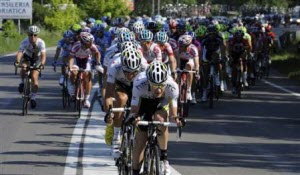
A flat road speed play is on the playlist for this week’s class. Coming in at 96 rpm’s and 3:03, it is great for a breakaway anytime you’d like to slip one in your profile.
There is a nice build from :35 to: 43 that is fun to use to cue building up leg speed and taking off, out of the saddle with your class.
Here is Erin McCarley, from Nashville (originally from SanDiego) and ‘Just Another Day’ from her second album released in 2012- My Stadium Electric.
John was talking with a neighbor friend after returning from a challenging group ride and invited him to ride along the following week. His response was, “I used to lead the A ride. I won't do it now, because I can't sit up front anymore.”
Andrew* was recently diagnosed with Multiple Myeloma. Thanks to many years of riding, racing, much training and knowing his body really well, he knew something was wrong. He had been training hard, riding a lot, and yet his performance was diminishing. He FINALLY (after much prompting from his wife) went to the doctor and blood tests revealed MM. Prognosis is “squiffy”…my term for not terminal, but not definitive. Andrew and his wife are taking it day by day.
I need to give you a bit of history… Andrew has been a significant force and influence in John's cycling ‘career'. As John timidly set out to gain some fitness 18 years ago, Andrew supported him wholeheartedly. First he brought over Power Bars, then a jersey, then some new bike shorts he, “would never use”… Andrew encouraged and helped John at every turn. (Plus, Andrew is a ‘Gear Head'. I am sure it pained him to see John riding in sweats, tennis shoes and a sweatshirt back in the old days!). As John progressed, Andrew would encourage him and ride with him. John would strategize as to how to overtake Andrew just once a season!!!! I will be forever thankful to Andrew for his passion for riding and encouragement for John as he started out.
As neighbors, we have watched each others children grow up and move on and continue in our quest to remain fit and healthful. I consider Andrew to be fit and healthful to this day, despite his diagnosis. I wish he felt the same.
Andrew has always been an example to me and John. He has been diligent in his eating and fitness routines. He did not ask for cancer and he is not keeping his MM diagnosis a secret. He is maintaining phenomenal fitness despite his diagnosis. I personally consider him a great example of what cancer and fitness can look like in co-existence. I only wish he saw it this way and would lead whatever ‘alphabet' ride he chose with confidence and courage, because he is, and has always been, a cycling hero in his own rite.
I think this begs us to ask ourselves, “What would I do if I were still healthy enough to ride, but not in the capacity I used to?” Would we be courageous enough to ride the ride we are able and be thankful? Would we take the opportunity to step up and be an example in lesser settings? Pride is a strong and wicked opponent.
We are all leaders. Sometimes ‘A' leaders and sometimes leaders in other ways. I pray I will see the difference and be willing to lead wherever I am destined to.
I believe Andrew is missing a huge opportunity to give and receive. It's not always about being the leader of the “A” group. The “B” and “C” group need leaders, motivators and examples too.
*Our neighbor and friend's name has been changed to protect his privacy
Lately, lively discussion has surrounded a series of posts by Krista Leopold. She uses hypothetical letters to the instructor to highlight instructor professionalism. In her most recent “letter”, Krista discusses a subset of professionalism — bad-mouthing other instructors or the facility.
Krista has opened the door on professional behavior (ethics) in our workplace. Let’s walk in.
Webster defines professionalism as “the skill, good judgment, and polite behavior that is expected from a person who is trained to do a job well.”
Ethics are “a system of moral principles; the rules of conduct recognized in respect to a particular class of human actions.” In this case, the human action is workplace etiquette. We learn ethics as children. Our parents called it “doing the right thing.”
From that perspective, let’s examine another behavior in our workplace — self-promotion.
The forums I browse, including ICI/PRO, feature discussions on how to promote ourselves to our riders: social media, web sites, newsletters, email, business cards. It seems like a good idea, but is it ethical?
Unless you own the studio, the riders in your classes are customers of the facility that pays you, not your own. We have no ethical business contacting their customers. Yet it’s done all the time.
Instructors with regular classes build contact lists of subs, for obvious reasons.
Instructors with regular classes also build contact lists of their riders, for less obvious reasons.
Most instructors are also on sub lists. Sooner or later, an email arrives from a popular instructor, who needs a sub for a prime time class. The sub thinks, “Teaching to a full room is always fun; I’ll do it!” Seconds later, the sub gets a response from the appreciative peer, “Thank you so much. You’ll love this class. It’s always full, and they like a great workout.”
The sub spends considerable time, effort and money preparing. After all, this is prime time, and people arrive 45 minutes early to get a bike.
The sub arrives 20 minutes before the class and opens the door to…an empty room. A bit weird, but there’s still time. A couple of people walk in. The sub smiles and does the meet-n-greet. At class time, there’s a roomful of mostly empty bikes.
What happened? The instructor contacted the regulars to inform them that a sub was teaching. That’s all it took to empty the usually full room. Have you experienced this?
A serious breach of professional etiquette, this behavior has long been standard in big-box gyms and crosses the ethical line. It’s about self-promotion. Not to participate forces one onto an unleveled playing field. The playing field is Head Count, the gold standard of an instructor’s worth. Is this an instructor survival tactic? Must one be unethical to protect one’s turf?
I’m no stranger to contradictions, but isn’t discouraging attendance essentially the same as bad-mouthing another instructor? I see this as an ethics issue, rather than a survival tactic. What do you think?
When an instructor contacts riders and influences them not to attend class, many things happen. None of these is good for anyone but the instructor — who needed help in the first place.
At the big-box gyms, where most of us teach, there’s no real need for self-promotion beyond doing a good job. Why? Well, as stated, our riders are not our customers. And the gym promotes its own programs and, by extension, the instructors teaching them.
Our first priority as employees is to keep the members happy, better known as service after the sale. We do that by implementing many time-tested principles often discussed on ICI/PRO.
As always, there’s an exception. Soul Cycle. Their business model, largely based on self-promotion both on- and off-stage, pits instructor against instructor, in favor of those who sell out the studio every class. It’s all about sales. From that point of view, these unethical tactics can at least be understood.
Currently there’s buzz surrounding a lawsuit alleging that Soul Cycle exploits instructors by not compensating them for all their time. Exploitation? Maybe. I see it as creating an environment of competition in the interest of sales. Let the best at self-promotion win.
But what we do in the big boxes is about service after the sale. That changes everything when it comes to workplace etiquette.
My own subbing experience was invaluable. Unfortunately, I learned that instructors may act professional around their riders but less so with their peers. I also realized how hard this job is, especially building a loyal following of regulars.
I’m proud that, through continuing education, experience and professionalism, I play to a full room in most of the six classes I teach per week. I still don’t know the emails or phone numbers of any riders in my classes.
I have no illusion of effecting behavioral change with these words. Management at big boxes made the choice long ago to leave it to the instructors. Empty studios are of no consequence because, in such facilities, the cycle studio is not a profit center. Not so in boutique studios. Let’s hear from studio owners on this issue and how they deal with such tactics.
If we’re going to examine professional behavior in a forum for indoor cycle instructors, let’s look at all of it and ask ourselves if we’re doing the right thing.




 If you have or know a