I you have a Monday 5/27 class somewhere in the USA – there's a good chance it will be cancelled for the holiday. If that's the case, be sure to get outside and enjoy your day off 🙂
Tuesday will be back to work – and you'll have a bunch of participants who will be eager to burn off a few of the Johnsonville brats they consumed (in quantity) the day before.
Don't know Johnsonville brats? They are a year round staple food for Wisconsinites or temporary college residents and a mandatory item on any Memorial Day menu here in the frozen north.
Even though they are technically bratwurst, these are nothing like those disgusting milky-white things your mother used to bring home and cook under the broiler. These are brats and they're awesome!
John's recipe for Johnsonville brats.
Cooking Johnsonville brats is a day-long, near zen-like experience. Similar to preparing a Thanksgiving dinner, but more fun cause you need to be in the right frame of mind to both prepare and then properly cook them 🙂
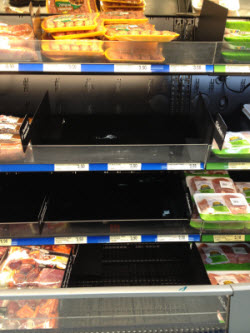
Empty shelves Saturday AM – what I was afraid of and it took 3 stops before I found my brats.
2 (or more) Original Johnsonville brat party packs. ONLY THE ORIGINAL VERSION!!! The only acceptable option is the Beer'n Brat which they make for people who don't have all day and need to get them on the grill ASAP. If you get to the store and find they are sold out of the original, don't be tempted to use any of the other flavored varieties. Better to go hungry or settle for hamburgers.
2 (or more) large white onions, cut into quarters.
1 (or more) 24 packs* of your favorite Wisconsin beer. My personal favorite is Leinenkugel's or Lienie's as we call it around here.
Real bakery brat buns – NOT HOTDOG BUNS! There is a difference.
Early in the morning, cube the onions and place in a large stock pot.
Add the brats.
Add enough beer to float the brats, reserving 1/2 of each bottle for the cook. It's going to be a long day, so pace yourself by limiting your alcohol consumption to just 1/2 a Lienie's at a time.
Bring to a roaring boil and then reduce to a simmer. Cover and let cook for 4 (or more) hours. Occasionally lift the lid and breath in the heavenly vapors with anticipation of what's to come.
Grill over direct heat for about 10 (or more) minutes, turning frequently. Have a water bottle handy to control the inevitable grease fire as these babies cook up. I forgot to add; wear an apron, or an old shirt, cause these things have a tendency to explode/spurt at you while you're enjoying watching them cook. I don't think it's possible to overcook a brat, so leave them on until they split and a bit burnt.
Serve on toasted brat buns with your favorite brown mustard. My favorite is Cleveland Stadium Mustard.
But keep the sauerkraut away. That stuff is really disgusting.
*Some areas of Northern Wisconsin call these “a suitcase” and the store clerk may become confused and offer you two 12 packs if you ask for a 24 pack.
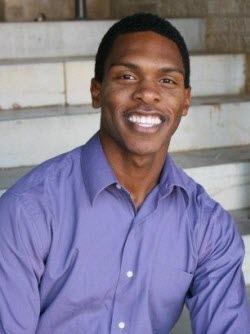
Getting back on the Free Music Friday track… I really enjoyed my time recording with Dunte Hector this week. Did I mention that he's only 23 years old? I subscribed to Dunte on Spotify and have been listening to his playlists. This track Alex Clare — Relax My Beloved jumped out a very powerful track that I could see using to get everyone establishing “Big Pedals” at the early stage of a climb. Big Pedals @ 63 RPM that I'll we'll then excelerate to ~ 80 RPM and sustain for however long it takes to reach the top.
Dunte Hector, Stages Indoor Cycling Master Educator presents his Kor180 Race of Truth as our latest Audio PROfile.
Within any Indoor Cycling class profile, there's the typical warmup and cooldown. For most of us, these segments of our classes remain fairly constant – it's the work-set in the middle that varies depending on our specific purpose for the class.
So in the interest of saving your precious time, some of our new Audio PROfiles will focus on the actual work-set… the important stuff and you'll easily be able to splice these into your normal routine.
We've added a new category; Class Work-Sets so you'll be able to find them quickly in the future.
These will also work well for anyone teaching a cardio/strength fusion class. Dunte teaches at Kor180 in Austin, TX and his classes follow a fusion format of 30 minutes of cycling followed by 30 minutes of strength.
Sometimes it's just being in the right place, at the right time to move into a position as Master Trainer for a major Indoor Cycling education company.
OK, maybe you need more than that. Like having a strong passion for fitness, a bicycle racing background and (in this case anyway) an engineering mindset that helps you to understand and then communicate the true value of adding metrics to an Indoor Cycling class.
Dunte joins me to discuss how he got his start with Stages Indoor Cycling and offers his ideas on effectively communicating power training to our students.
Later this week (shooting for Friday) I'll be publishing Dunte's Race of Truth Audio PROfile. We had some audio quality issues with Skype that made take #1 unusable and plan to re-record his profile Wednesday this week.
As I prepared to support ICG at IHRSA 2013, I considered the ICG tenet that learning is about removing resistance.
I had just gotten back from a bit of Vegas shopping. A nice saleslady asked me what I was doing in Vegas and told me about the time she and her friends first tried indoor cycling. She loved it and was hooked, but her friends ran away and never came back. She explained that their initial reluctance to try something with a reputation for being hard had unfortunately been validated.
The cycling class tradition is steeped in that reputation — it’s crazy hard and the people doing it are crazier still. The reputation makes it difficult to get new riders. There’s built-in resistance to the classes. Regrettably, many instructors deliver indiscriminately on the reputation.
Yet we know that doesn’t need to be the case. How an instructor begins a class can go a long way toward removing resistance for first-timers. So I’ve developed a list. I’m not sure if they’re “Dos and Don’ts” or “Pros and Cons”, but certainly following these tenets during every class will help improve the reputation of indoor cycling.
YOU MUST GET THERE AT LEAST 15 MINUTES EARLY!!
This seemingly simple, yet consistently underemployed, strategy will put you in a calmer place. Your riders can feel your tension. Moreover, it gives you a chance to get ready without stress and bond a bit with your riders. Especially first-timers.
BE ATTENTIVE TO FIRST-TIME RIDERS
Many first-time riders will not approach you with that information. They tend to wander in, head to the back of the room, and look for a bike that fits. If you’re in discussion with your roadie friend, picking videos, lacing up your bike shoes, emailing or texting, you could easily miss them. Be on the lookout.
PERFORM A BIKE FIT TO GET TO KNOW THEM AND LET THEM KNOW YOU
I’m often made fun of for the amount of time I take doing bike fits for my riders. Well, LOL, for first-timers, the key is the time you give them, rather than how precisely you fit them. While doing the bike fit, I ask their name, talk about the console (if applicable), show them how to change resistance, define some terms I’ll use, explain the order of tasks (fun, cadence, resistance), and most importantly, explain how to modify anything I ask. Make your first connection here.
START CLASS BY WELCOMING THE NEW PEOPLE
I may catch some flak here because some people don’t like to be called out. But rather than calling them out, I simply state that we have a first-timer and have everyone clap. Then we get to it.
MAKE EYE CONTACT AND GIVE POSITIVE REINFORCEMENT
During class, check in on your first-timer. It’s simple. Watch. Make eye contact. Smile and nod reassuringly. If they’re struggling, find an opportune moment to get off the bike, turn off the mic, and give some help. Help other riders along the way.
TALK TO THEM AFTER CLASS
As much as practical, get right to your first-timers and talk to them. How did it feel? What did you like? What didn’t you like? Did you get the workout you expected? Where to buy cycling shorts and shoes. Welcome them into the community.
FINAL WORDS ON EDUCATION
Innovation has been the cornerstone of the ICG mission. Our approach to education — learning is a process of removing resistance — is a giant leap forward for indoor cycling. As an instructor, you have the opportunity to remove resistance and educate both your regular riders and beginners. The longevity of our craft depends on bringing in, educating and motivating new riders. Removing resistance is the first step. Take it.
At IHRSA, I worked the ICG booth and was fortunate — in some bizarre way — to be cornered by two club owners after my second of three demo rides. Both used the same language.
“You’re very good at teaching to video. But, of course, that’s why your company brought you here. How can we get our instructors to do as well as you and make their classes just as compelling?”
I explained that the best programs are those where the synergy between club management and employees is high. When management works closely with the group exercise teams to educate, promote, nurture and applaud, good things happen. The corollary is that management first needs to go in search of “the best of the best (and) make them better”. (Yes, I stole that line from “Top Gun.”)
They were surprised to hear that ICG's online continuing education is free for everyone, not just those who buy our widgets. I explained our concept of educating by removing resistance. Our online modules are there for all — and you don’t have to start at the top. Nor do the instructors, who have learned a thing or two over the years, have to read all the chapters before taking the quiz at the end of each module.
As instructors, we can’t lose sight of the fact that, if we’re not working on improving our craft, then it could be better.
I saw this last Tuesday and forgot to share it with you. Our club ride begins at the Minnetonka Lifetime Athletic Club. Better known as The Spa, this is a unique LTF facility. Definitely not a Big Box, this club began as a women only club before being purchased by Lifetime.
When I got there Tuesday night they were setting up for an outdoor ride. How fun is that? We rolled before they got started and I heard later that they (Manager and Instructors) did a very nice job making this outdoor class an event, rather than just a class.
The area behind the fence is a small patio. After the class participants enjoyed Hors d'oeuvres and a cash bar – this is an adults only club. They even had live entertainment from a local duet. Is that something you could do at your club or studio?
Could I keep up in a group ride?
With Amy visiting her family in Phoenix, I become the de facto sub for her Saturday AM class. Which was fine – 55 and rain this morning = no outdoor ride for John. After class a regular member asked me if I felt she could keep up in a group ride. I dislike giving answers beginning with; “well that depends” – except in this situation it really does. Riding with a group depends on a number of factors. So I asked her the following:
Do you have a suitable road bike?
Are you comfortable riding close to others?
Are you OK riding on the road?
How far (miles) can you typically ride at a consistent pace?
It surprised (and delighted) me a little when she quickly answered positively to each question and then clarified what she was asking:
How many Watts do I have to make, to keep up in a group ride?
She's been listening and wanted to equate the power/watts she seeing in class to riding outdoors 🙂
I had to think about it for a few minutes, before I could answer her. I explained that most organised group rides have multiple “levels”:
“A” groups are normally drop rides. If you can't keep up you get dropped, and ride home by yourself. Based on my purely anecdotal experience, “A” groupers can sustain 1.5 or more watts per pound of body weight for the entire ride.
“B” groups, depending on the organization and/or leaders, are partial drop rides = we may wait for you or there maybe someone who will come back to help you catch up. To hang with the “Bs” you should be comfortable producing your body weight in watts > and be able to climb at around 1.5 watts per pound.
“C” groups areno drop rides. Everyone stays together and ride at the pace of the slowest rider.
But I don't want to slow everyone up – so what's the minimum watts I need to make?
I told her that there's no way to know that number. I encouraged her to show up one night and see what happens…
Who was it that decided climbing songs should be slow?
If I tried to stay with the group I ride with on a long climb, grinding along at 60 RPM, I'd be off the back (and on my own) in no time flat.
Sure a climb should make you struggle to turn the pedals – but to replicate an actual climb outdoors, might I suggest having everyone maintain their cadence in the 80s? Or at least the high 70s?
I've been keeping track of rider's cadences during our group rides, especially when the grade turns positive. Anyone who appears strong is spinning smoothly at 75 RPM or more. The grinders hang on for a little while… just a little, before their leg muscles fatigue and someone ends up waiting at the top – to help them catch back on.
Bicycles have gears for a reason. My new VeloVie has 20 to choose from. How I decide which gear to be in is simple…
I select the gear that allows me to maintain my prefered cadence of ~85 to 95 RPM.
Going up, down or on a flat I'm continuously shifting to keep my pedals in this RPM range. The one exception would be on a long downhill where I will have shifted down to the point where I'm pushing a huge gear at ~ 60 RPM. The exact opposite of conventional thinking.
The typical rookie mistake on the road is to wait to shift until the road literally forces you to do something. They're pedalling merrily along during the beginning of the climb, with their cadence slowly decaying and forward momentum slowing. That is until someone stuck behind them (that would be me) yells SHIFT. By that point the damage is done and they've lost touch with the wheel they were following. Riders behind (again me) are forced to pass them and fight to close the gap before we (once more me) get dropped as well.
A more experienced cyclist will respond instantly to the feel of the road pushing back against their pedals and shift gears. Same with any feeling that their legs are tiring and starting to slow. Shifting to maintain or increase cadence moves the production of work from fatigued legs, up to your (hopefully) less stressed cardiovascular system.
Todays free track is at a very powerful 85 RPM – but it's not a flat. Try coaching this as a climb. If you're riding a magnet cycle have everyone add load at 70 RPM until they feel the need to stand > then accelerate to the music's 85 RPM.
Friction folks will have participants find the tempo and then add the hill while staying with the music.
In either case, cuing everyone; “if you're feeling a burning in your legs > you're doing it right :)” “No burning? Then you're not keeping up, slipping off the back and you will be riding home alone!”