Image from http://www.lifetime-weightloss.com – click to read an additional article supporting this post.
By Team ICG® Master Trainer Joan Kent
A while ago, based on some long-held suspicions, I ran a PubMed search on weight gain and weight loss to assess the accuracy of a widely held belief. The belief, as the above title suggests, is that weight management hinges on the so-called “simple arithmetic” of calories in and calories out.
Even with the limited time I had for the search, I still located approximately 35-40 articles in various science journals that seem to challenge the calorie theory. I’ve categorized the results below, but need to start with a caveat. Most of the studies cited in this post were done on animals. (I’ve indicated specifically when the subjects were human.)
Some people will object because of that. For their benefit, I’d like to make two points: 1) Studies of this type would be unethical to perform on human subjects. No review board anywhere would approve research that involves locking people in a room, taking all control of their food intake away from them, and forcing them to gain or lose weight. 2) Are you truly prepared to state that weight management centers on calories in/calories out in the human body, while it’s Anything Goes with animals? Knowledgeable veterinarians, for example, have confirmed that the metabolic effects of Cushing’s disease, including the role of hormones in weight gain, are identical in humans and dogs.
So what happened in the studies? To sum it up, dietary factors were found to disrupt the link between calorie intake and weight, and different nutrients and hormones affected the weight outcome.
Fat content of the diet affected weight gain and loss.
– Rats on high-fat diets developed severe obesity without overconsumption of calories (4 studies).
– Mice showed greater weight gained per calories consumed (called “feeding efficiency”) on high-fat versus low-fat diets (1 study).
– Calorie-restricted, isocaloric diets of 10% and 50% fat both reduced body weight in rats, but body fat was higher in the 50% group (1 study).
– Total fat intake, rather than calorie intake, correlated with weight gain and was due principally to the saturated fat component (1 study).
– Saturated fat is associated with greater weight gain than unsaturated fat (2 studies). [This makes no sense from a calorie standpoint, since all fats contains 9 calories per gram. But saturated and unsaturated fats affect hormones differently, as mentioned briefly in a previous ICG® post on Cholesterol.]
– Fecal analysis showed people who consume nuts regularly excrete more fat, suggesting a discrepancy in gross calorie intake and calories absorbed (1 study).
Sugar content of the diet affected weight gain and loss.
– Abdominal fat deposits were caused by high-sucrose, isocaloric diets in rats, although the rats showed no differences in weight gain when compared with controls (1 study).
– Rats fed sucrose plus standard chow did not eat more calories than controls, but gained significantly more weight per calorie consumed (feeding efficiency) and had higher body fat than controls (1 study).
– Severe obesity developed in rats on a high-sugar diet and in rats on a high-fat diet, although controls eating standard chow ate significantly more calories than either the sugar group or the fat group (1 study).
– In a study of human identical twins, the dietary factor isolated as causing a difference in BMI between twins was sugar intake (1 study).
Nutrients affected sugar-induced weight gain.
– The protein content of a high-sucrose diet was inversely related to the effects of sucrose on weight gain and feeding efficiency (1 study). [Protein triggers the release of glucagon; its effects oppose those of insulin. More on insulin below.]
– Minerals added to a standard chow-plus-sucrose diet did not change calories, but decreased weight gain and feeding efficiency and improved glucose tolerance (1 study).
Insulin, a “fat storage” hormone, is a factor in weight gain.
– Rats injected with insulin gain weight with no change in diet or calorie intake (standard textbooks).
– Diet-induced insulin resistance preceded obesity development in rats (1 study).
– Insulin resistance functions as an adaptive mechanism to prevent further weight gain in obese human subjects (3 studies).
– A good night’s sleep vs. restless sleep altered hormone balance. Restless sleep caused fat storage to increase (2 studies). 

 [This result seems contradictory in light of calorie balance: Wouldn’t tossing and turning all night burn more calories than sleeping soundly?]
– The 24-hour rate of fat oxidation by skeletal muscle may be determined either by genetics or by diet. Insulin-triggering foods lower it (2 studies).
– High fructose intake induces high insulin levels, which can cause weight gain (5 studies).
– Chronic stress increases insulin and decreases brain dopamine, norepinephrine and beta-endorphin. The changes shift food preferences to carbs (specifically sugar) and fats, leading to weight gain (9 studies).
What appears to be a balance of calories in/calories out is often the result of a change in diet composition. That, in turn, changes the hormonal response. Hormones can affect weight more profoundly than calories. (More about hormones in a future post.)
Despite the documentation, some of you will believe this, some will not. What I hope is you’ll avoid telling your students that weight management is just simple arithmetic. Instead, please suggest that they shift their diets in a more healthful direction.
I promised we'd be offering full transcriptions of our best Podcast interviews and here they are!
You will find them by following the Transcription tag which will identify those Podcast interviews with a companion printout you can read online or download.
It takes about two weeks for the service we use to transcribe these and Jennifer will be adding them continuously in the future.
Look for transcriptions of past interviews from Jay Blahnik and Lawrence Biscontini in the near future.
I really enjoy adding a jump track in the middle of a long endurance segment, sandwiched between two, long, 90ish RPM flats. The jumps serve a couple of purposes;
They breakup a potentially monotonous part of your class.
The slower tempo encourages additional load, which should have everyone working a bit harder once we accelerate on to the second flat.
The speed needs to be just right. I like a track around 70 RPM and found this song while I was creeping on Schwinn Master Instructor Julz Arney's Spotify profile.
Macy Gray's “Nothing Else Matters” looks like this – once you move past your cluelessness.
If you've experimented with some of the 3/4 time track suggestions from this past weekend, you may have some confusion about how you count oddly timed music – like I did.
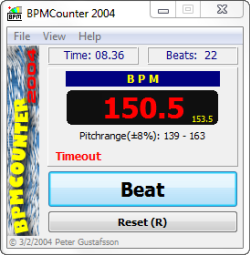
While I was writing the post, I wanted to find the RPM they communicated and share it with you. So I broke out my trusty BPM Counter*… and then quickly drove myself crazy trying to tap out the count; One-Two-Three / One-Two-Three and have it show a believable RPM. I actually quit trying to tap out the songs and instead jumped on my FreeMotion S11.0 down in the official ICI/PRO training facility (my basement) and rode to each song. Riding to the One-Two-Three / One-Two-Three comes easy to me – which is exactly why we recommend using music in 3/4 time to help your students Find The Beat – Find The Beat.Some LTF Instructors may get that private little joke.
When Amy returned, I explained that my rhythmic deficiencies were preventing me from tapping out the RPM successfully 🙁
She gave me a little smile and explained; “It's just Beat-Beat-Beat, Tap-Tap-Tap like any music in 4/4 time.” “Then you just divide it in half to find the RPM… silly.”
So I tried it again, this time forgetting the; One-Two-Three / One-Two-Three and instead just used Tap-Tap-Tap.
And she was right – as usual.
*Here's an old tap-to-the-beat program (PC only) that I've used for years. You can (right click here – save as) to your desktop. It's an .exe file that you need to run each time you want to use it. Your PC may warn you to be concerned about .exe files – you should if they don't come from somewhere not trustworthy (like a spam email) but this file is clean.
One of my goals for 2013 is to have a majority of my participants riding to the beat of my music. Not an easy task with the number of riders I teach that can't seem to hear the beat of the music – or are simply ignoring it.
Now I know that you may have been taught that it's not always the dominate beat that you should follow and match with your pedals. You're supposed to hear some subtle rhythm hiding in the music and follow it where ever it takes you.
Sorry, I don't (and never did) buy it – or at least I've never been able to hear these magical under tones and follow them. I (and most of the men in your class) need a strong beat if you expect us to follow it.
So let's give them something easy to follow. A beat that you can't ignore and has your head swinging from side to side.
That would be a Waltz… as in One-Two_Three / One-Two-Three / One-Two-Three / One-Two-Three / Right-Two-Three / Left-Two-Three / Right-Two-Three / Left-Two-Three
Amy's working on an audio version of this concept. I call her the Human Metronome and believe me, when we dance together, she leads. She has a very fun way to present this in your class that will have your (and my) participants learning to follow the intended cadence RPM that you designed into your class. Podcast #246 featuring Amy is now available.
But for now I wanted to give you some suggestions that you can add to a playlist
ICI/PRO Learn to Ride to the Beat Spotify playlist with 48 tracks that are in either 3/4 or 6/8 (Waltz) time.
This cover of Nothing Else Matters from Macy Gray would make an awesome 75 RPM climb. Listen to it with your eyes closed and count out the one-two-three / one-two-three and hear yourself cuing Left-Two-Three / Right-Two-Three to gently bring everyone in sync. Notice how each measure ends on the opposite leg – which many of the men in your class will find easy to follow.
While shopping for workout wear last weekend, I heard this fantastic song, and thought, “This would make for a phenomenal climb”. Luckily, I had my trusty phone with me and was able to Shazam it (prior to dropping said trusty phone in the toilet later that day, drying it out and it thankfully working again).
This 4:30, 68 rpm climb is haunting and motivating all at the same time. Having already used it twice this week, I have been asked a number of times what the song is and who sings it. Natasha Khan, known by her stage name as Bat for Lashes is captivating singing “All Your Gold” from her latest album, The Haunted Man.