
by Jim Karanas | Nov 5, 2012 | Master Instructor Blog, Mental Toughness

By Team ICG® Master Trainer Jim Karanas
Simplicity is the ultimate sophistication. — Leonardo Da Vinci
The tendency of the western mind is to expand and be progressive. The desire to “take it to the next level” is part of that, the goal of it. Progression is inherent in physical training. Until periodization became popular, all cardio-based training was based on progression. With periodization, cardio training still progresses, but in circular modules.
One of the things indoor cycling has been said to do is help someone “take it to the next level”. I used to use the phrase all the time. It suggests linear progress, which I’ve come to realize is not optimal, or even possible, in all training situations.
People like progress. Cyclists, club members, our class participants like to see themselves getting stronger. We like it ourselves. There's value in achievement. Achievement is invigorating.
Progress toward most goals is accompanied by measurement. In cycling, the attitude is, “If you can measure it, you can improve it.” Progress toward goals is also accompanied by learning. Learning to use heart rate effectively. Learning better technique. Learning to train with power. If we keep learning and adding more, the premise is, we’ll progress ever faster. In some cases, that’s true.
For a while, and up to a certain point.
A lifetime of training and riding a bike undergoes an ebb and flow (see my post “The Four Levels of Motivation”). As we continue to train over a lifetime, we of course get older, and desire often ebbs. The excitement behind achievement diminishes, largely because our performance does, along with our energy. We need, and search for, ways to bring back the energy.
The thing is we often look for energy in the wrong place. What can actually provide the greatest return of energy is not increased achievement, analysis or learning, but a return to simplicity.
Over centuries, the wisest philosophers have advised us to keep things simple.
Cycling, particularly indoor cycling, is simple. It’s a basic relationship among cadence, gear/resistance, and intensity. More accurate ways to dissect and measure a workout, or complex structure and patterns, will at times increase performance. After a while, though, they will just induce fatigue. That’s because our greatest source of energy will never be metrics. Or thinking. Over-analyzing will actually make things worse.
This is when a return to simplicity is best for a rider.
When you rollout, or start a class, the shift in consciousness is profound. The repetitive, circular action of the pedals creates a state of mental relaxation. This isn’t the time to over-cue, give detailed instruction and make things “mental.” The sensation of internal energy can’t be sensed when the mind is busy. If the mind is allowed to clear so the body experiences the simple act of turning a pedal stroke, then we (and the students) can feel the energy, the alertness, the aliveness, whatever you want to call it.
Turn off the computer. Forget performance. Feel the energy that comes from the sheer pleasure of riding a bike.
Measuring things, making things complex can sometimes be good for training. Over time, though, it can create fatigue and kill desire. Riding a fixed-gear bike with the computer off is one of the simplest and best ways to reinvigorate someone — and reconnect someone with the joy of riding a bicycle.
If you want to be successful, it's just this simple: Know what you're doing. Love what you're doing. And believe in what you're doing. — Will Rogers
by John | Nov 4, 2012 | Health and Wellness

Today is Daylight Saving Time change day here in the USA. After setting your clocks back an hour it's suggested that you should test the smoke alarms in your home > replacing the batteries if not hard wired.
But what about the battery in the AED in your Club or Studio?
I was sadden by reading this over at Pedal-On and it prompted me to write this post.
We have an AED on site. We are required to be CPR certified and CPR certifications generally now include instruction on the AED. When, however, a member had a (sadly, fatal) heart attack in our gym last summer, however, the AED's batteries were dead. Training to use the AED will only get you so far if they are not properly maintenanced.
Most AED's that I'm familiar with have a blinking light that indicates it's ready status > but does anyone actually check it?
This website has more information about AED maintenance.
Don't be shy in suggesting to your club owner or manager that today is a good time to confirm that your AED will be ready if needed.
by | Nov 2, 2012 | Music
 You know you are an Indoor Cycling Instructor when you hear a song and your first thoughts are; “hey this would be great to do —– to”.
But how often do we allow the first initial impression to put blinders on our perception of what a song can be used for? I believe that, yes some songs are good for a specific purpose in a class, but there are times when we need to reevaluate a track. I'll bet you'd be surprised with the versatility of some tracks in your library.
Metamixs' track Charlotte is a case in point. Clocking in at just under 5 minutes and a nice slow 88 bpm. Upon first hearing it my thoughts went towards using it as a cool down track, but it works just as well for those times when you are doing a long 10 minute warm-up, playing it in the first 5 minutes to settle the class down.
And yes it can even work on a long steady climb out of the saddle, especially when you want your riders to relax and settle into the calm breathing and slow cadence, before letting them charge to the top with a track with a dose of attitude.
Too often when we hear a song our minds automatically click to; this is a —–.
So the next time you are sorting through your music library, give your songs another listen with an open mind. See if they call you to use them for something a little different.
Artist – Metamix
Track – Charlotte
Length: 4:56
BPM: 88
Download link: http://viprhealthcare.typepad.com/files/charlotte.mp3
Original post link: http://www.mashuptown.com/2012/10/oldies-but-goldies-metamix.html
Podcast: Play in new window | Download
by Jim Karanas | Oct 29, 2012 | Correcting Form, Master Instructor Blog
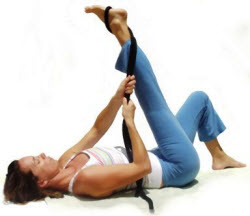
By Team ICG® Master Trainer Jim Karanas
Bicycling is a repetitive-motion exercise that can lead to tightness in several major muscle groups.
Static (traditional) stretching gradually lengthens a muscle to an elongated position and holds that position for 20 seconds. When done properly, static stretching slightly lessens the sensitivity of stretch receptors in our muscles. That allows the muscle to relax and stretch to a greater length.
In the last few years, however, several studies have found that doing static stretching before playing a sport actually makes you slower and weaker. This is because the lower sensitivity of the stretch receptors makes us less able to move fast or freely.
Static stretching is recommended after cycling and has a variety of benefits when done properly. Still, many elite athletes in all sports are ditching post-training static stretching altogether, and using “dynamic” stretching as a viable warm-up technique prior to exercise.
In 1995, I witnessed a stretching demonstration by a trainer named Jim Wharton. Using a rope, he taught me a method of flexibility training known as AIS, or Active-Isolated Stretching. Aaron Mattes, a kinesiologist and world-renowned expert on flexibility, developed this technique. I had the good fortune to study with both Jim Wharton and Aaron Mattes. I’ve used AIS every day for the past 17 years and have trained thousands of students to perform a 20-minute dynamic-stretching routine before riding. Most of them — seriously — continue to do it daily.
Cycling contracts skeletal muscles that attach to bones by tendons. Each muscle has sensory structures called stretch receptors that monitor the state of the muscle and feed the information back to the central nervous system. Stretch receptors are sensitive to the velocity of the movement of the muscle and the degree that it’s lengthened.
The Golgi Tendon Organ is a stretch receptor located at the insertion of skeletal muscle fibers into the tendon. It provides the sensory component of the Golgi tendon reflex, also known as the stretch reflex. The stretch reflex is a protective mechanism that attempts to prevent over-stretching and tearing of the muscle fibers.
AIS uses the body’s natural stretch reflex to enhance flexibility. Because it’s movement-based, it also dynamically stimulates blood flow and muscle extension through movement. These factors make it optimal for warm-up.
After a couple of seconds of stretching, a muscle begins to contract as a result of the protective stretch reflex. This is to prevent excessive elongation and a potential muscle tear. The key to AIS is not to continue stretching beyond this point. Static stretching continues, and that’s why it diminishes performance.
The Active-Isolated Stretching technique involves holding each stretch for only two seconds, rather than 20. The stretch is repeated 8 to 12 times for a progressive muscle release. This degree of repetition dramatically increases blood flow to the muscles to enhance warm up.
This method of stretching is also known to work with the body's natural physiological makeup to improve circulation and increase the elasticity of muscle joints and fascia.
The shorter stretch, however, needs to be coupled with reciprocal inhibition. This is another natural response of the muscle. Contracting the muscles on one side of a joint relaxes the muscle on the other side of that joint. When performing AIS, you actively contract the antagonist of the muscle you are trying to stretch (the agonist). This promotes an enhanced release in the target muscle. The antagonist contraction also stimulates blood flow and generates body heat.
Active-Isolated Stretching does many things that static stretching cannot:
– AIS provides a transition between inactivity and physical exertion.
– AIS assists the pre-exercise warm-up process by increasing blood flow and soft-tissue temperature. This makes is both a stretch sequence and a warm-up technique, and settles the long-running debate in the fitness industry about whether or not it’s necessary to warm-up prior to stretching. With AIS, both occur together.
– AIS produces supple, relaxed muscles, which have a higher capacity for activity.
– AIS reduces the likelihood of muscle cramping, tightness and pain.
– AIS increases and maintains the range of motion in a joint.
Personally, I’ve performed upper- and lower-body AIS daily, both pre- and post-riding, for 17 years. I attribute much of my athletic longevity and my body’s ability to perform at a high level to Active-Isolated Stretching.
AIS is one of the stretching methods most used by today's athletes, massage therapists, personal/athletic trainers, and fitness professionals. AIS allows the body both to repair itself and to prepare for daily activity.
To learn more, simply google Active-Isolated Stretching. An extensive YouTube library depicts the stretching techniques, and numerous websites have images of how the stretches should be done.
by John | Oct 27, 2012 | Instructor Tips and Tricks, Latest News, Spotify

So this morning I'm poking around on the internet and checked on what Chris Hawthorne had going on over at her Chrispins Blog. Chris is part of our ICI/PRO team of contributors and has a unique talent for creating excellent Indoor Cycling Class music playlists. She's also an excellent communicator and you'll find her tutorials on using Spotify very helpful.
As I'm reading through her latest post: Anything Could Happen Cycling Mix and I see what looks like a screenshot of her latest playlist. “That's nice” I think… but then I realize it's not a screenshot at all, but an actual Spotify player where someone can listen to each track, the whole way through > even if they aren't a Spotify user. I stand corrected – you need to be a Spotify user for this to work.
“HOW THE H.E. DOUBLE HOCKEY STICKS DID I MISS THIS?”
And then I smiled to myself and did a little nod.
That's exactly why I asked her to be part of our team 🙂
Here's the player that Chris had added to her post:
How cool is that?
I'll be adding these Spotify Players to each Audio PROfile this weekend.
P.S. I'm assuming that everyone can see the player above, regardless of where you are located. Please leave me a comment below with your location so we can confirm this.
by John | Oct 27, 2012 | Best Practices, iTunes & Spotify Training, Spotify
LifeTime Instructor's have a super secret community at LTPulse.com. I've been trying to help my fellow LTF Indoor Cycling Instructors there get up to speed with Spotify. In the process they've alerted me to some additional problems that you maybe having as well.
One Instructor, who I believe had reviewed some of our past How To articles about Spotify, expressed some frustration that I'm seeing now was completely my fault 🙁
In the latest version of Spotify (0.5x) the little pencil edit icon appears to have disappeared. All my earlier tutorials showed version (0.4x) which I'm still running on my 3g Spotiphone so I can show you the difference with these screen shots.
Here's the old version:

And here's the latest version – note the change:

Click the three dots icon and you'll find the edit option to change the order or delete songs. When changing the order of tracks, be sure to double check that you don't end up with duplicates. I'm not sure why it happens, but duplicates seem to appear everytime I try to reorder my playlists on my device.

Here's the Playlist I used if you're interested Thursday.
