Training for improved climbing is one thing. Training for the Dirty Dozen is another. Given the fact that probably less than 1% of the hills one normally climb are as steep as those of the Dirty Dozen, it doesn’t make sense to train for this level of power requirement. That is, unless you actually want to survive the 5 plus hours in November as you climb more steep ascents in one day than you normally do in an entire season. Throw in the fact that I am prone to cramping if I don’t really keep the legs fresh, and this is not something I can take lightly.
When I put a training plan together for myself or a student, I’ve gotta’ work backwards. Where do we want to end up, and then back it up to where we are, and the rest will fill in by measured and deliberate progression. As an endurance rider, and someone who helps people do their first epic ride or century, we have the luxury of focusing on a slow periodized program from start to finish with more and more time in the saddle.
However, this total event is only about 50 miles in length, with 3 food breaks. Endurance is not what I need to train for. My focus needs to be on producing the required power for each grade of hill I will encounter, sustaining heart rates above threshold for varying amounts of time, and keeping the legs from siezing up in the process.
Consequently, instead of a 6 day a week riding schedule with rides between 1 and 3 hours long, I’ll be training 3 to 4 days per week where all but one of those days each week will be fairly intense; very little time in Zone 1 & 2, about 50% in Zone 4, and a progressive increase of time above threshold. In most cases, I will want a day off or activer recovery after each day of training.
I will be focusing on improving lactate buffering, and increasing my threshold. Starting my “pre-training” routine a couple weeks ago, I’ve already begun to feel an increase in my threshold, but I will do a New Leaf metabolic test this week to establish a true baseline.
While at first blush this doesn’t seem like a lot of training, the intensity creates a significant challenge. In fact, I’ve averaged over 1000 points per week just for the pre-training weeks. So, I’ll be using 1150 training load points as my starting baseline, and shoot for a 5% increase each week to keep the body honest. This will get to about 1800 points at the week I will begin to taper. I need to get fitter, stronger and more tolerant of the inevitable pain, and this seems to be the right approach.
So here’s the outline of the training plan:
3 days intense training: 2 days outside, 1 day inside
1 day of active recovery riding inside
1150 starting points, and % splits: Zones 1: 0%, 2:10%, 3:30%, 4:50%, 5:10%
Ending targets 1800 points, 20% in Zone 5, Threshold increase of 10 – 15 BPM
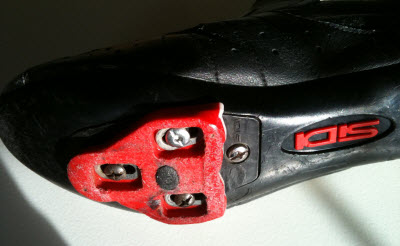
Everyone listened to squeak – squeak – squeak, from one person in the front row, for the entire two hour endurance ride Amy and I taught on New Year's day. I knew exactly what was causing it and it was everything I could do not to go down and ask this person to leave. It was driving me crazy!
The culprit; worn Look cleats 🙁
After class I explained to him that the trouble was his cleats were worn out. I asked that he replace them before the next class. His response was that he thought it was something with the bike. I told him how I have used Look pedals for years and the squeak they make when worn out was unmistakable.
“I'll spray them with something… so they don't make noise.”
While this sounds like a reasonable solution, I advised him against it telling him it's a real safety issue. You never want to spray a lubricant on Look cleats because:
They release very unpredictably, often with only a small percentage of the twisting force needed when “dry”
Hardwood floors and slippery shoes don't mix 🙁
They need to be replaced, so why delay the inevitable?
While I'm on the subject: when was the last time someone tested and adjusted the release tension on the bikes in your studio? SPD cleats, while not having the wear issues of Look cleats, still need to be checked for the proper release tension. I have found that the easiest way to do this is to take a shoe with new cleats and, holding the shoe with your hand, test that they engage and release with a reasonable amount of effort. Try it on a few and you will quickly learn what feels right.
It just may prevent an injury during one of your big sprint finishes!
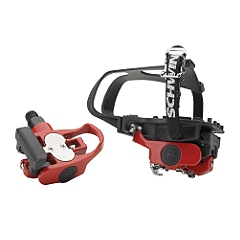
One last thing … for years clubs using the Schwinn Triple Link pedals (the Red Pedals with the removable shoe baskets) purposely set the release tension very low. This was so Instructors could remove shoe baskets without hurting themselves but in the process created a potential safety hazard. Now that my Red Pedal Tool for Schwinn Triple Link Pedals is available there is no reason not to set these pedals correctly.
I found that SportSmith.com has the best pricing on indoor cycling bike replacement Schwinn Triple link Pedals
Ask Amy about her biggest teaching challenge while on a working fitness vacation at a Caribbean resort and she will tell you it's accommodating all the different languages of the guests. Jamaica is very popular among Europeans and Asians, so in one class she may have students that speak German, Spanish, Russian and Japanese. Many know some English, but Amy has learned that sign language works the best because everyone understands it. She gets their attention, demonstrates what she wants and then leads them with nothing more than her smile and hand gestures.
I'm not saying we should adopt a form of sign language to communicate Heart Rate Training Zones. I'm not sure that would work… But the signage in your club or studio should simply and accurately show visually, exactly what you are speaking in your class.
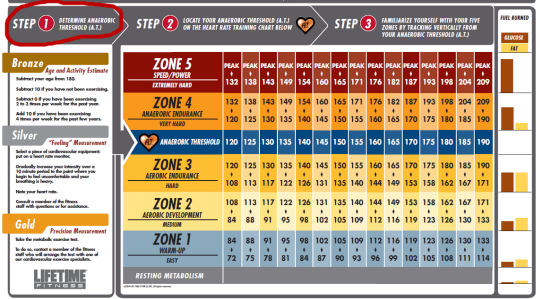
No health club is perfect, but I have to hand it to Life Time Fitness. They have done an exceptional job and educating all of their instructors on the concept of Threshold and the ever present Heart Rate Charts (in every studio) serve as visual reinforcement of the language we all use in class. You can download a pdf of the chart here.
Notice step one
I say exceptional job because it's very rare to find a student in my class that doesn't understand the concept of Threshold Heart Rate and in an average class 60% – 80% of the participants are wearing and using monitors. To put that in perspective, LTF has 90 clubs and in excess of 300,000 members that are being educated about the proper uses of Heart Rate Training .
Am I suggesting we adopt Life Time's chart? Not necessarily. We need a “generic” or “open source” version so everyone will be able to use it without cost or limitation.
How does your club compare?
Do your signage and fellow Instructors all speak the same language?
Are you resistant to establishing a standard? If so, then why?
The Phonographic Performance Company of Australia (PPCA), a leading recording industry group, won its bid to replace the previous copyright fee of 94.6 cents per fitness class, after the Copyright Tribunal ruled gyms should pay $15 per class to pay for the use of original music.
The ruling effectively meant that Instructors would be only able to use “approved” or “pre-cleared” music in their classes. This works great for Les Mills RPM programs because they are already using only this type of music.
Thankfully it appears that common sense prevailed and the ruling was overturned… at least for now.
Fitness Australia welcomed the decision and said the previous ruling would have had a detrimental effect on group exercise in the industry.
“If it had been upheld, the claim made by PPCA would have resulted in a typical fitness centre with 1500 members being forced to pay over $80,000 in fees per annum, a massive increase on the $2,000 they currently pay,” Fitness Australia chief executive Lauretta Stace said today.
“This decision will ensure that gyms, fitness and recreation centres remain viable and affordable for all Australians, helping them to maintain a healthy lifestyle.”
Help me understand this: The PPCA had an existing “use tax” and wanted to raise that tax 15oo%. Did they really believe every club would roll over and say “OK, we will pay the additional $78,000” and that the PPCA would take in additional revenue? I think the PPCA thought that Clubs didn't have a choice but pay the 1500% increase. But Clubs do have a choice and you can see it in action here in the USA with LA Fitness restricting Instructors to only use approved music. The result was clubs refusing to pay anything. So the effect was the PPCA gets less $$$ than their original deal.
The Internet (and iTunes) has changed everything and there's no turning back. Let me know your thoughts.
Hi ICI/PRO members. Amy here with my first attempt at a Friday Favorite, so please go easy on me.
Believe it or not, one of my favorite ways to try new music and listen to new bands, is to go to the library (I know, right?) and surf through the CD’s on the shelves. Not only does it force me to grab unusual artist’s names, but also CD titles that I would probably never take the time to peruse on the web. Then I listen to them in the car and download them onto my computer at my leisure . Best of all, it’s not $.99 a song, it’s FREE and I can save my money for another new pair of shoes! (Sorry guys, but it’s the truth).
One of the bands I have grown to love from this experience is Mute Math. I know many of you already use them because they have come up a few times on the Top 210 list Barbara is compiling, but for my virgin experience here, I am going to highlight my current favorites from this band off their self-titled CD MuteMath:
“You Are Mine”4:44: I am listening to it as I type this and it “gets me” every time. It is ethereal and gripping and I use it as a recovery, almost flat, road in the middle of my ride, after a hard climb. RPM:76
“Control”4:39: I love this song for climbing. RPM:72. I have my class stay in the saddle , and then get out to climb when the music surges at 2:12. I cue to “stay relaxed, breath and drop your shoulders”, when the music quiets at 3:05 and hit it again at 3:20.
“Reset” 5:26: I am stoked about this song! I needed a completely instrumental song for a video I am shooting this week and this is it baby! RPM: 90. The absolute perfect warm up song, because we do a lot of talking in the first few minutes of our class and it is nice to not have to talk over lyrics.
Other goodies on this CD I just haven’t used yet:
“Stallout” 7:10 RPM 88
“Noticed” 4:30 RPM 84 Energetic flat, with some room for load building
“Plan B” 4:47 RPM 64
“Break the Same” 6:00 RPM
100 Feels like a good sprint, break away to me
“Picture 19” 5:26 RPM 76 Nice easy does it climb
So, there you go. Not bad….8 really good, not just adequate, tunes off one CD. And you can reserve it FREE at your local library, or just download the 8 great tracks and not get any shoes. Enjoy and remember…. go easy on me.
In a move that may change the landscape of how media organizations make money online, the New York Times is finalizing its plans to charge readers for online content, basing its pay model on sites like Consumer Reports and WeightWatchers, not traditional media websites, according to a Reuters report.
The Times is learning that you can't afford to create quality content and then give it away for free. The problem they face is that what the Times publishes isn't very unique … you can find similar information on hundreds of other websites.
I like the Times' ingenuity when it comes to creating a separate model and I'm curious to see how this plan works out. The big concern I still have is how information from a site like WeightWatchers or Consumer Reports is valued – as a commodity. Those sites have a very specific, and often very motivated audience. Presumably, there is a clear end-goal attached to purchasing more or “better” information (lose weight, save money, etc. [or teach a better class :)]) The Times will need to make sure its online readers perceive its news content in the same way – required for a deeper understanding. There needs to be incentive and readers will also need to believe that they absolutely cannot get the same kind of information anywhere else.
The ICI/PRO Team invests a lot of time and effort into making indoorcycleinstructor.com and ICI/PRO the single most valuable resource there is for Indoor Cycling Instructors. When you are ready to take advantage of everything we publish Click here to start your monthly or annual subscription to ICI/PRO