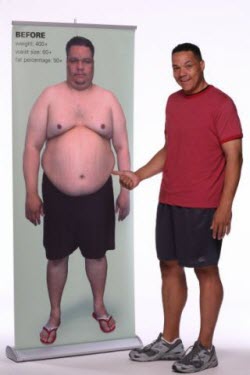
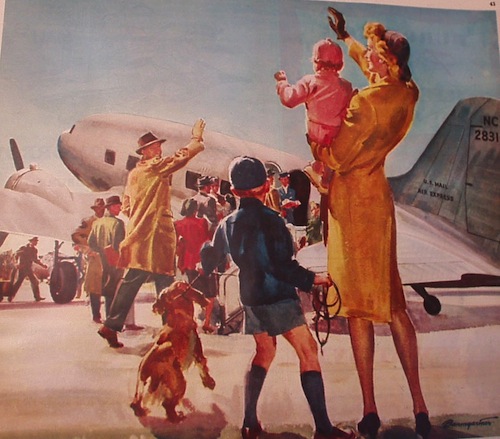
I'll bet Pete Thomas here made a few position changes.
Myth #7 – Once you find a good position, you shouldn't need to change it.
Back in Myth #3 I discussed how your students do want you to make suggestions to their setup, but they may offer some initial resistance because…
People are creatures of habit and routine. We all derive comfort from the familiar. Like robots, we try to do exactly the same thing every time we find ourselves in these familiar situations/places.
For the regulars in your class this means they get to the club at the same time, park in the same general location, attempt to get the same locker, find the same bike and set it up in exactly the same way, every time.
I was referring to making suggestions to students who's position on the bike was less than optimal.
So then once we get them set up correctly we shouldn't touch them, right?
Not always. People can (and do) change – and those changes may require a change in position.
Changes in weight can change more then your belly circumference.
I haven't experienced this personally, but my understanding is that adding some additional body fat can make your pants shorter. True story! Which makes perfect sense. If your butt gets bigger (due to the thickening of the fat layer beneath our skin, more material is needed to circumnavigate cover it, leaving less material in the length of each pant leg. Next people are making jokes about your flood preparations.
The inverse of this is true as well. As we loose body fat, we change dimensionally – hopefully everywhere – as the fat layers become thinner.
Now think about this. Let's say you have a successful student, one who loses a bunch of weight by regularly taking your class this winter. Can you imagine how a lessening of body fat can have an impact on saddle height? [you'd want to raise it]
Or vice versa? [lower it]
The trouble is that weight gain/loss is gradual, so a regular participant will just adopt with the changes.
So keep your eyes open for anyone who's beaten the battle of the bulge and help them celebrate their success by maybe raising their saddle a notch!
This Podcast is was originally published on November 19, 2008, I have updated it with our new Podcast host information and I am representing it now. I hope you enjoy it, Joey
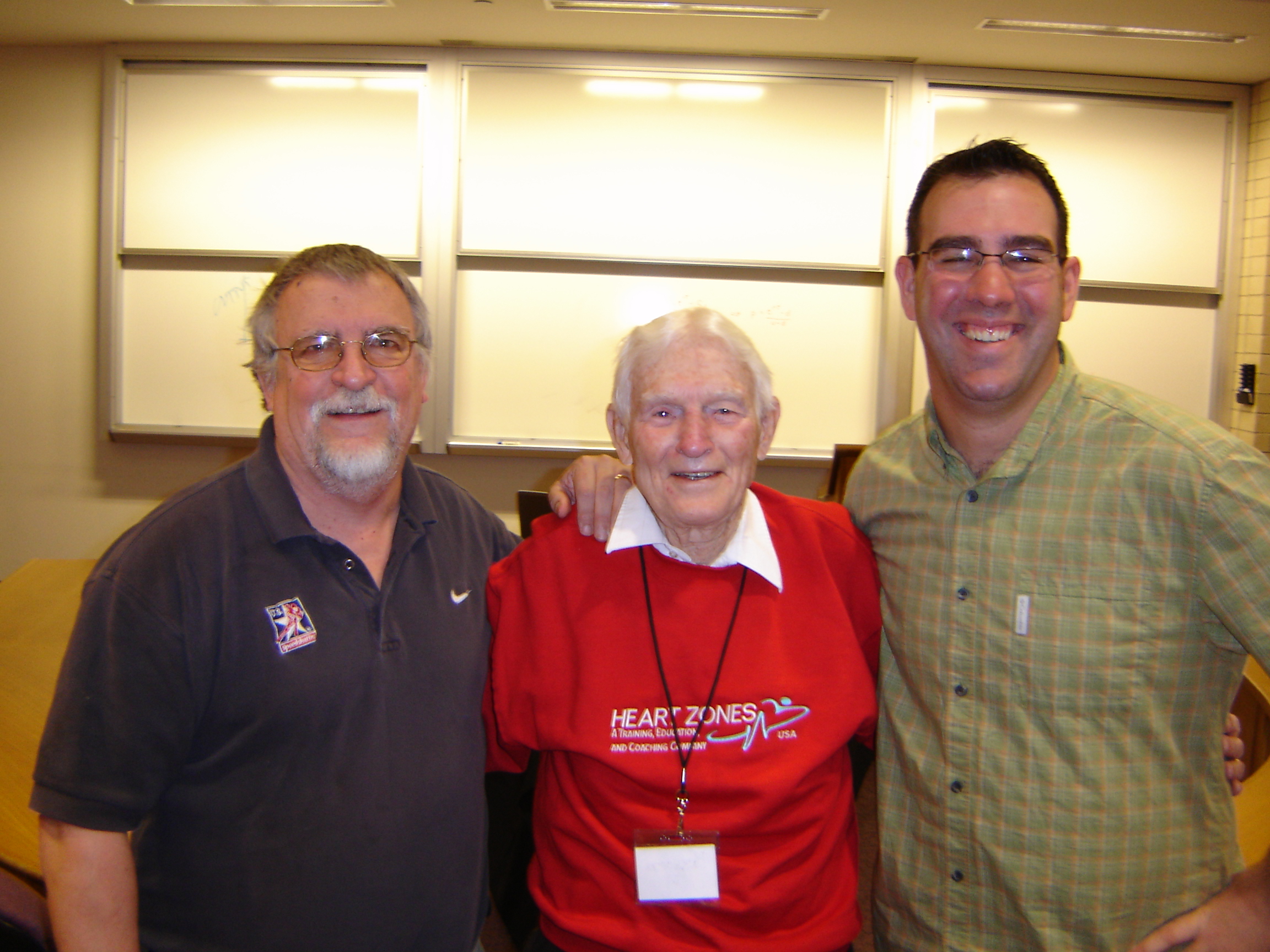
I met Paul Camerer, AKA Pink House, at the Heart Zones conference. We both were taking the level 1 Indoor Cycling certification course. Paul's birthday is December 26th and he will be 90 years old. That afternoon he will probably teach an Indoor Cycle class in his garage /studio or lace up the new running shoes he regularly wins at local 10K races. The guy is amazing and a real inspiration to everyone who meets him.
Here is an article all about Paul and his Pink House Studio!
That's Paul in between Dr. Carl Foster and Dr. Phil Skiba, MD
Listen to the Podcast below or subscribe using iTunes or Zune.
This week I have the extraordinary privilege to be working from my balcony in Punta Cana. I have never been to an all inclusive resort before, and it is quite the experience. The grounds are beautiful, you can go to any of the many restaurants or bars on the property, and there always seems to be a smiling face nearby ready to wait on your next need.
Last night we attended an outdoor band that was playing and there were six younger people that were hired by the resort to provide entertainment and get the crowd dancing etc… While all of them were great dancers, the lead young man was simply incredible. His feet were light and fast, and yet somehow thoughtful and deliberate. He was smiling from ear to ear, and seemed to be having as much fun doing his job as we were joining him on the dance floor. As talented at this young man was, one of his gifts seemed to be the ability to dance with a wide range of partners (guests that he would engage) and have them seem comfortable and loose. You could see the transformation in the people in only one minute: they went from thinking “oh, no, I can't dance with him, he is too good” to relaxing and enjoying themselves and then going back to their tables only to return to the dance floor with their spouse or partner.
It really got me thinking about customer service and how that impacts our industry and profession. Yes, being an indoor cycling instructor is, well at least should be, a profession. We have customers (riders) and it is really our job to guide them through this fitness experience that we have (hopefully) spent time and effort creating. In many ways, we should be presenting an image similar to this young man's for not just our riders, but all of those that are in the club or studio.
As with any great performer, his performance moved me, and has me thinking….Am I providing a high quality performance for my riders and most importantly, am I providing that experience to most of my riders or only just a few? As with most instructors, I have a core group of 10 or so people (about a third of the class) that seem to be in all of the classes I teach. They are all cyclists (they ride outdoors) and they work hard, they work very hard. They are inspirational to teach to and certainly in the midst of a very tough set they help to get me to the other side. But what about the other 20 or so people in that room? I am reaching them? Is my class actually fun and enjoyable, or has it become a 60 minute grueling experience?
I have often heard group exercise instructors talk about the class they just delivered and the gist of the conversation always seems to revolve around “killing” the people, or it being the “hardest” class they have had or something similar. Very rarely, if ever, do you I have pleasure of hearing about how they had the entire class pedaling to the beat and enjoying themselves. I am not sure that I myself have ever measured the success of one of my classes by the number of smiles I have seen on the participant's faces; but perhaps I should. Some, well really most, of my riders will never be on a triathlon course, so I should be mindful about training them like they headed there in three weeks.
So I challenge you, take a few moments and think about your next class. Are you providing great customer service? Are you including most of the riders, and not just your hardcore following? Are your riders having fun? As for myself, when I return I plan to taking the time to be sure that I am dancing with all of my customers, not just the cyclists!
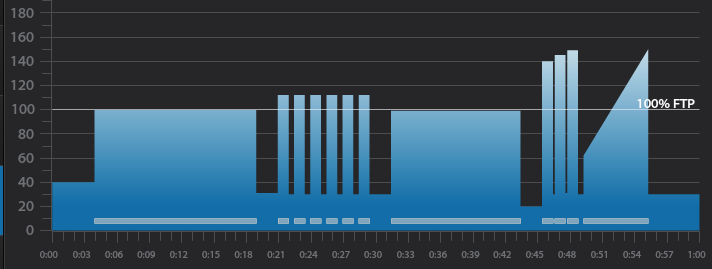
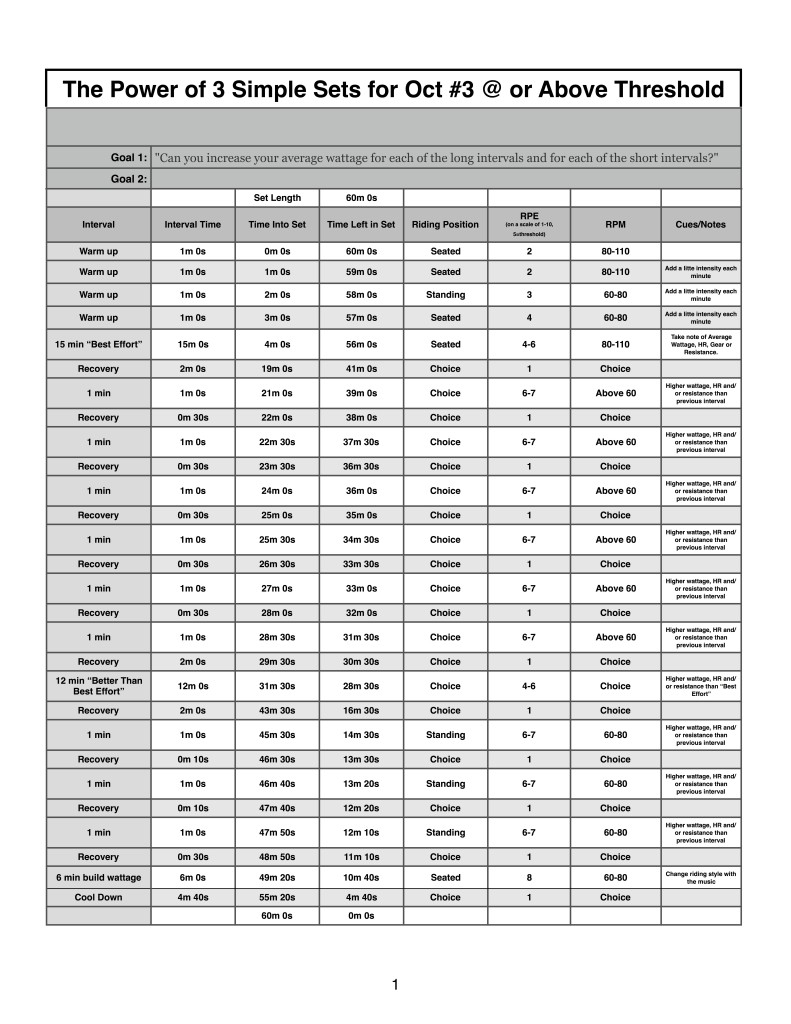
Below you'll find Week 3 of October's @ or Above Threshold Keep it Simple and Progress indoor cycling profile.
Workout Basics:
4 minute warmup
15 minute benchmark ride to find “Maximum Sustainable Wattage”
2 minute recovery
6 x 1 minute interval w/30 sec recovery after each
2 minute recovery
12 minte interval at higher wattage than the 15 minute benchmark
2 minute recovery
3 x 1 minute interval w/10 seconds recovery after each
6 minute interval increasing intensity throughout
4 minute 40 second cool down
Workout Goal:
“Can you increase your average wattage for each of the long intervals and for each of the short intervals?”
4 minute warm up
Slowly and steadily elevate the HR or Wattage to above threshold
No recovery, roll right into the next interval
15 minute “Maximum Sustainable Wattage” Test
Settle into a sustainable intensity, HR or Wattage
Ride for 15 minutes and let the songs dictate the terrain
2 minute recovery
6 x 1 minute w/30 seconds recovery after each interval goals and specifics:
Ride for 1 minute in any position and with an RPM above 60
Complete the every interval with a higher average wattage than the previous interval
30 second recovery or reset
12 minute @ Threshold Ride
Settle into a sustainable intensity, HR or Wattage
Ride for 12 minutes and let the songs dictate the terrain
Try to finish with a higher average wattage than the 15 minute interval
2 minute recovery
3 x 1 minute w/10 second recovery after each goals and specifics:
Ride for 1 minute in any position and with an RPM above 60
Complete the every interval with a higher average wattage than the previous interval
10 second recovery or reset
5 minute interval goals and specifics:
Increase intensity every minute until end of song
Cool Down
[wlm_private ‘PRO-Platinum|PRO-Monthly|PRO-Gratis|PRO-Seasonal|Platinum-trial|Monthly-trial|PRO-Military|30-Days-of-PRO|90 Day PRO|Stages-Instructor|Schwinn-Instructor|Instructor-Bonus|28 Day Challenge'].
Trainer Road Profile (If you're Trainer Road Member join my Team to get this and all profiles)
Your Carbonite Online backup subscription for your computer JOHN-PC is scheduled to automatically renew in 7 days. When you signed up for Carbonite you selected automatic renewal billing which provides uninterrupted backup protection.
You do not need to do anything! Carbonite will automatically charge the regular subscription price of $54.95, to your credit card, ending in 6941, in 7 days. Once the payment has been processed, we will send you a separate confirmation email/receipt.
I can't tell you, after two hard drive failures, how comforting it is to know everything on my PC is backed up. Not just once a month, but every night. And I do nothing but sleep while it happens. You can try it for FREE here.
I did a ton of traveling this past year. Visiting studios where I've been brought in to troubleshoot issues, attended multiple conferences (IDEA/IHRSA/WSSC) and I have lost count of how many dozens of classes I've taken as a participant in 2014.
When I take a class, as a consultant or participant, I pay attention to things many other's don't. Take for example Instructor cues directed at correcting form/position/techniques… they almost always come at the very beginning of class, during her/his initial introduction – never to be heard again.
Which is exactly the wrong time IMO > let me explain why.
Think about the last time you walked into a party, an important meeting or a new class at school. There's a good chance that you were consciously aware of your body language as you entered the room, right?
You want to project confidence, so you stand up straight and tall and walk with purposeful steps. Your chin is lifted and your gaze is focused across the room, not (hopefully) down at your feet.
Perfectly natural as most of us want to make a good first impression, when we meet with new or important people.
When we sit down in these situations, we tend to stay near the front edge of the chair. We smile and continue to display strong, erect posture while seated, that is as long as we stay focused on it.
Conversation requires us to concentrate on things other than what we look like. Over time we may tend to relax. When we do, we will start to soften our posture, drop our head & shoulders, slide back into the chair and slump slightly, rounding our once flat backs.
The same process occurs to the participants in your class.
The start of class is an exciting time for your participants. Riders maybe looking around at who's riding near them or watching the Instructor. Some will feel a touch of insecurity (how do I look on this bike?) that causes them to “preen” a bit when they realise others are doing the same and casting a critical eye on them as well.
In your next class watch for this, if you haven't noticed it already. You might see a few checking themselves out in the mirrors. Others are focused on the rider in front of them, as they try to appear disinterested – but many are and their body language gives them away. The first words you speak may cause a few to sit up a little straighter. Right now your class doesn't need any direction on form/position/technique.
Everything come crumbling down
I have to smile thinking back on family dinners when I was young. My dad was a stickler about not slouching at the table; “sit up Mac!” – my nickname – was a less than gentle reminder. It never came at the beginning when I was focused on looking like I was in the military, rather at some point later in the meal when I'd lost focus, interest, or was simply bored with the whole ordeal.
So when should you be cueing form/position/technique?
When you see that your class needs it. Pay attention to everyone during the recoveries. Are they reasserting themselves on the bike? Watch and you'll see this with many of your outdoor cyclists, as they gather themselves back after a hard effort. There's a lot of unspoken peer-pressure in a group ride and many cyclists have learned to fight through the fatigue and at least appear strong to those around them.
When you observe dropped heads, shoulders, elbows or rounded backs, this could be your cue to jump off and walk the room. I know for me personally, when the instructor is walking near me I will self-asses my form without them saying a word.
This is getting long so I'll save; When it is time to cue form/position/technique – what should I say?until next week.