by Joey Stabile | Aug 5, 2020 | Best Practices, Class Work-Sets, Creativity Indoor Classes, Instructor Training, KEEPING IT FUN, Master Instructor Blog, Training With Power
Welcome to the The Weekly Ride by Cycling Fusion
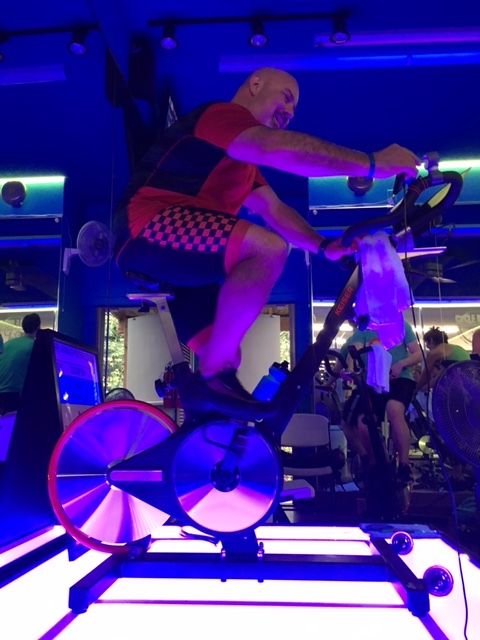
No more hunting for new music or counting out cues to develop your ride profile. Here is your ready to ride profile for a fully choreographed ride, that can be displayed from your phone, or printed out onto cue cards for your class. This ride is timed out, down to the second, to make your life as easy as possible!
(more…)
Originally posted 2018-06-12 06:36:07.

by John | Aug 2, 2020 | Instructor Training

Every study I'm familiar with says that exercise is good for improving your mental health > but wait. Now they're saying it's possible to have too much of a good thing.
Although fitness keeps your body healthy by regulating weight and building muscle strength, exercise also can improve your mind. An increase in self-esteem, lessening of anxiety, calming of the nerves and elevation of your mood can be results of exercise. However, a recent study by professors at Teachers College at Columbia University, New York, reported that too much exercise can lead to diminished mental health.
People who exercised more than 7.5 hours per week had sharply increased symptoms of depression and anxiety, irrespective of age, gender or physical health status, according to “The Relationship between Physical Activity and General Mental Health” report.
So what is the optimum amount of physical activity associated with better mental health? Depending on gender, age and general physical health, people who exercise 2.5 to 7.5 hours per week report better mental health. However, the largest mental health benefits occurred with two to four hours of exercise per week. Sixty-five percent of those with poorer mental health exercised more than four hours per week, the report found.
This study raises other questions. Do people who tend to be depressed and anxious engage in extended physical exercise as a way of keeping their mental symptoms under control? Or do repeated, long-lasting exercise sessions or overtraining actually cause symptoms of depression and anxiety? What do you think?
Good question… what do you think about this? Are there some people in your class that are “self medicating” with exercise and possibly over-dosing?
Originally posted 2012-10-25 06:15:33.
by Barbara | Aug 2, 2020 | Barbara Hoots, Best Practices, Instructor Tips and Tricks
by Barbara Hoots
Do you dream of teaching a kick-ass class in a packed studio with unstoppable energy? Follow my FIVE BEST TRICKS ON THE PLANET and I guarantee your dream will become a reality.
1. Volunteer to Be a Guest Speaker.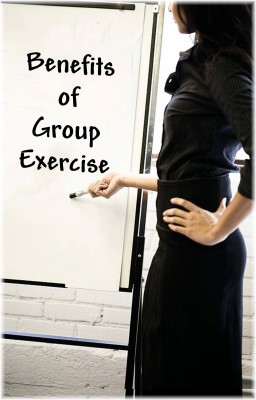
Last week I spoke to a local civic club on the benefits of group exercise and physiological effects of endorphins. While my
presentation was not specifically geared toward indoor cycling, I seized the opportunity to distribute free Spinning® passes and now
have six new students in class! Most civic, social, or religious organizations in your community are desperate for free guest speakers! Volunteer to give a presentation on the benefits of exercise and reap the reward — a full class!
2. Use Your Body
(more…)
Originally posted 2009-10-02 06:46:52.
by John | Jul 30, 2020 | Instructor Training, Zone based Heart Rate Training

A common theme in conversations I am having these days is; “today we we find ourselves right here… what do we need to do differently if we want to end up somewhere else next year?”
I have created a short survey (it should only take about 2 minutes) to learn where you are with Heart Rate training at your club or studio. My hope is that your answers will help guide us in the future, so we all end up where we want to be next year 🙂
The complete survey should display below. If you don't see it you can Click here to take survey
Originally posted 2011-05-22 10:03:17.
by Tom Scotto | Jul 30, 2020 | Master Instructor Blog
 I appreciate all of the comments on the previous post which discussed what those kcals were. Let’s continue with another number often found on our indoor bike computer (and other fitness equipment) – TRIP or Distance Covered.
Looking at your total distance number at the end of a cycling class can often provoke 2 very different responses: “Oh, that’s cool” and “No Stinkin’ Way!”. Someone who doesn’t do much riding outdoors may not have a perspective on (1) how fast they would actually be riding and (2) how far they could go in, say, an hour. This rider may see a TRIP number of 20.0 — 22.0 and think “oh, that’s cool”. Another rider who is accustomed to tracking their distance when riding out doors may view 26.0 to 28.0 (miles) after a steady hard class and say (out loud) “No Stinkin’ Way”.
What’s going on here?
As I coach, you keep hearing me talk about all of these “factors”. I seem to have factors for everything from cadence to training zones to power output to riding aero on an indoor bike and the list goes on. Well, smirk if you want, but the Tom Scotto FACTOR-Y is going to churn out a few more. Indoor bikes and fitness equipment that calculate distance are often only looking at a single measurement. For the indoor bike this would be the rotations of the flywheel (heavy wheel providing inertia/momentum). The bike computer simply adds up the number of rotations of the flywheel (not the legs or pedals) and determines the distance as how far the wheel’s circumference has traveled. Since there are no internal or external gears like on an outdoor bike, one rotation of the pedals ALWAYS equals the same amount of rotations of the flywheel. What are some of the other factors? How much resistance the rider is using can play a significant role. Is the person pushing a lot of resistance which could indicate a “fast” actual speed or spinning at high cadence with little resistance translating to a slower actual road speed? Is the rider going uphill or downhill? What about wind resistance (no, not the fans)?
Here is an example from one of my riding experiences and the factors:
A number of members from my team would travel to Turkey every year for a couple of weeks to train in the mountains in warmer temperatures. One day, after having our traditional cup of Çay (Turkish tea), we headed toward one of the bigger climbs in the Taurus mountain range. It took us about 30 minutes to ride to the base of the mountain road where the climbing began. We climbed for 3 hours, transversing close to 70 switchbacks (sharp winding turns in the mountain road). We descended on a shorter back road for 45 minutes and arrived back at the cafe. One of the locals sitting at an outside table asked us how far we had traveled. I confidently looked at my bike computer and was disappointed to read only 48 miles. We were out for over 4 hours and only covered less than 12 miles per hour. In this case, my computer was not incorrect because it included ALL of the factors involved in my ride (the foremost being going “slow” uphill).
Simple Math?
Bringing it back to our indoor bikes, due to the factors that the bikes are NOT considering, the number we see displaying as our TRIP distance will rarely ever be accurate. So what is it? Each manufacturer may calculate this differently, but here is the formula for the Keiser bikes:
– 200 revolutions on the Keiser M3 = 1.0 (TRIP)
– Flywheel is 49 inches in circumference
– 1 revolution on crankarm = 8.75 turns of flywheel
– 49 x 8.75 x 200 / 12 = 7145.8 feet
– 1.0 on our computer = the rear flywheel traveling 1.35 Miles
Remember, the above calculations do not include the “factors” so we are still ONLY measuring how far the circumference of the flywheel is traveling. So what is the TRIP number good for? Since it is directly linked to our cadence (the more pedal rotations the higher the TRIP), one can observe if their overall cadence was higher or lower for a given ride or effort. Although the Keiser bikes already provide an average cadence number, the TRIP can tell you how many rotations you pedaled during the class (divide your trip by 200).
So, as instructors, it is important that we understand how these number work and what they represent. This will enable us to give sound guidance to our riders so they can view their efforts with a touch of reality. This will better prepare them (and not discourage them) if and when they venture outside.
Originally posted 2011-03-10 07:00:15.
by Jim Karanas | Jul 27, 2020 | Master Instructor Blog, Mental Toughness
 By Team ICG® Master Trainer Jim Karanas –
What’s the use of a state-of-the-art bicycle and a robust training plan if the rider hasn’t developed spirit or mental control?
Many coaches will tell you that no equipment or training method has value unless it helps to develop your spirit. Those coaches search for ways to infuse a calm and balanced mental attitude in their students and assure heightened clarity of perception. They may turn to enlightenment/spirituality to help students understand life better and cope with its complexity.
In the pursuit of effortless power on the bike, you must know that you are more than your intellect tells you. Training that emphasizes discipline of mind and recognition of spirit is paramount in that. To my understanding, two concepts are the basis of all training: center and intrinsic energy. In previous posts, I’ve referred to these as balance and aliveness or vitality.
I first witnessed effortless power in the mid-1970s at a martial arts demonstration. An aikido master displayed the power of ki (or chi), our intrinsic energy. With the slightest shove, he sent the five students attacking him into the air and onto the floor. The attackers appeared to be on wires doing a Hollywood stunt.
The next time I witnessed it was in the late 1990s at an indoor rowing regatta. The women’s world record holder for 2000 meters was on a rowing ergometer, warming up for the upcoming heat. The power output on her computer and the ease with which she rowed simply did not match. It was the first time I witnessed the combination of advanced fitness and the effortless generation of power.
I saw it again in 2002, during an annual time-trial up Mt. Diablo in Northern California. I was pursuing the coveted “under an hour” t-shirt for the 10.8-mile, 3200’ ascent. Most of the way, I followed a giant of a man, 6’4” tall, who outweighed me by 50 lbs. He wasn’t built for climbing but floated up the mountain effortlessly. He broke the hour and I did not. What I saw didn’t match what I believed he should have looked like on that climb.
My first personal experience with effortless power was in 2006, during the Furnace Creek 508, which I rode in 33 hours and 49 minutes, qualifying for RAAM. It was my pinnacle in cycling, training and racing. During my race preparation, my coach instructed me to “forget everything you think you know about cycling.” I learned that you can’t train your way to effortless power.
Although effortless power is not a result of fitness, fitness does result from the necessary training that culminates in effortless power. The simplicity is what I still struggle with, even to this day. It’s not a constant state, being centered and channeling intrinsic energy. The last time I experienced it was in 2008.
Center, maintaining balance, is always a struggle because of our chaotic reality. I spoke with one of my mentors recently about the difficulty of maintaining balance if you’re involved with business, friends and family, or are at an age where health matters manifest. Balance is more achievable when things are simple. In our society, living simply takes great discipline and sacrifice. Our balance is in constant flux, and so is our ability to achieve effortless power.
Sensing intrinsic energy is easier for some than for others. It’s not a simple declaration that you’re happy to be alive. It’s not a thought at all. Thinking obscures the sensation of feeling alive, even though it’s inherent in everyone. It takes discipline and practice to stay constantly aware of it, even more so to direct it. I spend time in all my classes searching for new ways to communicate the sensation. Without it, effortless power can’t be experienced.
In part 1, “What About The Watt?” I alluded to an indoor cycling practice that uses watts for something more meaningful than measuring power and improved fitness (along with its inevitable decline).
The watt measures force. How much force you can apply is a perception. So watts represent a limitation — in your mind — of your ability. Typically, to improve your ability to generate watts, you train your fitness. This improvement is short-lived. My experience is that generating watts beyond your current belief system is largely unrelated to fitness. It’s related to balance and your ability to coordinate and direct your intrinsic energy.
If the training you provide in your classes deals solely with fitness improvement, your students will never sense effortless power. Their watts may go up for the short term, but will eventually decline and disappoint. If, instead, the training you provide deals with achieving balance and coordinating the sensation of life, the students’ watt display will, at times, feel effortless, regardless of age. The pursuit of that engages the student for life and will lead to greater clarity and understanding.
Accepting that effortless power happens can be difficult, but becomes more possible once you witness it or experience it yourself. To experience it, however, you must have the discipline to deviate from the way you currently train and train others.
You can experience this through indoor cycling and using watts. My next post will provide pragmatic, specific, how-to exercises for leading yourself and your students to effortless power.
Originally posted 2012-12-10 04:43:02.
